Intercom
 Shopify
 Stripe
 Slack
Slack Notion
 Google Workspace
 Confluence

Retell AI: The Complete Guide (2026)


Retell AI is a developer-focused platform for building AI voice agents that answer and make phone calls, and it has grown into one of the most capital-efficient companies in voice AI: press-reported revenue put it above $60 million in annualized revenue in 2026 on roughly $5 million raised. This guide covers what Retell actually is, how its voice pipeline works, what it costs down to the per-minute line items, what real users say on Trustpilot, and how it stacks up against Vapi and Macha for teams thinking about phone support specifically.

Retell sells itself as infrastructure for developers rather than a finished contact-center product. That distinction matters more than most vendor comparisons admit, so we will keep coming back to it: this is a platform you build on and meter by the minute, and it expects an engineer to own the pipeline.
What is Retell AI?
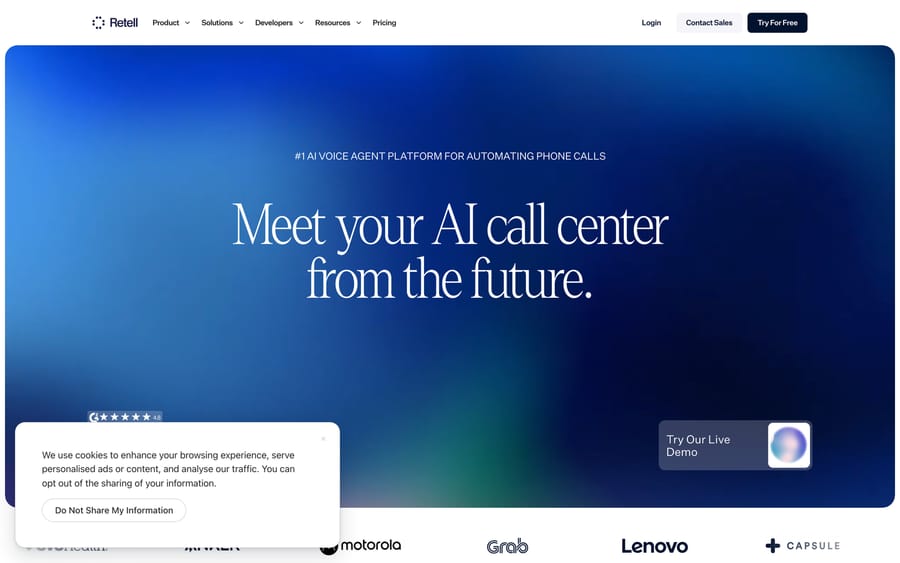
Retell AI is a voice AI platform that lets companies build agents to handle inbound and outbound phone calls: receptionist work, appointment booking, lead qualification, outbound campaigns, and call routing to a human when the conversation needs one. It came out of Y Combinator, was co-founded by Evie Wang, and by TechCrunch's 2024 profile, had raised a reported $4.53 million at the time, later reported closer to $5.1 million total. That is a small amount of capital next to the revenue Retell is now reported to generate.
The target buyer is explicit in how the product is built: engineering teams and technical founders who want to assemble a voice agent from parts, a speech-to-text vendor, an LLM, a text-to-speech voice, a telephony provider, instead of buying a packaged call-center seat. Industries named on Retell's site include healthcare, financial services, insurance, logistics, retail, and travel, and the homepage displays customer logos including Anker, Motorola, Grab, Lenovo, and Capsule alongside smaller healthcare and services brands.
Three case studies on Retell's site give a concrete sense of what a working deployment looks like: Pine Park Health, a senior-care provider, reports a 38% increase in scheduling NPS after deploying Retell for appointment coordination. SWTCH, an EV-charging company, reports cutting support costs by more than half. Medical Data Systems reports its Retell agent handling all of its inbound calls, transferring roughly 30% to a human, and collecting about $280,000 a month through the automated flow. These are vendor-published figures we could not independently audit, but they are specific enough to be checkable if you ask Retell for the underlying account during a sales call.
How Retell's AI works
Retell is built around a voice pipeline it assembles from named, swappable components rather than one black-box model:
- Speech-to-text: turns the caller's audio into text the LLM can reason over, tuned for the lower audio quality of a phone call instead of a clean studio recording.
- An LLM of your choice: Retell's pricing page lists model options from a "GPT 5 nano" tier at $0.0016 a minute up to a "GPT 6 Astra" fast tier at $0.64 a minute. The model is a cost lever you set per agent.
- Text-to-speech: Retell's own platform voices, priced separately from third-party voice providers.
- Turn-taking and latency management: the part Retell invests in most heavily by its own account. The company markets roughly 600ms round-trip latency and a proprietary turn-taking model, aimed at stopping the agent talking over a caller or leaving the awkward pause that makes a call feel robotic.
Telephony connects through SIP trunking, Twilio, Vonage, or a number Retell sells directly, which is what lets an existing business phone number route into an AI agent instead of a human queue. Agents are built through a visual, no-code flow builder for the conversation logic, but every layer underneath, model, voice, transcription vendor, is a configuration choice, which is closer to assembling infrastructure than filling out a chatbot builder's forms.
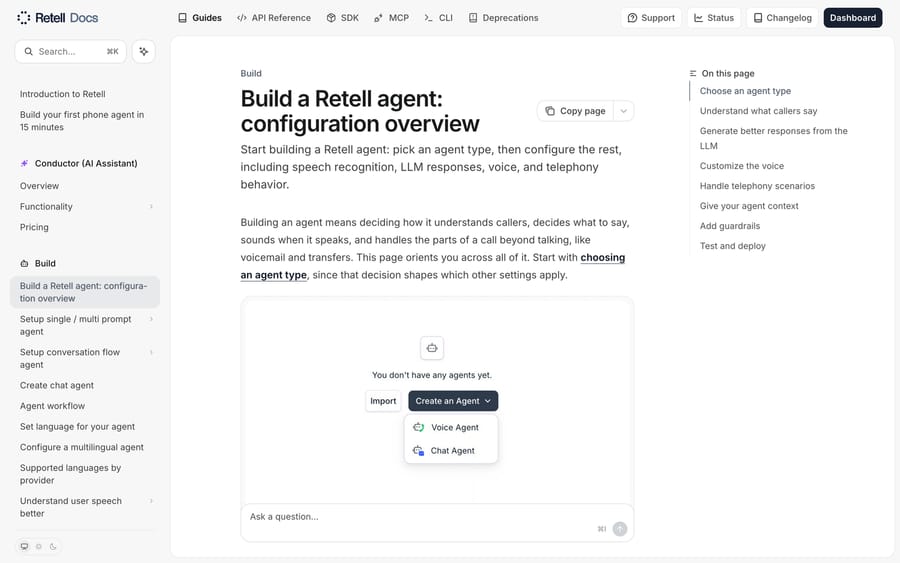
That component-level control is also where the pricing complexity comes from, which we get to below. Retell's own build documentation walks through choosing an agent type, then configuring speech recognition, LLM behavior, voice, and telephony behavior as four separate decisions rather than one setup screen.
Key features
- Voice and chat agents from one platform: the same builder produces phone agents and web/embedded chat agents, so a team building one conversation flow can reuse it across channels.
- Simulation and testing tools, including an LLM playground and simulation testing before an agent takes a live call.
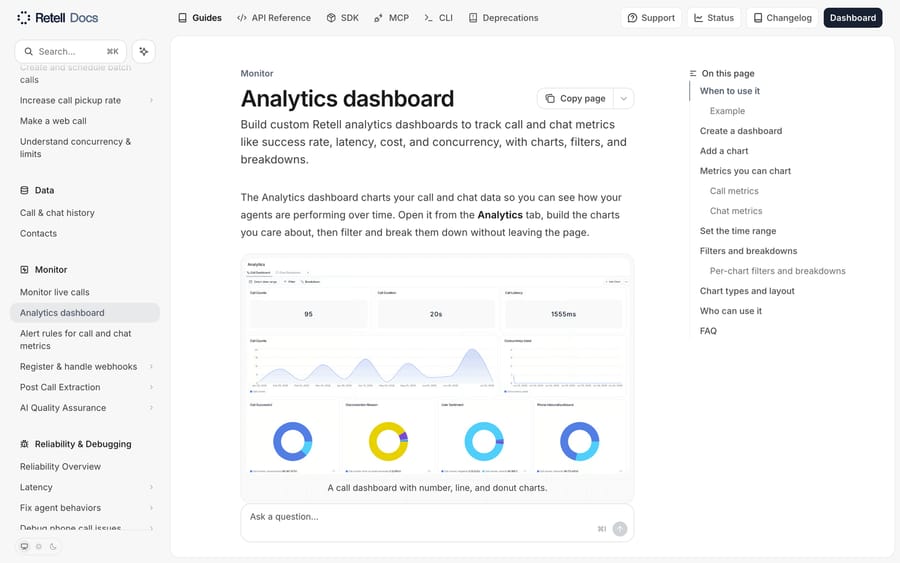
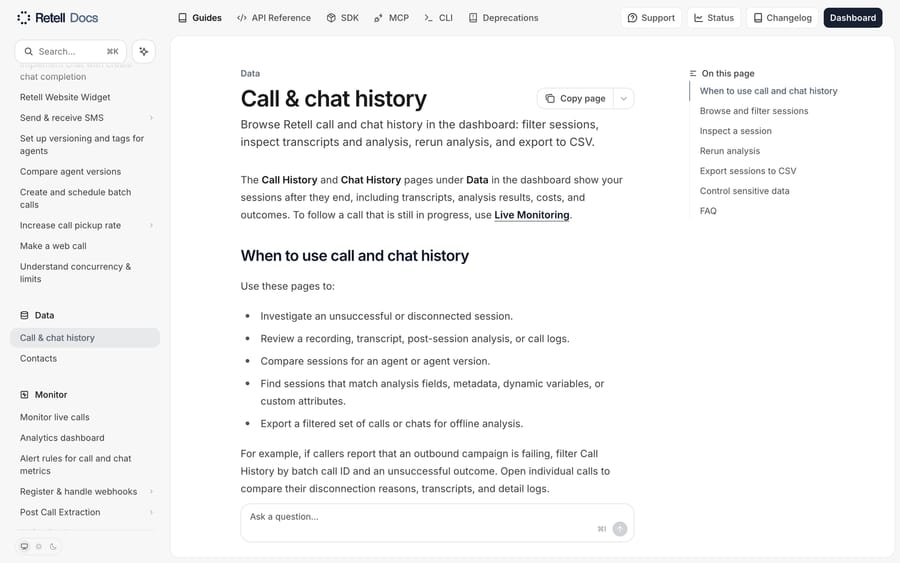
- Live call monitoring and a custom analytics dashboard that charts success rate, latency, cost, and concurrency, with filters and breakdowns you build yourself rather than a fixed report.
- AI quality assurance that can analyze up to 100% of calls instead of a sampled subset, billed separately at $0.10 a minute with the first 100 minutes free.
- Compliance certifications: HIPAA, SOC 2 Type II, GDPR, and ISO 27001, plus an enterprise option for on-premises deployment, which is why healthcare and insurance show up repeatedly among its named customers.
- Batch and scheduled outbound calling, for lead qualification and outreach campaigns on top of inbound support.
Retell AI pricing
Retell publishes real numbers, which is rarer than it should be in this category, but the total cost is assembled from several line items rather than one plan price. We checked retellai.com/pricing directly on 2026-09-17.
Pay-as-you-go starts at $0, with $10 in free credits and 20 free concurrent calls to test with. Beyond that, a voice call costs a blended $0.07 to $0.31 a minute, built from:
| Component | Cost |
|---|---|
| Retell voice infrastructure | $0.055/minute |
| Text-to-speech (Retell platform, MiniMax, Fish, Cartesia, OpenAI, Inworld voices) | $0.015/minute |
| Text-to-speech (ElevenLabs voices) | $0.040/minute |
| LLM | $0.0016/minute (GPT 5 nano) to $0.64/minute (GPT 6 Astra, fast tier) |
| Telephony | $0.015/minute (varies by country) |
| Knowledge base | $0.005/minute, plus $8/month per base (first 10 free) |
| Advanced denoising | $0.005/minute |
| PII removal | $0.01/minute |
| AI quality assurance | $0.10/minute (first 100 minutes free) |
On top of the per-minute meter, phone numbers cost $2/month, a verified number costs $10/month, and each extra unit of call concurrency beyond the free 20 costs $8/month. Enterprise pricing is custom and adds dedicated implementation support, custom MSA/DPA terms, role-based access control, custom SSO, and a 24/7 support portal.
Add the components up before you take the headline range at face value. The $0.07 floor is exactly $0.055 of voice infrastructure plus $0.015 of platform text-to-speech, and nothing else. It assumes no LLM and no telephony, which is to say it assumes a call that neither thinks nor connects to a phone. The cheapest configuration that actually places a call is $0.055 + $0.015 + $0.0016 + $0.015, or about $0.087 a minute, and that's on the cheapest model with the cheapest voice. Swap in an ElevenLabs voice and you're at $0.112 before the LLM gets interesting. The range isn't dishonest, but the bottom of it isn't a price anyone pays.
The incentive worth naming here: because the LLM line item alone can be 1 to 400 times more expensive depending on the model you pick, a team can genuinely halve its per-minute cost just by choosing a cheaper model tier, which most packaged contact-center platforms never expose as a lever at all. That transparency rewards a team that tunes its stack and quietly punishes one that leaves the default model running at scale without checking the bill.
At a support-relevant volume, say 4,000 minutes of calls a month (roughly 800 five-minute calls), a mid-tier model landing around $0.15/minute all-in works out to about $600/month before phone numbers and add-ons. That is a useful anchor if a sales call quotes you something wildly different.
What actual users say
Retell's G2 reviews page returned a 403 to an automated fetch on 2026-09-17, so we checked Trustpilot instead. Retell holds a 4.9 out of 5 rating from 814 reviews there as of that date, 802 of them posted in the preceding twelve months. The distribution is 94% five-star, 5% four-star, and 1% one-star, with almost nothing in between. Trustpilot skews toward people motivated enough to leave a review either way, and a shape like that, a wall of fives with a thin spike at one, is what a self-serve product with a fast onboarding and a thin support tier usually looks like.
The praise clusters around two things: ease of building an agent and the pace of updates. One reviewer, Anatoli, wrote: "I like that they update the platform regularly and each update actually makes things easier and more flexible to use." Danny M's review is shorter and points at the same thing: "Retellai is the best. literally just type what you want the agent to do and the ai build the agent for you." Christian Landsteiner (February 2026) points somewhere more operationally useful: "Where Retell really stands out compared to other providers is reliability and uptime."
The one-star spike is not random, and it has a single theme: support after you've paid. M Saeed (July 2026) writes "I have very bad experience with this AI. no Support no one here to help after making payment." Abdulselam Almnini (March 2026) is more specific about the same gap: "No clear support channel, no timeline for resolution, no transparency about which countries are restricted and why." That's roughly eight one-star reviews out of 814, so it isn't a widespread failure, but two independent reviewers four months apart describing the same missing escalation path is a pattern rather than an outlier. It's also the predictable shape of developer infrastructure sold self-serve: the product is fast to start and there is no account manager to call when a call won't connect in a country you needed.
Pros and cons
Pros
- Published, itemized pricing you can model yourself instead of a sales-gated quote.
- Real component-level control over the model, voice, and transcription vendor, which lets a technical team tune cost and quality independently.
- Genuine omnichannel reuse: the same agent logic runs for phone and embedded chat.
- Compliance certifications (HIPAA, SOC 2 Type II, GDPR, ISO 27001) that support regulated use cases like healthcare scheduling.
- A 4.9/5 Trustpilot score across 814 reviews is a meaningfully large, positive sample.
Cons
- The all-in per-minute cost is assembled from up to eight separate line items, which makes a clean monthly estimate harder than a flat-rate competitor. The advertised $0.07 floor excludes the LLM and the telephony, so the realistic cheapest call is about $0.087 a minute.
- It's a builder's tool. A team without engineering capacity to configure the pipeline will likely need Retell's paid implementation support or a systems integrator.
- Support after the sale is the single recurring complaint in an otherwise strong review base, and it's the whole of the one-star tail rather than a scattering of unrelated grievances.
- Retell handles voice calls. It has no ticket queue, no email channel, and nothing that resembles a help desk, so it solves one channel of support, not the whole inbox.
Who Retell AI is best for
Retell fits a team that already has, or is building, phone as a real support or sales channel and has engineering resources to own a voice pipeline: choosing a model, tuning latency, wiring telephony, and watching a per-minute bill. Healthcare scheduling, home-services dispatch, and outbound lead qualification are the shapes of business the case studies describe, and the compliance certifications back up a real appetite for regulated industries.
It's the wrong choice if your support volume mostly lives in email and chat tickets rather than phone calls, or if you want a packaged product with a single monthly price instead of a metered infrastructure bill you have to model yourself. A 15-person e-commerce support team fielding Zendesk tickets has almost no use for a per-minute voice pipeline; a 15-person home-services dispatcher fielding 2,000 inbound calls a month has a very direct one.
Retell AI vs alternatives
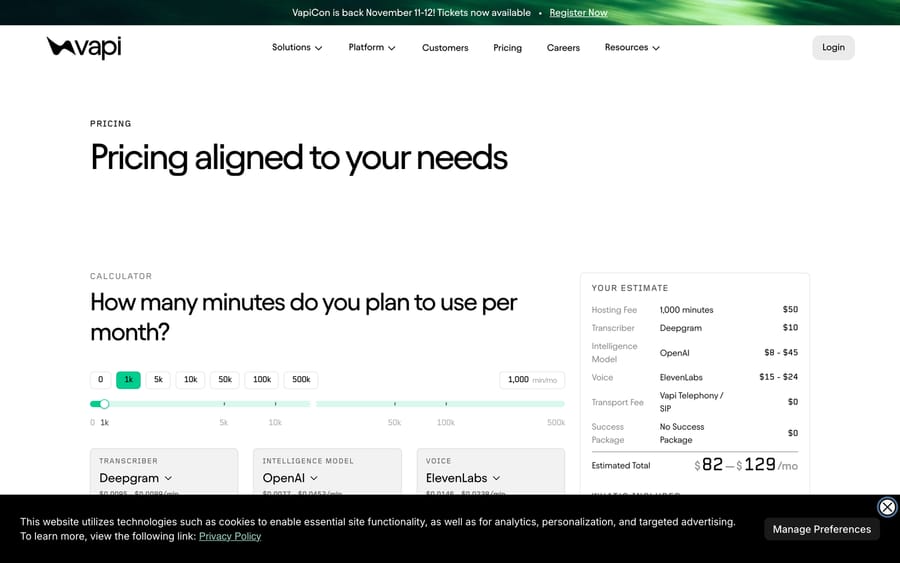
The closest comparison to Retell is Vapi, another developer-first voice AI platform with the same assemble-your-own-pipeline model. Vapi's free tier gives $5 of credits and $0.05/minute hosting; its Core plan is a flat $29/month for small teams; Pro starts at a $999/month minimum plus 10% of hosting fees; Premier is custom. Vapi's own calculator estimates $82–$129/month for 1,000 minutes at typical transcription, model, and voice settings, a genuinely different cost shape from Retell's blended $0.07–$0.31/minute. Run both calculators against your real call volume; a headline rate from either vendor won't tell you much on its own.
| Retell AI | Vapi | Macha | |
|---|---|---|---|
| Model | Voice-agent infrastructure, assemble your own pipeline | Voice-agent infrastructure, assemble your own pipeline | AI agent layer on your existing help desk |
| Channel | Phone calls, plus embedded chat | Phone calls, plus embedded chat | Email, chat, and Copilot tickets inside the help desk |
| Pricing | $0.07–$0.31/minute blended, itemized by component | $0/mo to start, Core $29/mo, Pro from $999/mo + 10% hosting | From $299/mo for 750 tickets (~$0.40/ticket), published |
| Setup | Self-serve builder; enterprise gets dedicated implementation | Self-serve builder; enterprise sales for Premier | Built, tested and monitored by the Macha team |
| Trial | $10 free credits, 20 free concurrent calls | $5 free credits | $50 free usage |
| Real-user rating | 4.9/5, 814 reviews (Trustpilot) | Not independently verified for this guide | N/A (newer platform) |
| Replaces your help desk? | No, voice only, no ticket queue | No, voice only, no ticket queue | No, sits on top of Zendesk, Freshdesk, Gorgias, or Front |
If your support volume is a phone queue, Retell or Vapi are the right category to be shopping in. If your support volume is the ticket queue sitting inside your help desk, a phone-first voice platform is the wrong tool even if it's a well-built one: none of Retell's pricing or features touch the inbox where most support teams actually spend their day. That's the gap Macha is built for, an AI agent layer that reads and answers inside Zendesk, Freshdesk, Gorgias, or Front rather than a separate voice stack you have to wire up and monitor yourself. For a broader look at how AI voice platforms differ from ticket-based agents, see our guide to AI agents for customer service and, for another enterprise voice comparison, Parloa.
How we researched this
We fetched Retell's homepage, pricing page, and build/analytics documentation directly on 2026-09-17, along with Vapi's pricing page for the comparison. G2's reviews page returned a 403 to automated access, so real-user evidence comes from Trustpilot's public review page instead, checked the same day. Revenue and funding figures are press-reported (TechCrunch, Sacra, Dealroom), not vendor-published, and are hedged accordingly. Customer results (Pine Park Health, SWTCH, Medical Data Systems) are vendor case studies we could not independently verify.
FAQ
What is Retell AI? Retell AI is a developer-focused platform for building AI voice agents that handle inbound and outbound phone calls, plus embedded chat agents, with per-minute pricing and component-level control over the model, voice, and transcription vendor.
How much does Retell AI cost? Pay-as-you-go pricing runs $0.07 to $0.31 a minute blended, starting with $10 in free credits and 20 free concurrent calls. The $0.07 floor covers only Retell's voice infrastructure and platform text-to-speech; add the cheapest LLM and telephony and a real call starts around $0.087 a minute. The final rate depends mostly on the LLM tier you choose, since that line item alone ranges from $0.0016 to $0.64 a minute. Enterprise pricing is custom.
Is there a free trial? Retell gives new accounts $10 in free usage credits and 20 free concurrent calls, with no fixed-length trial window to work against.
What has Retell AI's growth actually been? Press-reported figures (Sacra, Dealroom) put Retell above $60 million in annualized revenue in 2026, powering more than 50 million calls a month, on roughly $5 million raised since its Y Combinator start. Retell does not publish these figures itself.
Does Retell AI replace a help desk? No. Retell handles phone calls and embedded chat. It has no ticket queue or email channel, so teams running most of their support through a help desk would need a different tool, or one layered on top of the help desk itself, alongside it.
What do real users say about Retell AI? Trustpilot shows a 4.9/5 rating from 814 reviews as of 2026-09-17, 94% of them five-star and 1% one-star. Reviewers consistently praise how quickly they can build an agent, the pace of platform updates, and uptime; the one-star tail is almost entirely one complaint, no clear support channel after payment, raised by separate reviewers months apart.
How does Retell AI compare to Vapi? Both are developer-first voice AI platforms with per-minute, component-based pricing. Vapi adds a flat $29/month Core tier for small teams and a $999/month-minimum Pro tier; Retell stays fully usage-based until you reach its custom Enterprise plan. Run your own call-volume numbers through both pricing calculators; a headline rate alone won't tell you much.
What compliance certifications does Retell AI have? HIPAA, SOC 2 Type II, GDPR, and ISO 27001, with an enterprise on-premises deployment option, which is why healthcare and insurance appear repeatedly among its named customers.
Ready to automate the ticket queue instead of the phone queue? See how Macha's pricing works or start a trial on top of the help desk you already run.
Sources: Retell AI, Retell AI pricing, Retell build docs, Retell analytics dashboard docs, TechCrunch, "Retell AI lets companies build 'voice agents' to answer their calls", Trustpilot: Retell AI reviews, Vapi pricing, Sacra: Retell AI research.
Resolve tickets automatically with AI agents
Macha's AI agents work on top of the help desk you already use — no code.