Intercom
 Shopify
 Stripe
 Slack
Slack Notion
 Google Workspace
 Confluence

What Are the Best Intercom Alternatives in 2026? 9 Tools Compared


Most teams look past Intercom because of the bill: $29 to $132 per seat a month, plus $0.99 for every outcome Fin resolves, and now Salesforce owns Fin. We compare nine alternatives on price model, G2 rating and fit, with prices re-checked on 24 September 2026.
Key takeaways
- The best Intercom alternatives in 2026 are Zendesk, Freshdesk, Zoho Desk, Help Scout, Gorgias, Front, Crisp, Tidio and HubSpot Service Hub, each winning for a different reason to leave.
- Intercom charges $29 to $132 per seat a month on annual billing, plus $0.99 for every outcome Fin resolves and Copilot at $29 per agent.
- Crisp charges a flat monthly rate per workspace rather than per seat: $45 for Mini, $95 for Essentials and $295 for Plus.
- Help Scout is free for up to 5 users and meters its AI Answers bot at $0.75 per resolution, cheaper than Fin but still usage-based.
- Macha runs AI agents on existing help desks including Intercom, so a team unhappy with Fin's bill can keep Intercom and pay $299 a month for up to 750 tickets.

The best Intercom alternatives in 2026 are Zendesk for omnichannel depth, Freshdesk and Zoho Desk for value, Help Scout for simplicity, Gorgias for Shopify brands, Front for shared inboxes, Crisp for flat pricing, Tidio for small stores and HubSpot Service Hub for teams on HubSpot CRM. Most teams leave over the bill: Intercom charges $29 to $132 per seat a month plus $0.99 for every outcome Fin resolves, and Salesforce closed its acquisition of Fin on September 10, 2026.
What are the best Intercom alternatives at a glance?
| Tool | G2 rating (approx.) | Starting price | Pricing model | Best for | vs Intercom |
|---|---|---|---|---|---|
| Zendesk | 4.3/5 (~6,700) | $19–$115/agent/mo | Per seat + AI per resolution (~$1.50–$2.00) | Scaling teams wanting depth + ecosystem | More omnichannel/ticketing depth; AI also usage-priced |
| Freshdesk | 4.4/5 (~3,700) | $19/agent/mo (free program: 2 agents, 6 months) | Per seat + Freddy AI sessions | Cost-conscious omnichannel teams | Cheaper to start; less polished messenger |
| Help Scout | 4.4/5 (~440) | Free for 5 users; paid from $25/user/mo | Per user + AI Answers $0.75/resolution | Small/mid teams wanting simplicity | Simpler, warmer; lighter on AI + product tours |
| Gorgias | 4.6/5 (~550) | from $10/mo (50 tickets); Basic $60 | Ticket volume + AI per resolution | Shopify / DTC ecommerce | Ecommerce-native; not for SaaS/general |
| Front | 4.7/5 (~2,440) | from $25/seat/mo | Per seat | Collaborative, email-heavy ops | Shared-inbox feel; less messenger/AI-led |
| Crisp | 4.5/5 (~220) | Free / from $45/mo | Flat monthly (not per seat) | Budget SMB live chat | Flat, predictable pricing; smaller ecosystem |
| Tidio | 4.6/5 (~1,880) | Free / from $24.17/mo (annual) | Flat + Lyro AI per conversation | SMB ecommerce live chat + bots | Cheaper entry; lighter for complex support |
| HubSpot Service Hub | ~4.4/5 (~2,500) | $20–$150/agent/mo | Per seat (CRM-unified) | Teams on HubSpot CRM | One customer record across funnel; pricey at Enterprise |
| Zoho Desk | 4.4/5 (~6,500) | $7–$40/agent/mo | Per seat (free up to 3) | Budget omnichannel + Zoho stack | Far cheaper; busier UI, weaker messenger |
Prices checked on vendor pages 24 September 2026; G2 ratings are mid-2026 readings. Verify before buying.
For each tool below we cover what it is, who it wins for, its pricing model, its G2 rating with what users say, and how it differs from Intercom. We re-checked prices on each vendor's own page on 24 September 2026; G2 ratings are mid-2026 readings, and where a number is vendor-set or moves fast, we flag it.
A quick scope note: this is the broad "replace the whole platform" guide. If your only question is which AI agent to use instead of Fin — Decagon, Ada, Zendesk AI and the like — that's a different shortlist, and we cover it in the best Intercom Fin alternatives.
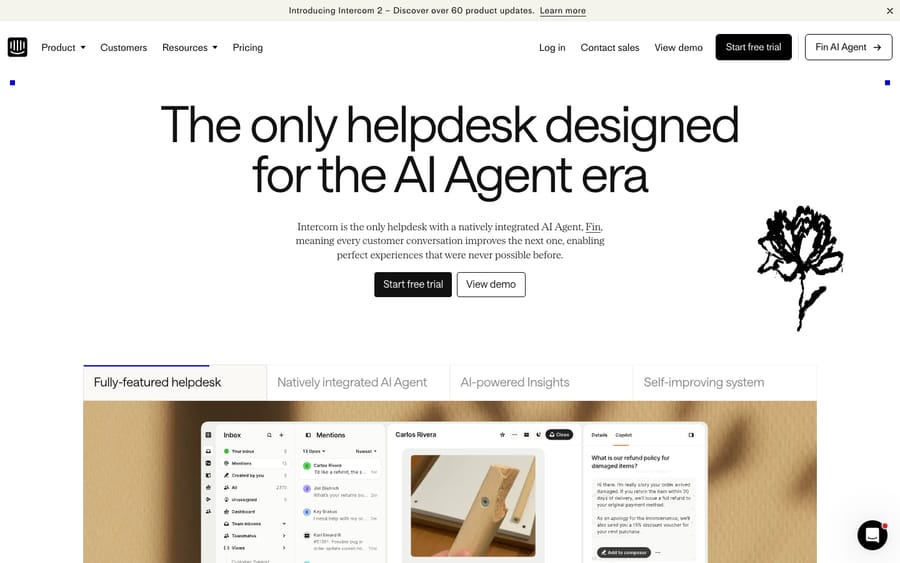
Why do teams look for an Intercom alternative?
Intercom isn't broken. But a few specific, recurring pressures push teams to look elsewhere.
- The acquisition. On June 15, 2026, Salesforce signed a definitive agreement to acquire Fin — the company that had renamed itself from Intercom a month earlier, on May 12 — for roughly $3.6 billion, folding it into the Agentforce platform, and completed the acquisition on September 10, 2026. Acquisitions of this size almost always bring roadmap, pricing, and packaging changes, and plenty of teams that aren't on Salesforce are now asking whether they want their support stack absorbed into one. That uncertainty alone is reason enough to know your options.
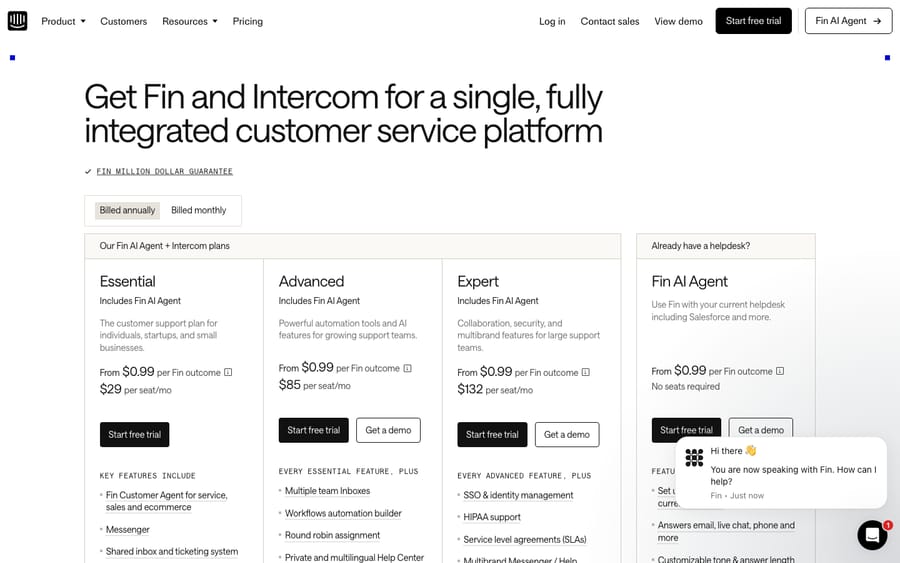
- Seat-plus-per-resolution pricing is hard to predict. Intercom charges per seat ($29 Essential, $85 Advanced and $132 Expert per seat/month, billed annually, per intercom.com/pricing), then Fin charges $0.99 per resolved outcome on top of that, then Copilot (AI for agents) is $29/user/month annually or $35 monthly after 10 free conversations per agent — plus usage fees for SMS, WhatsApp, and outbound. The base seat price is rarely the real bill.
- Bill creep is the single most-cited complaint. Across G2, Capterra, and Reddit, the dominant theme is costs that climb faster than expected as Fin handles more volume. One widely-shared r/SaaS thread is literally titled "Why my Intercom bill jumped from $4k to $9k/month."
- Outcome counting. Some users argue Fin's per-outcome billing counts "assumed resolutions" even when a customer abandons the chat or a human takes over — a fair thing to scrutinize when every resolution is a line item.
None of this makes Intercom a bad product. It makes it a specific one — excellent if you want a best-in-class messenger and AI and can absorb usage-based pricing, weaker if you need predictable costs, a phone-heavy or ecommerce-native setup, or independence from the Salesforce ecosystem. Keep your real reason in mind as you read; it determines which alternative actually fixes your problem.
How did we compare the alternatives?
We focused on established, currently-selling platforms an Intercom team could realistically move to, plus the ecommerce- and chat-specific tools that win for particular segments. For each we pulled live pricing from the vendor's own pages (or cited third-party trackers where pricing is quote-only), the current G2 star rating and approximate review count as a real-user signal, and we read through G2, Capterra, Trustpilot, and Reddit sentiment for recurring praise and complaints. G2 and Capterra review pages are bot- and login-walled (they return errors to automated fetches), so the user voices below are attributed by reviewer role and platform, or are aggregate community sentiment, rather than scraped profiles. Prices were re-read from vendor pages on 24 September 2026; confirm on each vendor's page before you sign.
Which 9 tools are the best Intercom alternatives?
1. Zendesk — the omnichannel heavyweight
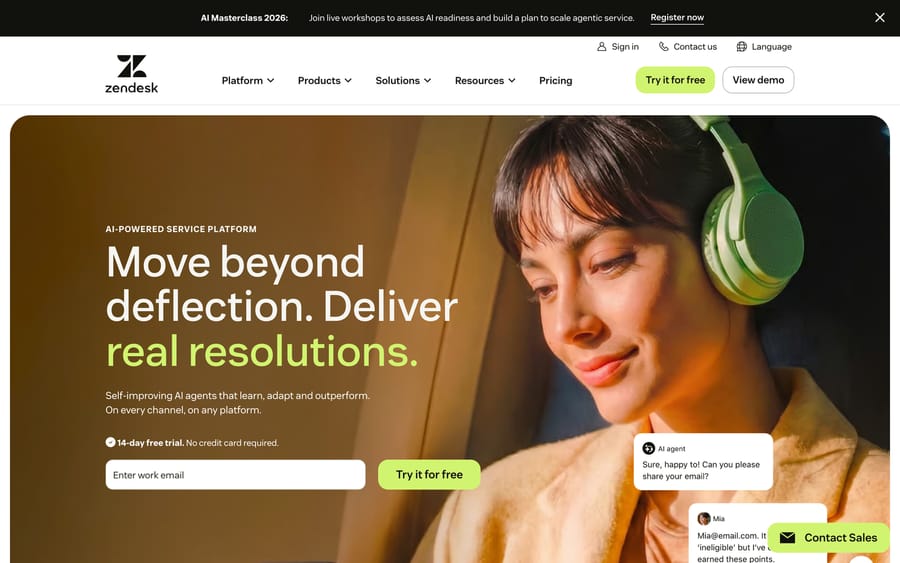
What it is: The category's most established support platform — deep, extensible omnichannel ticketing, a huge app marketplace, mature reporting, and native AI agents (built partly on the acquired Ultimate and Forethought technology). Who it wins for: Teams that need real ticketing depth, phone/voice, and a big integration ecosystem — and want a heavyweight rather than a messenger-first tool. Pricing model: Per seat, billed annually. Note the two product lines: the standalone Support plans start at $19/agent/month (Support Team), while the bundled Zendesk Suite (the omnichannel package most teams actually buy) starts higher at roughly $55/agent/month (Suite Team) and runs up to $115/agent/month (Suite Professional). AI agents are included in every plan, but each automated resolution is billed ($1.50 on a commitment or $2.00 pay-as-you-go, per Zendesk's pricing page), so like Fin, the AI is metered. Rating: G2 4.3/5 across ~6,700 reviews. How it differs from Intercom: Stronger as a true omnichannel helpdesk (especially voice and complex routing), with a larger ecosystem; Intercom's messenger and in-app experience are slicker. Both meter AI usage, so model that cost either way. For a full head-to-head, see our Zendesk vs Intercom comparison.
2. Freshdesk — the cost-conscious omnichannel pick
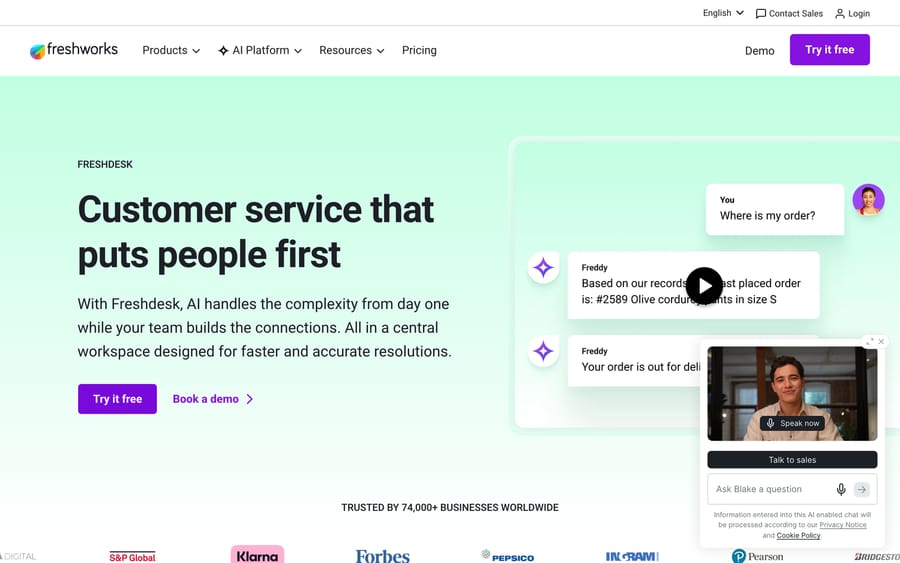
What it is: Freshworks' helpdesk — affordable, quick to set up, with omnichannel ticketing and the Freddy AI suite available as an add-on. Who it wins for: Cost-sensitive teams that want broad channel coverage and ticketing without Intercom's usage-based AI bill. Pricing model: Per seat — a free starter program (up to 2 agents, but now time-limited to 6 months rather than free-forever), then Growth $19, Pro $55, Enterprise $89/agent/month (annual), per Freshdesk's pricing page. Every plan includes 500 Freddy AI Agent sessions, then $49 per 100 sessions; Freddy Copilot is $29/agent/month on Pro and Enterprise. Rating: G2 4.4/5 (~3,700 reviews); Capterra 4.5/5. How it differs from Intercom: Much cheaper to start and simpler per-seat math, but its messenger and proactive in-app messaging are less polished, and advanced features sit in higher tiers. A natural landing spot for teams leaving Intercom mainly over cost.
3. Help Scout — the simple, human-first inbox
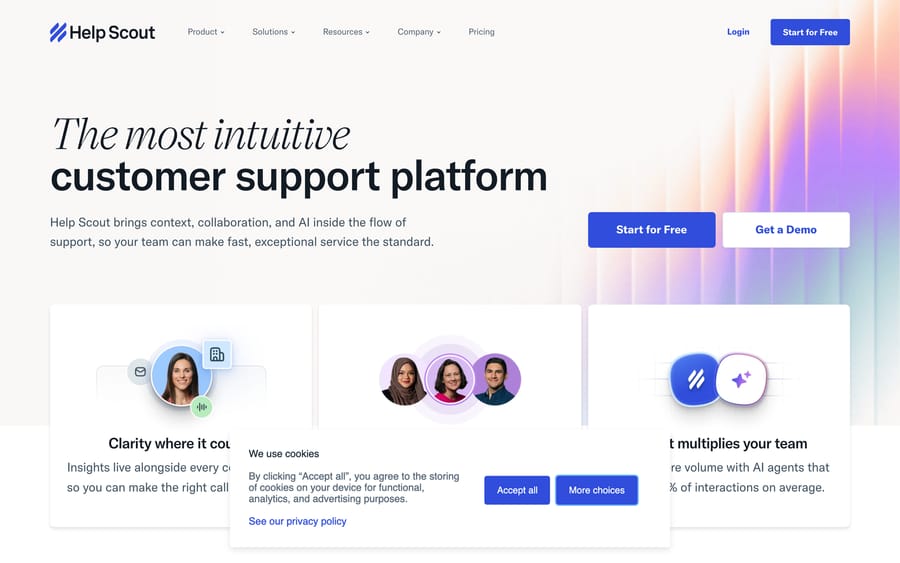
What it is: A clean, conversation-style helpdesk built around a shared inbox, knowledge base (Docs), and live chat (Beacon), with AI layered in. It deliberately hides the "ticket" machinery to feel like email. Who it wins for: Small to mid-sized SaaS and services teams that find Intercom heavy and want fast onboarding with a warm customer experience. Pricing model: Per user, with a free plan for up to 5 users, then Standard $25, Plus $45 and Pro $75 per user/month (annual). AI Answers, Help Scout's bot, bills $0.75 per resolution (helpscout.com/pricing), a third of Fin's rate but still metered. Rating: G2 4.4/5 (~440 reviews) — consistently praised for ease of use and quality of support. How it differs from Intercom: Friendlier and far simpler, with cheaper per-seat pricing and cheaper AI resolutions. The trade-off is reach: Intercom's messenger, product tours, and Fin's depth go further for product-led growth motions.
4. Gorgias — the ecommerce specialist
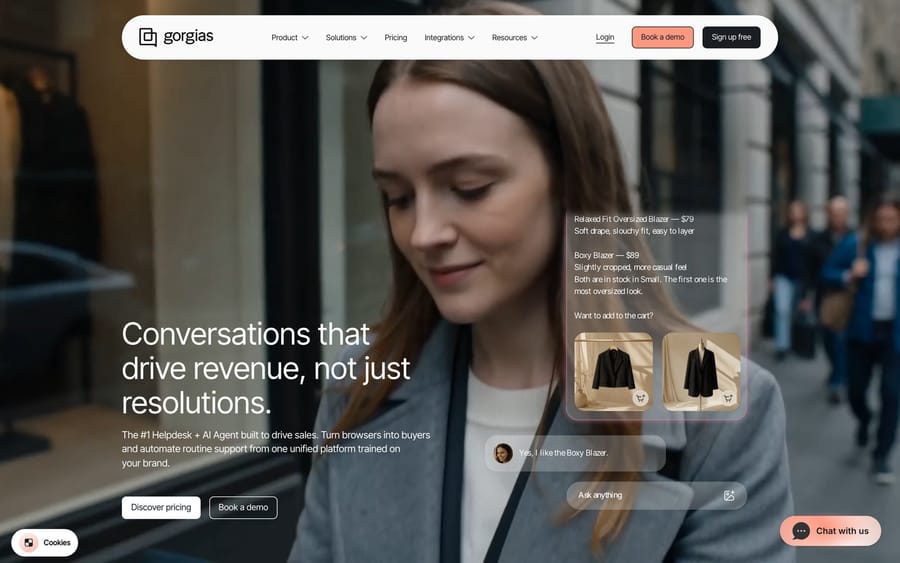
What it is: The Shopify-era helpdesk, purpose-built for ecommerce. It pulls order, refund, and subscription data into the ticket, and its AI Agent resolves WISMO, returns, and product questions natively. Who it wins for: Shopify, BigCommerce, and DTC brands whose support is mostly order-related. Pricing model: Billed on monthly ticket volume, not seats — Starter $10/month (50 tickets), Basic $60 (300), Pro $360 (2,000), Advanced $900 (5,000), per gorgias.com/pricing — with Automate AI priced per resolution (~$0.90–$1.00). Note each AI resolution also counts toward your ticket allowance. Rating: G2 4.6/5 (~550 reviews). How it differs from Intercom: Far better for retail conversations out of the box, with ecommerce data native to the ticket. It's a poor fit if you're SaaS or non-retail — this is a specialist, not a general Intercom replacement.
5. Front — the collaborative shared inbox
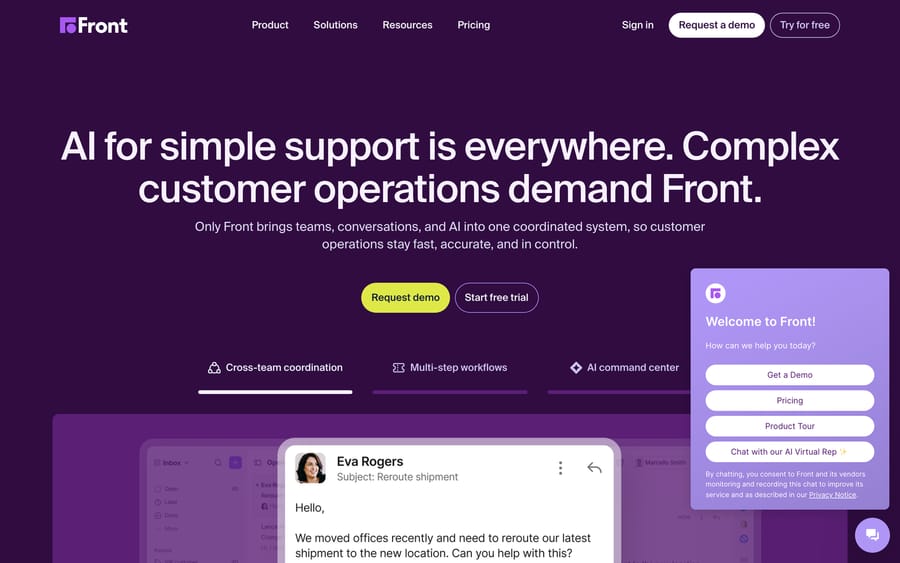
What it is: A shared-inbox platform that blends email, chat, SMS, and social into one collaborative workspace with internal comments, assignments, and shared drafts, plus AI layered on top. Who it wins for: Operations-heavy, high-touch teams (logistics, finance, B2B services) where support is a team sport and conversations need real collaboration. Pricing model: Per seat: Starter $25, Professional $65 and Enterprise $105 per seat/month on annual billing (front.com/pricing). Rating: G2 4.7/5 (~2,440 reviews) — among the highest-rated tools in this list. How it differs from Intercom: Feels like a souped-up collaborative inbox rather than a messenger-first platform. Excellent for email-dominant, relationship-driven operations; less suited to high-volume in-app chat deflection, which is Intercom's home turf.
6. Crisp — the flat-rate live chat option
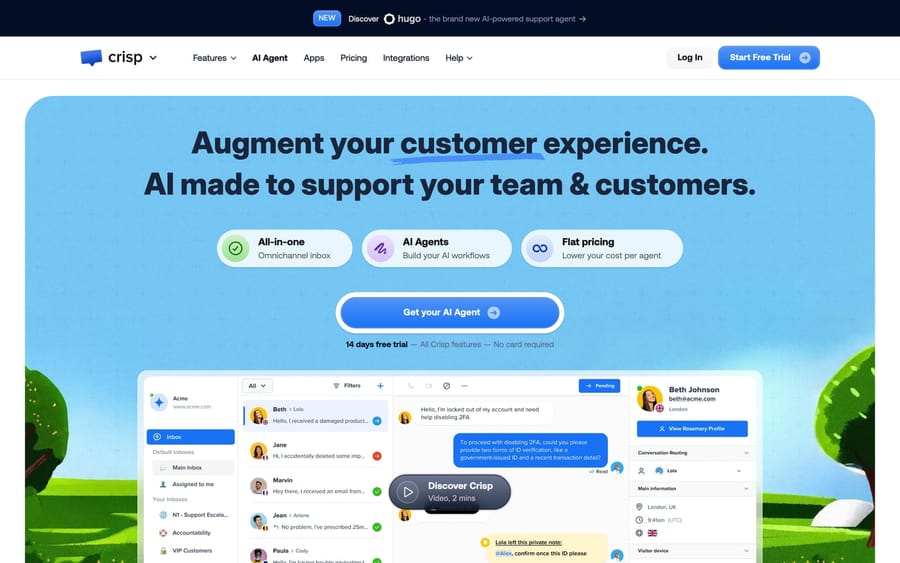
What it is: A multichannel messaging and live-chat suite with chatbots, a shared inbox, and a knowledge base, popular with startups and SMBs. Who it wins for: Small teams that want a modern messenger and chat experience without per-seat or per-resolution metering. Pricing model: Flat monthly pricing, not per seat — a free plan (2 agents), then Mini $45 (4 seats), Essentials $95 (10 seats), Plus $295 (20 seats) per month for the whole workspace, with extra seats at $10 (crisp.chat/pricing). This is the cleanest contrast to Intercom's seat-plus-resolution model: you know the number in advance. Rating: G2 4.5/5 (~220 reviews). How it differs from Intercom: Dramatically more predictable cost and a lower ceiling. You lose Intercom's depth (Fin's resolution quality, advanced product tours, enterprise reporting), but you gain a flat bill — exactly what bill-shocked Intercom refugees often want.
7. Tidio — the SMB ecommerce chat + bots pick
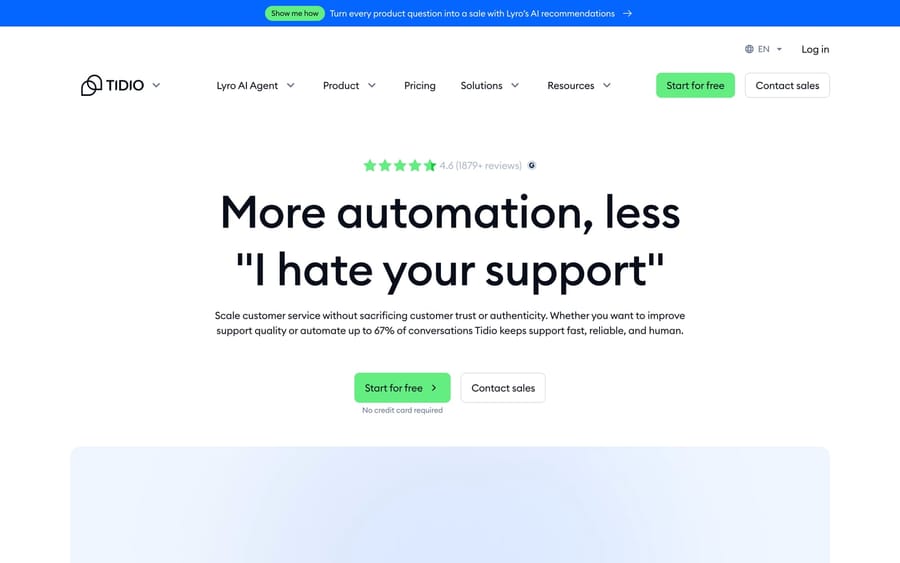
What it is: A live chat and chatbot platform with its Lyro AI agent, aimed at small ecommerce and SMB websites. Who it wins for: Small online stores and SMBs that want website live chat plus AI automation at an accessible price. Pricing model: A free plan (50 billable conversations), then Starter $24.17, Growth from $49.17 and Plus from $300 per month on annual billing (tidio.com/pricing); the Lyro AI agent is metered per conversation, with 50 free Lyro conversations to start. Rating: G2 4.6/5 (~1,880 reviews). How it differs from Intercom: Cheaper and quicker for a small storefront, with a friendlier learning curve. It's lighter for complex, multi-team support and lacks Intercom's enterprise depth — a downmarket alternative, not an upmarket one.
8. HubSpot Service Hub — the CRM-unified choice
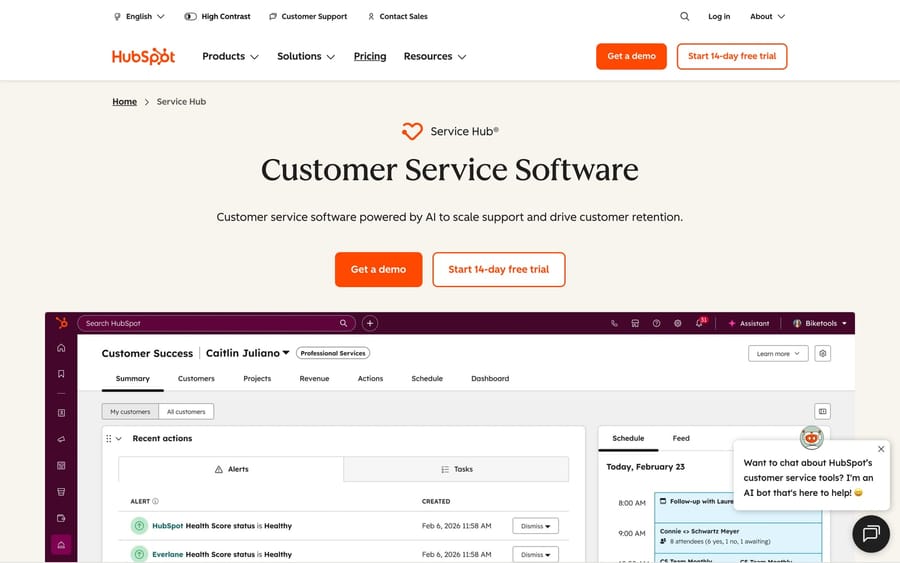
What it is: HubSpot's support product, tightly fused with its CRM, marketing, and sales tools, plus the Breeze AI customer agent. Support tickets sit on the same record as every sales and marketing touch. Who it wins for: Teams already on (or moving to) HubSpot that want support, sales, and marketing unified on one platform. Pricing model: Per seat — from $20/seat/month for Starter on monthly billing, $90 for Professional (annual, plus a $1,500 onboarding fee) and from $150 for Enterprise, with a free tier for up to 2 users (hubspot.com/pricing/service). Rating: ~G2 4.4/5 (~2,500 reviews). How it differs from Intercom: Unbeatable if you value one customer record across the full funnel; Intercom is the stronger pure support-and-messaging tool. HubSpot's Enterprise pricing climbs fast, and the CRM gravity is the whole point — adopt it for the platform, not just the helpdesk.
9. Zoho Desk — the budget powerhouse
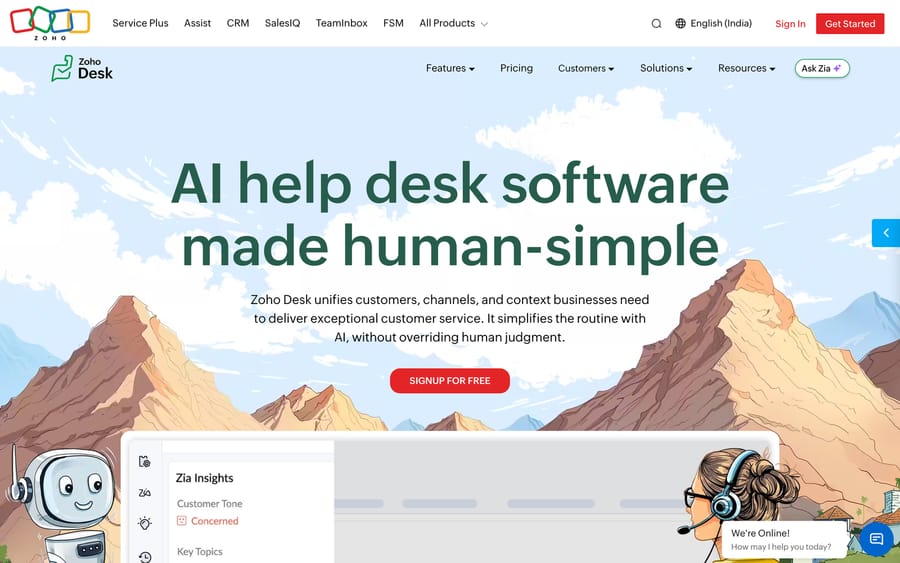
What it is: A feature-rich, omnichannel helpdesk that punches above its price, with strong automation, the Zia AI assistant, and tight integration into the broader Zoho suite. Who it wins for: Cost-conscious teams that want a lot of capability per dollar, especially anyone already on Zoho CRM or Zoho One. Pricing model: Per seat — $7/agent/month (Express), $14 (Standard), $23 (Professional) and $40 (Enterprise), billed annually, with a free tier for up to 3 agents (zoho.com/desk/pricing). Rating: G2 4.4/5 (~6,500 reviews) — one of the largest review bases in the category. How it differs from Intercom: Far cheaper and deep on classic ticketing and automation, but the UI is busier and the messenger/in-app experience is weaker. A strong value swap if your priority is omnichannel ticketing over a best-in-class chat widget.
Can you keep Intercom and replace only the AI bill?
A quick, honest disclosure since it's relevant here: we make an AI product, and it's worth being upfront about where it does and doesn't fit.
Macha is not an Intercom alternative, because it isn't a help desk at all. It's an AI agent layer that runs on top of Zendesk, Freshdesk, Gorgias, Front, HubSpot or Intercom. That list includes Intercom itself, so if your real problem is Fin's per-outcome bill, you can keep Intercom and run Macha agents on it instead of migrating. If you do move to one of the connected desks above, Macha adds AI resolution to that new helpdesk — reading the customer's question, pulling from your connected order/CRM data and help center, drafting and routing inside your existing workflow, and handing off to a human with context when it isn't confident.
Check that your destination is on that list before counting on it. Macha's pricing is per ticket (one charge per thread, however many replies it takes: $299/mo for up to 750 tickets, $1,199 for up to 3,000), with setup and monitoring by the Macha team included, rather than per resolution. At $0.99 an outcome, 750 Fin resolutions cost about $743 before seats. Like any layer, Macha is only as good as the integrations and knowledge you connect. If that's relevant to where you're headed, here's how the layer works on Zendesk, or you can try $50 of free usage, no credit card required.
What do users actually say about Intercom?
Ratings tell you the average; reviews tell you the why. Intercom holds a strong G2 rating of 4.5/5 (~3,500 reviews) and a matching Capterra 4.5/5 — people genuinely like the product. The friction is almost entirely about cost and predictability. Because G2 and Capterra review pages are bot-walled to automated access, the voices below are attributed by reviewer role and platform, or are aggregate community sentiment:
"The product is excellent, but the cost keeps continuing to increase and it's hard to substantiate for a small business." — paraphrased aggregate sentiment, G2 / Capterra reviewers, 2026
"Why my Intercom bill jumped from $4k to $9k/month… pricing is way more complicated than their marketing page suggests." — Reddit r/SaaS thread, 2026 (Fin's $0.99-per-outcome model plus outbound, WhatsApp, and SMS add-ons)
"Fin assumes the complaint was resolved even when a human takes over from the AI." — paraphrased from an Intercom community post on outcome counting, 2026
Read together, the message is consistent: Intercom is a good product whose pricing is hard to forecast at scale. That's the friction nearly every alternative above is trying to relieve — whether through flat pricing (Crisp), cheaper per-seat models (Zoho Desk, Freshdesk), or cheaper AI resolutions (Help Scout at $0.75). For the full breakdown of how the bill is built, see our Intercom pricing explained guide.
How do you choose the right Intercom alternative?
- Name your real reason for leaving. If it's cost predictability, look at flat-rate (Crisp) or cheap per-seat tools (Zoho Desk, Freshdesk, Help Scout). If it's the Salesforce acquisition, weigh how much ecosystem independence matters to you. If it's a channel or segment gap, match the tool to it.
- Match the tool to your channel mix and segment. Omnichannel + voice at scale? Zendesk. Ecommerce? Gorgias. Collaborative, email-heavy ops? Front. SMB live chat? Crisp or Tidio. On HubSpot already? Service Hub.
- Model the total cost, including AI. Intercom taught everyone this lesson. Some tools meter AI per resolution (Zendesk, Gorgias), some per conversation (Tidio), some per session (Freshdesk), and some charge flat (Crisp). Compare like-for-like at your actual volume, not the sticker seat price.
- Weigh migration cost honestly. Moving platforms means data migration, retraining, and rebuilt workflows. That effort is worth it for a structural problem (predictability, segment fit, ecosystem) and overkill for a single feature gap.
- Pilot on a real slice of your queue. Whatever you shortlist, run it on live conversations and measure resolution rate, CSAT, and time-to-first-response against your Intercom baseline before you commit.
Frequently asked questions
What is the best Intercom alternative in 2026? There's no single winner — it depends on why you're leaving. Zendesk is the strongest omnichannel upgrade; Zoho Desk and Freshdesk are the best value; Help Scout wins on simplicity; Crisp offers flat, predictable pricing; Gorgias owns ecommerce; Front is best for collaborative email-heavy teams; Tidio suits small online stores; and HubSpot Service Hub is best if you're on HubSpot CRM.
Is Intercom being acquired by Salesforce? Yes. Salesforce signed a definitive agreement on June 15, 2026 to acquire Fin — the company that had renamed itself from Intercom on May 12 — for approximately $3.6 billion, and completed the acquisition on September 10, 2026, with plans to fold it into the Agentforce platform. For many teams not on Salesforce, that change is itself a reason to evaluate alternatives now.
Why is Intercom so expensive? Intercom stacks three pricing layers: per-seat plans ($29 Essential, $85 Advanced and $132 Expert per seat/month annually), Fin AI at $0.99 per resolved outcome, and Copilot ($29/user/month annually, $35 monthly) for agent-side AI — plus usage fees for SMS, WhatsApp, and outbound. The base seat price is rarely the final bill, which is why "bill creep" is the most common complaint. See our Intercom pricing explained breakdown.
What's the cheapest Intercom alternative? Zoho Desk ($14/agent/month plus a free tier) and Freshdesk (a 6-month free starter program for up to 2 agents, then $19) are the most budget-friendly full helpdesks. Crisp is the cheapest for flat-rate live chat (free, then $45/month for the whole workspace), and Tidio has a free plan for small stores. Help Scout is free for up to 5 users. Always add AI costs when comparing.
Which Intercom alternative has the most predictable pricing? Crisp is the clearest — it bills flat per month for the whole workspace rather than per seat or per resolution, so you know the number up front. Per-seat tools with cheaper metered AI (like Help Scout, at $0.75 per resolution) are also easier to forecast than Intercom's $0.99 per-outcome model.
Should I just replace Fin instead of all of Intercom? If you like Intercom's platform and only the AI agent is the problem, you may not need to migrate the whole stack — there's a separate shortlist of AI agents you can run instead of Fin in our best Intercom Fin alternatives guide.
Which Intercom alternative should you pick?
The best Intercom alternative is the one that fixes your specific reason for looking. Zendesk is the omnichannel heavyweight; Zoho Desk and Freshdesk the value picks; Help Scout the simplicity choice; Crisp the flat-rate live-chat option; Tidio the SMB store pick; Gorgias the ecommerce specialist; Front the collaborative inbox; and HubSpot Service Hub the CRM-unified option. With Intercom now inside Salesforce, it's a sensible moment to know your options — but the playbook doesn't change: pin down your channel mix and segment, model the total cost including AI, and pilot on real conversations before you migrate. And if your real frustration was AI cost, whether you stay on Intercom or move to Zendesk, Freshdesk, Gorgias, Front, HubSpot or Intercom, remember an AI layer on top can add resolution to your new helpdesk without locking you into per-resolution pricing.
Prices re-checked on vendor pages 24 September 2026; ratings are mid-2026 readings. Helpdesk and AI pricing in this category changes fast — confirm current terms on each vendor's site before buying.
Add AI agents to your Intercom
Macha reads the conversation, drafts the reply and takes the action, inside the Intercom you already run.