Intercom
 Shopify
 Stripe
 Slack
Slack Notion
 Google Workspace
 Confluence

Help Scout vs Front (2026): Which Is Better for Your Support Team?


Help Scout suits teams that want simple, email-first support with a strong knowledge base and a free plan, while Front suits teams where several people work the same customer threads together. Both start at $25 a seat, but Front tops out at $105 on Enterprise against Help Scout's $75 on Pro.
Key takeaways
- Help Scout fits SMB teams wanting simple, email-first support with a Docs knowledge base, while Front fits B2B and operations teams that work customer threads together.
- Help Scout and Front both start at $25 a seat; Help Scout has a free plan for up to 5 users and tops out at $75 on Pro, while Front has no free plan and runs to $105 on Enterprise.
- Help Scout bills its AI Answers agent at $0.75 per resolution, while Front charges $20 a seat each for Copilot and Smart QA below Enterprise.
- Front's Autopilot agent is usage-based on every tier, and Front's pricing page lists it starting at $0.05 per conversation.
- On Front, Macha adds an AI agent layer the Macha team sets up and runs in safe mode for you, at about $0.40 a ticket with a dedicated success manager included; it does not connect to Help Scout.

Choose Help Scout if you want simple, email-first support with a strong knowledge base and a free plan (up to 5 users, 100 contacts a month); choose Front if several people work the same customer threads together and you'll pay for it. Both start at $25 a seat, but Front tops out at $105 a seat on Enterprise against Help Scout's $75 on Pro, and Front sells most of its AI as $10 to $20 per-seat add-ons below Enterprise, while Help Scout bills AI Answers at $0.75 per resolution (prices checked 24 September 2026).
| Question | Help Scout | Front |
|---|---|---|
| Entry price | $25/user/mo (Standard, monthly rate) | $25/seat/mo (Starter, annual) |
| Top published tier | $75/user/mo (Pro, 10-user minimum) | $105/seat/mo (Enterprise) |
| Free plan | Yes: 5 users, 100 contacts/mo | No |
| Customer-facing AI | AI Answers, $0.75 per resolution | Autopilot, from $0.05 per conversation |
| Best for | SMB support teams wanting simplicity | B2B and ops teams that work messages together |
Disclosure: Macha (the company publishing this) makes an AI agent layer that runs on top of Zendesk, Freshdesk, Gorgias, Front, HubSpot or Intercom. It does not integrate with Help Scout, and it's a layer rather than a help desk, so it isn't a contender here. There's one short aside on where it fits at the end.
How did we compare Help Scout and Front?
We pulled plan names and prices from the official pricing pages for Help Scout and Front, cross-checked against our own deep-dives on Help Scout pricing and Front pricing. For real-user signal we used G2 and Capterra aggregate ratings, review counts, and recurring themes, with an attributed reviewer quote for each tool. Where a figure isn't published cleanly (Front's exact monthly rates, Autopilot's unit), we flag it. We re-checked both pricing pages on 24 September 2026; pricing in this space moves, so confirm current rates before you budget. Our next review is scheduled for December 2026.
What is the core difference between Help Scout and Front?
This is the whole decision, so slow down on it.
Help Scout is email-first customer support, kept deliberately simple. It's a shared inbox plus a genuinely good knowledge base (Docs) and an embeddable help widget (Beacon), aimed at small and growing teams who want to answer customers well without a complex helpdesk. The mental model is customer support software that feels like email: fast to learn, light to run.
Front is a collaborative shared inbox built for customer operations. It's designed for teams who work messages together (assignments, internal comments, @mentions, shared drafts, and workflow rules) across email, chat, SMS, and social. It leans toward B2B, account-driven, and operations-heavy teams (logistics, finance, professional services) where several people touch the same customer relationship. The mental model is team collaboration layered onto a shared inbox.
That single split (simplicity for support vs. depth for collaboration) drives almost every difference below.
What does Help Scout do well?
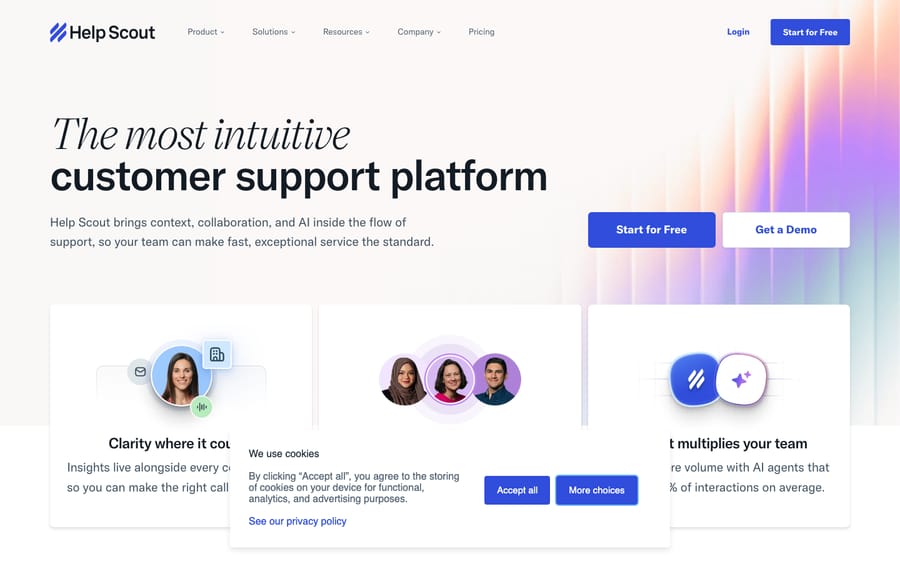
Help Scout is a customer support platform centered on a clean shared inbox. Its calling card is approachability: teams get up and running fast, and customers get replies that look like normal email rather than ticket numbers.
Core strengths:
- Shared inbox for email, live chat, and social (Messenger, Instagram, WhatsApp), with collision detection and saved replies.
- Docs: a strong, easy-to-build knowledge base for customer self-service.
- Beacon: an embeddable widget that surfaces help articles and chat in your app or site.
- Workflows and reporting: automation rules plus CSAT and support analytics, scaling with the plan.
- AI features: AI Drafts and AI Assist included on paid plans, plus the customer-facing AI Answers agent (priced per resolution).
Help Scout's trade-off is the flip side of its simplicity: it's less configurable than a full helpdesk, and its collaboration tools, while solid, aren't as deep as Front's.
What does Front do well?
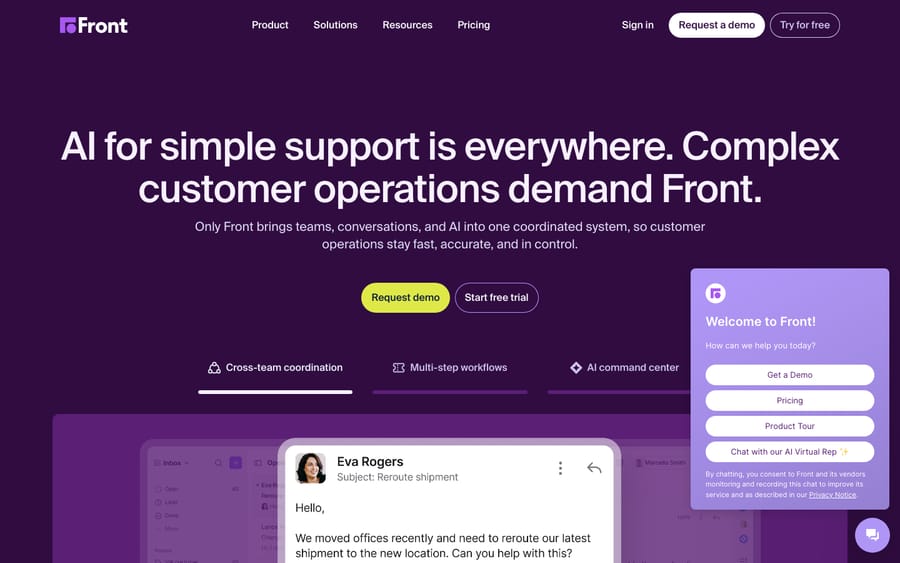
Front is a collaborative shared inbox and customer-operations platform. Where Help Scout thinks in tickets and CSAT, Front thinks in shared ownership of conversations, getting a whole team aligned on the same customer thread without forwarding emails or pinging each other in Slack.
Core strengths:
- Deep collaboration: internal comments, @mentions, shared drafts, and clear message assignment on every conversation.
- Omnichannel: email, chat, SMS, social, and more, unified (omnichannel sits on Professional and up).
- Workflow automation: rules, macros, and routing that scale across multiple workspaces.
- Customer-ops fit: analytics, SLAs, and integrations aimed at B2B and operations teams who manage relationships, not just tickets.
- Front AI: Copilot (agent-side), Smart QA and Smart CSAT (add-ons below Enterprise, included on Enterprise), plus the customer-facing Autopilot deflection agent (usage-based on every tier).
Front's trade-off: it's more powerful and more collaborative, but also more complex and more expensive once you add the AI layer, and its knowledge-base/self-service story is less of a centerpiece than Help Scout's Docs.
How do Help Scout and Front compare side by side?
| Help Scout | Front | |
|---|---|---|
| Best described as | Simple, email-first customer support | Collaborative shared inbox + customer ops |
| Ideal team | SMB support teams wanting simplicity | B2B / ops teams that work messages together |
| Collaboration | Solid (shared inbox, collision detection) | Deep (comments, @mentions, assignments, drafts) |
| Knowledge base | Docs: a core strength | Available, less of a centerpiece |
| Omnichannel | Email, chat, social on paid plans | Email, chat, SMS, social (omnichannel on Pro+) |
| Entry price | $25 / user / mo (Standard, monthly; 16% off annual); Free plan exists | $25 / seat / mo (Starter, annual) |
| Top published tier | $75 / user / mo (Pro, 10-user min) | $105 / seat / mo (Enterprise) |
| Free plan | Yes (up to 5 users, 100 contacts/mo cap) | No (free trial only) |
| AI model | AI Answers: $0.75 / resolution | Autopilot: from $0.05 / conversation; per-seat AI add-ons |
| G2 rating | ~4.4 / 5 (~435 reviews) | ~4.7 / 5 (~2,429 reviews) |
| Capterra rating | ~4.7 / 5 | ~4.5 / 5 (~250 reviews) |
Prices checked on the official pricing pages on 24 September 2026; ratings from G2 and Capterra as of mid-2026. Confirm before budgeting, since pricing changes often.
Is Help Scout or Front cheaper?
Both bill roughly per person per month, but the ladders diverge in ways that matter.
Help Scout (per user/month, monthly billing):
- Free: $0 · up to 5 users, 1 inbox, 1 Docs site, capped at 100 contacts/month.
- Standard: $25 · the real entry point for up to 25 users: multiple inboxes, live chat, SMS, WhatsApp, Instagram and Messenger.
- Plus: $45 · up to 50 users: advanced workflows, two SLA policies, a secure portal, unlimited AI drafts.
- Pro: $75 · SSO/SAML, HIPAA, dedicated support and up to 50 light users, with a 10-user minimum (a $750/mo floor at the monthly rate).
Annual billing knocks ~16% off the seat cost, and Help Scout also has a free on-ramp Front lacks. One wrinkle worth knowing: Help Scout switched to a "contacts helped" model in late 2024, walked much of it back after backlash, and now shows per-user pricing for new signups, but some accounts remain on the legacy contact-based plan. Full detail in our Help Scout pricing breakdown.
Front (per seat/month, billed annually):
- Starter: $25 · shared inbox and ticketing, but generally a single channel type and capped at 10 seats.
- Professional: $65 · omnichannel, macros, larger automation pool, multiple workspaces; capped at 50 seats.
- Enterprise: $105 · unlimited seats, custom roles, and bundled Front AI (Copilot, Smart QA, Smart CSAT).
The catch with Front is AI. On Starter and Professional, the AI features are paid add-ons: Copilot $20/seat/mo, Smart QA $20/seat/mo, Smart CSAT $10/seat/mo (or QA+CSAT bundled at $25/seat). The customer-facing Autopilot agent is usage-based and an add-on on every tier: Front's page lists it "starting at $0.05 per conversation" (checked 24 September 2026), while some third-party breakdowns cite around $0.89 per resolution, a meaningfully different model, so confirm the exact unit. Front's page says annual billing saves 24% against monthly, but doesn't print the monthly rates. Full detail in our Front pricing breakdown.
The practical read: entry prices match at $25, but they climb differently. Help Scout's top published tier ($75) is below Front's ($105), and Help Scout's AI is a single clean per-resolution line. Front's real cost is "seats plus the AI add-ons you'll actually turn on," which makes it easy to under-budget. If you want the cheapest predictable start, Help Scout (with its free tier) usually wins; if you'll pay for collaboration depth, Front's premium can be worth it.
Which has better collaboration, Help Scout or Front?
This is where Front earns its reputation. Internal comments, @mentions, shared drafts, and explicit message assignment are first-class everywhere in the product: a team can debate a reply privately, hand off ownership, and co-author a response without a single forwarded email. For ops-heavy and B2B teams where multiple people share a customer relationship, that's the whole reason to buy Front.
Help Scout collaborates well too: shared inbox, collision detection so two agents don't reply at once, private notes, @mentions. But it's pitched at support efficiency rather than deep team co-working. If your support is mostly one agent owning a conversation end-to-end, Help Scout's lighter model is plenty (and simpler). If your conversations routinely involve three people across two departments, Front's depth is the differentiator.
How do Help Scout AI and Front AI compare?
Both ship AI, but with different philosophies.
Help Scout keeps it simple: AI Assist (rewrite, tone, translate) and AI Drafts (draft from your docs and past tickets) are included on paid plans (Plus and Pro get unlimited AI drafts), and the customer-facing AI Answers agent is billed at a clean $0.75 per resolution (after a 3-month trial, max one charge per conversation). The whole thing is easy to reason about.
Front offers more AI surface area but charges for most of it. Copilot (agent drafting/summaries), Smart QA, and Smart CSAT are per-seat add-ons unless you're on Enterprise, and Autopilot, the deflection agent, is usage-based on every tier. There's more here, but more to budget, and the recurring user critique is exactly that: capable AI, à la carte cost. If you want AI resolution with predictable math, Help Scout's single per-resolution line is the cleaner story; if you want a broader AI toolkit and will pay per seat for it, Front offers more.
What do users say about Help Scout and Front?
Aggregate sentiment is strong for both, with a notable gap in review volume.
- Help Scout: ~4.4/5 on G2 (around 435 reviews) and ~4.7/5 on Capterra. The standout theme is ease of use and a human, email-like experience. As one G2 reviewer put it: "The shared inbox, automation features, and reporting tools help streamline support workflows while still delivering a human, email-like experience for customers." The common watch-outs are reporting depth, the steep Standard-to-Plus jump, and lingering confusion from the 2024–25 pricing-model changes.
- Front: ~4.7/5 on G2 (around 2,429 reviews, far more than Help Scout) and ~4.5/5 on Capterra (~250 reviews). Reviewers consistently praise collaboration: internal comments, assignments, and @mentions that keep teams aligned without forwarding. One G2 reviewer: "The shared inboxes, internal comments, and clear assignment of messages help our team stay organized and aligned without needing to forward emails or rely on external chat tools." The most frequent criticisms are price (especially with AI add-ons) and a steeper learning curve than Help Scout.
Net: Front rates slightly higher on G2 with a much larger review base (signal of broader adoption), Help Scout edges it on Capterra and on "value for money," and the shared complaint across both is cost once you scale: AI for Front, the Plus tier for Help Scout.
Who should choose Help Scout, and who should choose Front?
- Choose Help Scout if you're an SMB support team that values simplicity: you want a clean shared inbox, a strong knowledge base (Docs), fast onboarding, predictable per-resolution AI, and ideally a free or low-cost start. It's the better "just answer customers well, without complexity" pick.
- Choose Front if you're a B2B or operations team that works messages collaboratively: multiple people on the same customer relationship, internal comments and assignments as a daily habit, omnichannel needs, and a willingness to pay a premium (and budget AI add-ons) for that depth.
- It's close if you're a mid-sized support team that wants both decent collaboration and a knowledge base, in which case price the AI you'll actually use (Help Scout's $0.75/resolution vs. Front's seat add-ons + Autopilot) and let total cost and the free-trial feel break the tie.
Where does an AI layer like Macha fit?
One narrow, honest aside: if you're evaluating these because you want stronger AI resolution on top of your support tool, it's worth knowing how the layer approach differs, though to be clear, Macha does not integrate with Help Scout. Macha is an AI agent layer that runs on top of Zendesk, Freshdesk, Gorgias, Front, HubSpot or Intercom, so it isn't an option if your inbox is Help Scout, and it never replaces the desk itself.
We mention it mainly as a billing-model contrast, and as an option if you choose Front. Help Scout bills AI per resolution and Front's Autopilot is per conversation/resolution; Macha bills per ticket on one plan priced by volume, from $299 a month for up to 750 tickets: one charge per thread, however many automated steps an agent takes along it (understanding a ticket, pulling an answer, drafting a reply, tagging, routing). The reasoning is that most automation is work done along the way, not one tidy outcome, and that a per-resolution price rewards the vendor for counting outcomes rather than for the work. Neither model is universally better. On Front, Macha is also the done-for-you option: the Macha team analyzes your past tickets, builds the knowledge base and the agent, and runs it in safe mode, with drafts as internal notes in your help desk, until the drafts are right. That's about $0.40 a ticket, which includes the setup and a dedicated success manager who handles your changes. If you want to see the per-ticket approach in practice, there's $50 of free usage, no credit card required.
Frequently asked questions
What's the difference between Help Scout and Front? Help Scout is simple, email-first customer support software (shared inbox + Docs knowledge base + Beacon) aimed at SMB support teams. Front is a collaborative shared inbox and customer-operations platform built for teams, especially B2B and ops teams, who work messages together with internal comments, @mentions, and assignments across channels.
Is Help Scout or Front cheaper? Both start at $25/user (or seat)/month, and Help Scout has a free plan Front lacks. Help Scout's top published tier is $75 vs. Front's $105, and Help Scout's AI is a single $0.75/resolution line. Front's real cost is higher once you add its AI features (Copilot/QA/CSAT per seat, Autopilot usage-based), so Help Scout is usually the cheaper, more predictable option.
Which has better collaboration, Help Scout or Front? Front. Internal comments, @mentions, shared drafts, and explicit message assignment are central to Front and ideal for teams who share customer relationships. Help Scout collaborates well (shared inbox, collision detection, notes) but is pitched more at support simplicity than deep team co-working.
Which is rated higher, Help Scout or Front? They're close. Front rates ~4.7/5 on G2 (across ~2,429 reviews) vs. Help Scout's ~4.4/5 (~435 reviews); Help Scout rates ~4.7/5 on Capterra vs. Front's ~4.5/5. Front has far more reviews, while Help Scout often scores better on ease of use and value for money.
Does Macha work with Help Scout or Front? Front yes, Help Scout no. Macha is an AI agent layer that runs on top of Zendesk, Freshdesk, Gorgias, Front, HubSpot or Intercom, and it does not integrate with Help Scout. On Front, the Macha team sets the agent up and runs it in safe mode for you, at about $0.40 a ticket with a dedicated success manager included.
So which should you choose?
Help Scout vs. Front isn't about which tool is better; it's about which instinct fits your team. Help Scout is the simpler, email-first choice: a clean shared inbox, a strong knowledge base, fast onboarding, predictable per-resolution AI, and a free on-ramp, which makes it ideal for SMB support teams who want to answer customers well without complexity. Front is the collaboration-and-ops choice: deep internal comments, assignments, and omnichannel workflows for B2B and operations teams who work messages together, at a premium and with AI sold mostly as add-ons. Both are well-reviewed; match the tool to how your team actually works, price the AI you'll genuinely use, and confirm every rate on the official pricing pages before you commit, because they change often.
Vendor prices were re-checked on 24 September 2026 on Help Scout's and Front's official pricing pages; ratings are from G2 and Capterra as noted. Front's exact monthly rates and Autopilot's unit aren't published cleanly and are flagged as such. Next review: December 2026.
Add AI agents to your Front
Macha reads the conversation, drafts the reply and takes the action, inside the Front you already run.