
 Shopify
 Stripe
 Slack
Slack Notion
 Google Workspace
 Confluence

Freshdesk vs HappyFox (2026): Which Help Desk Costs Less and Fits Your Team?


Freshdesk starts at $19 an agent a month billed annually and HappyFox Help Desk at $24, and neither lists a free plan on its pricing page anymore. Freshdesk suits teams that want built-in Freddy AI and one vendor for every channel, while HappyFox suits IT-style teams that need asset management and large teams that can use unlimited-agent plans.
Key takeaways
- Freshdesk Growth costs $19 an agent a month billed annually, while HappyFox Help Desk starts at $24 an agent a month, and each vendor offers a 14-day trial.
- Freshdesk's pricing page no longer lists a free plan; a separate Free program covers up to 2 agents for 6 months instead.
- Freshdesk's Freddy AI Agent gets 500 sessions as a one-time allowance per account, then costs $49 per 100 sessions, and Freddy AI Copilot adds $29 an agent a month.
- HappyFox sells AI as separate products, with HappyFox AI from $14 an agent a month and its Chatbot at $0.33 per resolution.
- HappyFox's unlimited-agent plans charge a flat annual fee with a yearly ticket allowance, which can undercut Freshdesk's per-seat pricing for teams of 50 agents and up.

Freshdesk is cheaper to start, at $19 an agent a month billed annually for Growth against $24 for HappyFox Help Desk, while HappyFox is the better fit for IT-style teams that need native asset management and for large teams that can use its unlimited-agent plans (both vendors' pricing pages, checked 24 September 2026). Neither shows a free plan on its pricing page today: Freshdesk offers a 14-day trial plus a Free program for up to 2 agents for 6 months, and every HappyFox plan starts with a 14-day trial.
How do Freshdesk and HappyFox compare at a glance?
| Freshdesk | HappyFox | |
|---|---|---|
| Best for | Teams wanting one vendor for tickets, AI and adjacent channels | Teams wanting a clean, customizable ticketer with native asset management |
| Pricing entry | Growth $19/agent/mo billed annually; 14-day trial; Free program for up to 2 agents for 6 months | Help Desk from $24/agent/mo; 14-day trial, no credit card |
| AI / automation | Freddy AI Copilot ($29/agent/mo add-on) + Freddy AI Agent (500 one-time sessions, then $49 per 100) | Smart Rules, canned actions, load balancer; HappyFox AI from $14/agent/mo, Chatbot $0.33 per resolution |
| Omnichannel | Email, chat, phone, social; full multichannel via Freshdesk Omni ($29/$79/$119) | Email and web, plus Contact Center Suite from $99/agent/mo for voice and chat |
| Ease / admin | Fast to start; deeper automation gated to higher tiers | Reviewers consistently praise ease of use and support quality |
| Standout strength | Unified Freddy AI ecosystem and transparent tiers | Built-in asset/ITSM management and setup speed |
Prices below were checked on 24 September 2026 and change often, so confirm on each vendor's live pricing page before you buy.
How much do Freshdesk and HappyFox cost?
Freshdesk publishes a straightforward per-agent ladder. Per Freshworks' official Freshdesk pricing, the tiers billed annually are Growth at $19/agent/mo, Pro at $55/agent/mo and Enterprise at $89/agent/mo. The pricing page no longer lists a free plan. It offers a 14-day trial of Enterprise instead, and a separate Free program covers up to 2 agents for 6 months. The catch most buyers hit is add-on creep: Freddy AI Copilot is an extra $29/agent/mo, the Freddy AI Agent gets 500 sessions as a one-time allowance per account and then costs $49 per 100 sessions, and full multichannel pushes you toward Freshdesk Omni ($29/$79/$119 per agent/mo annually). We break the true all-in cost down in Freshdesk pricing explained.
HappyFox takes a different shape. It sells several distinct products rather than one ladder, and each one starts with a 14-day trial.
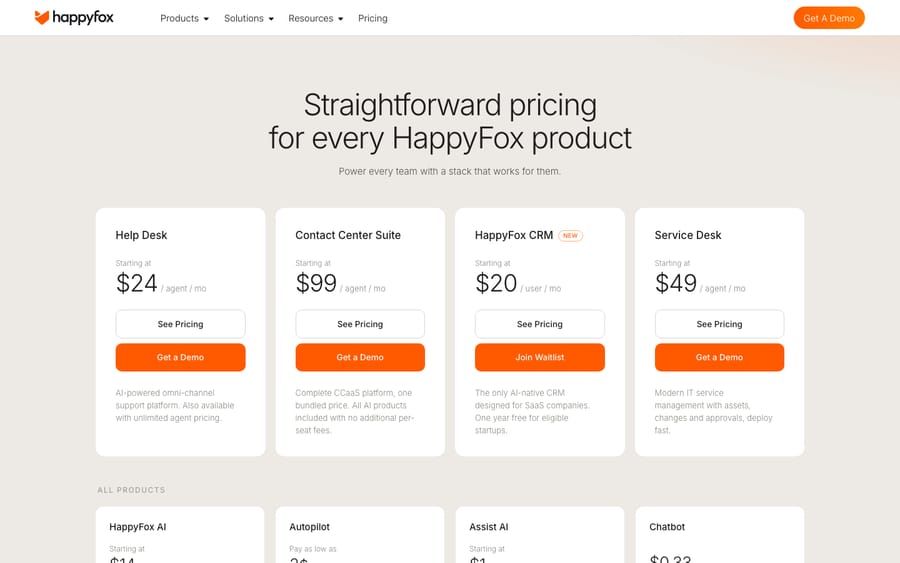
Per HappyFox's official pricing, the starting prices are Help Desk from $24/agent/mo, Contact Center Suite from $99/agent/mo, HappyFox CRM from $20/user/mo (still a waitlist product) and Service Desk from $49/agent/mo. Annual billing saves 20%. HappyFox also sells unlimited-agent plans: a flat annual fee with a yearly ticket allowance instead of per-seat pricing, pitched at teams of roughly 20 to 25 agents and up. That model is where HappyFox can undercut per-seat pricing. If you have 50 agents but moderate ticket volume, a volume plan can beat paying Freshdesk's per-agent fee for every seat. The trade-off is that HappyFox AI (from $14/agent/mo), Chatbot ($0.33 per resolution), Autopilot (from 2 cents per successful action) and Workflows (from $199 a month) are separate paid products, so a realistic all-in figure for a mid-sized team lands well above the $24 sticker.
The honest summary on price: for most small and mid teams, Freshdesk is cheaper to start thanks to the $19 floor. For large teams with contained ticket volume, HappyFox's unlimited-agent model can win on total cost. Both vendors change pricing regularly, so treat every figure here as a starting point, not a quote.
Which has better AI, Freshdesk or HappyFox?
AI is the main battleground for help desks in 2026, and this is where the two philosophies diverge most sharply.
Freshdesk's edge is a long-standing, unified AI strategy: Freddy AI, split into Freddy AI Copilot (an agent-assist layer that summarizes tickets, drafts replies and coaches agents) and Freddy AI Agent (an autonomous conversational bot billed in sessions). Because it's woven through the product, turning AI on in Freshdesk is mostly a matter of enabling it and paying for it. Note the incentive in the session model: once the 500 one-time sessions are gone, every extra 100 conversations the bot touches costs $49, whether or not it resolves them. If native, out-of-the-box AI resolution is central to your plan, Freshdesk is still the more complete story.
HappyFox leans on strong deterministic automation, with AI sold on the side. Its standout differences are native asset management (hardware, software licenses and warranties tracked alongside tickets, with a requester's assigned assets surfacing automatically) plus ITIL-friendly workflows and tight SLA controls. That makes HappyFox a natural fit for internal IT and service-desk teams that need process compliance without jumping to a heavyweight ITSM platform. HappyFox's AI is a set of separate products with their own prices, so it's an add-on decision rather than a built-in default. The exception is the Contact Center Suite, which HappyFox says includes all its AI products with no extra per-seat fees.
Which automates ticket workflows better?
Both tools automate well; they just weight it differently. Freshdesk's automation (ticket routing, scenario automations, SLA policies) is easy to set up, but the stronger pieces start gating behind Pro and Enterprise, a pattern worth budgeting for.
HappyFox counters with Smart Rules, canned actions that bulk-apply multi-step macros, automated time tracking, SLA-breach alerts and a ticket load balancer that distributes work across agents. In practice, several reviewers find HappyFox's canned actions and load balancing a touch stronger out of the box, while Freshdesk's is faster to configure but tiered. If you want deep, repeatable macro workflows without hitting a paywall early, HappyFox rewards the effort. If you want automation that "just works" on day one, Freshdesk feels friendlier.
Which is easier to set up and run?
This is HappyFox's home turf. On G2's Freshdesk vs HappyFox comparison, HappyFox has historically rated ahead of Freshdesk on ease of use and quality of support (we couldn't load the live scores on 24 September 2026, so check the page for current figures). Reviewers consistently praise HappyFox's clean interface, logical navigation and responsive support team, and onboarding new agents is fast.
Freshdesk is also quick to start, but its breadth means more surface area to configure, and admins sometimes trip on which capabilities live on which plan. Neither is hard to run. HappyFox simply has a slight edge on day-one friendliness and support experience, while Freshdesk trades a little of that for far greater reach.
How do their ecosystems and support compare?
Freshdesk's advantage is the Freshworks ecosystem: tight ties to Freshchat, Freshcaller, Freshservice and a large marketplace of integrations, plus the option to grow into full omnichannel via Freshdesk Omni. If you expect to add channels or adjacent products over time, staying inside one vendor is convenient.
HappyFox's advantage is focus and support quality. Its support reputation is a recurring theme in reviews. Its Contact Center Suite ($99/agent/mo) adds voice and chat for teams that need omnichannel without leaving the platform. The ecosystem is smaller than Freshworks', but for teams that want one well-run tool rather than a sprawling suite, that's a feature, not a bug.
What are the pros and cons of each?
Freshdesk pros: low $19 entry; a Free program for up to 2 agents for 6 months; unified Freddy AI (Copilot plus autonomous Agent); broad omnichannel via Omni; large integration marketplace; transparent published pricing. Freshdesk cons: the best automation and AI are gated to higher tiers and add-ons, so real cost climbs; AI Agent sessions are metered after the one-time 500; breadth means more to configure.
HappyFox pros: excellent ease of use and quality of support; native asset management and ITIL-friendly workflows; strong canned actions and load balancing; unlimited-agent plans that can save large teams money. HappyFox cons: a higher per-agent floor; AI, chatbot, workflows and autopilot are separate paid products; some reviewers cite reporting friction and mobile-app gaps; unlimited-agent plans come with a fixed yearly ticket allowance.
Which should you choose?
- Small teams and startups on a budget: Freshdesk. The $19 Growth plan and the 2-agent Free program make it the cheapest honest way in, and you can add AI later.
- Internal IT / service-desk teams: HappyFox. Native asset management and ITIL-friendly workflows do work Freshdesk's help desk doesn't, without the weight of a full ITSM suite.
- Teams betting on native AI deflection: Freshdesk. Freddy AI is more integrated out of the box than HappyFox's separate AI products.
- Large teams with contained ticket volume: HappyFox. The unlimited-agent model can beat per-seat pricing at 50 agents and up.
- Teams that prize simplicity and support: HappyFox. Its ease of use and support reputation are the differentiator when you want one tidy tool run well.
Can you add an AI agent on top of either help desk?
Your help desk choice and your AI agent choice don't have to be the same decision. Freshdesk and HappyFox are both solid systems of record for tickets, SLAs and workflows, but the reasoning-heavy work of reading a ticket, understanding intent, pulling an order status from your own systems and drafting a grounded reply is a distinct capability. That's the category of AI agents for customer service, and it's worth understanding the build-versus-buy tradeoff before you commit to any vendor's bundled AI.
Macha is one such layer. It runs on top of the help desk you already use, including as a native connector for Freshdesk, rather than replacing it. It reads and writes the same tickets your team already handles, drafts or sends grounded replies, triages by intent, and looks up account or order data through a custom tool that turns a REST API into something the agent can call. Macha bills per ticket, one conversation charged once however many messages it takes, never per resolution, starting at $299 a month for up to 750 tickets with setup by the Macha team included; the pricing page has the breakdown. Macha connects to Zendesk, Freshdesk, Gorgias, Front, HubSpot or Intercom; HappyFox isn't on that list today.
FAQ
Is Freshdesk or HappyFox cheaper? For most small and mid-sized teams, Freshdesk is cheaper to start: Growth is $19/agent/mo billed annually, versus HappyFox Help Desk from $24/agent/mo (both checked 24 September 2026). Neither lists a free plan on its pricing page, though Freshdesk runs a Free program for up to 2 agents for 6 months. For large teams with contained ticket volume, HappyFox's unlimited-agent plans can undercut per-seat pricing.
Which has better AI? Freshdesk has the more integrated native AI story with Freddy AI Copilot (agent assist, $29/agent/mo) and Freddy AI Agent (autonomous, 500 one-time sessions then $49 per 100). HappyFox sells AI as separate products, such as HappyFox AI from $14/agent/mo and Chatbot at $0.33 per resolution, so Freshdesk generally wins on out-of-the-box AI.
Does HappyFox do asset management and Freshdesk not? HappyFox includes native asset management (hardware, software licenses, warranties) alongside tickets, which suits internal IT teams. Freshdesk's help desk doesn't offer this natively; asset and ITSM management sit in Freshworks' separate Freshservice product.
Which is easier to use? Reviewers give HappyFox a slight edge, and it has historically rated ahead of Freshdesk on ease of use and quality of support on G2. Freshdesk is also quick to start but has more surface area to configure.
Can I add AI to Freshdesk or HappyFox without switching help desks? Yes. An AI agent layer like Macha runs on top of your existing help desk rather than replacing it. Macha connects to Freshdesk as a native connector today, reading and writing the same tickets your team already handles while the help desk stays the system of record.
Ready to add an AI agent layer on top of your help desk? Start a free trial of Macha and connect it to your Freshdesk in minutes.