
 Shopify
 Stripe
 Slack
Slack Notion
 Google Workspace
 Confluence

Is Gorgias Worth It in 2026? Pricing, AI Fees and Who It Suits


Gorgias is worth it for a Shopify store with 500 or more action-heavy tickets a month, and hard to justify for small, FAQ-heavy or non-Shopify stores. The help desk plan is only part of the bill: AI Agent interactions are charged on top, and past the bundle they cost $1.50 each.
Key takeaways
- Gorgias is worth it for Shopify stores handling roughly 500 to 3,000 tickets a month, especially when 40% or more of contacts need an action like a refund or order edit.
- Gorgias help desk plans run from $10 a month for 50 tickets to $900 for 5,000 tickets on monthly billing, with overages of $0.40 or $0.36 per ticket.
- Gorgias charges both a ticket fee and an automation fee when AI Agent resolves a ticket, so a Pro store automating 600 tickets pays about $1,165 instead of $360.
- Gorgias holds 4.6 on G2 but a TrustScore of 2.1 across 152 Trustpilot reviews, a gap Ringly attributes to pricing surprises and support complaints.
- Gorgias AI Agent is set up per connected Shopify store, and third-party breakdowns say it is not supported on WooCommerce, BigCommerce or Magento.

Gorgias is worth it for a Shopify store handling roughly 500 to 3,000 tickets a month where many contacts need an action (a refund, an order edit, a cancellation), and hard to justify below about 150 tickets or on a non-Shopify stack. The help desk starts at $10 a month for 50 tickets and runs to $900 for 5,000 on monthly billing, but the AI Agent is metered on top, so the real bill for an automating store can be three times the plan price.
| Store profile | Monthly tickets | Verdict |
|---|---|---|
| Very small / side project | Under ~150 | Usually overkill: a cheaper inbox does the same job |
| Small DTC, mostly FAQs | 150–500 | Depends: worth it only if action-heavy on Shopify |
| Growing DTC, action-heavy | 500–3,000 | The sweet spot: this is who Gorgias is built for |
| High-volume / seasonal peaks | 3,000+ | Worth it, but watch overages and AI double-billing |
The break-even isn't a single number. It's a mix of volume and ticket type. A common piece of buyer guidance says Gorgias earns its price when 40% or more of your contacts require an action rather than just an answer, because that's where its Shopify-native tooling saves real agent minutes. Treat that as a rule of thumb, not a Gorgias figure.
What does Gorgias cost in 2026?
Gorgias meters on billable tickets, not agent seats. The Gorgias pricing page lists these help desk plans on monthly billing, with the AI Agent bundle shown alongside:
| Plan | Help desk (monthly) | Tickets included | Overage per ticket | With AI Agent (monthly / annual) |
|---|---|---|---|---|
| Starter | $10 | 50 | $0.40 | $40 with 30 automated interactions (monthly only) |
| Basic | $60 | 300 | $0.40 | $90 / $77 with 30 interactions |
| Pro | $360 | 2,000 | $0.36 | $550 / $471 with 190 interactions |
| Advanced | $900 | 5,000 | $0.36 | $1,430 / $1,227 with 530 interactions |
Past the bundle, each automated interaction costs $1.50. Enterprise is custom. Our Gorgias pricing explained piece breaks the tiers down in full.
Where is Gorgias genuinely worth it?
Credit where it's due: Gorgias is a well-built product. Ringly's rating analysis reports 4.6 out of 5 on G2 across 547 reviews (checked June 2026). Reviewers repeatedly praise the same things: an interface new agents learn fast, and a Shopify integration that's hard to beat. Order details, refunds, subscription changes and cancellations surface right inside the ticket, so an agent rarely has to tab out to the Shopify admin. For a busy DTC team, that's the whole point.
The other strength is that Gorgias is ecommerce-native by design rather than a general help desk with a Shopify plugin bolted on. Tickets get auto-tagged by intent (returns, exchanges, WISMO), and the automation and macros are built around the actions a store actually performs. If you've ever watched an agent copy an order number between five browser tabs, the appeal is immediate. Our what is Gorgias explainer covers the fundamentals.
Why do Gorgias reviews split between G2 and Trustpilot?
On Trustpilot, Gorgias holds a TrustScore of 2.1 across 152 reviews (checked 24 September 2026), against that 4.6 on G2. Ringly's rating analysis puts the gap down to pricing surprises and support complaints rather than the product. G2 reviewers are mostly the agents who use Gorgias every day. Trustpilot reviewers are more often the people who pay for it.
Three specific things drive the complaints:
1. Per-ticket billing and overages. Exceed your allotment and overages kick in automatically at $0.40 a ticket on Starter and Basic, $0.36 on Pro and Advanced. That's fine in a steady month. During a BFCM spike, ticket volume can balloon and the overage line with it.
2. The AI Agent "double-billing." This is the one that surprises people most. Gorgias's AI Agent is billed per automated interaction on top of the help desk plan: $1.00 on Starter, $0.90 on Basic and Pro, $0.85 on Advanced inside the bundle, then $1.50. Gorgias's billing docs confirm that an automation fee and a ticket fee apply to the same ticket when AI Agent resolves it without a human, and an interaction counts as automated if the customer doesn't need a human within 72 hours. Do the arithmetic for a Pro store on monthly billing that automates 30% of its 2,000 tickets: that's 600 automated interactions. The $550 Pro bundle covers 190, and the other 410 cost $1.50 each, or $615. The bill lands near $1,165 against the $360 help desk sticker. We unpack how the automation is metered in Gorgias AI Agent explained.
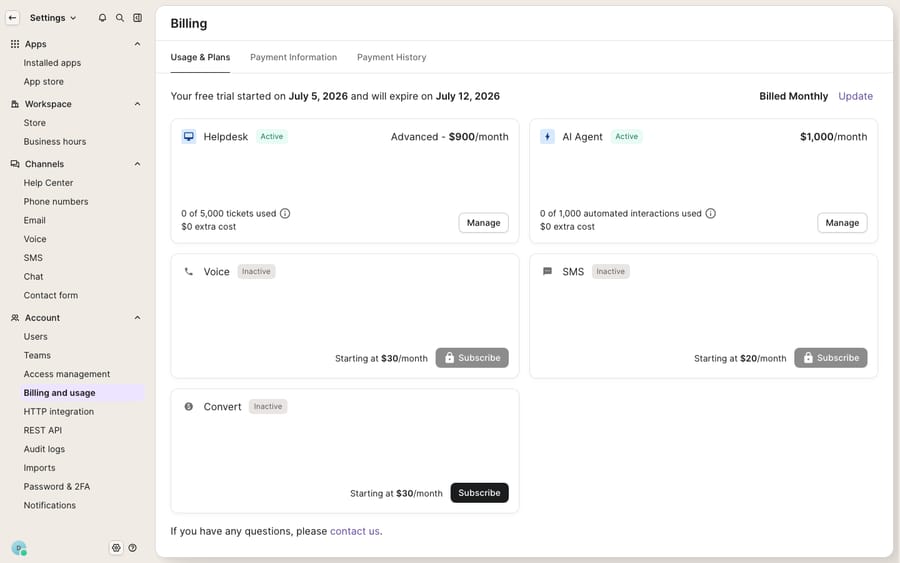
You can see the shape of it on the billing screen above: an Advanced help desk plan at $900 a month sits next to a separate AI Agent line, with Voice, SMS and Convert stacked as further paid add-ons. For a store leaning into AI, "Gorgias" is two large bills, not one. The incentive is plain: Gorgias earns more on every ticket its AI closes, because that ticket pays twice.
3. Sales pressure and support. Community threads and reviews raise a softer, recurring complaint: aggressive sales tactics on the way in, and slower-than-hoped support once you're paying. Discussions on communities like r/Entrepreneur show merchants weighing Gorgias's real ecommerce strengths against pricing that feels less predictable than they'd like. None of this makes the product bad, but it's the difference between a great tool and a great purchase.
Does Gorgias work well without Shopify?
Much of what makes Gorgias special is tied to Shopify. The core help desk connects to WooCommerce on every plan, BigCommerce from Basic and Magento from Pro, per the pricing page's comparison table. The AI Agent is narrower: Gorgias's AI Agent docs describe one AI Agent "for each Shopify store you connect", and Ringly's September 2026 breakdown states it isn't supported on BigCommerce, Magento or WooCommerce stores. If you're a Shopify Plus brand, that dependency is a feature. If you're on WooCommerce, BigCommerce or a headless stack, a big chunk of the value disappears and the price gets much harder to defend. That's often the deciding factor, and a common reason merchants end up scanning the best Gorgias alternatives.
So, is Gorgias worth it for your store?
If you're a Shopify store doing 500+ action-heavy tickets a month, Gorgias is very likely worth it. The integration depth and ecommerce-native workflows save agent time, and the G2 score is earned. If you're small, mostly answering FAQs, off Shopify, or nervous about variable bills, be cautious. Per-ticket overages and the AI double fee can push your real cost well above the advertised plan, which is what drags the Trustpilot score down.
The trap is buying on the sticker price and being surprised by the invoice. Model your real monthly cost before you sign: base plan plus likely overages plus AI Agent interactions past the bundle. Do it at your peak month's volume, not your average, especially before an annual commitment.
How does an AI layer on top of Gorgias change the math?
The bill scares people because Gorgias's AI Agent charges per automated interaction, which couples cost to volume in a way that's hard to forecast during a peak. A separate AI layer on top of Gorgias changes how the automation is priced without replacing your help desk.
Macha runs as an AI agent for customer service on top of the Gorgias you already use. It isn't a help-desk replacement, and Gorgias stays your system of record. Its connector reads tickets and full message threads, replies publicly or posts internal notes, updates status, priority and tags, searches customers and macros, and routes to teams. The meter is different: Macha is one plan priced by monthly ticket volume, from $299 a month for up to 750 tickets, billed per ticket however many messages and tool calls it takes, with setup and monitoring by the Macha team included. There are no overages; agents pause when the month's tickets run out, so a BFCM spike can't produce a surprise invoice. Because it can call your order and account systems through a custom tool, the agent can do the action-heavy work (look up an order, check a refund status) that makes those tickets expensive by hand. Macha is still a second bill next to your Gorgias plan, so compare it against the AI Agent line, not the help desk line, on our pricing page.
FAQ
Is Gorgias worth the money in 2026? For Shopify stores with a meaningful share of action-heavy tickets (refunds, order edits, cancellations), yes. The integration depth saves real agent time, and G2 reviewers rate it 4.6. For small stores, FAQ-heavy queues, or stores off Shopify, it's often hard to justify against cheaper options.
Why is Gorgias's Trustpilot score lower than its G2 score? G2 (4.6) mostly reflects the agents who use the product. Trustpilot (2.1 across 152 reviews in September 2026) captures more of the billing and support experience, where overage surprises and the AI double fee come up most.
What is the "double-billing" complaint about Gorgias AI Agent? When AI Agent resolves a ticket without a human, Gorgias charges both a help desk ticket fee and an automation fee for it, per its billing docs. Automated interactions past the plan's bundle cost $1.50 each, so a Pro store automating 600 tickets a month pays about $1,165 on monthly billing instead of $360.
What store size is the break-even for Gorgias? Roughly 500+ monthly tickets on Shopify, especially when 40% or more require an action rather than just an answer. Below about 150 FAQ-style tickets, a cheaper inbox usually does the same job for less.
Does Gorgias work well without Shopify? The help desk connects to WooCommerce, BigCommerce and Magento, but the AI Agent is built per connected Shopify store, and third-party breakdowns say it isn't supported on the other three. Non-Shopify stores lose much of what makes Gorgias worth the price.
Weighing the AI bill specifically? Start a free trial of Macha with $50 of usage and no credit card, and see how a per-ticket layer on top of Gorgias compares before you commit to a big annual number.