Intercom
 Shopify
 Stripe
 Slack
Slack Notion
 Google Workspace
 Confluence

What Are the Best Gorgias Alternatives in 2026? Cheap and Free Options Priced


Gorgias costs $40 a month for 50 tickets with its AI Agent, or $10 for the helpdesk alone, and most teams shopping for an alternative want a smaller or steadier bill. Nine alternatives are priced here from their own pages, plus the free options an ecommerce team can run and which complaint each one fixes.
Key takeaways
- Re:amaze is the closest Gorgias alternative for Shopify stores, priced at $29 a team member a month on Basic or $59 flat for unlimited team members up to 500 responded conversations.
- Gorgias plans run from Starter at $40 a month for 50 tickets to Advanced at $1,430 for 5,000, and switching off the AI Agent drops Starter to $10.
- Every Gorgias plan with the AI Agent includes an automated-interaction allowance, 30 on Starter and Basic and 530 on Advanced, then charges $1.50 per extra interaction.
- Chatwoot's free cloud Hacker plan covers 2 agents and 500 conversations a month, and self-hosting Chatwoot removes both caps at no license cost.
- eDesk includes its AI Agent on every plan and bills $0.99 per outcome it resolves, with native connections to Amazon, eBay, Walmart and Shopify.

The best Gorgias alternatives in 2026 are Re:amaze for a like-for-like Shopify swap at $29 a team member a month, Freshdesk or Zendesk at $19 an agent for per-seat pricing, eDesk for Amazon and eBay sellers, and Chatwoot, Crisp or Tidio if the budget is $0. Gorgias itself starts at $40 a month for 50 tickets with its AI Agent included, or $10 a month for the helpdesk alone (gorgias.com/pricing, checked 24 September 2026).
A disclosure up front: we make an AI agent layer called Macha that runs on top of a help desk, including Gorgias. It isn't a help desk and it isn't counted in the nine; it gets one clearly marked section. For how Gorgias itself charges, see our Gorgias pricing breakdown.
Which Gorgias alternative fits which team?
| Tool | Pricing model | Entry price (checked 2026-09-20) | Best for | vs Gorgias |
|---|---|---|---|---|
| Zendesk | Per agent, AI billed separately | $19/agent/mo (Support Team) | Scaling brands wanting depth | Per seat; deeper and pricier |
| Freshdesk | Per agent | $19/agent/mo (Growth) | Budget omnichannel support | Cheaper start, less DTC-native, no free plan (a Free program covers 2 agents for 6 months) |
| Help Scout | Per user | Free, then $25/user/mo | Small DTC wanting a simple inbox | Simpler; lighter on order data |
| Re:amaze | Per user or $59 flat | $26.10/user/mo annual | Shopify brands wanting Gorgias-like, cheaper | Closest like-for-like; flat option capped at 500 conversations |
| Richpanel | Per agent plus a portal | $0 portal, $69/agent/mo desk | DTC leaning on self-service deflection | Deflection-first; yearly contracts only |
| eDesk | Per user, AI per outcome | $39/user/mo | Multichannel marketplace sellers | Amazon and eBay native, not just Shopify |
| Kustomer | Per user, 8-seat minimum | $89/user/mo (June 2026 figure) | Mid-market, relationship-led | Customer timeline, not ticket-per-order |
| Gladly | Custom, 10-agent minimum | Quote (June 2026 figure) | Premium, voice-heavy retail | People-centered; enterprise floor |
| Tidio / Crisp | Per conversation / flat | Free, then $24.17 or $45 | Small DTC wanting chat-first and cheap | Chat-led; lighter help desk depth |
Why do teams look for a Gorgias alternative?
Gorgias isn't broken. It's specific, and the frictions that push brands to shop around are consistent.
Ticket-based pricing punishes volume. Gorgias bills on monthly tickets instead of agents, which is a gift to a lean team with lots of people and a problem for a seasonal brand. The current plans are Starter $40 a month for 50 tickets (monthly billing only, 3 seats), Basic $90 or $77 on annual for 300, Pro $550 or $471 for 2,000, and Advanced $1,430 or $1,227 for 5,000. Past your quota, overage is $0.40 a ticket on Starter and Basic and $0.36 on Pro and Advanced. Black Friday is a line item.
Those headline prices include the AI Agent. The pricing page now has an "Add AI Agent" toggle, and with it off the helpdesk alone is Starter $10 a month, Basic $60 or $50 on annual, Pro $360 or $300, and Advanced $900 or $750, on the same ticket quotas and overage rates. If you mainly want a cheaper Gorgias bill, that toggle is the first thing to try.
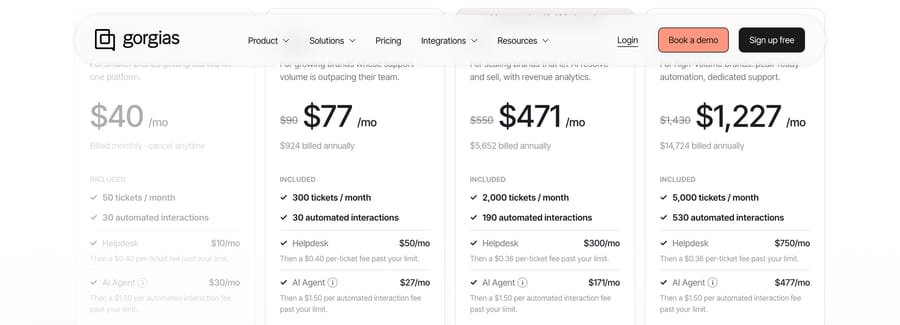
The AI has its own meter. Every plan now includes an allowance of automated interactions, 30 on Starter and Basic, 190 on Pro, 530 on Advanced, and charges $1.50 for each one past it. The plan cards break the headline into a Helpdesk component and an AI Agent component, so you can see which half of the bill is which. That's clearer than it used to be, and it's still two meters running at once.
It's ecommerce-only by design. Gorgias is built for Shopify-era retail. That focus is a strength for stores and a dead end for anyone whose support isn't order-driven.
The customer is a stack of orders. Gorgias is transaction-centric. Brands moving toward high-LTV, relationship-led support sometimes want a unified customer timeline instead of a ticket built around the latest order.
Name the incentive: a per-ticket model earns the vendor more when your store gets busier and nothing when your team gets faster, while a per-seat model does the reverse. Neither is dishonest. They just reward different things, and the right one depends on whether your cost driver is headcount or volume.
What can an ecommerce team run for $0 instead of Gorgias?
This is the half most Gorgias roundups skip, and it's what the r/shopify thread asking for a cheaper alternative to Gorgias and the one simply titled "Gorgias Alternative" are actually asking for. Reddit blocks our crawler, so both are linked rather than quoted.
| Option | Free tier | What you get at $0 | Where it breaks |
|---|---|---|---|
| Chatwoot | Hacker, $0 | 2 agents, 500 conversations/mo, live chat only | No help center, no automation, 30-day retention |
| Crisp | Free forever | 2 seats, chat widget, ecommerce integrations | No AI credits, 100 customer profiles |
| Tidio | Free | 50 billable conversations/mo, 10 seats | Lyro AI is 50 conversations for the life of the account |
| Help Scout | Free | 5 users, 1 inbox, 1 Docs site, 100 contacts/mo | No live chat, 10 articles |
| Richpanel | Self-Service Portal, $0 | Up to 50 orders/mo, 1 store, FAQs and order flows | The Help Desk itself starts at $69 an agent |
Chatwoot is the only one with no ceiling, because you can self-host it: the license costs nothing, and the 2-agent and 500-conversation caps belong to the cloud plan; the software itself has neither. It gives you shared inbox, live chat and a help center from one install. Our Chatwoot explainer covers what running it involves. What it won't do is pull Shopify order data into the conversation the way Gorgias does out of the box.
Crisp Free is two seats, the chat widget, mobile apps and ecommerce integrations for Shopify, WooCommerce, Adobe and PrestaShop, with a 100-profile cap and, in its own words on the plan card, "No AI credits included."
Tidio Free gives 50 billable conversations a month across 10 seats. The Lyro AI allowance is the part to read carefully: Tidio's own table says your first 50 Lyro conversations are free for the lifetime of the account, not per month.
Richpanel's free tier is a self-service portal. Its pricing page splits into two products; the portal's monthly view shows a $0 plan covering up to 50 orders a month with one store, one language, FAQs and order flows, and it can sit on top of Zendesk, Gorgias, Help Scout or Salesforce while your agents keep replying where they already do. That's a genuinely useful way to cut WISMO volume without changing help desks.
The honest limit on all of this: at $0 you're getting a chat widget or a deflection portal, not Gorgias. If your queue is 1,000 order-related tickets a month, the free tier is a way to shave the top off it, not a replacement.
How did we compare the alternatives?
We looked at tools a Gorgias team could realistically move to: general-purpose help desks with strong ecommerce stories, Shopify-native specialists built for the same job, and chat-first options for smaller brands. For each one we checked the price on the vendor's own live pricing page on September 20, 2026 and captured a screenshot the same day; Gorgias, Freshdesk and Re:amaze were re-checked on September 24, 2026. Two pages, Kustomer's and Gladly's, render their plans in JavaScript our fetch couldn't read, so their figures are carried from this guide's June 2026 research and labeled with that date rather than presented as current.
G2's review pages are bot-walled to automated access, so the attributed reviewer quote below comes from Capterra, which serves reviews publicly. We did not migrate a real store onto any of these tools for this guide.
What are the 9 best Gorgias alternatives?
1. Zendesk, the scalable, ecosystem-rich platform
A deep, extensible support platform with omnichannel ticketing, a large app marketplace including Shopify, mature reporting and native AI agents. Per agent instead of per ticket: Support Team $19, Suite Team $55 and Suite Professional $115 an agent a month on annual billing, with AI agents billed per automated resolution. Zendesk's pricing page lists that rate as $1.50 committed or $2.00 pay-as-you-go (see also Zendesk on outcome-based pricing), and its plan table includes 5 automated resolutions per agent a month on Support Team and Suite Team and 10 on Suite Professional, which Zendesk's help center describes as a monthly dollar allowance per seat of $2, $5 or $10 depending on plan, since May 18, 2026. It suits brands outgrowing ecommerce-only ticketing who want configurability and analytics. It's the wrong choice if you want Shopify context out of the box, because you connect that integration yourself instead of buying it as the whole product.
2. Freshdesk, the budget omnichannel option
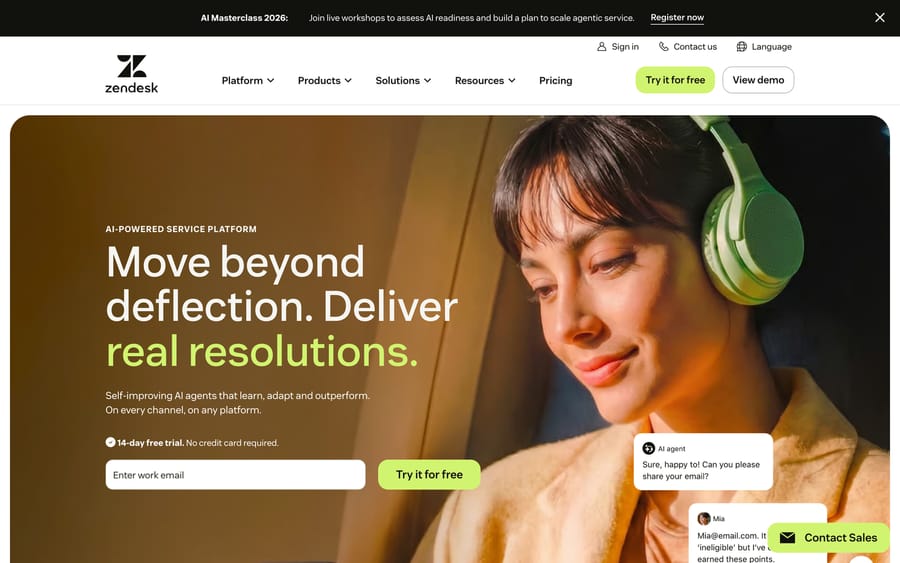
Freshworks' quick-to-deploy help desk with omnichannel ticketing, automation and the Freddy AI add-on. Growth is $19 an agent a month on annual billing, Pro $55 and Enterprise $89. Freddy AI Agent comes with 500 sessions as a one-time allowance per account, then $49 per 100 sessions. There's no longer a $15 standalone tier, and Freshdesk's free plan ended: the pricing page offers a 14-day trial, and a separate Free program covers up to 2 agents for 6 months. It suits cost-conscious teams wanting broad channel coverage. It isn't DTC-native, so you won't get order and refund context without building the Shopify integration yourself.
3. Help Scout, the simple, human-first inbox
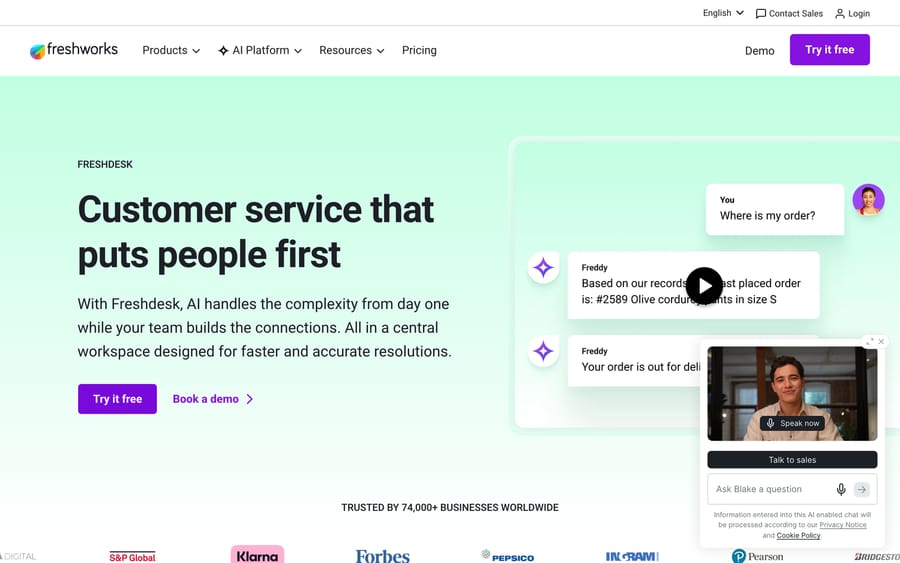
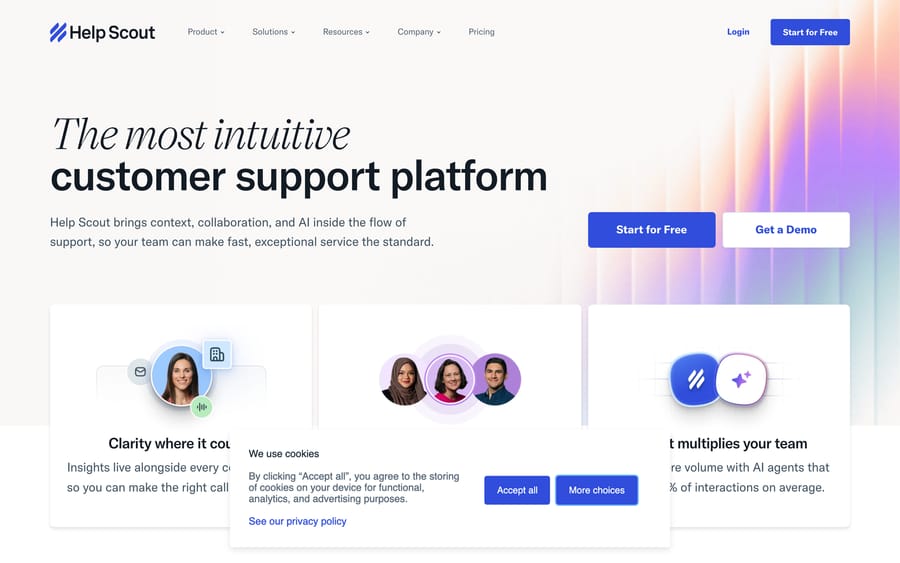
A conversation-style help desk built around a shared inbox, a Docs knowledge base and a help widget, with AI layered in. It hides the ticket machinery so the whole thing feels like email. There's a Free plan for 5 users with 1 inbox, 1 Docs site and 100 contacts a month, then Standard $25, Plus $45 and Pro $75 a user a month on annual billing, or $30, $54 and $90 monthly. AI Answers is $0.75 per resolution. It suits small DTC and services teams that find ticketing tools heavy. It's lighter on ecommerce depth, so it fits brands whose support is more conversational than order-ops.
4. Re:amaze, the closest Shopify-native like-for-like
A Shopify-focused help desk with email, chat, social, FAQ and push campaigns, plus order lookups, returns and customer data in the inbox. Basic is $29 a team member a month, Pro $49 and Plus $69, each 10% cheaper on annual billing at $26.10, $44.10 and $62.10. The flat $59 Starter is still there and now carries a cap the older listings miss: it's "all of the features in Basic for unlimited team members. Limited to 500 Responded Conversations per month."
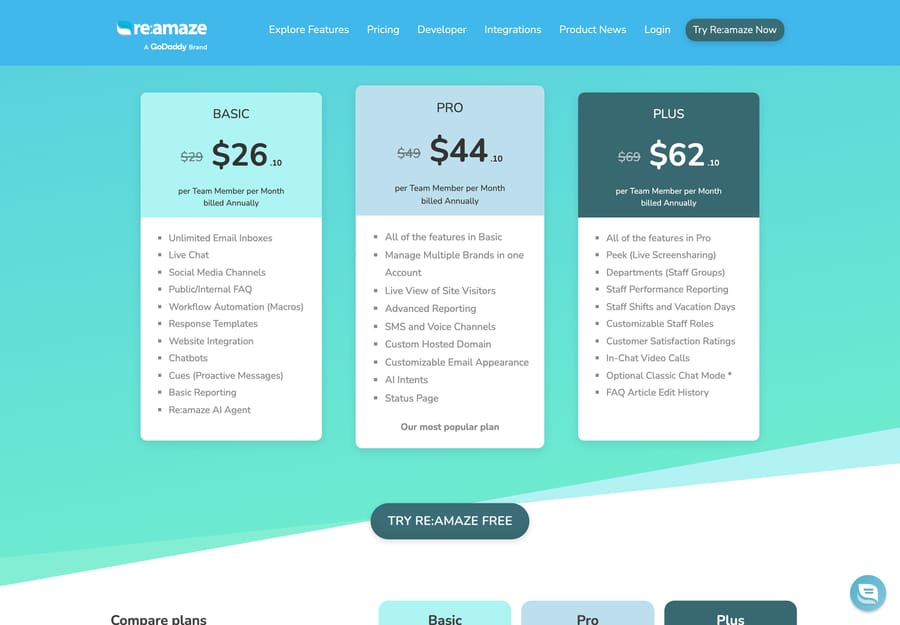
It's the most direct swap here: similar Shopify integration and inbox feel, priced per seat or flat instead of per ticket. SMS and voice run through Twilio and Aircall at their own rates. The trade-off is a smaller ecosystem and less polished AI than Gorgias's newer Agent.
5. Richpanel, the self-service-first help desk
An ecommerce help desk built around a portal that lets shoppers track orders, start returns and resolve common issues without an agent. The structure changed this year: the Help Desk is Pro $69 and Pro Max $99 an agent a month with an Enterprise tier, and the Self-Service Portal is sold separately with a $0 plan up to 50 orders a month and a $50 plan up to 500. The page also says "All subscriptions are on yearly contracts," which is the detail to check before you commit.
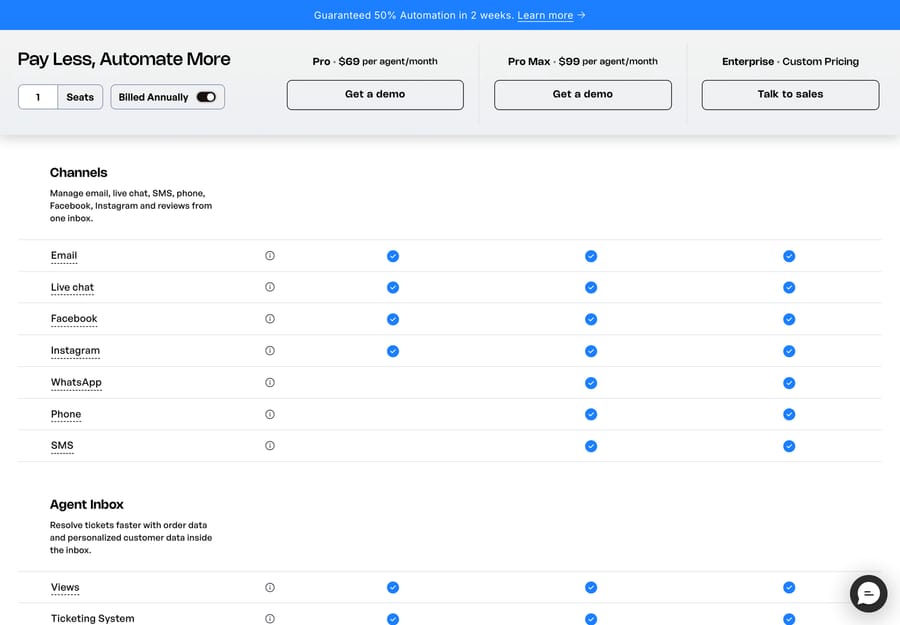
It suits DTC brands whose inbox is mostly repeat WISMO and returns questions. The watch-out is that the portal and the desk are two purchases, so model the total before assuming it beats Gorgias.
6. eDesk, the multichannel marketplace specialist
Built for marketplace sellers: native connections to Amazon, eBay, Walmart and Shopify, pulling messages and full order data into one inbox. Essential is $39 a user a month, Growth $89 and Professional $119, and its AI works differently from everyone else here. In eDesk's own words, "AI Agent is included everywhere, you only pay $0.99 per outcome it resolves."
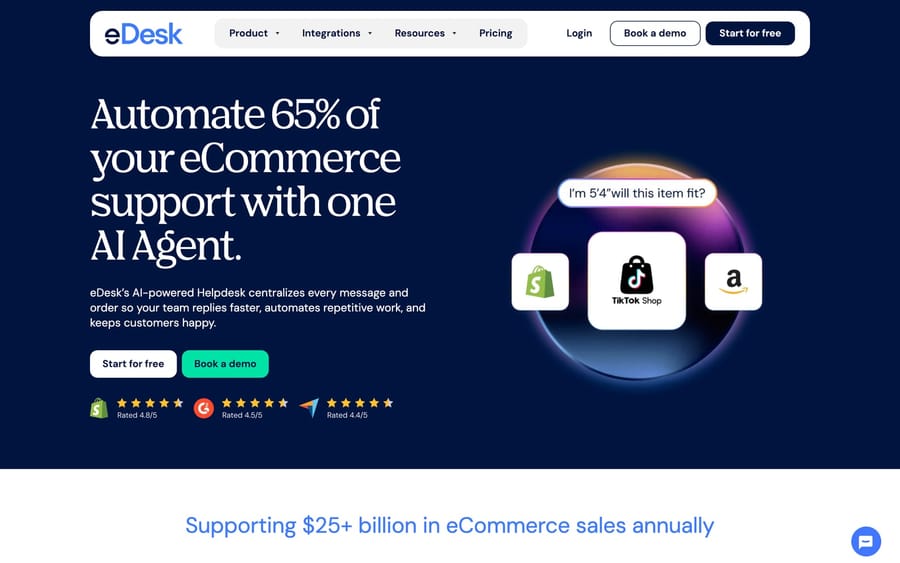
It suits brands selling across marketplaces as well as their own store. The recurring complaint in reviews is that annual price increases are hard to justify.
7. Kustomer, the relationship-led CRM platform
A customer-service CRM that organizes support around a single real-time customer timeline, including orders, conversations, loyalty and shipping, in place of a ticket built around the latest order. Its pricing page renders in JavaScript we couldn't read on September 20, 2026, so the figures we have are from June 2026: per user, annual, 8-seat minimum, Enterprise $89 and Ultimate $139 a user a month, with AI as an add-on. Treat those as indicative and get a quote.
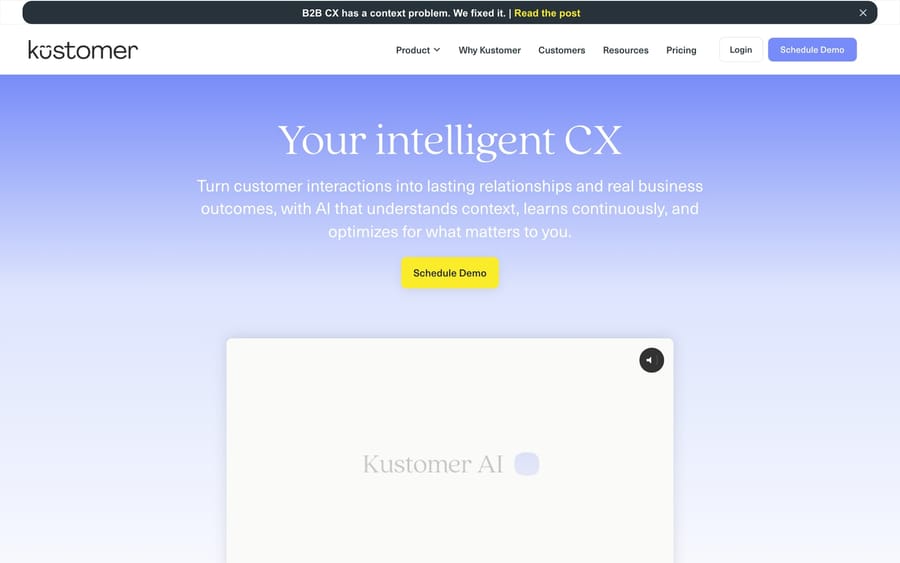
It suits mid-market DTC brands doing relationship-led, high-LTV support. The floor is high and there's more setup than a plug-and-play Shopify desk.
8. Gladly, the people-centered premium platform
A support platform without tickets: conversations are organized around the person across voice, chat, email and social. Its pricing is custom-only, and we couldn't re-read the page this round either, so the shape we have from June 2026 is a 10-agent minimum on annual contracts, with voice and SMS usage billed on top.
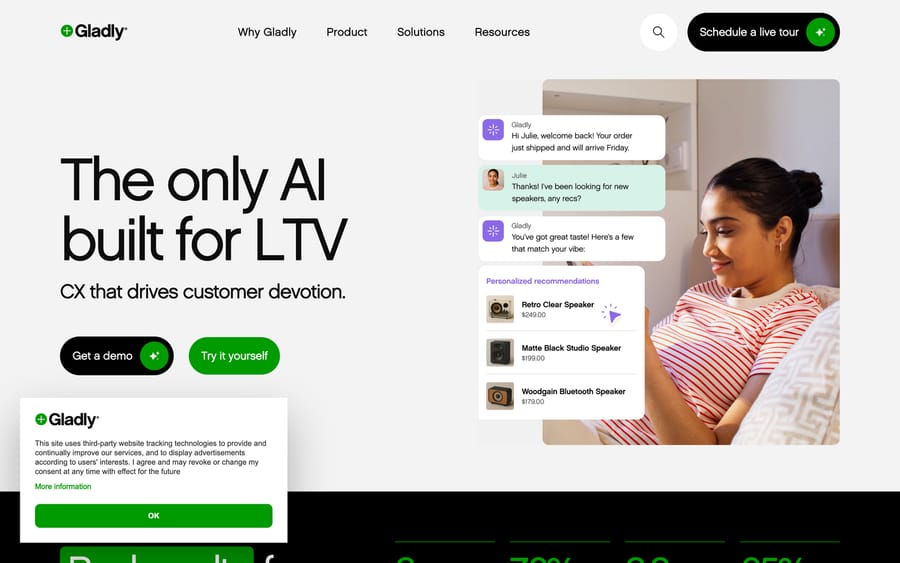
It suits premium, voice-heavy retail brands. It's a step up in cost and ambition from Gorgias, not a cheaper escape hatch.
9. Tidio and Crisp, the chat-first budget picks
Two lightweight, chat-led tools. Tidio pairs live chat with its Lyro AI agent and ecommerce automations: Free with 50 billable conversations a month, Starter $24.17, Growth from $49.17, Plus from $300 a month plus usage. Crisp is a shared inbox and chatbot platform priced flat per workspace: Free forever with 2 seats, then Mini $45, Essentials $95 and Plus $295 a month.
Both are much cheaper and faster to stand up than a full ecommerce desk, and neither has Gorgias's order-ops tooling. Crisp's flat model is the one that scales best for a growing team, because adding people doesn't change the bill. We go deeper on both in our free live chat roundup.
Where does an AI agent layer fit, including on Gorgias?
The disclosure again, and a correction to an earlier version of this page: we make Macha, and it does integrate with Gorgias.
Macha is an AI agent layer that runs on top of the help desk you already have, Gorgias included. It reads the customer's actual question, pulls from your connected order data and help center, resolves routine tickets inside your existing workflow, and hands off to a human with full context when it isn't confident. It runs on Zendesk, Freshdesk, Gorgias, Front, HubSpot or Intercom, so it survives a migration if you make one.
The billing unit is the thing worth comparing here. Macha is one plan priced on monthly ticket volume, from $299 a month for 750 tickets, about $0.40 a ticket at every tier, with one charge per thread however many replies it takes. Set that against Gorgias's two meters, a per-ticket plan fee plus $1.50 per automated interaction past the allowance, and the arithmetic is different in a way worth doing on your own numbers. Setup and monitoring by our team are included on every plan.
It suits teams already running Zendesk, Freshdesk, Gorgias, Front, HubSpot or Intercom who want agents acting inside the ticket. It's the wrong choice if your problem is the help desk itself, because a layer won't fix a platform you've outgrown. There's $50 of free usage to try it, no credit card, the pricing page has the full table, and Macha on Gorgias covers the integration.
What do real users say about Gorgias?
Ratings give you the average; reviews give you the why. The consistent praise is ease of use and the Shopify integration, and the consistent criticism clusters on cost, especially overages during seasonal spikes, reporting depth and AI accuracy. An attributed Capterra review from March 2026 captures both halves:
"The pricing model fits a collaborative business environment, because charging per ticket instead of per user allowed nearly everyone in our company to use it freely without worrying about seat limits." (Frank A., Head of Digital, Business Supplies and Equipment, Capterra, March 2026)
Unlimited seats is the genuine upside of the model. The flip side is in the same sentence: when volume is your cost driver instead of headcount, a busy month is an expensive one.
How do you choose the right Gorgias alternative?
- Name your real reason for leaving. Unpredictable cost points to a per-seat tool: Re:amaze, Zendesk, Freshdesk, Help Scout. A relationship model points to Kustomer or Gladly. Marketplaces point to eDesk. Deflection points to Richpanel.
- Check whether you need to leave at all. If the complaint is the AI meter and the desk is fine, you can switch the AI Agent off and pay the helpdesk-only price, or put an agent layer on top of Gorgias to change the unit without a migration.
- Model the total at your peak month, not your average. Gorgias taught everyone this. For per-ticket tools, project your busiest month's tickets and automated interactions. For per-seat tools, count seats and add-ons: Richpanel's portal, Re:amaze's Twilio and Aircall usage, Kustomer's minimum.
- Read the cap under the flat rate. Re:amaze's $59 unlimited-seat plan stops at 500 responded conversations a month, and Richpanel's contracts are yearly. Flat pricing usually has a shape.
- Weigh migration cost honestly. Moving help desks means data migration, retraining and rebuilt Shopify workflows. Worth it for a structural problem, overkill for one feature gap.
- Pilot on a real slice of your queue, across a normal week and a busy one, and measure resolution rate, CSAT and cost per resolution against your Gorgias baseline.
Frequently asked questions
Is there a free alternative to Gorgias? Not a like-for-like one. Chatwoot is free to self-host and gives you a shared inbox, live chat and a help center with no seat cap; its cloud free plan is 2 agents and 500 conversations a month. Crisp Free is 2 seats, Tidio Free is 50 conversations a month, and Help Scout Free is 5 users with no live chat. None of them pulls Shopify order data into the conversation the way Gorgias does.
What is the cheapest alternative to Gorgias? For a small store, Re:amaze's $59 flat plan covers unlimited team members up to 500 responded conversations a month, which is the best value here if your volume fits. Below that, Tidio Free and Crisp Free cost nothing, and Crisp Mini at $45 a month covers 4 seats. Freshdesk at $19 an agent and Help Scout at $25 a user are the cheapest general-purpose desks.
How much does Gorgias cost in 2026? Starter is $40 a month for 50 tickets and 30 automated interactions, monthly billing only, or $10 for the helpdesk without the AI Agent. Basic is $90 a month or $77 on annual for 300 tickets, Pro $550 or $471 for 2,000, and Advanced $1,430 or $1,227 for 5,000. Overage is $0.40 a ticket on the lower two plans and $0.36 on the upper two, and automated interactions past your allowance are $1.50 each.
What is the closest alternative to Gorgias for Shopify? Re:amaze. It has the same Shopify integration shape, order lookups and returns in the inbox, and the same conversational feel, priced per seat at $26.10 to $62.10 a month on annual billing or flat at $59 for unlimited seats up to 500 conversations.
Does Macha work with Gorgias? Yes. Macha is an AI agent layer that runs on top of Zendesk, Freshdesk, Gorgias, Front, HubSpot or Intercom. An earlier version of this guide said it didn't support Gorgias, which was wrong. It isn't a Gorgias replacement; it resolves routine tickets inside the desk you already run, priced per ticket at about $0.40 instead of per automated interaction.
Can I cut my Gorgias bill without switching? Often, yes, and it's the cheaper experiment. Start with the pricing toggle: Gorgias sells the helpdesk without the AI Agent from $10 a month. Deflection is the next lever: Richpanel's self-service portal has a $0 tier and sits on top of Gorgias, and an agent layer changes the unit you pay for. Both are reversible in a way a migration isn't.
Which Gorgias alternative is best for Amazon and eBay sellers? eDesk, at $39 to $119 a user a month, with native connections to Amazon, eBay and Walmart alongside Shopify. Its AI Agent is included on every plan and billed at $0.99 per outcome it resolves.
Is Re:amaze cheaper than Gorgias? At low volume with several agents, usually. Five agents on Re:amaze Basic is $130.50 a month on annual billing, or $59 flat if you stay under 500 responded conversations. Five agents on Gorgias is whatever your ticket volume costs, which at 300 tickets is $77 a month and at 2,000 is $471.
So which Gorgias alternative should you pick?
The best Gorgias alternative is the one that fixes your specific reason for looking. Re:amaze is the closest Shopify-native swap and the cheapest at low volume. Zendesk is the deepest upgrade, Freshdesk the budget omnichannel pick, Help Scout the simplicity choice, eDesk the marketplace specialist, Richpanel the deflection-first option with a free portal, and Kustomer and Gladly the relationship-led premium platforms. Chatwoot, Crisp and Tidio are what $0 actually buys. Decide whether your problem is volume-based cost, channel mix or a relationship model, model the total at your busiest month, and check whether a layer on top of Gorgias solves it before you migrate anything.
Sources: Gorgias pricing, Re:amaze pricing, Richpanel pricing, eDesk pricing, Freshdesk pricing, Help Scout pricing, Zendesk pricing, Crisp pricing, Tidio pricing, Chatwoot pricing, all read 2026-09-20 (Gorgias, Freshdesk and Re:amaze re-read 2026-09-24); Zendesk on outcome-based pricing; r/shopify, "Cheaper alternative to Gorgias?" and "Gorgias Alternative".
Add AI agents to your Gorgias
Macha reads the ticket, drafts the reply and takes the action, inside the Gorgias you already run.