Intercom
 Shopify
 Stripe
 Slack
Slack Notion
 Google Workspace
 Confluence

Is Gorgias a CRM? No, Here's What It Is Instead (2026)


No, Gorgias is not a CRM. It is an ecommerce help desk that resolves support tickets across email, chat, SMS and social with Shopify order data in the ticket, and it sits next to a CRM such as HubSpot or Salesforce rather than replacing one.
Key takeaways
- Gorgias is an ecommerce help desk, not a CRM, because it has no sales pipeline, deal stages, lead scoring or revenue forecasting.
- The Gorgias ticket sidebar shows only the 10 most recent Shopify orders for a customer, alongside tags, notes and lifetime spend pulled from Shopify.
- Gorgias agents can create, duplicate, cancel or refund a Shopify order and edit its shipping address without opening the Shopify admin.
- Gorgias and Klaviyo sync both ways, so agents see Klaviyo segments and lists in the ticket and brands can pause flows for customers with open tickets.
- HubSpot contact data reaches Gorgias through a partner-built HTTP integration, while Salesforce connects through tools like Zapier or custom API work.

No, Gorgias is not a CRM: it's an ecommerce help desk built around support tickets, with no sales pipeline, deal stages, lead scoring or revenue forecasting. It does keep a customer record beside each ticket, including the 10 most recent Shopify orders in the sidebar, which is why some buyers call it a "support CRM." Here's how the two categories split:
| CRM (e.g. Salesforce, HubSpot) | Help desk (e.g. Gorgias) | |
|---|---|---|
| Primary job | Win and grow revenue (sales/marketing) | Resolve customer issues (support) |
| Core object | Leads, contacts, deals, pipeline | Tickets / conversations |
| Used mainly by | Sales & marketing teams | Support / customer service teams |
| Signature features | Pipeline & deal management, lead scoring, sales sequences, forecasting | Ticketing, omnichannel inbox, macros, automation, help center, CSAT |
| Key question | "Where is this deal in the funnel?" | "How do we resolve this issue fast?" |
| In an ecommerce stack | HubSpot / Salesforce (sales); Klaviyo (marketing) | Gorgias |
The confusion is understandable, because Gorgias does store a rich customer record (profiles, tags, lifetime spend, order history), and some buyers loosely call any tool with a customer sidebar a CRM. The sections below cover what separates a CRM from a help desk, what customer data Gorgias stores, where its CRM-like features stop, and how it connects to Shopify, Klaviyo and a sales CRM. Facts were checked against Gorgias's own product pages and help docs on 24 September 2026.
Byline: Written by Abbas — operator at Macha, working at the intersection of customer support and AI (LinkedIn). Reviewed by Ankeet Guha, co-founder. Published June 21, 2026 · Last updated September 24, 2026.
CRM vs. help desk: what's the actual difference?
These two categories overlap just enough to be confusing, so it's worth pinning down precisely (the table above has the short version).
A CRM (customer relationship management) system manages the commercial relationship — mostly sales, and sometimes marketing. Its job is to move people from prospect to customer and grow the account over time. The core objects are leads, contacts, accounts, deals, and pipelines, and the core features are pipeline/deal tracking, lead scoring, sales sequences, revenue forecasting, and (in marketing-flavored tools) automated campaigns. The question a CRM answers is: "Where is this relationship in our funnel, and what do we do next to win or grow it?"
A help desk (also called customer support or service software) manages the support relationship — what happens after someone is already a customer, or is asking a pre-sales question. Its core object is the ticket: a single customer issue, with its conversation, status, priority, and assignment. Its core features are ticketing, omnichannel inboxes (email, chat, SMS, social), automation/routing, macros, a help center, and CSAT reporting. The question a help desk answers is: "What does this customer need help with right now, and how fast can we resolve it?"
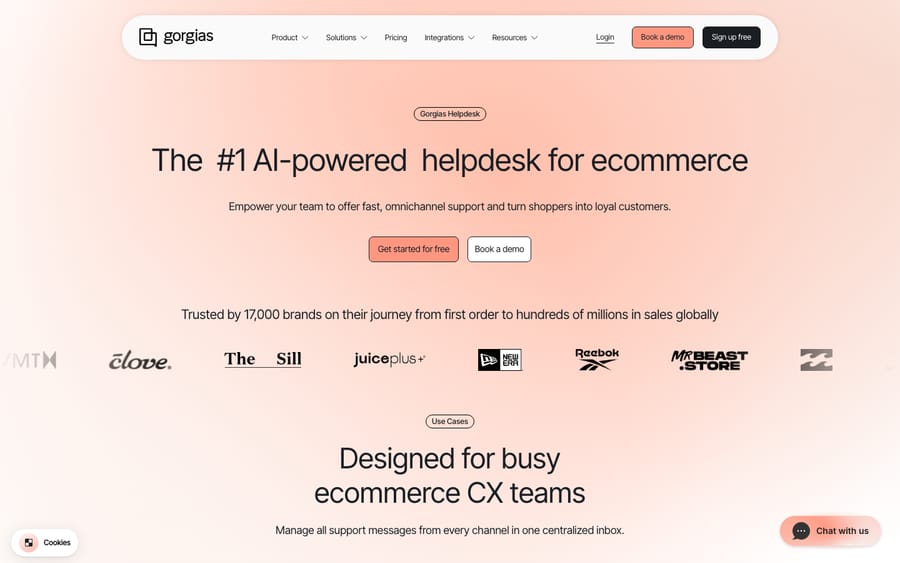
Gorgias lives entirely in the right-hand column. Gorgias titles its help desk page "The Leading Customer Support Helpdesk for Ecommerce," and its homepage title is now "The Conversational AI platform for Ecommerce." Both are support categories, not sales-CRM ones (Gorgias help desk, checked 24 September 2026). It has no sales pipeline, no deal stages, no lead scoring, and no revenue forecasting — because those aren't a support tool's job.
What customer data does Gorgias store, and why do people think it's a CRM?
This is the root of the confusion. Gorgias isn't only a list of tickets — it keeps a genuinely useful customer record alongside each conversation. When a shopper messages you, the ticket sidebar pulls together (Gorgias + Shopify integration):
- Customer profiles — contact details (name, email, phone), with tags and internal notes you can automate against.
- Order history — pulled live from Shopify: order status, line items, shipping, subscriptions, and lifetime spend, all visible without leaving the ticket. (Gorgias's Shopify FAQ says the sidebar shows only the 10 most recent orders. On connection, Gorgias imports Shopify customer profiles and order history in the background; its setup doc doesn't state a lookback window.)
- Conversation history — every past support interaction across email, chat, SMS, and social, in one timeline.
Agents can also act on that data (create, duplicate, cancel or refund an order, or edit its shipping address) without opening the Shopify admin (Gorgias; see also eesel: Gorgias side panel for Shopify data). So Gorgias really does store contacts, order context, lifetime value, and a full interaction history — which looks a lot like the customer database at the heart of a CRM.
It's the same impulse that leads people to call any tool with a customer list a "CRM." But holding customer data is necessary for a CRM, not sufficient. What makes a CRM a CRM is the sales-and-relationship machinery built on top of those records — pipelines, deals, scoring, forecasting, lifecycle ownership — and that's exactly what Gorgias doesn't have. Most of the data in Gorgias's sidebar isn't even Gorgias's own: it's read from Shopify, the actual system of record. We unpack the full feature set in What is Gorgias?.
A note on the "support CRM" label
You'll occasionally see Gorgias described as a "support CRM" or "ecommerce CRM." Don't let it throw you. That phrasing uses "CRM" in its loosest possible sense ("software that touches customer relationships"), not in the standard sales/marketing sense the word almost always means. When a buyer asks "is Gorgias a CRM?" they're usually really asking one of two things — "can it run my sales pipeline?" or "can it run my marketing flows?" — and the honest answer to both is no. Gorgias is a help desk that keeps customer context, not a CRM.
How do Gorgias's CRM-like features compare with a real CRM?
Let's be fair to Gorgias: it has features that overlap with a CRM, especially for support-led customer context. Here's where the line actually falls.
What Gorgias gives you (CRM-adjacent):
- A searchable directory of customer profiles with tags, notes, and contact info.
- Full order and interaction history per customer, with lifetime spend surfaced beside the ticket.
- Support-driven revenue tracking — attributing sales that originate from support conversations (chat, proactive campaigns).
- Customer segmentation and automation built on tags and order attributes.
What Gorgias does not do (and a CRM does):
- Sales pipeline & deal management — no leads, deals, opportunities, or stages.
- Lead capture, scoring, and routing — no ranking prospects by likelihood to close.
- Sales sequences / cadences — no automated multi-step sales outreach.
- Revenue forecasting — no projecting pipeline into expected revenue.
- Marketing automation — no nurture campaigns or lifecycle email/SMS flows (that's Klaviyo's job in ecommerce).
- A cross-team system of record — Gorgias isn't the single source of truth for sales, marketing, and service.
Independent reviewers land in the same place: "No, Gorgias is not a CRM tool. It's an ecommerce helpdesk" — it manages support conversations, not the full customer relationship lifecycle (Ringly: Is Gorgias a CRM tool?). The practical takeaway: Gorgias can tell you everything a customer has ever ordered and asked support, but nothing about where they sit in your sales funnel.
How does Gorgias work with Shopify, Klaviyo, and a CRM?
Here's where it clicks into place. In a real ecommerce stack, the customer record is shared across several specialized tools, and Gorgias is one of them — the support layer. The clearest sign Gorgias is built to sit next to a CRM rather than be one is that it integrates with CRMs (Ringly). The typical division of labor for a growing Shopify brand:
- Shopify — the system of record. This is where customers, orders, products, and lifetime spend actually live. Gorgias reads from Shopify and writes actions back to it (refunds, cancellations, address edits), but Shopify owns the data.
- Klaviyo — the marketing "CRM." When ecommerce people say "CRM," they often mean their email/SMS marketing platform. Klaviyo runs the lifecycle flows (welcome, abandoned cart, post-purchase, win-back). Gorgias and Klaviyo sync both ways: agents see a customer's Klaviyo email, phone, segments and lists inside Gorgias, Klaviyo SMS and email replies land in Gorgias, and brands can pause Klaviyo flows for customers with open tickets (Klaviyo and Gorgias integration).
- HubSpot or Salesforce: the sales CRM. Brands with a real B2B or wholesale motion run a true sales CRM. The connection is lighter than the Shopify one. HubSpot contact data reaches the Gorgias sidebar through a partner-built HTTP integration you configure with a HubSpot private app token (Gorgias docs). Salesforce has no native Gorgias app we could find; teams connect it through tools like Zapier or custom API work (eesel). Either way the pipeline stays in the CRM.
- Gorgias — the support layer. It unifies the conversations and gives agents the full picture, pulling the other systems' data into one ticket view.
The pattern in all of these: each tool owns its own job, and integrations keep the shared customer record consistent across them. That's the architecture to aim for — specialized tools, synced — rather than stretching one tool to do everything. Most DTC brands run Shopify + Klaviyo + Gorgias and only add a standalone sales CRM when they start running real B2B sales.
Do you need a help desk, a CRM, or both?
Most growing ecommerce companies eventually need several of these — but not all at once, and not for the same reason. Use this to decide:
- You need a help desk (Gorgias) if your bottleneck is support volume: tickets piling up across email, chat, SMS, and Instagram; slow response times; agents toggling between Shopify and the inbox; no shared queue or macros. This is a "we can't keep up with customer questions" problem.
- You need a marketing platform (Klaviyo) if your bottleneck is retention and repeat purchases: no automated email/SMS flows, no segmentation, no campaigns. This is the "ecommerce CRM" most DTC brands actually mean.
- You need a sales CRM (HubSpot / Salesforce) if you run a real sales motion — wholesale, B2B, or high-touch accounts — and leads or deals are slipping with no pipeline view or forecasting.
- You need more than one if you're doing serious support and marketing and (sometimes) sales — which most scaling brands are. The win is a single, shared view of each customer across the tools.
A useful rule: don't try to force a help desk to run your sales pipeline or your marketing flows, and don't try to force a CRM to be your support inbox. Each is mediocre at the other's job. Pick the tool that matches your actual bottleneck first, then connect the others as you grow.
Where does an AI agent layer fit next to Gorgias?
One more nuance worth knowing. Whether you run Gorgias alone or Gorgias plus Klaviyo and a CRM, a big share of your support tickets are repetitive questions — "where's my order," "how do I start a return," "do you ship to X" — that your policies and order data could already answer. That's exactly the work a dedicated AI agent layer is built for.
Macha is one such layer, though worth being upfront: it runs on top of Zendesk, Freshdesk, Gorgias, Front, HubSpot or Intercom, and it's ours. The idea is the same one that matters here: it isn't a help desk and it isn't a CRM. It reads the customer's actual question, draws on your connected knowledge and conversation history, resolves the issue in the same thread, and hands off to a human with full context when it isn't confident. Like any integration, it's another thing to configure and only as good as the knowledge you connect it to — but if your ticket mix is mostly repetitive questions, that's where native help-desk automation tends to stop scaling. On a supported help desk you can try it free: $50 of free usage, no credit card, no time limit. (To be clear: this doesn't make any help desk a CRM, and an AI layer doesn't replace one either — it just resolves support faster.)
Frequently asked questions
Is Gorgias a CRM? No. Gorgias is an ecommerce help desk — a customer support platform built around tickets and conversations. It stores customer profiles, tags, order history, and lifetime spend, but it has no sales pipeline, deal management, lead scoring, or forecasting — the features that define a CRM. It's built to integrate with CRMs, not be one.
Why do people call Gorgias a "support CRM"? Because "CRM" gets used loosely to mean "any software that manages customer relationships." Gorgias's customer-context sidebar — profiles, order history, lifetime spend — feels CRM-like. But in the standard (sales/marketing) meaning of CRM, Gorgias isn't one; it's a support tool that keeps customer context.
What customer data does Gorgias store? Customer profiles (name, email, phone), tags and internal notes, full conversation history, and Shopify-sourced order data (order status, subscriptions, shipping, and lifetime spend, with the 10 most recent orders in the sidebar) surfaced in the ticket. Note that much of the order data is read live from Shopify, which remains the actual system of record.
Is Klaviyo the CRM for Gorgias? In ecommerce, Klaviyo is the closest thing most brands have to a "CRM," but it's really a marketing automation platform (email/SMS lifecycle flows). Gorgias and Klaviyo integrate two-way so profile attributes sync between them, but they do different jobs: Klaviyo markets, Gorgias supports.
Can I connect Gorgias to a CRM like Salesforce or HubSpot? Yes, with some setup. HubSpot contact data can appear in the Gorgias sidebar through a partner-built HTTP integration, and Salesforce connects through iPaaS tools such as Zapier or custom API work. The pipeline itself stays in the CRM; Gorgias only shows the relevant record next to the conversation.
Do I need a help desk or a CRM? Depends on your bottleneck. If support volume is overwhelming you, you need a help desk (Gorgias). If repeat purchases and retention are the gap, you need a marketing platform (Klaviyo). If sales leads and deals are slipping, you need a sales CRM. Scaling brands often run all three, integrated.
So should you treat Gorgias as your CRM?
No. Gorgias is an ecommerce help desk, not a CRM. It's customer-support software — omnichannel tickets, macros, automation, a help center, and an order-aware customer sidebar — and while it stores profiles, order history, and lifetime spend (which is why people mistake it for a CRM), it has none of the sales machinery (pipelines, deals, lead scoring, forecasting) that defines an actual CRM, and none of the marketing automation that ecommerce brands usually mean by "CRM." Those roles belong to other tools: Shopify owns the customer and order records, Klaviyo runs marketing, and HubSpot or Salesforce runs sales — all of which Gorgias integrates with rather than replaces. If your problem is support volume, get a help desk; if it's retention, get a marketing platform; if it's sales pipeline, get a CRM; if it's all of them, run them together and connect them. Untangle the categories once, and the question stops being confusing: Gorgias handles the support relationship, a CRM handles the sales one.
Verified against Gorgias's official product pages, help docs and third-party sources, 24 September 2026. Gorgias revises product packaging, integrations, and pricing periodically — confirm current details on gorgias.com before relying on them.
Add AI agents to your Gorgias
Macha reads the ticket, drafts the reply and takes the action, inside the Gorgias you already run.