Intercom
 Shopify
 Stripe
 Slack
Slack Notion
 Google Workspace
 Confluence

What Is Gorgias as a Customer Service Platform? Features, Pricing and Fit (2026)


Gorgias is a customer service platform built only for ecommerce, with one inbox for every channel, Shopify order actions inside each ticket and an AI Agent, priced by ticket from $10 a month. It suits online stores whose tickets are mostly about orders, and the costs stack up as ticket and AI volume grow.
Key takeaways
- Gorgias is an ecommerce-only customer service platform that lets agents refund, edit, cancel and manage subscriptions on Shopify orders without leaving the ticket.
- Gorgias prices by ticket, from $10 a month for 50 tickets on Starter to $900 a month for 5,000 tickets on Advanced, with Enterprise custom.
- Gorgias sells its AI Agent as bundles, such as $190 for 190 automated interactions on Pro, and charges $1.50 for each interaction past the bundle.
- An AI-resolved Gorgias conversation counts as a billable ticket and as an automated interaction, so a Pro brand with 500 AI resolutions pays about $1,015 a month.
- Gorgias attributes a sale to support when the customer orders within three days of creating the ticket, a window shortened in January 2025.

Gorgias is a customer service platform built only for ecommerce: one inbox for email, chat, SMS, social, WhatsApp and voice, with Shopify order actions (refunds, edits, cancellations, subscriptions) inside each ticket, an AI Agent, and revenue reporting, priced by ticket from $10 a month for 50 tickets. It's excellent for online stores whose tickets are mostly about orders, and a poor fit for anyone else. If you just want the definition, start with what is Gorgias; this piece goes a level deeper into Gorgias as an operating platform. Pricing and plan details below were re-checked against gorgias.com on 24 September 2026.
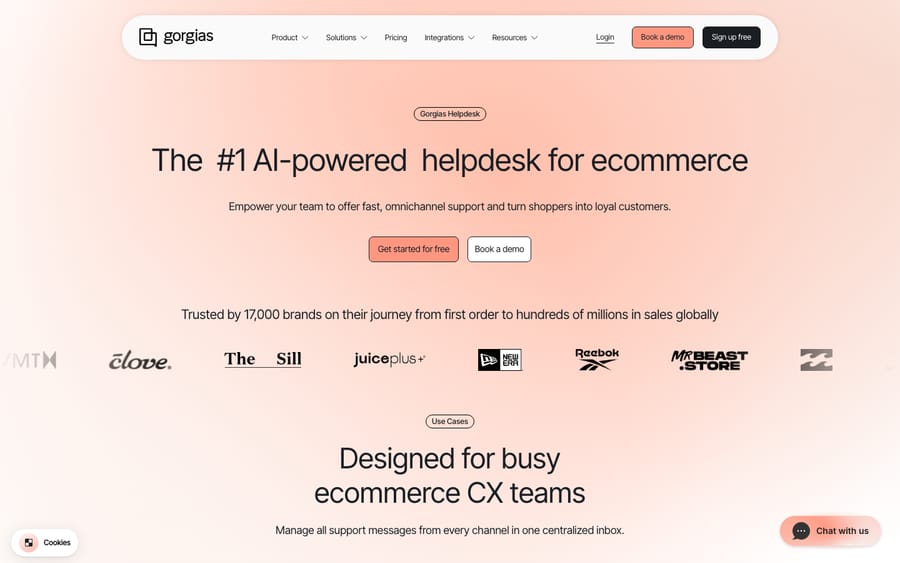
What is Gorgias, in 30 seconds?
| Dimension | What Gorgias is |
|---|---|
| Category | Ecommerce-native help desk / CX platform |
| Best fit | Shopify, BigCommerce, Magento, WooCommerce brands |
| Channels | Email, live chat, SMS, social, WhatsApp, voice |
| Signature strength | Order context + actions (refunds, edits, subscriptions) inside the ticket |
| Automation | Macros, a rules engine, and an autonomous AI Agent |
| Pricing model | Per billable ticket, not per agent: 3 user seats on Starter, 500 on Basic and above |
| Honest limit | Ecommerce-only fit; ticket and AI fees stack at scale |
How does the Gorgias inbox work?
The foundation is a single inbox that pulls every customer conversation into one place: email, live chat, SMS, social media (Instagram, Facebook, TikTok), WhatsApp and voice. Instead of agents bouncing between the Shopify admin, an email client and Instagram DMs, every message lands in the same queue with the same tools beside it.
What makes the inbox feel like a platform rather than a shared mailbox is the context panel. Next to each ticket, Gorgias shows the customer's order history, fulfillment status, lifetime value and recent activity, so an agent can answer "where's my order?" without leaving the conversation. Seats aren't what you pay for: Starter includes 3 user seats and every plan above it includes 500, because the price is set by tickets (more on that below).
What can agents do with Shopify orders inside a ticket?
This is the heart of the bet. Plenty of help desks can show order data; Gorgias lets agents act on it from inside the ticket. Through its two-way Shopify integration, an agent can:
- Issue a full or partial refund
- Edit or cancel an order before it ships
- Manage subscriptions (pause, skip, swap, cancel)
- Apply a discount or duplicate an order
- See and edit shipping and customer details
No tab-switching and no pasting order numbers into the Shopify admin. For a DTC team where most tickets are about orders, this cuts handle time on the most common requests. Gorgias also connects to BigCommerce, Magento and WooCommerce, plus 150+ apps across reviews, loyalty, returns and shipping, so the order panel can also show returns status (Loop, AfterShip) or loyalty points (Yotpo, LoyaltyLion).
How do macros and rules automate routine tickets?
Before any AI enters the picture, Gorgias automates a lot through two older, reliable mechanisms.
Macros are saved replies that carry dynamic variables (customer name, order number, tracking link) and perform actions such as applying tags, changing status or triggering an integration step, in one click. A "where is my order" macro pulls the live tracking link and closes the ticket.
Rules are the if-this-then-that engine. Incoming messages can be auto-tagged, prioritized, assigned to the right agent or team, or auto-answered based on conditions you set (channel, keywords, customer attributes, order value). Together, macros and rules handle a large share of routine volume deterministically, with no model involved, which many ops leads still prefer for high-stakes flows.
What does the Gorgias AI Agent do?
On top of macros and rules sits the Gorgias AI Agent, which resolves conversations end to end, 24/7, rather than just suggesting a reply. It reads the question, pulls from your help center and policies, and can take the same order actions an agent would (tracking, address changes, returns, cancellations).
You choose a skill for the AI Agent. As a Support Agent, it resolves service issues; as a Shopping Assistant, it leans pre-sales, recommending products and surfacing offers. Gorgias markets up to ~60% of inquiries resolved without a human, but treat that as a ceiling. Independent reviewers and Gorgias's own case studies put real-world automation closer to ~26–56% (apparel brand Psycho Bunny reports roughly 26% of tickets resolved by the AI Agent), because deflection depends on your catalog, policies and ticket mix (independent Gorgias AI review). For configuration and pricing detail, see our Gorgias AI Agent explainer.
One billing detail surprises teams: Gorgias's billing docs say an AI-resolved conversation counts as a billable ticket and as an automated interaction. If the AI hands over to a human, only the ticket fee applies. So automation lowers labor cost but doesn't take the ticket off your meter.
Can Gorgias run proactive chat campaigns?
Yes. Light chat campaigns (triggered by page URL or time on page) are available on all plans, and the paid Convert add-on unlocks targeting on Shopify data such as cart value, purchase history and customer tags. The textbook example: a shopper with $150+ in their cart who shows exit intent gets a chat offering a free-shipping code. This is where the line between support tool and revenue tool blurs, which is the positioning Gorgias leans into.
How does Gorgias report on revenue and CSAT?
Gorgias covers the standard metrics: CSAT surveys, first response time, resolution time, volume by channel and tag, and agent performance. Its differentiated layer is revenue attribution, included on the Pro and Advanced plans.
Gorgias counts a ticket as converted if the customer places an order within three days of creating the ticket, then reports how much revenue support generated, which agents convert best and which channels drive the most sales. The window was cut to 3 days in January 2025 (from 5 for the Revenue Report and 7 for the Shopping Assistant). The Convert campaign report adds impressions, engagements, orders and revenue for proactive campaigns. For a CX leader arguing that support drives sales, built-in attribution is a strong card. Read it as directional, though: a purchase inside a 3-day window is correlation with a cutoff, not proof the ticket caused the sale.
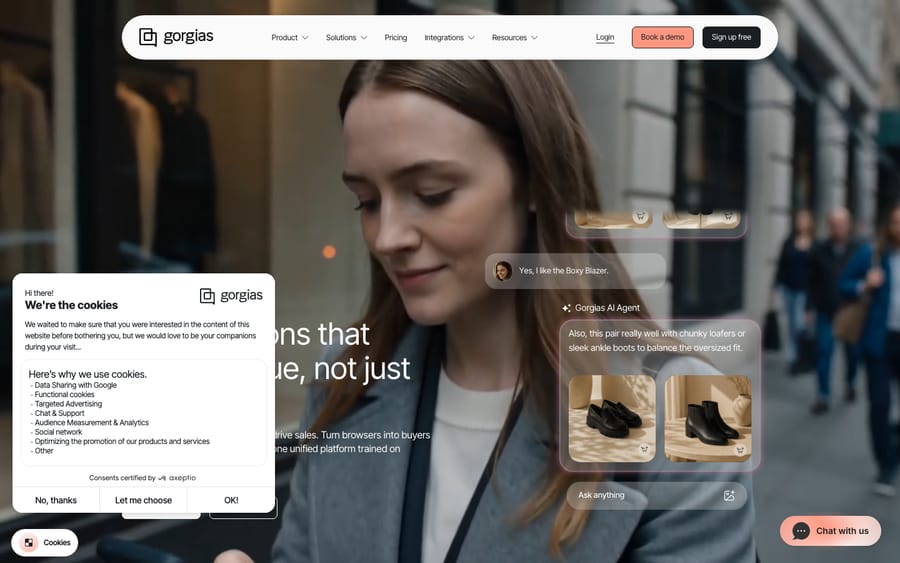
What does a day on Gorgias look like for a support team?
- Tickets arrive across email, chat, SMS and social into one inbox.
- Rules auto-tag and route: urgent shipping issues to the senior queue, pre-sales chat to the sales-minded agent.
- The AI Agent takes routine questions (tracking, returns, "did my order ship?") and resolves what it can.
- Agents handle the rest with order context and one-click macros, taking refund, edit and subscription actions without leaving the ticket.
- Convert campaigns engage high-intent shoppers in the widget.
- Analytics roll up CSAT, response times and the revenue support influenced.
Everything a store-support agent needs is one panel away, and that tightness is the point.
How much does Gorgias cost in 2026?
Gorgias bills by billable ticket, not by agent. From gorgias.com/pricing, 24 September 2026:
| Plan | Monthly | Annual (per month) | Tickets included | Overage | AI Agent bundle (monthly) |
|---|---|---|---|---|---|
| Starter | $10 | Monthly only | 50 | $0.40/ticket | $30 for 30 interactions |
| Basic | $60 | $50 | 300 | $0.40/ticket | $30 for 30 |
| Pro | $360 | $300 | 2,000 | $0.36/ticket | $190 for 190 |
| Advanced | $900 | $750 | 5,000 | $0.36/ticket | $530 for 530 |
| Enterprise | Custom | Custom | 5,000+ | Custom | Custom |
The AI Agent is sold as a bundle of automated interactions on top of the helpdesk plan (annual billing trims the bundles to $27, $171 and $477 on Basic, Pro and Advanced). Past the bundle, each automated interaction costs $1.50. An automated interaction is a ticket the AI fully resolves without a human within 72 hours. Voice and SMS are add-ons whose price scales with call and text volume; Gorgias doesn't publish those rates on the pricing page.
Here's what that means at a stated volume. A brand on Pro (monthly) handling 2,000 tickets, with the AI resolving 500 of them, pays $360 for the helpdesk, $190 for the 190-interaction bundle and 310 × $1.50 = $465 for the rest: $1,015 a month. Those 500 AI resolutions still count toward the 2,000 tickets. The per-ticket model rewards small, efficient teams and charges for raw volume, and the AI overage rate is higher than the bundle rate, which nudges you to buy the bigger bundle. Our Gorgias pricing breakdown does the full math, including where the bill starts to climb.
Is Gorgias secure and how long does onboarding take?
For teams that must clear a security review, Gorgias states it is SOC 2 Type II certified and complies with GDPR and CPRA, encrypting data in transit (TLS) and at rest and storing it in regional clusters (US, EU, Australia) (Gorgias Trust Center). SSO and audit logs sit on the higher plans. Gorgias also states that data used in AI Agent interactions is not used to train third-party language models, a question worth confirming for any AI help desk you evaluate.
A basic Shopify connection can be live in under an hour. A full multichannel rollout (email authentication, business hours, rules and AI configuration) realistically takes a few days to tune, and migrating historical tickets from another help desk like Zendesk adds time scaled to your data volume. Onboarding is self-serve on Starter and Basic, 1:1 on Pro and white-glove on Advanced.
Who is Gorgias a good fit for, and who should look elsewhere?
Gorgias fits if you are:
- A Shopify / BigCommerce / WooCommerce store where most tickets are about orders
- A team that wants agents (and AI) taking refund, edit and subscription actions in the ticket
- A brand that wants to tie support to revenue and run proactive campaigns
- A small or efficient team that benefits from pricing by ticket rather than by seat
Look elsewhere if you are:
- Not ecommerce. A SaaS, B2B or services company won't use the order-centric core.
- A very high-volume operation where per-ticket and per-interaction fees stack up
- A team needing deep ITSM, complex SLAs or general-purpose breadth beyond storefront support
That ecommerce focus is both the strength and the limit: Gorgias is excellent at the job it's built for and mostly irrelevant outside it.
What do Gorgias users say in reviews?
As read in June 2026, Gorgias held roughly 4.6/5 on G2 (around 550 reviews) and 4.6/5 on Capterra (130+ reviews), strong marks for the category. The praise and the gripes line up across both sites:
- On ecommerce fit (the praise): Reviewers single out the Shopify integration above everything else, with feedback along the lines of "the deep Shopify connection lets our team refund, edit, and track orders without ever leaving the ticket."
- On cost at scale (the watch-out): The most common complaint is price stacking: "between the per-ticket billing and the separate AI fee, the bill climbs faster than you expect as volume grows."
(Both quotes are paraphrased summaries of recurring review themes, not single attributed reviews.) The crowd lands on the same trade-off as this overview: excellent ecommerce fit, with cost discipline needed at scale.
Where do separate AI agent layers fit?
If you're evaluating Gorgias mainly for its AI, the wider market includes AI agent layers that sit on top of an existing help desk rather than replacing it. Our own product, Macha, is one: an AI agent layer for Zendesk, Freshdesk, Gorgias, Front, HubSpot or Intercom. To be clear: Macha is not a help desk and not a Gorgias alternative. If your store already runs on Gorgias, its native AI Agent is the obvious option to test first. Macha prices differently, per ticket on one plan from $299 a month for up to 750 tickets, with setup by the Macha team included. You can see how the layer works on Macha on Zendesk and start with $50 of free usage, no credit card required.
Frequently asked questions
Is Gorgias a full customer service platform or just a help desk? Both, for ecommerce. It covers the help-desk basics (multichannel inbox, macros, SLAs, CSAT) and adds what ecommerce teams need on top: store actions in the ticket, an autonomous AI Agent, proactive campaigns and revenue analytics.
What channels does Gorgias support? Email, live chat, SMS, social media (Instagram, Facebook, TikTok), WhatsApp and voice, all in one inbox. Voice and SMS are paid add-ons.
Does Gorgias work with platforms other than Shopify? Yes. The Shopify integration is the deepest, but Gorgias also connects to BigCommerce, Magento and WooCommerce, plus 150+ apps for returns, loyalty, reviews and shipping.
How is Gorgias priced? By billable ticket, not per agent. Plans run from $10/mo (50 tickets) to $900/mo (5,000 tickets) on monthly billing, with Enterprise custom. AI Agent bundles add $30 to $530 a month, and each automated interaction past the bundle costs $1.50. An AI-resolved conversation also counts as a billable ticket.
Can Gorgias's AI actually resolve tickets on its own? Yes. The AI Agent resolves conversations and takes order actions, not just drafts replies. Gorgias cites up to ~60% automated resolution; real results depend on your ticket mix and policies.
Is Gorgias good for non-ecommerce businesses? Generally no. Its core value is order context and store actions. SaaS, B2B and services teams will find a general-purpose help desk a better fit.
What should you model before choosing Gorgias?
Gorgias gives an online store everything it needs to run support and little it doesn't: the unified inbox, in-ticket Shopify actions, macros and rules, the AI Agent, proactive campaigns and revenue attribution. The trade-offs are just as clear. It's ecommerce-only by design, and ticket fees plus AI bundles and overage reward efficiency but get expensive at high volume. If you're a Shopify or DTC brand whose tickets are mostly about orders, Gorgias is one of the most complete platforms you can run. Before you commit, put your real monthly ticket count and expected AI resolutions into the pricing table above, the way the $1,015 Pro example does.
Add AI agents to your Gorgias
Macha reads the ticket, drafts the reply and takes the action, inside the Gorgias you already run.