Intercom
 Shopify
 Stripe
 Slack
Slack Notion
 Google Workspace
 Confluence

What Is Gorgias? The Ecommerce Help Desk, Its AI Agent and Pricing (2026)


Gorgias is a customer service help desk built for ecommerce, used mostly by Shopify brands, that puts order data and order actions inside every ticket. Plans are priced by ticket volume rather than per agent, and its AI Agent is billed on top per automated interaction.
Key takeaways
- Gorgias is an ecommerce help desk founded in 2015 that puts Shopify order data inside each ticket and prices plans by tickets, from $10 a month for 50 tickets.
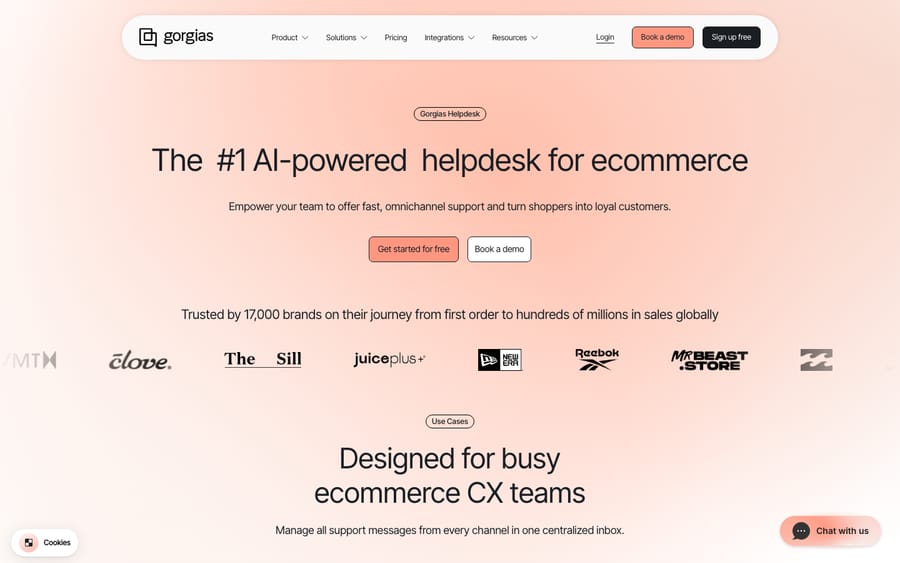
- Gorgias says it powers 17,000+ ecommerce brands and customer conversations for 40% of Shopify brands, which are the company's own homepage claims.
- Gorgias Pro costs $360 a month for 2,000 tickets on monthly billing, with overage of $0.36 per extra ticket past the allowance.
- The Gorgias AI Agent costs about $1.00 per automated interaction on monthly billing and $1.50 per interaction past the prepaid block.
- Gorgias bills a ticket fee plus an automation fee when AI Agent resolves a conversation without handing it to a human agent.

Gorgias is a help desk built for ecommerce stores, mainly Shopify brands: it turns email, chat, social, SMS and phone messages into tickets, shows each customer's orders inside the ticket, and adds a paid AI Agent, with plans from $10 a month for 50 tickets. Instead of copy-pasting order numbers between the inbox and the store admin, agents (and the AI) can refund, cancel or edit an order without leaving the conversation. Figures below were checked against Gorgias's own pages on September 24, 2026.
| Question | Short answer |
|---|---|
| What is it? | An ecommerce help desk plus an AI Agent |
| Who makes it? | Gorgias, Inc., founded 2015, headquartered in San Francisco |
| Who is it for? | DTC brands on Shopify, BigCommerce, Magento or WooCommerce |
| How is it priced? | By tickets a month, not per agent: $10 (50 tickets) to $900 (5,000 tickets), Enterprise custom |
| What does the AI cost? | About $1.00 per automated interaction on monthly billing, $1.50 past your prepaid allowance |
| Main catch? | An AI-resolved conversation is billed as a ticket and as an automated interaction |
Who makes Gorgias?
Gorgias is made by Gorgias, Inc., a private (Series C) software company. The origin story explains its whole personality:
- It was founded in 2015 by Romain Lapeyre (CEO) and Alex Plugaru, originally in France, now headquartered in San Francisco (Crunchbase).
- It has raised roughly $104M+ across nine rounds and grown to 250+ employees across eight global offices (PitchBook).
- Gorgias says it powers 17,000+ ecommerce brands and that it powers customer conversations for 40% of Shopify brands (Gorgias homepage, its own claim).
That last number is the tell. Gorgias didn't try to be a general-purpose help desk for every industry. It bet entirely on ecommerce, and on Shopify in particular. Everything below flows from that decision.
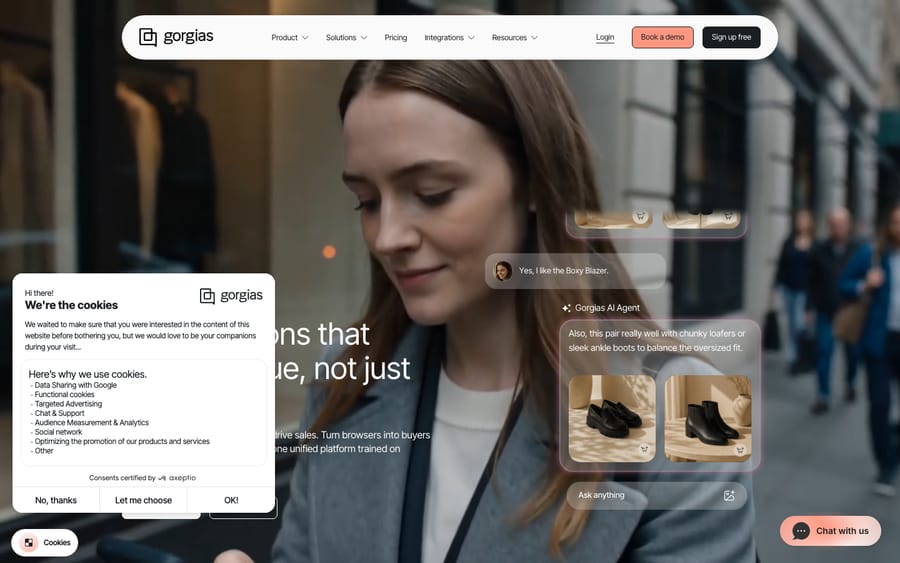
How does Gorgias describe itself?
Gorgias titles its homepage "The Conversational AI platform for Ecommerce", and the headline, "Conversations that drive revenue, not just resolutions", is the key to understanding the product.
Most help desks treat support as a cost center: close the ticket, keep customers happy, move on. Gorgias frames support as a revenue channel for online stores, answering the pre-sale "does this come in blue?" question, recovering an abandoned cart, or upselling during a return. That's why its reporting tracks revenue generated by support, not just resolution time, and why it ships proactive sales tools alongside the inbox. Whether your team needs that framing depends on whether your support genuinely sells, but it's the lens Gorgias is built around.
What does Gorgias do? Core capabilities
At its core Gorgias is a ticketing system, but one wrapped tightly around ecommerce data and channels. Here's what that includes.
1. Unified ticketing across every channel
Every customer message becomes a ticket in one shared inbox, no matter where it came from:
- Email, the classic shared support inbox.
- Live chat, a customizable on-site chat widget.
- Social media: comments and DMs from Facebook, Instagram and more, including ad comments.
- SMS and WhatsApp: text-message support (SMS is an add-on on the pricing page).
- Voice / phone: phone support through Gorgias Voice, a paid add-on, inside the same help desk.
The promise is one screen showing a customer's entire history across every channel, so the Instagram DM from this morning and last week's email sit side by side.
2. Shopify and order data inside the ticket
This is Gorgias's signature feature and the main reason ecommerce teams pick it. Gorgias has one of the deepest bi-directional integrations with Shopify (plus BigCommerce, Magento, and WooCommerce): the customer's orders, tracking, and details appear in a sidebar next to the conversation, and agents can cancel, refund, duplicate, or edit an order, or manage a subscription, without leaving the ticket (Gorgias order management). The sidebar also pulls in third-party apps like Recharge (subscriptions), Loop Returns, and Yotpo (reviews), so the context an agent needs to resolve a question is right there.
For a support team, the difference is concrete: no tab-hopping between the help desk and the store admin to look up "where's my order."
3. Macros and rules (automation)
Gorgias automates the repetitive housekeeping that eats an agent's day:
- Macros, saved, templated replies that can also auto-fill order details and trigger actions (like issuing a refund) in one click.
- Rules, if-this-then-that automations that tag, prioritize, assign, and route tickets, or auto-respond to common questions, based on message content, intent, or customer data.
Because macros can chain actions across Shopify and your stack, a single click can do work that would otherwise take an agent several steps.
4. AI Agent
Gorgias's AI Agent (formerly sold as Automate) is an autonomous bot that resolves common support questions end to end, order status, returns, WISMO ("where is my order"), simple edits, across email, chat, and SMS. Gorgias's homepage says it can "Automate 60% of support." Treat that as a vendor best-case figure: independent reviewers report the AI is meaningfully better than its 2024 self but still benefits from supervision, and one analysis pegged response accuracy below the category average (Gorgias AI reviews, Ringly). One limit worth knowing: Gorgias's own AI Agent pricing article lists email, chat and SMS as its channels and does not mention phone, so plan on humans answering calls.
5. Chat and Campaigns (Convert)
Beyond reactive support, Gorgias includes proactive, sales-oriented tools:
- Chat, the live-chat widget customers use to reach a human or the AI Agent instantly. (We go deeper in our Gorgias chat explained guide.)
- Campaigns, proactive, targeted messages pushed through the chat widget (think on-site offers or nudges), aimed at converting browsers, not just answering them.
This is the "drive sales" half of the positioning in practice.
6. Revenue and CSAT reporting
Gorgias's analytics cover the usual support metrics, ticket volume, response and resolution time, agent performance, and CSAT, but its standout is revenue reporting: tying support conversations to sales generated. That lets a CX lead show support's contribution to revenue, not just its cost.
Who is Gorgias for?
Gorgias's sweet spot is direct-to-consumer (DTC) ecommerce brands on Shopify (and BigCommerce/Magento/WooCommerce), typically growing-to-enterprise online stores with real support volume across chat, social, and email.
It's a strong fit if you:
- Run an online store and want order data and order actions inside every ticket.
- Sell on Shopify and want the deepest native integration available.
- See support as part of the revenue engine (pre-sales questions, upsells, win-backs), not purely cost.
- Need social and SMS handled in the same place as email and chat.
It's a poor fit if you're not ecommerce. Gorgias has little to offer a B2B SaaS support team, an internal IT help desk, or a services business. Those teams are better served by general-purpose platforms like Zendesk or Freshdesk. If you've outgrown Gorgias or it doesn't fit your model, see our roundup of the best Gorgias alternatives.
How much does Gorgias cost?
Gorgias uses a ticket-based pricing model, you pay for a monthly ticket allowance, not per agent (a notable difference from per-seat help desks). As of September 24, 2026, the helpdesk plans are:
| Plan | Price (monthly / annual) | Tickets/mo | Agents |
|---|---|---|---|
| Starter | $10 | 50 | 3 seats |
| Basic | $60 / $50 | 300 | 500 seats |
| Pro | $360 / $300 | 2,000 | 500 seats |
| Advanced | $900 / $750 | 5,000 | 500 seats |
| Enterprise | Custom | 5,000+ | custom |
Two things matter beyond the headline numbers:
- Ticket overage. Go over your allowance and you pay per extra ticket ($0.40 a ticket on Starter and Basic, $0.36 on Pro and Advanced).
- The AI Agent is billed separately, and it double counts. You add a prepaid block of automated interactions to your plan: on monthly billing $30 for 30 on Starter or Basic, $190 for 190 on Pro and $530 for 530 on Advanced, so about $1.00 each (about $0.90 on annual billing), then $1.50 per automated interaction past the block. The catch: Gorgias's billing docs charge "both a ticket fee + automation fee if AI Agent responds to a ticket and does not hand over the conversation to a human agent." So an AI-handled conversation can cost you the automation fee and a ticket toward your quota, which you should model carefully before you assume the AI saves money. We break the whole bill down in Gorgias pricing explained.
Annual billing saves roughly two months (~17%). As always, Gorgias revises packaging periodically, so confirm current numbers on its pricing page.
What is Gorgias good at, and where does it fall short?
Where Gorgias shines:
- Deep Shopify and ecommerce integration: order context and order actions live in the ticket.
- Revenue-aware support, proactive chat campaigns and revenue reporting that treat support as a growth lever.
- True omnichannel for stores, email, chat, social, SMS, and voice in one inbox.
- Fast to launch for a DTC team versus heavier enterprise platforms.
Where it falls short:
- Pricing can climb unpredictably, the ticket model plus separately-metered AI (with the double-count) means costs scale with volume in ways that surprise teams; this is the most common complaint in reviews.
- AI accuracy needs supervision, improving fast, but not set-and-forget, and Gorgias doesn't list phone as an AI Agent channel.
- Ecommerce-only, outside online retail, it's the wrong tool.
On independent review sites, reviewers mostly praise the Shopify integration and ease of use, and the recurring gripe is cost at scale.
Where does an AI agent layer fit with Gorgias?
Gorgias's built-in AI Agent is good at deflecting the repetitive WISMO-and-returns questions that dominate an ecommerce queue. But a fair number of tickets sit in the harder middle: they need a real answer pulled from your docs, policies, or past conversations, resolved right there in the thread. That middle is where a dedicated AI agent layer comes in.
To be upfront: Macha is one such layer. It runs on top of Zendesk, Freshdesk, Gorgias, Front, HubSpot or Intercom, so it sits on your existing Gorgias account rather than replacing it. Gorgias's own AI Agent is the native path; a layer is the add-on route when you want tickets resolved from your docs, policies and past replies, with escalation to a human with full context when the agent isn't confident. It's only as good as the knowledge you connect it to. Macha bills per ticket, from $299 a month for 750 tickets, with setup and monitoring by the Macha team included, and you can try it with $50 of free usage, no credit card required.
Frequently asked questions
What is Gorgias in simple terms? Gorgias is a customer-service help desk built specifically for ecommerce. It turns every customer message, from email, chat, social, SMS, or phone, into a ticket, pulls in the customer's Shopify order data, and adds automation and an AI agent so your team can resolve (and even sell during) support conversations from one place.
Is Gorgias a Shopify-only tool? No, but Shopify is its strongest integration by far. Gorgias says it powers customer conversations for 40% of Shopify brands. It also integrates with BigCommerce, Magento, and WooCommerce.
What is Gorgias chat? It's Gorgias's live-chat widget, where customers reach your team or AI Agent on your site. Gorgias also offers Campaigns, proactive, targeted messages sent through that widget to convert shoppers. See our Gorgias chat explained guide.
How much does Gorgias cost? Gorgias prices by ticket volume, not per agent: Starter $10/mo (50 tickets), Basic $60/mo (300), Pro $360/mo (2,000), Advanced $900/mo (5,000), and custom Enterprise. The AI Agent is billed separately, about $1.00 per automated interaction on monthly billing and $1.50 past your prepaid block, and an AI-resolved ticket also counts as a helpdesk ticket. Full breakdown in Gorgias pricing explained.
Who owns Gorgias? Gorgias is a private, venture-backed company founded in 2015 by Romain Lapeyre and Alex Plugaru, headquartered in San Francisco.
Is Gorgias the same as the Greek philosopher? No. Gorgias the software is an ecommerce customer-service platform. It shares a name with the ancient Greek sophist (and Plato's dialogue) but has nothing to do with philosophy.
What's the difference between Gorgias and Zendesk? Gorgias is purpose-built for ecommerce with deep Shopify/order integration and revenue-focused tools; Zendesk is a general-purpose help desk used across many industries with broader enterprise depth. For online stores, Gorgias's ecommerce fit is the draw; for non-retail or large multi-team operations, a general platform usually wins.
Should you use Gorgias?
Gorgias is the help desk built for ecommerce, a ticketing platform that unifies email, chat, social, SMS, and phone, drops Shopify order data and order actions into every conversation, automates with macros and rules, deflects with an AI Agent, and adds proactive chat campaigns plus revenue reporting to treat support as a growth channel. It's an excellent fit for DTC brands on Shopify and a poor one for anyone outside online retail. The main thing to watch is cost: the ticket model plus separately-metered AI (which double-counts against your ticket quota) can scale faster than expected, so model your real volume before you commit. If you sell online and live in Shopify, Gorgias is one of the most natural homes for your support, just go in with eyes open on pricing.
Verified against Gorgias's official homepage, pricing page and billing docs, September 24, 2026. Gorgias revises packaging and pricing periodically, so confirm current figures on gorgias.com before relying on them.
Add AI agents to your Gorgias
Macha reads the ticket, drafts the reply and takes the action, inside the Gorgias you already run.