Intercom
 Shopify
 Stripe
 Slack
Slack Notion
 Google Workspace
 Confluence

Is Gorgias Worth It in 2026? Pricing, Pros, Cons and Who It's For


Gorgias is the help desk Shopify brands keep choosing for order data inside every ticket, and the one they most often complain about when the bill arrives. Here is what it does well, what it really costs once AI Agent is switched on, and who should look elsewhere.
Key takeaways
- Gorgias is worth it mainly for Shopify and DTC brands, with helpdesk plans from $10 a month for 50 tickets up to $900 a month for 5,000 tickets.
- Gorgias AI Agent costs $0.90 per interaction on annual plans or $1.00 on monthly plans, and $1.50 each once the plan's bundle runs out.
- Every Gorgias AI Agent interaction also counts as a helpdesk ticket, so a Pro plan with 1,000 AI resolutions a month reaches about $1,765 against a $360 sticker price.
- Gorgias AI Agent requires a Shopify store connected to Gorgias, so BigCommerce, Magento and WooCommerce stores get the help desk but not the AI.
- Gorgias held a G2 rating of 4.6 from about 550 reviews in June 2026, with Value for Money its lowest Capterra sub-score at 4.4.

Gorgias is a strong help desk for Shopify brands and a poor fit for almost anyone else: plans run from $10 a month for 50 tickets to $900 a month for 5,000, and its AI Agent needs a connected Shopify store and bills every automated interaction on top of the ticket it also uses up (gorgias.com/pricing, checked 24 September 2026). One disclosure up front: Macha is our own product, an AI agent layer that runs on top of Zendesk, Freshdesk, Gorgias, Front, HubSpot or Intercom. It is not a Gorgias alternative, and it gets one flagged aside near the end.
| Question | Short answer (24 Sept 2026) |
|---|---|
| Who it's for | Shopify and DTC ecommerce brands |
| Helpdesk price | Starter $10, Basic $60, Pro $360, Advanced $900 a month (50 / 300 / 2,000 / 5,000 tickets) |
| AI Agent price | $0.90 per interaction on annual plans, $1.00 on monthly; $1.50 past the plan's bundle |
| Billing catch | Each AI Agent interaction also counts as a helpdesk ticket |
| AI Agent requirement | A Shopify store connected to Gorgias |
| Ratings (June 2026 readings) | G2 4.6 from about 550 reviews; Capterra 4.6 from about 130 |
| Main complaints | Hard-to-predict bills, shallow reporting, support responsiveness |
(Quick disambiguation, since the name is shared: this review is about Gorgias the ecommerce help desk at gorgias.com, not the Platonic dialogue.)
How we reviewed it: pricing re-read on 24 September 2026 from Gorgias' pricing page and Gorgias' help docs; ratings and sentiment were read in June 2026 from G2, Capterra, the Shopify App Store and community threads (those rating pages block automated access, so the numbers are cited, not screenshotted); product details come from Gorgias' own site and docs, shown below.
What is Gorgias, and who is it built for?
Gorgias is a customer-support help desk built for ecommerce. Where general-purpose desks like Zendesk and Freshdesk serve every industry, Gorgias bets on one vertical: online stores, and Shopify stores above all. Every customer message (email, live chat, SMS, social, WhatsApp) becomes a ticket, but the differentiator is what sits next to that ticket: the customer's order history, fulfillment status, and the ability to edit or refund an order without leaving the conversation.
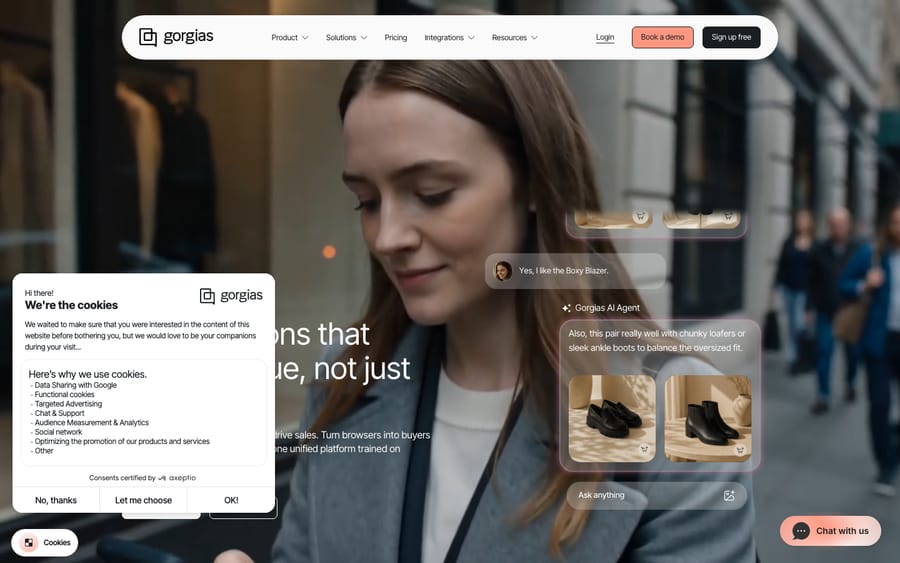
It's built for DTC and ecommerce brands. Shopify and WooCommerce connect on every plan, BigCommerce from Basic up, and Magento from Pro up, per the plan comparison on the pricing page. The honest one-line summary: Gorgias is the help desk you choose when support is a revenue channel and your store data needs to live inside every ticket. If you're not running an online store, it's almost certainly the wrong tool. For a fuller primer on the platform, see what is Gorgias.
What does Gorgias actually do, feature by feature?
Gorgias' ecommerce focus shows up in nearly every feature.
Ecommerce-native ticketing and the agent workspace
The core is a shared inbox where agents triage every channel in one queue. What sets it apart is the store sidebar: an agent answering a "where is my order?" message sees the order, tracking and customer lifetime value right there, and can refund, cancel or duplicate an order in a click. Reviewers consistently call this the biggest reason they stay, because it removes the tab-hopping that general-purpose desks force on ecommerce teams.
Macros and ecommerce automation (Rules)
Gorgias' macros can do more than paste canned text. They inject live order variables and take actions (apply tags, trigger refunds, update orders) as they reply. Its Rules engine auto-tags, prioritizes and routes tickets based on intent and order data. For high-volume WISMO ("where is my order") and returns traffic, this saves real time.
Revenue tracking
This is a feature general-purpose desks don't ship: Gorgias ties support interactions to sales. Revenue attribution is listed on the Pro and Advanced plans, where you can see which conversations converted, which agents drove the most revenue, and how support touches lifetime value. As one G2 reviewer put it: "Love how Gorgias links support replies with order data so we can track revenue from each agent's actions — super useful for e-commerce." For brands that treat support as a growth lever, it stands out.
AI Agent
Gorgias sells two products, Helpdesk and AI Agent. AI Agent resolves customer questions end to end, especially WISMO, order edits and returns, across email, chat, SMS and social channels. Pointed at routine tier-1 ecommerce questions with good help-center content behind it, it works well. Two caveats matter. Independent reviewers such as Ringly put real-world automation around 26–56%, below the "up to 60%" marketing line. And Gorgias' setup guide lists a Shopify store connected to Gorgias as a requirement, so BigCommerce, Magento and WooCommerce stores can use the help desk but not AI Agent. How AI Agent is billed is the most important thing to model before you buy, so it gets its own section below.
Reporting and analytics
Gorgias includes dashboards for volume, response and resolution times, CSAT and revenue. The ecommerce metrics are a genuine plus. Depth is a recurring complaint: reviewers want richer team-performance tracking over time, and some note that stats can include out-of-hours time in ways that distort response numbers, plus a refresh delay. If you live in dashboards, test this hard before committing.
How much does Gorgias cost in 2026?
Gorgias bills by tickets handled per month, never per agent, in the words of its pricing page. That suits big teams (Basic, Pro and Advanced each include 500 user seats; Starter includes 3), but your cost tracks your volume, not your headcount.
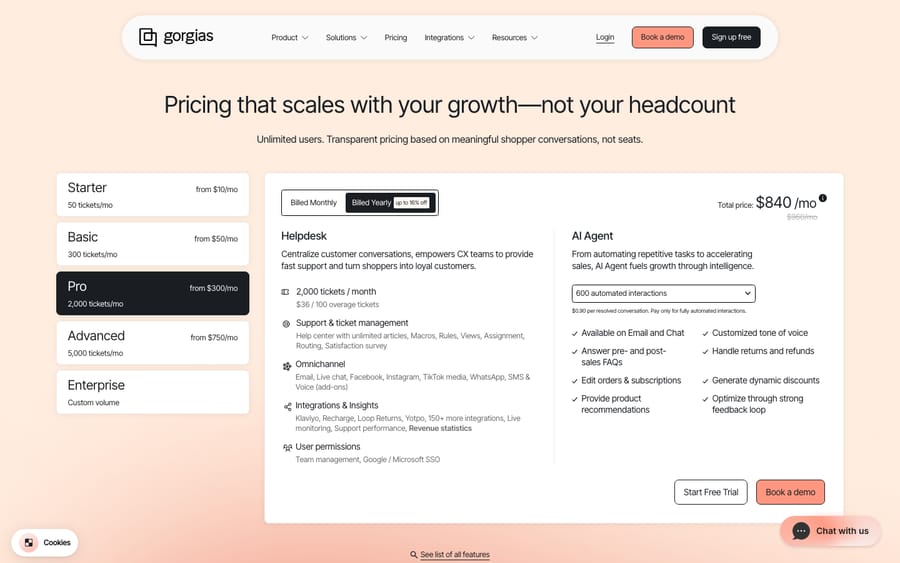
| Plan | Helpdesk (monthly / annual) | Included tickets | Ticket overage | AI Agent bundle (monthly) |
|---|---|---|---|---|
| Starter | $10 (monthly only) | 50 | $0.40 | $30 for 30 interactions |
| Basic | $60 / $50 | 300 | $0.40 | $30 for 30 |
| Pro | $360 / $300 | 2,000 | $0.36 | $190 for 190 |
| Advanced | $900 / $750 | 5,000 | $0.36 | $530 for 530 |
| Enterprise | Custom | Custom | Custom | Custom |
The footnotes matter more than the table:
- Ticket overages add up. Past your monthly allowance, each extra ticket costs $0.40 on Starter and Basic or $0.36 on Pro and Advanced. On a busy month (a sale, a shipping fiasco), that line is the surprise on your invoice.
- AI Agent is billed per automated interaction. Gorgias' pricing FAQ puts interactions at $0.90 each on annual plans or $1.00 on monthly plans. Past the bundle, each one costs $1.50. The annual AI bundles are $27 (Basic), $171 (Pro) and $477 (Advanced).
- The double-billing catch. The same FAQ says it plainly: "Each AI Agent interaction also counts as a helpdesk ticket and is billed accordingly." You pay the ticket and the AI fee on the same conversation. If a shopper still reaches a human within 72 hours, Gorgias charges only the ticket.
What does 50% automation cost on Pro? Take Pro on monthly billing with 2,000 tickets a month and AI Agent resolving 1,000 of them. The helpdesk is $360, and all 2,000 tickets fit the quota. The AI line is $190 for the first 190 interactions plus 810 × $1.50 = $1,215, so the month comes to about $1,765. Gorgias may quote a larger AI bundle at a lower rate, so ask for your tier before you budget, and model the AI line and the ticket line together. We break the full math down in our Gorgias pricing explainer.
Voice and SMS are separate add-ons that, per the pricing page, scale with usage; Gorgias doesn't publish a flat per-ticket rate for them.
What do real users say about Gorgias?
Aggregate scores are the closest thing to a crowd verdict. Observed in June 2026 (not re-read on 24 September, because the pages block automated access):
- G2: 4.6 / 5 from roughly 550 reviews.
- Capterra: 4.6 / 5 from about 130 reviews (Ease of Use 4.6, Customer Service 4.5, Features 4.5, Value for Money 4.4, the lowest sub-score).
- Shopify App Store: about 4.3 / 5, with more mixed sentiment than the review sites.
Those are good numbers. The softer Value for Money score and the Shopify App Store spread are the tell: people like the product and watch the bill.
What reviewers praise. The Shopify integration and ease of use top every list. The per-ticket (not per-seat) model is a recurring favorite, because everyone in the company can be in the tool without seat-count anxiety. The revenue link stands out too, as the G2 reviewer quoted above said. Automation that handles WISMO and returns around the clock rounds out the wins.
What reviewers criticize. Two themes dominate. First, price and billing complexity: the per-ticket model plus per-interaction AI plus overages is, in many reviewers' words, hard to predict, and the AI double-billing surprises people. Second, reporting depth: community and Trustpilot sentiment repeatedly says analytics "could be deeper, especially for tracking team performance over time." A verified Capterra ecommerce manager also found the "interface is a bit overwhelming" at first, and some reviewers describe slow loads at high ticket volume. Support quality draws the sharpest edge-case complaints, mostly that responses can be repetitive or that some issues drag on. None of these sink the product for the right buyer.
What are the pros and cons of Gorgias?
Pros
- Best-in-class Shopify integration. Order data, refunds and edits live inside the ticket.
- Ecommerce-native automation. Macros that take actions and Rules that route by intent and order data save time on WISMO and returns.
- Revenue tracking. Ties support to sales and per-agent revenue on Pro and Advanced.
- Per-ticket pricing, not per-seat. 500 user seats on Basic and above, so large teams avoid seat fees.
- Capable AI Agent for routine ecommerce. Handles common tier-1 questions around the clock when fed good help-center content.
Cons
- Pricing is hard to predict. Ticket allowances, overages and per-interaction AI make the monthly bill a moving target.
- AI double-billing. Each AI Agent interaction also counts as a ticket, so model the combined cost before you switch automation on.
- Shopify-centric. AI Agent needs a connected Shopify store, and the whole product is wasted on non-ecommerce use.
- Reporting is shallow for some. Recurring requests for deeper, time-based team-performance analytics.
- Support and polish gripes. Edge-case support complaints, an "overwhelming" first-run interface and occasional slowness at high volume.
Who should choose Gorgias, and who shouldn't?
Choose Gorgias if you're a Shopify or DTC ecommerce brand that wants store data, refunds and order edits inside every ticket, you treat support as a revenue channel, and you can model ticket-based pricing. For that profile Gorgias is excellent, and the 4.6 G2 and Capterra ratings reflect a lot of happy stores in exactly that bucket.
Look elsewhere if you're B2B or non-ecommerce (the whole value proposition assumes a storefront), you're on BigCommerce, Magento or WooCommerce and want AI Agent (it needs a Shopify store), you need deep, customizable reporting, or you're budget-sensitive with volume spiky enough that per-ticket-plus-per-interaction billing would sting. At that end, weigh the field: we line up the strongest options in the best Gorgias alternatives.
Where does a separate AI agent layer fit (and where does Macha fit)?
Gorgias' AI is capable for Shopify ecommerce, but it's billed per interaction, tied to Shopify, and counts against your ticket plan. Some teams, especially those whose support isn't purely ecommerce, end up on a general-purpose desk like Zendesk or Freshdesk and add a dedicated AI agent layer on top.
That's the category our own product, Macha, sits in, disclosed plainly because it's ours. Macha is not a help desk and not a Gorgias alternative; it's an AI agent layer that runs on top of Zendesk, Freshdesk, Gorgias, Front, HubSpot or Intercom. It reads the customer's question, pulls from your connected knowledge and past tickets, and resolves the issue in-thread, escalating to a human with full context when it isn't confident. It bills per ticket, one charge per thread however many automated steps it takes, from $299 a month for 750 tickets, with setup and monitoring by the Macha team included. If you'd rather keep everything native, Gorgias' own AI Agent is your path. If the layer sounds like you, see how the agent layer works or try it ($50 of free usage, no credit card required).
Frequently asked questions
Is Gorgias good in 2026? Yes, for ecommerce. It carried strong ratings in June 2026 (G2 4.6/5 from about 550 reviews, Capterra 4.6/5 from about 130, Shopify App Store about 4.3) and is arguably the best Shopify-native help desk, with order data, revenue tracking and ecommerce automation built in. The caveats are unpredictable ticket-plus-AI pricing, an AI Agent that needs Shopify, and shallow reporting for some.
How much does Gorgias cost? Helpdesk plans are Starter $10 (50 tickets, monthly only), Basic $60 or $50 annual (300), Pro $360 or $300 annual (2,000), Advanced $900 or $750 annual (5,000), and Enterprise custom. Overages are $0.40 or $0.36 per ticket. AI Agent adds $0.90 per interaction on annual plans or $1.00 on monthly, $1.50 past the bundle, and each interaction also counts as a ticket. See the pricing explainer for the full breakdown.
What are Gorgias' main pros and cons? Pros: deep Shopify integration, ecommerce-native macros and automation, revenue tracking, per-ticket (not per-seat) pricing, a capable AI Agent for WISMO and returns. Cons: hard-to-predict pricing, AI double-billing, Shopify dependence for AI Agent, shallow reporting for some, and edge-case support complaints.
Is Gorgias good for non-Shopify or B2B teams? Generally no. The product's value is ecommerce store data inside tickets, and AI Agent requires a connected Shopify store. B2B and non-ecommerce teams are usually better served by a general-purpose desk; see the best Gorgias alternatives.
Why do people say Gorgias gets expensive? Because three meters can run at once: your ticket allowance (with overages), per-interaction AI billing, and the rule that every AI Agent interaction also counts as a helpdesk ticket. On Pro monthly with 2,000 tickets and 1,000 AI resolutions, the published rates add up to about $1,765 a month, against a $360 sticker price.
What do Reddit and review sites say about Gorgias? Sentiment is mostly positive on the product (especially Shopify integration and ease of use) but consistently flags pricing complexity and reporting depth, with sharper edge-case complaints about support responsiveness and slowness at high volume.
Is Gorgias worth it for your store?
For Shopify and DTC brands it's one of the best help desks you can buy: order data in every ticket, ecommerce-native automation, revenue tracking competitors don't ship, and a 4.6 across roughly 550 G2 reviews. The caveats are equally real: pricing is hard to predict, AI Agent needs Shopify and bills on top of the ticket, reporting runs shallow for data-hungry teams, and support draws sharper edge-case complaints than the headline rating suggests.
If you're a Shopify brand that treats support as a revenue channel and can model ticket-based billing, Gorgias is a safe bet. If you're B2B, non-ecommerce, off Shopify, or budget-sensitive with spiky volume, work out your effective monthly cost first, then weigh it against the alternatives before you sign.
Pricing and billing rules read from Gorgias' pricing page and help docs on 24 September 2026. Aggregate ratings and review quotes were observed in June 2026 on G2, Capterra, the Shopify App Store and community threads and may have changed. Macha is our own product (an AI agent layer that runs on top of Zendesk, Freshdesk, Gorgias, Front, HubSpot or Intercom, and is not a Gorgias alternative), disclosed as such.
Add AI agents to your Gorgias
Macha reads the ticket, drafts the reply and takes the action, inside the Gorgias you already run.