Shopify
 Stripe
 Slack
Slack Notion
 Google Workspace
 Confluence

Freshdesk vs Jira Service Management (2026): Which Fits Customer Support, and Which Fits ITSM?


Freshdesk is the pick for external customer support across email, chat and social, while Jira Service Management is the pick for IT teams running incidents and changes linked to Jira Software. Entry prices are close, at $19 an agent for Freshdesk Growth and about $20 for JSM Standard, but the AI, setup effort and free options differ.
Key takeaways
- Freshdesk suits external customer support across email, chat, phone and social, while Jira Service Management suits IT teams running incident, problem and change management linked to Jira Software.
- Freshdesk's paid plans are Growth at $19, Pro at $55 and Enterprise at $89 an agent a month billed annually, and the public pricing page no longer lists a free plan.
- Freddy AI Agent now comes with every paid Freshdesk plan with 500 sessions included, while Freddy AI Copilot is a $29 per agent add-on on Pro and Enterprise.
- Jira Service Management is free for up to 3 agents, and Atlassian pitches its Standard plan as a fully featured service desk at $20 an agent a month.
- Freshdesk's Free program covers two agents for six months and is only reachable from Admin > Account > Plans and Billing inside an existing account.

Choose Freshdesk if you run external customer support across email, chat, phone and social, and Jira Service Management (JSM) if you run IT or internal service operations that need incident, change and problem management linked to Jira Software. Entry prices are close: Freshdesk's Growth plan is $19 an agent a month billed annually, and JSM's Standard plan is about $20 an agent a month, with a free tier for up to 3 agents. Freshdesk no longer shows a free plan on its pricing page; it now opens with a 14-day trial of its Enterprise plan.
How do Freshdesk and Jira Service Management compare at a glance?
| Freshdesk | Jira Service Management | |
|---|---|---|
| Best for | Customer-facing support teams handling high email/chat/social volume | IT, DevOps, and internal service teams running ITIL-style operations |
| Pricing entry | 14-day trial; paid from $19/agent/mo (Growth, annual); a Free program (2 agents, 6 months) only from inside an account | Free (up to 3 agents); paid from ~$20/agent/mo (Standard) |
| AI / automation | Freddy AI Agent on every paid plan (500 sessions included); Copilot add-on at $29/agent/mo on Pro and Enterprise | Atlassian Intelligence / Rovo; automation rules engine |
| Omnichannel | Strong: email, chat, phone, social, WhatsApp in one inbox | Limited: portal and email first; customer channels are secondary |
| Ease / admin | Fast to configure, gentle learning curve | Deep but complex; meaningful setup and admin investment |
| Standout strength | Speed to value and true omnichannel customer support | ITSM depth (incident/problem/change) plus native dev-team integration |
Freshdesk prices checked on Freshworks' pricing page on 24 September 2026; JSM prices from Atlassian's pricing page as captured in July 2026. Both change, so confirm on each vendor's live page.
How much do Freshdesk and Jira Service Management cost?
The two tools price similarly at the entry point but diverge in what you're actually buying.
Freshdesk (per Freshworks' official pricing page, billed annually, checked 24 September 2026) sells three paid plans: Growth at $19/agent/month, Pro at $55/agent/month, and Enterprise at $89/agent/month. The public page no longer lists a free plan. New accounts get a 14-day trial of Enterprise, and a Free program for up to two agents lasts six months and is reachable only from Admin > Account > Plans and Billing. The AI tiering has also moved: Freddy AI Agent now comes with every paid plan, with 500 sessions included (extra sessions cost $49 per 100). Freddy AI Copilot is a $29/agent/month add-on on Pro and Enterprise only, and Freddy AI Insights is listed on Enterprise.
Jira Service Management (per Atlassian's official pricing page, captured first-hand below) offers Free for up to 3 agents, then Standard, Premium, and Enterprise. JSM's pricing differs in shape: it scales with team size in bands, so the effective per-agent number drops as you add agents. Atlassian leans on this in its own comparison, pitching "a fully featured service desk… for $20/agent per month." The plans aren't feature-identical, so treat vendor-vs-vendor price claims with care, but the entry economics are close.
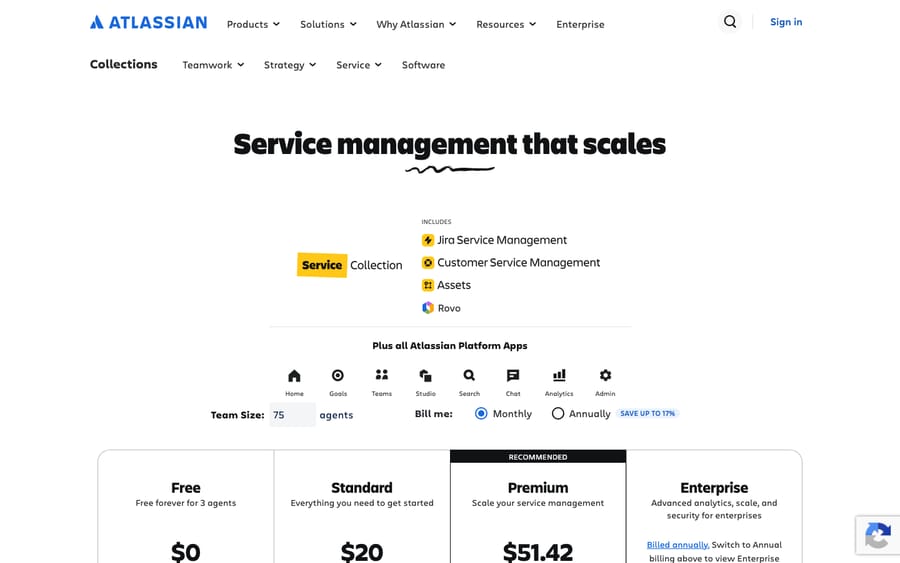
At the low end they're comparable. Where the bill diverges is intent. Freshdesk's Pro is where agent-facing customer AI (Copilot) becomes available, while JSM's Premium and Enterprise are where ITSM depth (asset management, advanced incident tooling, higher automation limits) turns on.
What features and AI does each one ship?
This is where the "same words, different jobs" gap is widest.
Freshdesk is a customer support help desk. Its features orbit the external ticket: a unified inbox, canned responses, a customer portal and knowledge base, and omnichannel. Email, chat, phone, social and WhatsApp funnel into one place, which is what a support team fielding public volume needs. Its AI, Freddy, is aimed at deflection and agent assist: an AI agent that answers customers from your knowledge base (now on every paid plan), a Copilot that drafts replies, and Insights for analytics.
Jira Service Management is an ITSM platform. It ships ITIL-aligned incident, problem, change, and request management, plus asset and configuration management on higher tiers. Its defining feature is one Freshdesk structurally can't match: JSM is, in Atlassian's words, "the only ITSM tool and service desk built on a software development platform," so a service ticket can be linked directly to a Jira Software issue and handed to the engineers who own the fix. Its AI, Atlassian Intelligence / Rovo, focuses on summarizing complex technical issues, drafting responses, and surfacing knowledge for agents. Add the 800+ Marketplace apps Atlassian cites and it's deeply extensible.
If your work is "answer customers," Freshdesk's feature set is pointed the right way. If your work is "run IT operations and loop in developers," JSM's is.
Which one automates workflows better?
Both automate, with different philosophies. Freshdesk emphasizes accessible automation: dispatch rules, SLA policies, and scenario automations that a support admin can build without deep technical skill. JSM's automation engine is more granular, with reviewers on G2 praising its customizable queues and rules, but that power comes with a configuration burden. Freshdesk gives you sensible automation fast; JSM gives you near-unlimited automation once you've invested in setting it up.
Which is easier to set up and administer?
This is the clearest split in the reviews. Freshdesk is repeatedly described as fast to start and easy to configure, with a clean interface new agents pick up quickly. JSM is the opposite bargain: reviewers consistently flag a steep learning curve and note that "the setup is complex, the UI can feel overwhelming for new users, and configuration of workflows, ticket types, and backend settings requires significant time." That's a design choice. JSM rewards teams willing to invest in configuration with depth Freshdesk doesn't offer, but if you want a team productive next week, the gap matters.
How do reviewers rate them, and what ecosystem comes with each?
On aggregate sentiment the two are close. In our July 2026 capture of the G2 comparison, Freshdesk held ~4.4/5 across roughly 3,728 reviews and Jira Service Management ~4.3/5 across roughly 973; G2 blocked a re-check today, so treat the counts as dated. Freshdesk reviewers often praise its customer support and pricing transparency. JSM reviewers praise its integrations and workflow flexibility, which fits a tool that lives inside the Atlassian ecosystem (Jira, Confluence, Bitbucket). Pick your ecosystem gravity: Freshworks if you want an all-in-one customer suite, Atlassian if your engineering org already runs on Jira.
What are the pros and cons of each?
Freshdesk pros: fast to deploy; true omnichannel customer support; clean, low-training UI; transparent pricing; Freddy AI Agent included on every paid plan. Freshdesk cons: not an ITSM tool (weaker on formal change and asset management); no native link to a software-dev backlog; no public free plan any more; Copilot is a paid add-on and only on Pro ($55/agent) and up.
Jira Service Management pros: deep, ITIL-aligned ITSM (incident/problem/change/asset); built on a dev platform, so support-to-engineering handoff is native; extensible via Marketplace; strong automation; a real free tier for 3 agents. Jira Service Management cons: steep learning curve and complex setup; weaker out-of-the-box omnichannel for external customer support; can become hard to maintain if configured poorly.
Neither is "worse." They're aimed at different buyers.
Which should you choose?
- You're a customer support team (e-commerce, SaaS support, services) fielding email/chat/social volume and want to be live quickly → Freshdesk. It's built for exactly this.
- You're an IT / internal service / DevOps team running incidents and changes, and you need tickets wired to engineering work → Jira Service Management, especially if your org already lives in Jira.
- You're a mixed org with customer support and IT that files bugs to developers → the classic middle path: run Freshdesk for customer support and JSM for IT/dev, and use the Freshdesk↔Jira integration to push escalations from a customer ticket into an engineering issue.
- You're a tiny team on a budget → JSM is free for up to 3 agents with no time limit. Freshdesk's Free program covers 2 agents for six months, then you move to Growth at $19.
Can you add an AI agent on top of either one?
Whichever help desk you land on, the reasoning-heavy work (reading a ticket, understanding intent, drafting a grounded reply, fetching an order or account status) isn't something a ticketing engine or an SLA timer does on its own. That's a job for an AI agent layer, and it's worth understanding the build-vs-buy tradeoff before you wire one in.
Macha is that layer, and it isn't a help desk you'd compare against Freshdesk or JSM. It runs on top of the help desk you already chose, and today that means Zendesk, Freshdesk, Gorgias, Front, HubSpot or Intercom. On the Freshdesk side, Macha connects as a native connector: you plug in your subdomain and API key, and Macha reads and writes the same tickets, triaging by intent, drafting or posting grounded first replies, and looking up live order or account data through a custom tool that turns a REST API into something the agent can call. Macha bills per ticket (one conversation, charged once however many messages it takes), never per resolution, starting at $299 a month for 750 tickets; see the pricing page. So the choice isn't Macha instead of Freshdesk; it's Macha plus the help desk that fits your team.
FAQ
Is Jira Service Management the same as Freshdesk? No. Freshdesk is a customer support help desk built for external, omnichannel support (email, chat, phone, social). Jira Service Management is an ITSM platform built for IT and internal service operations with ITIL-aligned incident, problem, and change management, and native links to the Jira Software dev backlog. They share ticketing vocabulary but target different jobs.
Which is cheaper, Freshdesk or Jira Service Management? At the entry point they're close. Freshdesk starts at $19/agent/month (Growth, annual) after a 14-day trial; JSM has a free tier for up to 3 agents and paid Standard from roughly $20/agent/month, with the effective rate dropping as team size grows. Prices change, so confirm on each vendor's live pricing page.
Does Freshdesk still have a free plan? Not on its public pricing page. Freshdesk's help center describes a Free program for up to two agents that lasts six months, which you switch to from Admin > Account > Plans and Billing inside an existing account.
Can I use Freshdesk and Jira Service Management together? Yes, and many teams do. A common setup runs Freshdesk for customer support and JSM for IT/engineering, using the Freshdesk↔Jira integration to escalate a customer ticket into a Jira issue for developers. That middle path avoids forcing one tool to do both jobs.
Which is easier to set up? Freshdesk. Reviewers consistently describe it as fast to deploy with a gentle learning curve, while JSM is deeper but has a steeper setup and admin burden. If speed to value matters most and your job is customer support, Freshdesk wins on ease.
Can I add AI to Freshdesk without switching help desks? Yes. An AI agent layer like Macha connects to Freshdesk as a native connector and runs on top of your existing help desk, drafting grounded replies, triaging by intent, and pulling live data, without replacing Freshdesk or its SLAs.
Whichever help desk you choose, you can layer AI agents on top. Start a free trial of Macha with $50 of free usage and no credit card, and connect it to your Freshdesk in minutes.