
 Shopify
 Stripe
 Slack
Slack Notion
 Google Workspace
 Confluence

Freshdesk vs Kayako (2026): Which Help Desk Is Cheaper and Better for AI?


Freshdesk publishes per-agent prices from $19 a month, while Kayako leads with a Kay AI agent billed at $1 per resolved ticket and sells its full platform by quote. For most teams Freshdesk is the safer default; Kayako fits teams that want to pay for AI resolutions instead of seats.
Key takeaways
- Freshdesk is the better default for most teams in 2026, with published annual prices of $19, $55 and $89 per agent per month for Growth, Pro and Enterprise.
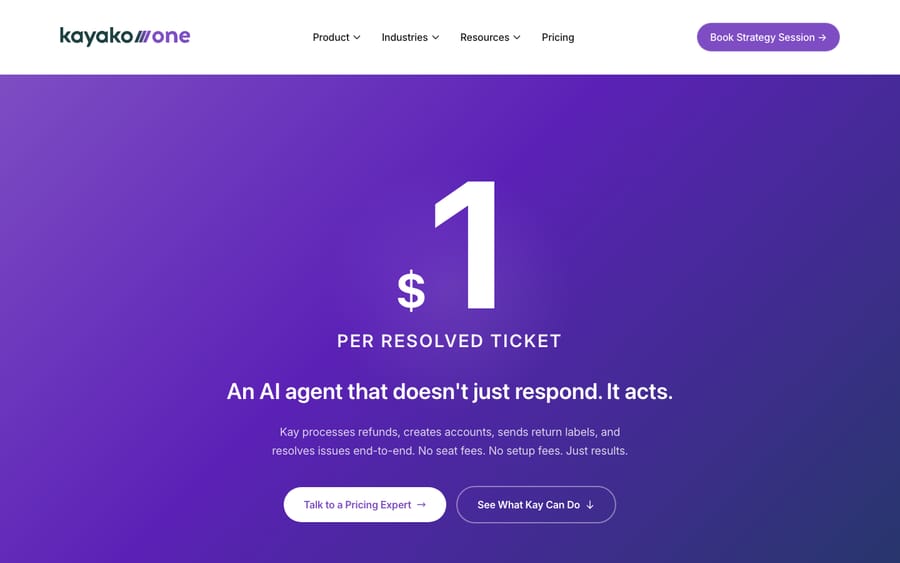
- Kayako's pricing page lists the Kay AI agent at $1 per resolved ticket with no seat fees, while the full Kayako One platform is priced only by quote.
- Freshdesk's Freddy AI Copilot costs $29 per agent per month, and the Freddy AI Agent gives each account 500 one-time sessions before charging $49 per 100.
- Freshdesk no longer shows a free plan on its pricing page; a separate Free program covers up to 2 agents for 6 months.
- Kayako holds 4.0 out of 5 from 176 Capterra reviews, with reviewers praising lightweight ticketing but calling the interface dated.

For most teams Freshdesk is the better pick in 2026: it publishes per-agent prices ($19, $55 and $89 a month on annual billing for Growth, Pro and Enterprise), while Kayako sells its full desk, Kayako One, by quote and leads with a Kay AI agent billed at $1 per resolved ticket. Kayako is the sharper choice only if you want to pay for AI resolutions rather than seats and are happy to buy through a sales call.
How do Freshdesk and Kayako compare at a glance?
| Freshdesk | Kayako | |
|---|---|---|
| Best for | Teams that want published per-agent pricing and a big app marketplace | Teams that want outcome-priced AI resolution and white-glove onboarding |
| Pricing entry | Growth $19/agent/mo, Pro $55, Enterprise $89 (annual); 14-day trial | Kay AI agent $1 per resolved ticket; Kayako One price by quote only |
| Free option | No free plan on the pricing page; a Free program covers up to 2 agents for 6 months | None listed |
| AI / automation | Freddy AI Copilot $29/agent/mo; Freddy AI Agent 500 one-time sessions, then $49 per 100 | Kay AI agent that takes actions (refunds, shipping, API calls), billed per resolution |
| Omnichannel | Email, chat, phone, social, WhatsApp (Omni packages) | Unified inbox: email, live chat, social; narrower channel breadth |
| Reviews | Reviewers rate setup and admin as easier (G2) | 4.0 out of 5 from 176 reviews on Capterra; UI often called dated |
Prices checked on the vendors' own pricing pages on 24 September 2026. Packaging changes often, so confirm before you buy.
Which is cheaper, Freshdesk or Kayako?
This is where the two products differ most.
Freshdesk publishes its pricing. The Freshdesk pricing page lists three paid tiers on annual billing: Growth at $19, Pro at $55 and Enterprise at $89 per agent per month, with 20% saved by paying annually and a 14-day trial of Enterprise. The page no longer shows a free plan; a separate Free program covers up to 2 agents for 6 months. AI is mostly an add-on. Freddy AI Copilot costs $29 per agent per month (annual), and the Freddy AI Agent is billed per session: each account gets 500 sessions as a one-time allowance, then pays $49 per 100 sessions. You can model a Freshdesk bill from public numbers before you ever talk to sales.
Kayako no longer works that way. Its pricing page has dropped the old per-agent tiers. It leads with the Kay AI agent at $1 per resolved ticket, which it describes as having no seat fees and no setup fees, charged only when Kay resolves an issue with no human involved. The full platform, Kayako One (inbox, ticketing, knowledge base, chat, automation, reporting, Kay and white-glove onboarding), carries no public price: you talk to a pricing expert. One third-party review, eesel AI's 2026 Kayako review, reports a base seat fee of roughly $79 per agent per month on top of the per-resolution charge. Kayako's own page does not confirm that figure, so get it in writing on a quote. Either way, costs scale with resolution volume: a busy team clearing thousands of AI resolutions a month will see the $1 fees add up, so model your own ticket volume first.
Bottom line on price: Freshdesk wins on transparency. Published seat prices let most teams self-serve. Kayako's outcome model only makes sense if paying strictly for resolutions is your priority and you are comfortable buying through sales.
Which has better AI, Freddy or Kay?
Both tools cover the help desk basics (ticketing, a knowledge base, SLAs and reporting), so the interesting differences are in how each one approaches AI.
Freshdesk's Freddy AI spans a copilot that drafts and summarizes for agents and an AI Agent that deflects repetitive queries across email, chat and messaging, priced per session rather than per seat. Kayako's Kay is more action-oriented: it is built to process refunds, update shipping, create accounts and close cases by calling your APIs. Kayako's pricing page claims a 68% AI resolution rate; that is the vendor's own figure, not an independent test.
That is a real split. Freshdesk gives you modular AI you bolt onto a mature desk; Kayako bets the product on an agent that takes actions and charges you when it succeeds. For the wider picture, our overview of AI agents for customer service explains the deflect, resolve and automate spectrum both vendors are chasing.
Which handles automation and workflows better?
Freshdesk's automation is deep and well documented: time- and event-triggered rules, ticket dispatch, SLA policies with reminders and escalations, and a large marketplace of apps and integrations. That breadth is a big reason reviewers pick it for growing teams; you can usually wire up what you need without custom development.
Kayako's automation is capable but narrower, centered on its unified inbox and on Kay taking actions. If your main workflow is "let the AI resolve or route it," that focus helps. If you rely on a long tail of third-party integrations and long rule chains, Freshdesk gives you more room.
Which is easier to set up and run?
Head-to-head reviews give Freshdesk the edge. On G2's Freshdesk vs Kayako comparison, reviewers found Freshdesk easier to use, set up and administer, and preferred doing business with Freshdesk overall.
Kayako is praised for being lightweight for day-to-day ticket work, and it holds 4.0 out of 5 from 176 reviews on Capterra (checked 24 September 2026). The recurring complaint is an interface that feels dated and sometimes cluttered, plus practical gaps: a weaker mobile app and the often-cited lack of native auto-refresh in busy queues. None of these is a dealbreaker, but they are why "legacy" comes up so often in Kayako discussions.
What support and ecosystem does each vendor offer?
Freshdesk benefits from the scale of Freshworks: extensive documentation, an active community, a large partner and app ecosystem, and support that climbs with your plan. Kayako takes a more hands-on approach. White-glove onboarding and setup are listed as part of Kayako One, which suits teams that want a guided rollout and a managed relationship rather than a self-serve marketplace.
What are the honest pros and cons?
Freshdesk pros: published per-agent pricing; modern interface; broad app marketplace; well-documented automation and SLAs; easier setup per reviewers. Cons: no free plan on the pricing page anymore; AI is mostly paid on top (Copilot per seat, AI Agent per session after the 500 one-time sessions), so the all-in cost climbs; per-session billing needs modelling.
Kayako pros: the Kay agent is charged only when it resolves a ticket; it takes actions through your APIs; lightweight ticketing; white-glove onboarding; a 4.0 out of 5 review average. Cons: no public price for Kayako One; interface seen as dated; weaker mobile app and no native auto-refresh; per-resolution fees scale with volume; reviewers mention past frustration over price increases and auto-renewals.
Which should you choose?
- Small or budget-conscious teams, or anyone who wants to self-serve: choose Freshdesk. Published seat pricing and a 14-day trial let you start without a sales call.
- Teams whose top priority is outcome-priced AI resolution: consider Kayako. If you would rather pay per resolved ticket, want an agent that acts on your APIs, and value guided onboarding, it is built for you. Model your resolution volume against the $1 charge first.
- Growing teams that depend on many integrations and complex workflows: lean Freshdesk for the marketplace and automation depth.
- Teams that value a hands-on vendor relationship over breadth: Kayako's onboarding is a real draw.
For most organizations, Freshdesk's transparent pricing, modern UI and ecosystem make it the safer default. Kayako is the better pick when outcome-priced, action-taking AI is the whole point.
Can you add a separate AI agent on top of either help desk?
The AI agent inside your help desk is only as good as what that vendor ships, and it is locked to their desk. You can instead run a separate AI agent layer on top of your help desk, one that reads and writes the same tickets, grounds answers in your own content and calls your systems through custom tools. Macha is that layer for Freshdesk: it connects to the Freshdesk you already use as a native connector and never replaces your desk. If you are deciding between a built-in agent and a dedicated platform, our take on the build-vs-buy tradeoff is a useful companion read. Macha's pricing is per ticket, starting at $299 a month for up to 750 tickets: one conversation is charged once however many messages it takes, rather than per resolution.
In practice you connect Macha to Freshdesk with your subdomain and API key, and it works the same tickets your team already handles: drafting grounded replies, triaging by intent, and looking up order or account status through a custom tool that turns a REST API into something the agent can call. Macha runs on Zendesk, Freshdesk, Gorgias, Front, HubSpot or Intercom; Kayako is not one of them.
FAQ
Is Freshdesk or Kayako cheaper? It depends on how you want to pay. Freshdesk publishes seat pricing from $19 per agent per month on annual billing (Growth), so small teams can predict the bill. Kayako lists its Kay AI agent at $1 per resolved ticket and prices the full Kayako One platform by quote. For most teams Freshdesk is easier to budget; for pure pay-per-resolution, Kayako's model may suit. Check both pricing pages before you buy.
Does Kayako still have per-agent pricing tiers? Not publicly. As of 24 September 2026, Kayako's pricing page leads with Kay at $1 per resolved ticket and asks you to talk to a pricing expert for Kayako One. eesel AI's review reports a roughly $79 per agent base fee, which Kayako's page does not confirm, so ask for it on a quote.
Does Freshdesk still have a free plan? Not on its pricing page. Freshdesk now shows Growth, Pro and Enterprise with a 14-day trial; a separate Free program covers up to 2 agents for 6 months.
Which has better AI, Freshdesk or Kayako? They are built differently. Freshdesk's Freddy AI is a copilot plus a per-session AI Agent focused on deflection; Kayako's Kay is built to take actions such as refunds, shipping updates and API calls, charges per resolution, and claims a 68% resolution rate on Kayako's own page. The better one depends on whether you want broad deflection or action-taking resolution.
Is Kayako considered a legacy help desk? It is an older product that reviewers still like for lightweight ticketing, but the interface is often called dated or cluttered, and there are gaps like a weaker mobile app and no native auto-refresh. Its move to an AI-first, outcome-based model is an attempt to modernize. Freshdesk is generally seen as the more modern desk.
Can I add AI to Freshdesk without switching help desks? Yes. An AI agent layer like Macha connects to Freshdesk as a native connector and runs on top of your existing desk without replacing it. It drafts grounded replies, triages by intent and calls your systems through custom tools, while Freshdesk stays the system of record.
Ready to add an AI agent layer on top of your Freshdesk? Start a free trial of Macha and connect it in minutes.