Shopify
 Stripe
 Slack
Slack Notion
 Google Workspace
 Confluence

Does Gorgias Charge Twice for AI-Resolved Tickets? Double Billing vs Per-Ticket AI (2026)


A conversation the Gorgias AI Agent closes with no human involved within 72 hours is billed twice: once as a helpdesk ticket and once as an automated interaction. Here is how the two meters stack on today's prices, and how per-ticket AI billing changes the arithmetic.
Key takeaways
- Gorgias bills one conversation twice, as a helpdesk ticket and as an automated interaction, only when the AI Agent resolves it with no human reply within 72 hours.
- Gorgias's AI Agent costs $1.00 per automated interaction on Starter, $0.90 on Basic and Pro, and $0.85 on Advanced, then $1.50 each past the plan's prepaid allowance.
- On annual Gorgias Pro, 2,000 tickets with 1,000 resolved by the AI Agent comes to about $1,686 a month, more than triple the $471 plan price.
- Gorgias's per-ticket overage is $0.40 on Starter and Basic and $0.36 on Pro and Advanced, while Enterprise overage pricing is custom and not published.
- Macha runs on top of Gorgias and bills each conversation once as a ticket, from $299 a month for 750 tickets, about $0.40 a ticket, with setup by the Macha team and a dedicated success manager included.

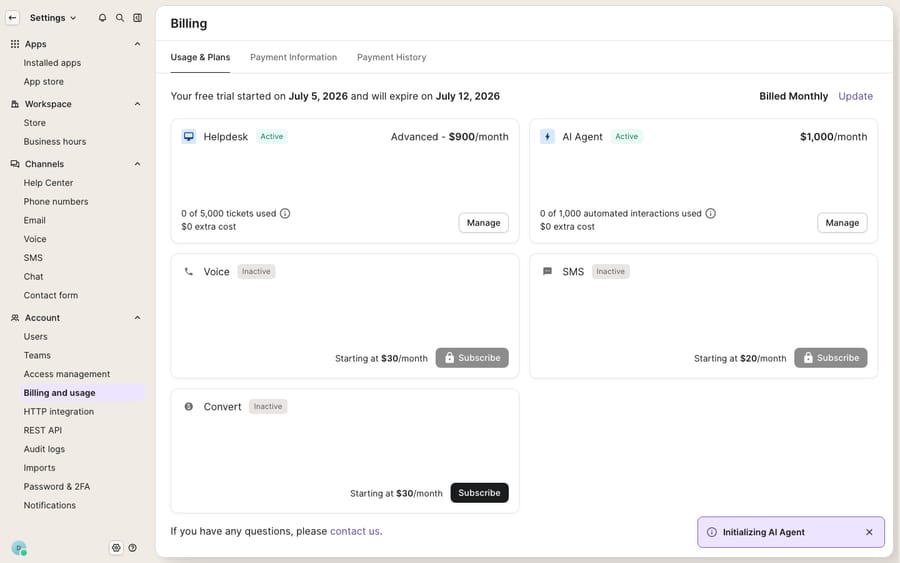
Yes: when Gorgias's AI Agent resolves a conversation with no human involved within 72 hours, that one conversation is billed twice, once as a helpdesk ticket and once as an automated interaction at $0.85 to $1.00, rising to $1.50 once you pass your plan's AI allowance (gorgias.com/pricing, checked 24 September 2026). If a teammate replies inside those 72 hours, the conversation costs a ticket only.
| Gorgias plan (with AI Agent) | Tickets / month | Overage per ticket | AI interactions included | Per interaction | Past the allowance |
|---|---|---|---|---|---|
| Starter, $40/mo | 50 | $0.40 | 30 | $1.00 | $1.50 |
| Basic | 300 | $0.40 | 30 | $0.90 | $1.50 |
| Pro, $471/mo annual | 2,000 | $0.36 | 190 | $0.90 | $1.50 |
| Advanced | 5,000 | $0.36 | 530 | $0.85 | $1.50 |
What does Gorgias actually meter?
Gorgias bills on usage rather than seats, which is a sensible model on its own. But it meters two different things, and the confusion starts where they overlap.
The first meter is the billable helpdesk ticket. Every plan bundles a quota of tickets: 50 on Starter, 300 on Basic, 2,000 on Pro and 5,000 on Advanced. Go over it and each extra ticket costs $0.40 on Starter and Basic and $0.36 on Pro and Advanced, per the Gorgias pricing page. Enterprise pricing is custom and not published. That's the classic help-desk unit.
The second meter is the automated interaction, which is what most people call an AI resolution. Since Gorgias added an "Add AI Agent" toggle to its pricing page, every plan with the AI Agent includes a prepaid block of interactions: 30 on Starter and Basic, 190 on Pro and 530 on Advanced. The per-interaction rate in Gorgias's comparison table is $1.00 on Starter, $0.90 on Basic and Pro, and $0.85 on Advanced. Past the block, each automated interaction costs $1.50. On annual Pro, the helpdesk line is $300 a month and the AI Agent line is $171, so the plan runs $471 before any overage.
Individually, both are defensible. The friction is that a single automated conversation can trip both meters at once.
When does one conversation become two charges?
Here's the rule, straight from Gorgias's own documentation. Per the How you're billed for using Gorgias help article, an automation fee and a ticket fee apply to the same ticket only when the ticket is entirely resolved by AI Agent, without human intervention. So the cleanest, most fully automated cases, the ones you'd expect to be cheapest, are exactly the ones that get billed twice.
There's an important qualifier that softens it, and it's only fair to state it plainly. Gorgias uses a 72-hour rule: an interaction only counts as "automated" if the customer doesn't need a human agent within 72 hours. If a teammate jumps in during that window, the conversation is billed as a ticket only, with no separate automation fee. The double charge lands on the conversations the AI closed cleanly and nobody reopened.
For a WISMO-heavy ecommerce inbox, that distinction matters, because WISMO is precisely the category the AI resolves end to end without a human ever looking. Here's the arithmetic on today's Pro prices, billed annually: 2,000 tickets a month, half resolved by the AI Agent. The helpdesk line is $300 and the AI line is $171 for the first 190 interactions. The other 810 automated interactions cost $1.50 each, or $1,215. The month comes to about $1,686, and every one of those 1,000 automated conversations also used up one of your 2,000 helpdesk tickets. The automation you switched on to save money has more than tripled the plan price.
The incentive is easy to see. A vendor that charges per automated interaction earns more as its AI closes more tickets, and the allowance is sized so a busy store crosses it quickly. The myAskAI breakdown cites one merchant on the Advanced plan at $13.5k a year who saw roughly $14,000 in AI charges stacked on top after enabling AI. That's myAskAI's report, not a figure Gorgias publishes, but it matches the mechanics.
None of this means Gorgias AI is a bad product. It means you have to model the combined cost, tickets and automated interactions together, instead of reading the headline plan price and assuming you're covered.
What do native Gorgias Automate and AI do well?
It would be dishonest to frame this as "Gorgias bad." For a brand that lives inside Gorgias, the native automation is strong, and for a lot of teams it's the right first move.
- It's already there and already connected. The AI Agent reads your Shopify order data, your macros and your help center out of the box, with no integration project. For a fuller tour of the native stack, our complete guide to Gorgias Automate and AI and the Gorgias AI Agent explained walk through it.
- It's tuned for ecommerce. WISMO, order tracking and simple returns are the AI Agent's home turf, and it handles them with almost no setup.
- Outcome-priced automation is legible to finance. "We paid $0.90 and the ticket closed" is an easy sentence to defend in a budget review.
Where it stops is worth naming just as plainly. First, outcome billing means you're paying for an outcome definition Gorgias controls, and that definition bills you twice on the conversations you automated most cleanly. Second, "automated" flattens a lot of nuance: a bot that deflects with an FAQ link, a bot that actually does something (issues the return, edits the order) and a bot that just replies convincingly all count the same to the meter, even though their value to the customer is very different. That gap between deflection, true resolution and automation is the heart of our take on AI agents for customer service.
How does per-ticket AI billing change the math?
A different unit changes the arithmetic. Instead of a fee per automated outcome, a per-ticket model charges once for the whole conversation, however many messages it takes, however many tools it calls, however many orders it looks up. You pay for the conversation you actually handled, not for a binary outcome whose definition belongs to someone else.
Macha is an AI agent layer built this way. To be clear about what it is: Macha runs on top of the Gorgias you already use through a live native connector. It isn't a Gorgias replacement and it doesn't move your help desk of record. It reads and writes the same Gorgias tickets, and you keep Gorgias for everything Gorgias is good at. What changes is the AI meter. Macha bills per ticket, one conversation charged once however many messages it takes, never per resolution. One plan, priced by volume: $299 a month for up to 750 tickets, $599 for 1,500, $1,199 for 3,000, about $0.40 a ticket. That price includes setup by the Macha team and a dedicated success manager who handles your changes afterwards: a new category, an instruction change, a new tool. A one-message WISMO reply and a multi-step return that fetched an order, checked a policy and posted a resolution cost the same.
Be precise about what that saves. The Gorgias helpdesk ticket still counts against your Gorgias plan, because Gorgias is still your help desk. What goes away is the second, per-interaction AI charge. Rerun the example: switch the Gorgias AI Agent off and Pro is $300 a month on annual billing. Put the 1,000 automated conversations on Macha's $599 tier and the month is about $899, against roughly $1,686 for the native route.
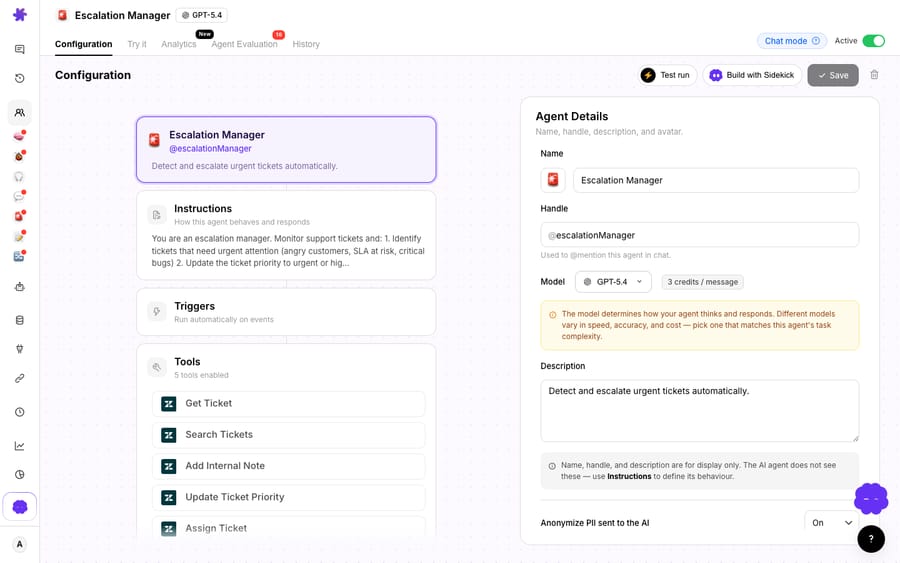
The screenshot below is from the Macha demo org: an Escalation Manager agent, configured once and then left to work tickets. Whatever it does inside a conversation, one reply or ten with tool calls in between, that whole conversation is one ticket on the bill.
The practical difference on an ecommerce inbox:
| Native Gorgias AI Agent | Per ticket (Macha layer) | |
|---|---|---|
| Unit billed | One fee per automated interaction | One ticket: the whole conversation, charged once |
| WISMO reply, 1 message | $0.85 to $1.00 inside the allowance, $1.50 past it | One ticket, about $0.40 |
| Multi-step return | Same per-interaction fee | Still one ticket, about $0.40 |
| Double charge? | Automation fee plus a billable ticket on the same conversation | No AI fee on top of the Gorgias ticket beyond the one Macha charge |
| Over the limit | $1.50 per interaction past the AI allowance | No overages: agents pause until you move up a tier or add a top-up; see pricing |
| Setup | Switched on in Gorgias; a Customer Success Manager depends on your annual Shopify GMV | Done for you by the Macha team, with a dedicated success manager, included |
| What it optimizes for | Closing the case (however defined) | The conversations you actually handled |
The point isn't that per-ticket billing is always cheaper. Macha is another vendor on top of the Gorgias bill, and that's honest. The point is that the price is predictable: one conversation, one AI charge, however many steps it took to finish. For a high-volume, low-complexity WISMO inbox, that predictability usually lands in your favor.
How do you add per-ticket AI without leaving Gorgias?
Because Macha is a layer, adoption is additive, not a migration.
- Keep Gorgias as your system of record. Your inbox, macros, views and Shopify data stay exactly where they are.
- Connect Macha to Gorgias via the native connector. The step-by-step is in connect Gorgias to Macha for automated ticket replies. That connection, plus the tools your answers come from, is your part, about 15 minutes. The Macha team then analyzes about a month of your past tickets, builds the knowledge base and the agent, and runs it in safe mode, with drafts as internal notes in Gorgias, until the drafts are right.
- Give the agent real tools. Point a custom tool at your order or subscription API so the agent can fetch a tracking status or start a return itself, instead of linking to an FAQ. The Macha team builds and tests these custom tools for you.
- Decide the split. Let the Macha agents carry the high-volume, repetitive work (WISMO, tracking, simple subscription changes), and route the complex cases to humans, the same handoff Gorgias's 72-hour rule already rewards.
If you're still comparing the native route head-on, our Gorgias pricing explained breakdown lays out the plan tiers and where the AI fees attach.
FAQ
Does Gorgias really charge twice for an AI-resolved conversation? In one specific case, yes. Per Gorgias's billing documentation, an automation fee and a helpdesk ticket fee apply to the same ticket only when the AI Agent resolves it entirely, with no human involvement. If a human replies within 72 hours, it's billed as a ticket only, with no separate automation fee.
How much is a Gorgias AI resolution? Gorgias calls it an automated interaction. The pricing page lists $1.00 on Starter, $0.90 on Basic and Pro, and $0.85 on Advanced, prepaid in a block of 30, 30, 190 or 530 interactions, then $1.50 each past the block. Check your own Billing & usage page too, as pricing changes.
Can I turn the Gorgias AI Agent off to avoid the second charge? Yes. The pricing page has an "Add AI Agent" toggle, and the helpdesk-only prices start at $10 a month on Starter and $300 a month on annual Pro. With it off, conversations are billed as tickets only.
What does per-ticket billing mean instead? Instead of a fee per automated interaction, you're charged once for the conversation itself: one thread with one person, charged once however many messages, tool calls or order lookups it takes. Macha starts at $299 a month for 750 tickets, about $0.40 each, which includes setup by the Macha team and a dedicated success manager who handles your changes.
Does Macha replace Gorgias? No. Macha is an AI agent layer that runs on top of Gorgias through a live native connector. Gorgias stays your help desk and system of record; Macha reads and writes the same tickets and adds AI agents on top, billed per ticket.
Which model is cheaper for my store? It depends on your mix. High-volume, low-complexity inboxes (lots of one-message WISMO) tend to favor a flat per-ticket charge, because past the AI allowance every automated Gorgias interaction costs $1.50. Model your real ticket and automation volumes together before deciding.
Want to see per-ticket economics against your own Gorgias volume? Start a free trial of Macha: $50 of free usage, about 125 tickets, with no credit card. The Macha team sets up your first agent on it and runs it in safe mode until the drafts are right.