Shopify
 Stripe
 Slack
Slack Notion
 Google Workspace
 Confluence

One AI Layer, Four Helpdesks: Zendesk, Freshdesk, Gorgias & Front


Most teams don't get to pick their helpdesk from a clean sheet. You inherited Zendesk from the last support lead, or your Shopify store grew up on Gorgias, or the ops team lives in a Freshdesk that finance already pays for, or the whole company runs out of shared inboxes in Front. Switching is a six-month project nobody wants. So when you go shopping for AI, the real question isn't "what's the best AI helpdesk" — it's "what AI can I add to the helpdesk I already have, without ripping anything out?"
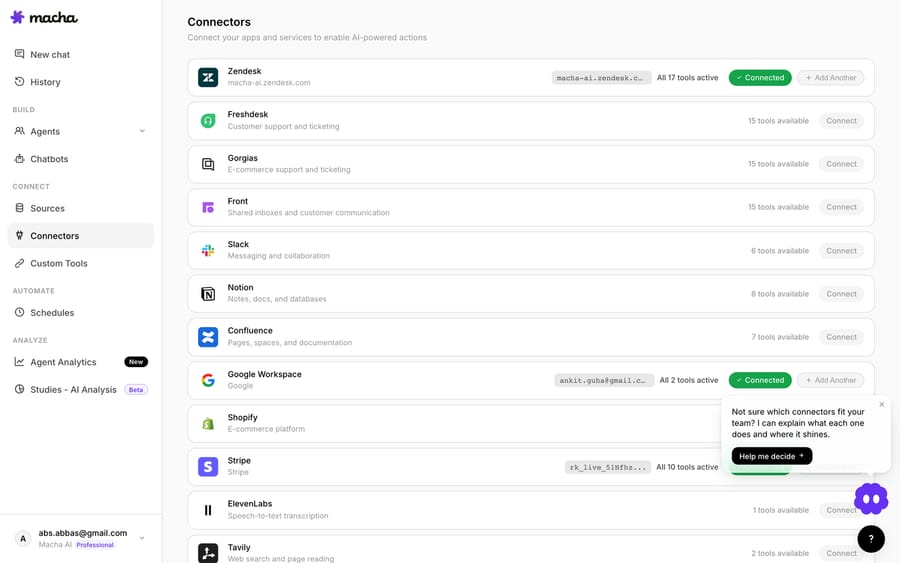
That's the question Macha is built to answer. Macha is not a helpdesk and it isn't trying to replace yours. It's an AI agent layer that sits on top of the helpdesk you run today — reading tickets, drafting and posting replies, updating status and fields, routing to the right queue, and pulling in commerce and knowledge context from tools like Shopify, Stripe, and Notion. The same agents, the same builder, the same knowledge base — wired into Zendesk, Freshdesk, Gorgias, or Front.
This post is a connector-by-connector look at what that actually means: what each of the four helpdesk integrations can do, where they're identical, and the few places they genuinely differ.
Why "layer, not replacement" is the whole point
There are two ways to bring AI into support. One is to migrate to a platform that bundles its own AI — you move your tickets, your macros, your routing rules, your SLAs, and your team's muscle memory onto someone else's rails. The other is to leave the system of record exactly where it is and bolt an AI agent onto it through the API.
Macha is firmly the second kind. Your tickets keep living in Zendesk (or Freshdesk, Gorgias, Front). Your agents, reporting, and SLAs don't move. Macha authenticates into the helpdesk, listens for the events you care about, and acts inside the same ticket your human agents see — public replies are public replies, internal notes are internal notes, tags are real tags.
This is the same shape the rest of the "AI on top of your helpdesk" category has converged on. eesel AI plugs into Zendesk, Freshdesk, Gorgias, Front and more on a pay-per-task model (around $0.40 per resolved ticket at time of writing). Fini runs its agent inside a similar spread of helpdesks. The premise everyone agrees on: teams want AI without the migration. Where Macha differs is less about which logos it supports and more about what the agent is allowed to do once it's in — which is the rest of this article.
One quick distinction worth making: Gorgias is itself a Shopify-native helpdesk with its own AI Agent. Macha isn't a Gorgias alternative — it's a layer you can run on Gorgias (or instead bring the same agent logic to Zendesk and Front), so the choice of helpdesk and the choice of AI stop being the same decision.
The capability you get on every helpdesk
Before the differences, the baseline. All four connectors are live and share the same core verbs, because Macha's agents are built once against a common action vocabulary. On every supported helpdesk an agent can:
- Read the full ticket / conversation — the entire message thread, requester or contact details, assignee, status, tags, and custom fields.
- Search tickets/conversations and the people behind them (users, contacts, customers).
- Reply publicly to the customer through the ticket's own channel — email, chat, and so on.
- Post a private internal note that only agents see.
- Update status, priority, and tags.
- Update custom fields (with validation, so dropdown values and dates are checked before they're written).
- Assign / route the ticket to a specific agent, group, team, or teammate.
- Read attachments — extract text from PDF, DOCX, XLSX, and CSV files a customer sent in.
- Fire automatically on new events via triggers (more on that below) — no human has to hand the ticket to the AI.
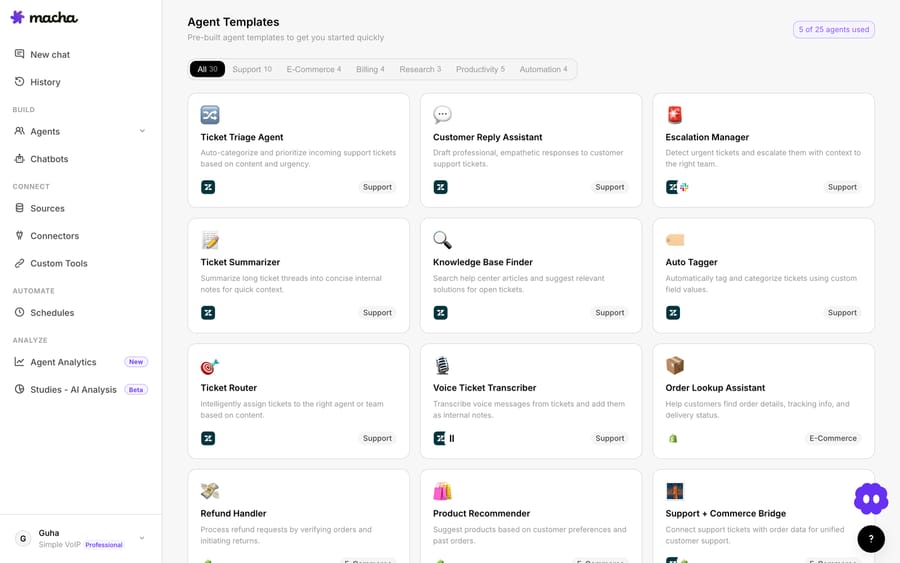
In practice, that's enough to run an end-to-end workflow on any of the four: new ticket arrives → agent reads it → looks up the order in Shopify and the policy in Notion → drafts a reply → either posts it or leaves an internal note for a human → sets status and tags → routes if it needs a specialist. The helpdesk underneath barely changes the recipe.
You build that workflow once, against Macha's agent builder and templates — not four times.
Where the four connectors differ
The differences are real but narrow. Here's the honest map.
| Capability | Zendesk | Freshdesk | Gorgias | Front |
|---|---|---|---|---|
| Auth | OAuth / API Key | API Key | API Key | API Token |
| Read ticket + custom fields | ✅ | ✅ | ✅ | ✅ |
| Public reply + internal note | ✅ | ✅ | ✅ | ✅ (note supports @mentions) |
| Update status / priority / tags / fields | ✅ | ✅ | ✅ | ✅ (status = archive / reopen / trash) |
| Assign / route | Agent + group | Agent + group | User + team | Teammate |
| Read attachments (text extract) | ✅ | ✅ | ✅ | ✅ |
| Image attachment analysis (AI vision) | ✅ | — | — | — |
| Live knowledge-base sync | ✅ Help Center auto-sync | On-demand article search | — | — |
| On-demand article / macro search | Articles (semantic) | Articles | Macros (canned responses) | Tags list |
| Triggers (autonomous events) | 8 | 3 | 4 | 4 |
| Social / messaging channels in triggers | ✅ (WhatsApp, Messenger, IG, LINE, Telegram, web) | — | New-message events | New-message events |
A few of these deserve a sentence.
Zendesk is the deepest connector. It's the only one with AI vision on image attachments — the agent can actually see a screenshot, receipt, or damaged-product photo and describe it — and the only one with live Help Center sync, where your published articles flow into Macha's knowledge base over a webhook and stay current. It also has the richest trigger set (eight events, including a dedicated Messaging trigger that fires on WhatsApp, Messenger, Instagram, LINE, Telegram, and web chat). If Zendesk is your stack, you get the most surface area. We go deeper on it on the Macha on Zendesk page.
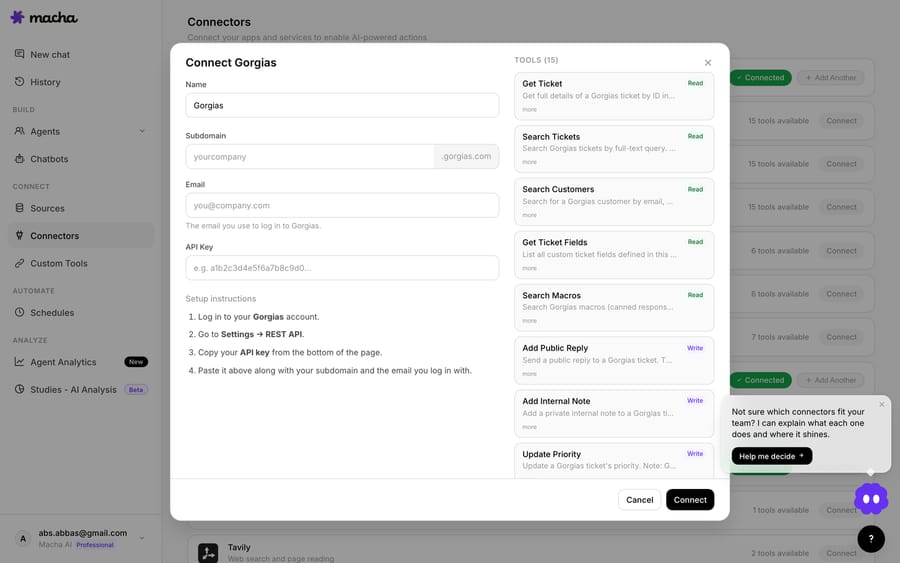
Gorgias adds macros. Because Gorgias teams live and die by canned responses, the connector can search your macros and apply the right pre-written reply — handy for Shopify support where the same WISMO, returns, and cancellation answers repeat all day. Pair it with Macha's Shopify connector and the agent has live order context to drop into those replies.
Front is the shared-inbox specialist. It's the one connector whose internal comments support @mentions, so the agent can tag a specific teammate when it escalates. It also exposes inboxes, teammates, and teams, and searches contacts across every handle (email, phone, social) — the things a multi-channel inbox team needs for routing. Its status verbs match Front's mental model: archive (close), reopen, or trash.
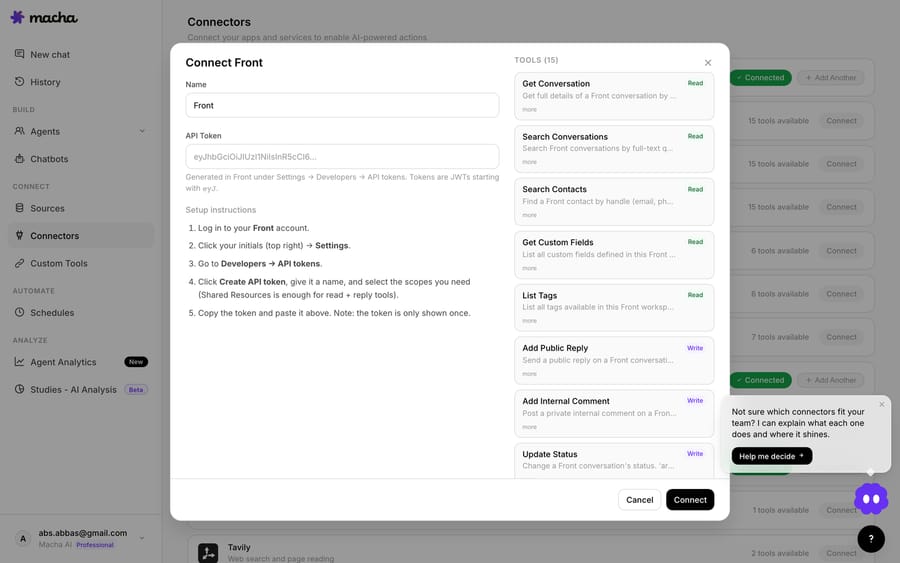
Freshdesk is the clean middle. Full read/reply/note/status/priority/tags/fields/assign, plus knowledge-base article search and agent/group listing for routing. It doesn't (yet) do live KB sync or image vision, but for end-to-end ticket handling it has everything an agent needs.
The headline: the workflow you design transfers across all four. What changes is the trimming — a couple of premium tricks on Zendesk, macros on Gorgias, @mentions and inboxes on Front.
Triggers: how the agent runs without a human
A connector that can only act when a person asks it to is a copilot. The interesting part is autonomous triggers — Macha attaching to a helpdesk event so the agent runs on its own.
Every helpdesk fires on new tickets/conversations and on customer replies / new messages, and every one exposes a Custom Webhook option — Macha generates a URL you drop into any native rule (a Zendesk trigger, a Freshdesk automation, a Gorgias HTTP integration, a Front rule's "Send a webhook" action) so you decide exactly which tickets reach the AI. Zendesk adds status-changed, priority-changed, assigned, closed, and that omnichannel Messaging trigger; Front adds a conversation-assigned event.
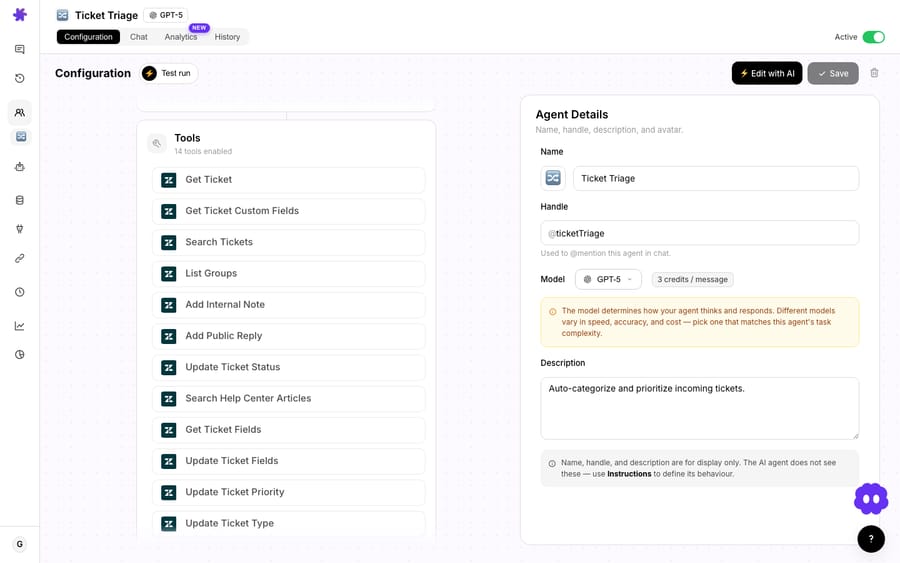
The practical pattern most teams start with: gate the AI behind a native rule (e.g. only tickets tagged ai-eligible, or only the billing inbox) using Custom Webhook, watch it draft internal notes for a week, then let it post public replies once you trust it. Same pattern on all four helpdesks.
What it costs to run
Macha doesn't charge per helpdesk or per "resolution." You pay in credits, and a credit is spent per AI action — each model call the agent makes. The default model (GPT-5.4 Mini) costs 1 credit per action; lighter or heavier models range roughly 0.5 to 9 credits depending on which you pick. A simple "read ticket, draft reply, post it" run is a handful of credits; a research-heavy multi-tool run is more. You see and choose the model, so cost is a dial you control, not a surprise.
That's a deliberately different shape from resolution-based pricing. eesel bills ~$0.40 per resolved ticket; Gorgias's own AI counts each AI conversation at roughly $0.90–$1.00 and as a ticket. Credits-per-action means you're paying for the automation work done, not betting on an outcome the model doesn't fully control. New accounts start with a 7-day free trial, no credit card required — connect a helpdesk and run real tickets before you decide. Full plans are on the pricing page; a single Professional workspace can connect multiple tools at once, so a four-helpdesk org isn't four subscriptions.
Watch-outs: when this isn't the right fit
A few honest caveats.
- If you don't have a helpdesk yet, Macha isn't your starting point — it layers onto one. Stand up Zendesk, Freshdesk, Gorgias, or Front first, then add the agent.
- Knowledge sync is a Zendesk advantage. On Freshdesk, Gorgias, and Front the agent can search articles on demand (or you point it at Notion, Confluence, Google Docs, or uploaded files instead), but you don't get the same live Help Center auto-sync Zendesk has. If a single always-current KB pulled straight from your helpdesk is non-negotiable and you're not on Zendesk, plan to use Macha's own knowledge sources.
- Image vision is Zendesk-only today. If "read the screenshot the customer attached" is core to your workflow and you're on another helpdesk, that specific trick isn't there yet.
- One helpdesk per workflow, not a merge. Macha connects to all four, but it isn't a unified-inbox product that fuses tickets from multiple helpdesks into one stream. If you run two helpdesks at once, you build agents against each — you don't get a single merged queue.
- It's only as good as its access. An agent that can't see the order, the policy, or the account won't magically resolve the ticket. Budget time to connect the commerce/knowledge tools that give it context; the helpdesk connector alone is half the picture.
FAQ
Does Macha replace my helpdesk? No. Macha is an AI agent layer that runs on top of Zendesk, Freshdesk, Gorgias, or Front. Your tickets, agents, SLAs, and reporting stay exactly where they are.
Can one Macha account connect to more than one helpdesk? Yes. You can connect multiple tools to a single workspace and build agents against each. Note that Macha doesn't merge tickets from different helpdesks into one unified queue — each helpdesk keeps its own.
Which helpdesk gets the most capability? Zendesk, currently. It's the only connector with AI image vision, live Help Center sync, and the largest trigger set (eight events including omnichannel messaging). Freshdesk, Gorgias, and Front share the same core ticket actions; Gorgias adds macro search and Front adds @mention escalation and inbox routing.
Do I need engineering to set it up? No. Helpdesk connectors authenticate with OAuth or an API key/token, and agents are built in Macha's no-code builder and templates. Custom webhooks (optional) are a copy-paste URL into your helpdesk's native rules.
How is this priced versus per-resolution AI? Macha bills in credits per AI action (default model = 1 credit; ~0.5–9 by model), not per resolved ticket. You choose the model, so cost is something you tune. See the pricing page.
Where can I read the connector details? The integrations directory has a page per helpdesk listing every action and trigger, and the docs walk through connecting one and building your first agent.
Macha is the AI agent layer for the helpdesk you already run. Connect Zendesk, Freshdesk, Gorgias, or Front, point it at your commerce and knowledge tools, and let agents resolve, triage, and route — on the rails you already have. Start a 7-day free trial, no credit card required.
Add AI agents to your Zendesk
Macha reads the ticket, drafts the reply and takes the action, inside the Zendesk you already run.