Shopify
 Stripe
 Slack
Slack Notion
 Google Workspace
 Confluence

Automated Resolution vs Deflection vs Automation: What's the Difference? (2026)


Automated resolution is when an AI agent solves a customer's issue end-to-end — no human touches it and the problem is actually fixed. That sounds simple, but it gets confused constantly with two neighboring terms — deflection (the contact avoided a human) and automation (any task a system did automatically) — and the confusion is not accidental. These three words describe genuinely different things, they're measured in genuinely different ways, and vendors have a real financial reason to blur the lines between them, because the line you land on decides whether you're billed per "resolution," per action, or not at all. This guide defines all three precisely, shows how each is measured, walks through why "resolution" means something different at Fin, HubSpot, Gorgias, and Zendesk, and lists the questions that cut through the marketing.

The three terms, defined precisely
The fastest way to keep these straight is to notice that each one answers a different question.
- Deflection answers: did the contact avoid a human agent? A deflected contact is one that got handled by self-service, a help-center article, or a bot instead of landing in an agent's queue. Deflection is about avoidance — it says nothing about whether the customer was helped. (We go deep on this in what is deflection rate.)
- Automated resolution answers: did the AI actually solve the issue, end-to-end, with no human? This is the strict one. A resolution requires the customer's problem to be genuinely fixed — the refund processed, the password reset, the question correctly and completely answered — without escalation. Resolution is about outcome.
- Automation answers: did a system perform a task without a person doing it manually? This is the widest term. Tagging a ticket, routing it to the right queue, drafting a suggested reply, looking up an order, triggering a macro — every one of those is automation, and none of them necessarily resolves anything. Automation is about work performed.
So the relationship is nested but not equal. Every automated resolution involves automation, and most deflections involve some automation — but plenty of automation resolves nothing, and plenty of "deflections" leave the customer unhelped. Holding the three apart is the entire point.
| Term | The question it answers | What it measures | A high number means… |
|---|---|---|---|
| Deflection | Did the contact avoid a human? | Avoidance | Fewer tickets reached agents (helped or not) |
| Automated resolution | Did the AI fully solve it, no human? | Outcome | Issues genuinely fixed without escalation |
| Automation | Did a system do the task automatically? | Work performed | More steps ran without manual effort |
Tellingly, even the vendors maintain this separation in their own docs. Zendesk's help center publishes a whole article distinguishing deflection, AI agent-handled, automated resolution, and custom resolution rates as four separate metrics — proof that these aren't interchangeable, even if the sales decks treat them that way.
Why vendors blur them (it's a billing decision)
Here's the uncomfortable part. The choice of which term a vendor builds its dashboard — and its invoice — around is rarely neutral, because each maps to a different way of charging you.
- If a vendor bills per resolution, it's in their interest to define "resolution" broadly, so more interactions clear the bar and the meter ticks more often.
- If a vendor leads with deflection in marketing, a big-sounding number (often inflated by abandonment) makes the product look effective — even when the underlying resolution rate is far lower.
- If a vendor bills per action (or per conversation), "resolution" stops being a billing event at all, so there's no definition to stretch.
The gap this creates is well-documented across the industry: vendors and analysts repeatedly point out that a headline deflection figure can sit on top of a much lower true-resolution figure, because deflection counts an abandoned chat and a confidently wrong answer exactly the same as a real fix (MavenAGI, Fini, Duckie). Treat those specific percentages as directional and vendor-authored — but the direction is real and consistent: the word a vendor optimizes for tells you what they want you to look at. The deeper version of this trade-off — paying for outcomes versus paying for work — is the subject of our per-action vs per-resolution AI pricing breakdown.

Update (June 2026): Salesforce has agreed to acquire Fin (formerly Intercom) for ~$3.6 billion and plans to fold it into Salesforce's Agentforce — the deal was announced June 15, 2026 and is expected to close around Q4 of Salesforce's FY2027, worth weighing in any long-term Intercom/Fin decision.
How each one is measured
Because they answer different questions, they're computed differently — and the formulas expose how much room there is to interpret.
Deflection is typically deflected contacts ÷ total contact attempts × 100. The slippery part is the denominator and what counts as "deflected" — a customer who reads an article and silently gives up can be logged as a deflection just as easily as one who got their answer. (The honest formula and the abandonment trap are covered in detail in our deflection rate guide.)
Automated resolution rate is automated resolutions ÷ total conversations × 100 — but everything rides on how "resolution" is detected, and there are two fundamentally different methods:
- Assumed (implicit) resolution — the system declares victory when the customer doesn't reply or reopen within a time window (commonly 24–72 hours). Cheap to measure, but it can't tell a satisfied customer from one who quietly left.
- Confirmed (explicit) resolution — the customer takes a positive action ("That helped 👍," an affirmative reply, a CSAT thumbs-up) or an LLM independently verifies the issue was solved. Harder to game, closer to the truth.
The single biggest reason two products quote wildly different resolution rates is which of these they use. As Zendesk's own guidance on AI resolution rate and independent measurement write-ups stress, a verified-resolution number and an assumed-resolution number are not comparable — and the honest metrics to pair them with are re-contact rate (do "resolved" customers come back within 48–72 hours?) and CSAT.
Automation is usually measured as a count or rate of automated actions or tasks — how many replies were drafted, tickets tagged, lookups run, workflows triggered — independent of outcome. It's the most honest-to-measure of the three precisely because it doesn't require anyone to judge whether the customer was happy; it just counts work the system did.
Why "resolution" means something different at every vendor
This is where buyers get burned, because "automated resolution" is not a standardized term. Each major platform defines it — and bills for it — its own way. Here's how four of the biggest differ in 2026.
Intercom Fin charges $0.99 per outcome, and a "resolution" is one type of outcome. It counts when, after Fin's last answer, the customer either confirms it helped (clicks "That helped 👍" or replies affirmatively — a confirmed resolution) or exits without asking for more help within 24 hours (an assumed resolution). Fin bills at most once per conversation. The catch buyers miss: that 24-hour assumed resolution still bills at $0.99 even if the customer simply wandered off (Intercom's Fin AI Agent outcomes docs; see also Gleap's breakdown).
HubSpot Breeze moved its Customer Agent to outcome-based pricing in April 2026: each resolved conversation costs 50 credits (~$0.50 at $10 per 1,000 credits). HubSpot counts a conversation "resolved" when the agent shares a content source or performs an action with no human handoff within 72 hours of its last message — or when a lead is marked qualified, partially qualified, or not qualified. And there's a reopen wrinkle: if the customer replies after the 72-hour window, the conversation is treated as reopened, the window resets, and a new resolution can be billed for the same thread (HubSpot's Customer Agent docs; resolve247 analysis).
Gorgias Automate counts an interaction as an automated resolution only after the AI resolves it entirely on its own and 72 hours pass with no human agent stepping in. It also de-duplicates: if the same shopper uses an automation to answer the same question twice inside that 72-hour window, it isn't double-counted — which is why Gorgias's own reports deliberately omit the most recent 72 hours (Gorgias automation docs).
Zendesk defines an automated resolution as the AI fully resolving an issue with no live-agent help, counted per conversation, and — distinctively — uses an internal LLM to verify the resolution was legitimate, alongside a 72-hour no-reopen window (Zendesk's automated resolutions docs).
Line those up and the lesson is stark: a "resolution" can be customer-confirmed, LLM-verified, assumed-after-24-hours, or assumed-after-72-hours; it can re-bill on reopen or not; it can de-dupe repeats or not. Comparing two vendors' resolution rates — or their per-resolution prices — without reading these definitions is comparing numbers that don't mean the same thing.
What buyers should ask
Before you trust any "automated resolution" or "deflection" number on a slide, ask:
- "Resolution, deflection, or automation — which are you reporting?" Pin the word down first. If they say "resolution," make them define it precisely.
- **"Is a resolution confirmed or assumed?"** Confirmed (customer action or LLM verification) is real; assumed-after-a-timeout includes everyone who quietly gave up. This single answer can swing the number by tens of points.
- "What's the time window, and does a reopen re-bill?" A 24-hour vs 72-hour window changes the count; a reopen that triggers a fresh charge changes your invoice.
- "What's the re-contact rate on 'resolved' tickets?" If customers come back within 48–72 hours, the resolution number is inflated. This is the honesty check.
- "Does a resolution also count as something else I'm billed for?" Some platforms count an AI resolution and an underlying ticket/interaction — read the double-count fine print.
- "What exactly am I billed for — the outcome, the conversation, or each action?" This determines whether definitional fuzziness even affects your bill. (Our per-action vs per-resolution guide works the math.)
Where this leaves automation pricing — and Macha
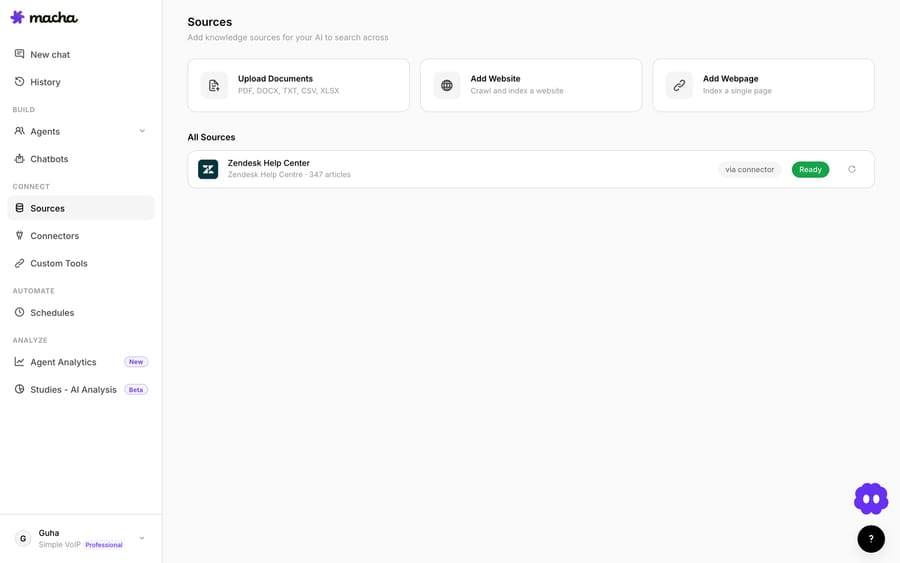
There's a reason this distinction matters beyond vocabulary, and it's worth being upfront about since we publish this. Macha is an AI agent layer that runs on top of your existing helpdesk — Zendesk or Freshdesk — rather than replacing it. And Macha deliberately bills per AI action — each step an agent takes, like reading a ticket, pulling from your connected knowledge, drafting a reply, tagging, or routing — not per "resolution" and not per "deflection."
The reason is exactly the ambiguity this whole article documents. A "resolution" is a fuzzy, vendor-defined, sometimes-assumed event; charging for one we can't always verify would mean billing you for a number we got to define. So Macha prices the work the agent actually does and treats it as automation and orchestration, because outcomes genuinely vary with how good your knowledge base is and how messy your tickets are. That's an honest framing, not a superior one: per-action asks you to understand your usage, and if you'd rather pay only when a vendor declares a win — and you trust their definition — a per-resolution agent may suit you better. An AI agent is also only as good as the knowledge connected to it, which is why what feeds the agent matters as much as how it's billed.
If repetitive, answerable questions dominate your queue, that's the line where automation starts paying off — and you can watch the work happen action by action rather than trusting a tidy "resolved" label. You can try it free — 7-day free trial, no credit card required.
Frequently asked questions
What is automated resolution? Automated resolution is when an AI agent fully solves a customer's issue end-to-end — the problem is actually fixed, with no human agent involved and no escalation. It's stricter than deflection (which only means the contact avoided a human) and narrower than automation (which is any task a system does automatically, resolved or not).
What's the difference between automated resolution and deflection? Deflection measures avoidance — the contact didn't reach an agent — and counts abandoned or wrongly-answered conversations as successes. Automated resolution measures outcome — the issue was genuinely solved. A bot can show a high deflection rate while its true resolution rate is far lower, because deflection can't tell a helped customer from one who gave up.
How is automated resolution rate measured? It's automated resolutions ÷ total conversations × 100, but everything depends on how "resolution" is detected. Assumed resolution declares success when the customer doesn't reply within a window (24–72 hours); confirmed resolution requires a positive customer action or LLM verification. Always pair the rate with re-contact rate and CSAT to catch inflation.
Why do vendors define "resolution" differently? Because for many of them resolution is a billing event, and a broader definition means more billable resolutions. Intercom Fin counts assumed resolutions after 24 hours; HubSpot uses a 72-hour window that can re-bill on reopen; Gorgias requires 72 hours with no human and de-dupes repeats; Zendesk LLM-verifies. None are "wrong," but they aren't comparable — read each definition before comparing prices or rates.
Is automation the same as resolution? No. Automation is any task performed without manual effort — tagging, routing, drafting, looking up an order. Most of those don't resolve anything on their own. Resolution requires the customer's issue to actually be fixed. You can automate heavily and still have a low resolution rate, and vice versa.
Which metric should I optimize for? Resolution that customers confirm, with a low re-contact rate and healthy CSAT — that's the one that reflects real help. Use deflection as an operational load indicator and automation as an efficiency measure, but never report either alone or treat a big deflection number as proof the AI is working.
The bottom line
Deflection, automated resolution, and automation answer three different questions — did the contact avoid a human, did the AI actually solve it, and did a system do the work — and the differences are not pedantic. They're measured differently, they're easy to conflate, and vendors have a billing incentive to blur them, which is why "automated resolution" can mean a customer-confirmed fix at one vendor and a 24-hour silent timeout at another. Before you trust any number, pin down which term you're looking at, demand the exact definition of "resolution" (confirmed vs assumed, the window, the reopen and double-count rules), and check it against re-contact rate and CSAT. The headline metric on the slide is only as honest as the definition underneath it — and the definition is usually written by whoever profits from the number.
Sources reviewed June 2026; vendor resolution definitions and rates were current as of mid-2026 from each company's documentation and secondary coverage, and several illustrative percentages are vendor-authored — treat them as directional and confirm definitions on each vendor's own docs. Next review by December 2026.
Automate your support workflows
Macha's agents run multi-step workflows across the tools you already connect.