Shopify
 Stripe
 Slack
Slack Notion
 Google Workspace
 Confluence

Best Gorgias Competitors (2026): The Ecommerce Helpdesk Landscape


Gorgias won its reputation as the help desk built for Shopify — a shared inbox that pulls order data, edits, refunds and cancellations right into the ticket so agents rarely leave the screen. But it is not the only tool that does this, and the moment you start shopping you discover the "Gorgias competitor" label covers wildly different products: ecommerce-native inboxes that mirror Gorgias almost feature-for-feature, CRM-style platforms built around a unified customer timeline, lightweight SMB-chat tools that lead with a widget, and marketplace-first desks tuned for Amazon and eBay sellers. This guide is a map of that landscape by segment, not a ranked listicle. The goal is to help you find the box your business belongs in first, then pick within it — because the right competitor depends far more on your channel mix and catalogue than on any single feature checkbox.

If you want a straight ranked list of swaps, we keep a separate best Gorgias alternatives post for that. This one stays deliberately different: it groups the field so you can reason about categories.
At a glance: the four segments
Here is the landscape sorted into the four buckets that actually predict fit. Prices are entry points as of capture and move often — confirm on each vendor's own page before you commit.
| Tool | Segment | Best for | Pricing entry (as of capture) | Ecommerce / Shopify depth | AI / automation | Channels | Standout strength |
|---|---|---|---|---|---|---|---|
| Gorgias | Ecommerce-native | Shopify brands wanting deep order actions | ~$10–$60/mo + AI per resolution | Deep, native | AI Agent (Shopify-first) | Email, chat, SMS, social, voice | Shopify actions in-ticket |
| Richpanel | Ecommerce-native | DTC brands wanting AI to carry volume | ~$300/mo usage-based | Deep (Shopify, Recharge, Loop) | AI-first, resolution-guaranteed | Email, chat, social | AI conversation model |
| eDesk | Marketplace-focused | Multi-marketplace sellers | ~$39/agent/mo | Broad (Shopify + Amazon/eBay/Walmart) | AI Assist add-on | Email, chat, marketplaces | Marketplace coverage |
| DelightChat | Ecommerce-native (WhatsApp) | WhatsApp-led ecommerce | ~$29/mo + WhatsApp at cost | Shopify + WhatsApp commerce | Automations, broadcasts | WhatsApp, IG, email, chat | WhatsApp marketing + support |
| Kustomer | CRM-style | Larger brands wanting one timeline | Demo-gated | Integrations, not native-first | AI + automation | Omnichannel | Unified customer record |
| Zoho Desk | CRM-style | Zoho-stack businesses | ~$14+/user/mo (INR storefront) | Via integrations | Zia AI | Omnichannel | Value + Zoho suite |
| Re:amaze | SMB-chat | Small teams, predictable seats | ~$29/user/mo | Solid (Shopify, BigCommerce) | Basic automation + AI | Email, chat, social, SMS | Simplicity + flat option |
| Tidio | SMB-chat | Small stores leading with chat | ~$24.17/mo + Lyro AI | Shopify app, lighter depth | Lyro AI (per conversation) | Chat, email | Chat-first + Lyro |
| Help Scout | SMB-chat (support-led) | Brands wanting predictable seats | ~$25/mo + AI per resolution | Integrations, not native-first | AI Answers ($0.75/resolution) | Email, chat, docs | Clean, human support UX |
Pricing: the models matter more than the numbers
The single biggest reason teams leave Gorgias is billing surprise, so it is worth understanding what kind of meter each competitor runs before you compare sticker prices.
Gorgias itself is ticket-metered. On its published tiers (gorgias.com/pricing), plans run from a Starter around $10/mo up through Basic $60/mo, Pro $360/mo and Advanced $900/mo on monthly billing, with annual pricing shaving those down (Pro to $300/mo, Advanced to $750/mo), all as of capture — and the full Gorgias pricing breakdown explains how billable tickets are counted. The AI Agent is a separate add-on charged roughly $1.00 per resolved conversation monthly ($0.90 annual), and reviewers on G2, where Gorgias holds a 4.6 rating, repeatedly flag that ticket fees plus per-resolution AI fees can roughly double a bill at scale.
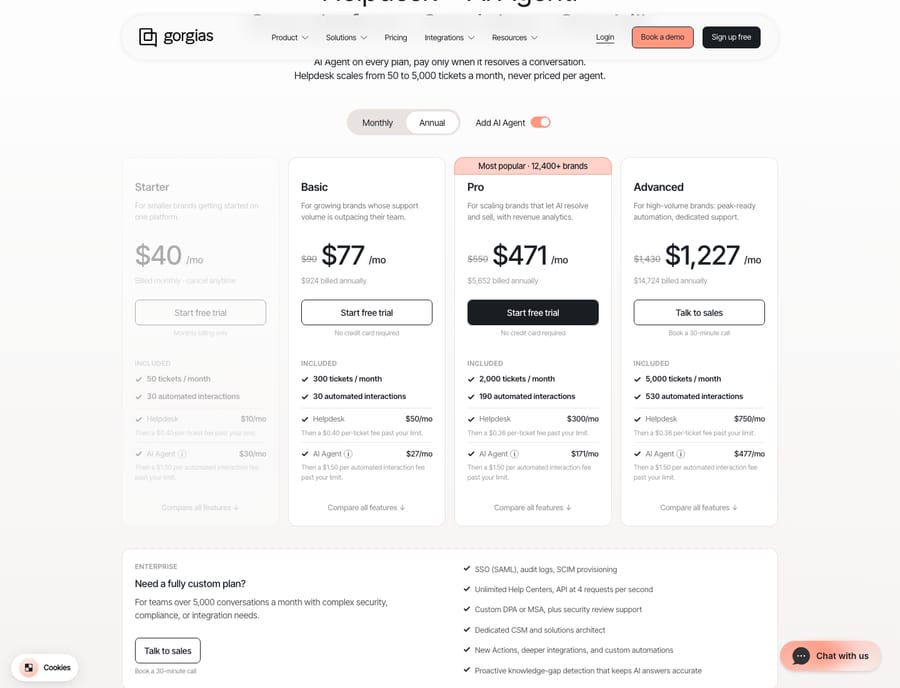
The competitors split cleanly by meter. Usage-based: Richpanel starts around $300/mo as of capture (roughly 1,000 AI conversations at $0.20 each plus one seat at $100), per richpanel.com/pricing; Tidio layers a Lyro AI conversation meter on top of its plans. Per-resolution: Help Scout adds AI Answers at $0.75 per resolution, and Gorgias' own AI add-on works the same way. Flat per-seat: Re:amaze runs $29 / $49 / $69 per user/mo (Basic/Pro/Plus) with a $59 flat unlimited-seat Starter; eDesk lists Essential $39, Growth $89, Professional $119 per agent/mo; DelightChat runs $29 / $99 / $299/mo with WhatsApp charges billed at cost; Zoho Desk sits at the value end (its India storefront lists tiers from roughly Rs 420 to Rs 2,400 per user/mo billed yearly). Kustomer is demo-gated with no public per-tier price, which itself signals its enterprise posture.
The lesson: a flat per-seat tool is predictable but you pay whether or not a ticket is worth answering; a usage or per-resolution meter tracks value but can spike in a sale. Neither is "cheaper" in the abstract — it depends on your ticket-to-revenue ratio.
Ecommerce & Shopify depth
This is the axis where the segments separate hardest. Ecommerce-native tools — Gorgias, Richpanel, DelightChat — treat the storefront as a first-class object: order lookups, refunds, subscription edits (Recharge, Loop) and cancellations happen inside the ticket, and the AI can be trusted to act, not just answer. Gorgias sets the bar here and it is why brands with heavy refund/edit volume stay. What Gorgias is at its core is that Shopify-action layer.
Marketplace-focused eDesk is the specialist: alongside Shopify and WooCommerce it plugs into Amazon, eBay, Walmart and TikTok Shop, which no purely Shopify-tuned tool matches — if a big slice of your revenue is on marketplaces, this segment is your shortlist of one. CRM-style platforms (Kustomer, Zoho Desk) reach ecommerce data through integrations rather than a native-first design; you gain a unified customer record and cross-team workflows, you lose the out-of-the-box order-action fluency. SMB-chat tools (Tidio, Re:amaze, Help Scout) offer solid Shopify apps but lighter action depth — great when most tickets are questions, less so when most are "edit my order."
AI & automation
Every vendor now ships "AI," but the depth varies by segment. Richpanel is the most AI-forward, marketing a resolution guarantee (a stated minimum of tickets resolved by AI or your money back) and pricing around it. Gorgias' AI Agent is capable but positioned Shopify-first in its docs, and we cover its scope in the Gorgias AI Agent explained. Tidio's Lyro and Help Scout's AI Answers handle deflection well for lighter, FAQ-heavy volumes. Zoho's Zia and Kustomer's automation lean into routing and CRM workflows more than storefront actions. Across the board, the honest read from the Gorgias review corpus and its peers is that native AI is excellent at deflecting the repetitive 40–60% and weaker at the long-tail, multi-system reasoning where an AI agent for customer service that can call your own tools earns its keep.
Channels & ease of onboarding
On channels, the ecommerce-native and CRM-style tools tend to be broadest — Gorgias covers email, chat, SMS, social and voice; Kustomer is built omnichannel; DelightChat is unusual in leading with WhatsApp (plus Instagram) as a primary support-and-marketing surface, which is decisive in markets where WhatsApp is the default customer channel. Tidio and Help Scout are lighter but cleaner.
On onboarding, the SMB-chat segment wins: Tidio, Re:amaze and Help Scout are famous for being live in an afternoon. Gorgias and Richpanel need a little more setup to wire up their storefront actions but reward it. eDesk's marketplace connections and Kustomer's CRM configuration are the heaviest lifts, appropriate to the scale they target.
Which should you choose?
- You are a Shopify DTC brand with heavy order actions → stay ecommerce-native. Gorgias if you value the mature action layer; Richpanel if you want AI to carry more volume on a usage meter.
- A big share of revenue is on Amazon / eBay / Walmart → eDesk, full stop — its marketplace coverage is the differentiator.
- WhatsApp is your primary channel → DelightChat, which fuses WhatsApp support and marketing.
- You are scaling past the SMB stage and want one customer timeline across teams → CRM-style: Kustomer at the top end, Zoho Desk if you live in the Zoho suite or want maximum value.
- You are a small team that wants predictable per-seat billing and fast setup → SMB-chat: Re:amaze for a flat option, Help Scout for a clean support-led UX, Tidio if you lead with live chat.
The genuine takeaway is that Gorgias remains a very strong default for Shopify-first brands — its 4.6 G2 rating is earned — and most "competitors" are really specialists that beat it on one axis (marketplaces, WhatsApp, AI volume, or billing predictability) rather than across the board.
A note on the AI layer, whichever desk you pick
There is one decision that sits above this whole map. Every tool here bundles some native AI, and that native AI is generally good at the repetitive deflection band and thinner at the long-tail work — the ticket that needs a lookup in your OMS, a check against your 3PL, or a policy decision that spans systems. That gap is the same no matter which desk you land on.
Macha is an AI agent layer that runs on top of the help desk you already chose — not another desk in this comparison. It connects natively (including a native Gorgias integration) and reads and writes the same tickets, so you keep your inbox, your channels and your team, and add agents that can reason across your stack — looking up an order or account through a custom tool that turns a REST API into something the agent can call. Credits are consumed per AI action, not per resolution — the pricing page has the breakdown.
FAQ
Who are Gorgias' main competitors in 2026? They fall into four segments: ecommerce-native (Richpanel, eDesk, DelightChat), CRM-style (Kustomer, Zoho Desk), SMB-chat (Tidio, Re:amaze, Help Scout), and marketplace-focused (eDesk). Which one fits depends on your channel mix and catalogue more than on any single feature.
What is the closest direct alternative to Gorgias? For Shopify-first brands, Richpanel and Re:amaze are the most direct ecommerce-native swaps. eDesk is the closest if a meaningful share of your sales runs through marketplaces like Amazon or eBay.
Is Gorgias more expensive than its competitors? It depends on the meter. Gorgias uses ticket-based billing plus a per-resolution AI add-on, which can be predictable for seasonal brands but spike at high volume. Flat per-seat tools like Re:amaze and Help Scout are steadier; usage-based tools like Richpanel and Tidio track value but can move with volume. Confirm current numbers on each vendor's page.
Which Gorgias competitor is best for marketplaces? eDesk. It is built for multi-marketplace sellers, integrating Amazon, eBay, Walmart and TikTok Shop alongside Shopify and WooCommerce — coverage the Shopify-tuned tools do not match.
Do I have to replace Gorgias to get better AI? No. An AI agent layer like Macha runs on top of your existing help desk (Gorgias included) as a native connector, adding agents that reason across your systems while your inbox, channels and team stay exactly where they are.
Ready to add an agent layer on top of whichever desk you pick? Start a free trial of Macha and connect it in minutes.
Add AI agents to your Gorgias
Macha reads the ticket, drafts the reply and takes the action, inside the Gorgias you already run.