
 Shopify
 Stripe
 Slack
Slack Notion
 Google Workspace
 Confluence

How Much Does Front AI Cost vs Per-Ticket AI? (2026)


Front charges for its AI agent per conversation, starting at $0.05, and for its teammate tools per seat, with Copilot and Smart QA at $20 a month each. Here is what each meter pays for, where native Front AI is the right choice, and how per-ticket pricing changes the math when your automation rate moves.
Key takeaways
- Front Autopilot starts at $0.05 per conversation, while Copilot and Smart QA cost $20 per seat per month each and Smart CSAT $10, all included on Enterprise.
- Front's seat plans are Starter at $25, Professional at $65 and Enterprise at $105 per seat per month on annual billing, with Compose, Translate, Summarize and Topics on every plan.
- Front caps Compose at 200 actions per teammate per day, and applies the same 200-per-day limit to Translate requests and manually triggered summaries.
- Front AI Answers is no longer available for purchase; it cost $0.70 per resolution, and Front's help center now points teams to Autopilot Resolve instead.
- At 3,000 conversations a month, Front Autopilot's published $0.05 starting rate gives a $150 floor, while an unconfirmed third-party $0.89 per resolution implies $1,201.50 to $1,735.50.

Front charges for AI two ways: Autopilot, its AI agent, starts at $0.05 per conversation, while Copilot and Smart QA are $20 per seat per month add-ons (Smart CSAT is $10, or $25 for the QA and CSAT bundle), all on top of seat plans from $25 a seat. Compose, Translate, Summarize and Topics are included on every plan. The rest of this page works through what each meter charges for and what changes when you price per ticket instead.
| Front AI capability | What it does | Pricing (front.com/pricing, 24 Sept 2026) |
|---|---|---|
| Autopilot | AI agent that resolves conversations across email, chat, SMS | Starting at $0.05 per conversation |
| Copilot | Real-time reply assistant that drafts responses for teammates | $20/seat/mo add-on, included in Enterprise |
| Smart QA | Automated quality assurance scoring | $20/seat/mo add-on, included in Enterprise |
| Smart CSAT | AI-powered satisfaction tracking | $10/seat/mo add-on, included in Enterprise |
| Smart QA + Smart CSAT bundle | Both analytics tools together | $25/seat/mo |
| Compose, Translate, Summarize, Topics | Drafting, translation, summaries, contact-reason analysis | Included on all plans (200 per teammate per day each) |
How does Front price its AI in 2026?
Front sells AI on top of its per-seat plans rather than baking all of it into the base price. The Front pricing tiers start with the seat cost itself: Starter at $25/seat/mo (up to 10 seats), Professional at $65/seat/mo (up to 50 seats), and Enterprise at $105/seat/mo, all on annual billing. The AI layers on from there.
Some AI is included everywhere. Every plan ships with the lightweight tools: Topics, Compose (AI drafting, "up to 200 total Compose actions per teammate per day" per Front's pricing page), Translate (200 requests per teammate per day), and Summarize (200 manually triggered summaries per teammate per day). These are useful, low-stakes helpers, and Front gives them away on every tier.
The heavier AI is where the meter starts. Per front.com/pricing, the agent (Autopilot) is metered per conversation, while the teammate tools (Copilot, Smart QA, Smart CSAT) are metered per seat. On Enterprise the seat-based tools are included; Autopilot is not. That split is coherent, and it's also where the unit economics get interesting.
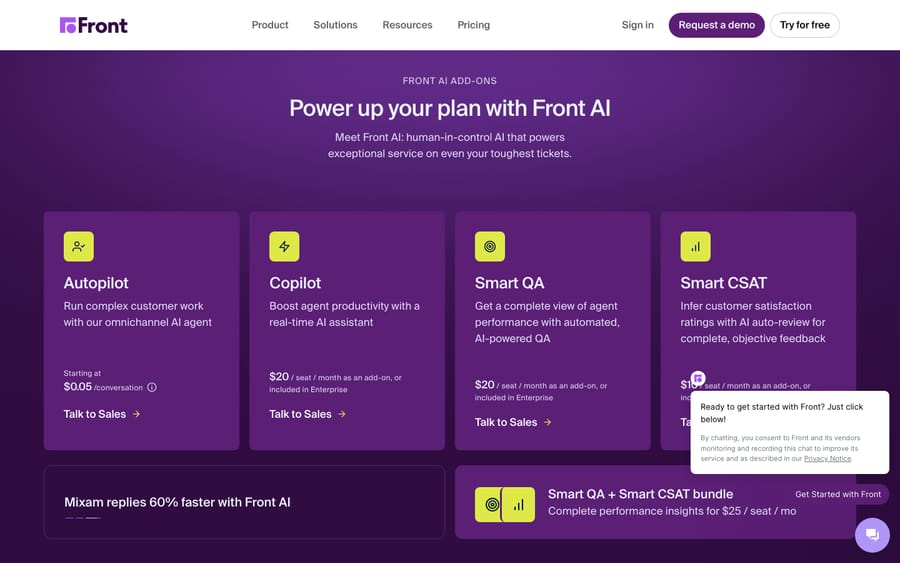
One piece of arithmetic worth doing: Professional at $65 plus Copilot at $20 plus the $25 QA and CSAT bundle comes to $110 a seat, $5 more than Enterprise at $105, which includes all three. A team that wants the full seat-based AI set is usually better off on Enterprise.
Where does native Front AI earn its keep?
Before the comparison, credit where it's due. Front's AI is woven into the shared inbox, and for several jobs it's the right tool.
Compose and Summarize are free wins. Because they're included on every plan, a sales rep drafting a follow-up or an ops teammate catching up on a 40-message thread gets real help at zero marginal cost. There's nothing to justify to finance, and 200 actions a day is more than most teammates use.
Copilot fits the collaborative model. Front is a shared-inbox platform built for teams working conversations together, and a per-seat reply assistant matches that shape: you pay for the humans you already have, and they draft faster. For a small support pod, $20 a seat is a predictable line item.
Autopilot resolves the easy tail. For high-volume, low-variance questions (order status, hours, password resets) an agent that closes the conversation without a human is what you want, and at a starting rate of $0.05 a conversation the meter is cheap when the conversation is simple.
Front's AI line-up has also changed. AI Answers, Front's earlier answer bot, is no longer sold. Its help center article carries the banner "AI Answers is no longer available for purchase" and points readers to Autopilot Resolve instead, per Front's own documentation. While it was on sale, AI Answers cost $0.70 per resolution. If you're evaluating Front AI today, Autopilot and Copilot are the products that matter. For the full feature breakdown, Front AI explained walks through each one.
What does "per conversation" actually charge for?
Here's the subtlety. Autopilot's "starting at $0.05/conversation" is a charge on the conversation it engages, not strictly on the problem it solves. Front also says "starting at", which means some Autopilot usage costs more than $0.05, and the pricing page doesn't publish what. Your automation rate, the share of conversations an agent can fully close without a human, isn't a constant either. It moves with product changes, seasonal question mix, documentation quality, and how ambitious you get with what the agent attempts.
That variability is the crux. Consider two months with the same volume (illustrative figures):
| Scenario | Conversations Autopilot engages | Genuinely resolved | Escalated to a human anyway |
|---|---|---|---|
| Good month | 2,000 | 1,700 (85%) | 300 |
| Rough month (product bug spike) | 2,000 | 1,000 (50%) | 1,000 |
At the $0.05 starting rate, both months meter the same $100 on the AI side even though the value delivered fell by 41%. When outcomes are stable, per-conversation pricing is clean and easy to forecast. When outcomes swing (a launch, an outage, a policy change) you pay for engagement on conversations that still needed a human. That's not a knock on Front specifically. Any vendor that meters engagement earns the same whether the agent resolved the case or not, so the risk of a bad month sits with you.
How does per-ticket pricing change the math?
A per-ticket model prices the conversation as a whole: one thread with one person, charged once however many times the agent reads it, calls a tool to fetch an order, drafts and sends. It isn't a seat subscription, and it isn't a bet on an outcome. Macha bills per ticket, never per resolution, on one plan priced by volume: $299 a month for up to 750 tickets, $599 up to 1,500, $1,199 up to 3,000, with setup and monitoring by the Macha team included. Outcomes vary with your knowledge and your queue, so Macha prices the ticket it handled, not a resolution it can't always guarantee.
What changes when you meter per ticket:
- Cost tracks tickets, not seats. A quiet month costs less at the next tier down. You're not paying $20 a seat for a teammate who barely touched Copilot that week.
- Reasoning depth doesn't move the bill. A quick tag-and-route and a multi-tool workflow that pulls an order, checks a policy and drafts a tailored reply are each one ticket. That matters for AI agents in customer service, where the useful work is usually the multi-step kind.
- You control the aggression. Because you pay per ticket and not per step, you decide how much reasoning to spend on which queues without watching a meter.
Be clear-eyed about the unit price, though. At 2,000 conversations a month, Autopilot at its $0.05 starting rate is $100, and Macha's tier for that volume is $1,199. If your AI job is simple deflection of easy questions, Front's starting rate is hard to beat. The case for a per-ticket layer is the work Autopilot's native actions can't do: calling your own API, running multi-step workflows, and doing it with a team that sets it up and monitors it for you.
So the comparison isn't "cheaper" versus "more expensive". It's which risk you'd rather hold. Per-seat pricing charges you for humans whether or not they use the tool, and per-resolution pricing hangs your bill on a definition you don't own. Per-ticket pricing ties cost to a number your own inbox already reports, which is easier to reconcile when your resolution rate is moving.
What does Front AI cost at 3,000 tickets a month?
At 3,000 conversations a month, the only Autopilot figure Front publishes gives a floor of $150 a month (3,000 × $0.05), and five Professional seats add $325. Front sells Autopilot through sales and doesn't publish what a billable conversation is above the starting rate or what the rate is at volume. What we can do is show the range a buyer should expect to be quoted into, and what to ask.
The spread between published figures is large. Front's pricing page says "starting at $0.05/conversation." A third-party comparison from eesel AI (dated 24 August 2026) says "Front charges $0.89 for every Resolution", counting a resolution when the customer doesn't reply within 24 hours on chat and SMS or 72 hours on email. We checked Front's pricing page again on 28 September 2026 and it still shows only the starting rate. We haven't been able to confirm the $0.89 figure with Front, and it's 18 times the starting rate, so treat it as an upper-end planning number, not a price. To turn a per-resolution rate into a monthly figure we use two resolution rates from Gorgias's Ecom Lab, which reported that "the median brand resolves 45% of AI-touched tickets end-to-end. The top quartile clears 65%" (Gorgias Ecom Lab, 28 April 2026, a vendor self-report on Gorgias merchants).
| Monthly, 3,000 conversations, 5 seats | 45% resolved (1,350) | 65% resolved (1,950) |
|---|---|---|
| Professional seats, 5 × $65 (annual) | $325 | $325 |
| Autopilot at the published floor, 3,000 × $0.05 | $150 | $150 |
| Autopilot at the third-party $0.89 per resolution (unconfirmed) | 1,350 × $0.89 = $1,201.50 | 1,950 × $0.89 = $1,735.50 |
| Front total, floor to third-party figure | $475 to $1,526.50 | $475 to $2,060.50 |
| Add Copilot for the 5 teammates, 5 × $20 | +$100 | +$100 |
| Enterprise instead (Copilot, Smart QA and Smart CSAT included), 5 × $105 | $525 seats + Autopilot | $525 seats + Autopilot |
| Macha on the same Professional seats: $1,199 + $325 | $1,524 | $1,524 |
Read the table as a negotiation map. If Front quotes anywhere near the starting rate for your 3,000 conversations, Autopilot is far cheaper than any per-ticket layer, including Macha, and you should take it for the simple deflection work. If the quote is per resolution and lands near the third-party figure, the Front line passes Macha's $1,199 plan once Autopilot resolves about 1,348 conversations a month ($1,199 ÷ $0.89), which is right at the 45% median. The incentive behind sales-led pricing is to price to your volume and your alternatives, which is why walking in with the arithmetic matters.
Five questions to put to Front sales before you sign: What exactly is a billable Autopilot conversation, and does an escalated one count? Is the rate per conversation or per resolution at our volume? Is there a monthly minimum or a committed volume? Do unused conversations roll over? Does the contract cross the $25,000 line where Front's pricing page says an onboarding package is required?
Macha's side is simpler to quote because it's published: $1,199 a month for up to 3,000 tickets, charged per ticket whether it's resolved or handed to a teammate, with setup and monitoring by the Macha team included, and $1,999 for up to 5,000 if you grow past it. Macha fits teams already running Zendesk, Freshdesk, Gorgias, Front, HubSpot or Intercom who want a published price they can put in a budget before talking to anyone. On Front, Macha's connector searches conversations, replies to customers, updates conversations and assigns teammates, triggered when a conversation is created, a message arrives or a conversation is assigned. For what Autopilot does and doesn't do on its own, see Front AI explained; for the same arithmetic on other volumes, see AI support cost at 1,000 tickets a month.
Should you use Front AI, a per-ticket agent layer, or both?
| Dimension | Native Front AI | Per-ticket agent layer (Macha) |
|---|---|---|
| Billing unit | Per seat (Copilot/QA/CSAT) + per conversation (Autopilot) | Per ticket: one thread, charged once |
| Entry price | Autopilot from $0.05/conversation | $299/mo up to 750 tickets |
| Best at | Compose/Summarize, in-inbox assist, simple deflection | Multi-step reasoning, tool calls, workflow automation |
| Cost when automation rate drops | Meters on engagement regardless | Meters tickets handled, not steps or resolutions |
| Custom API/backend calls | Limited to native actions | Custom tools call your REST API |
| Relationship to Front | Built into Front | Runs on top of Front, never a replacement |
The right read isn't "replace Front AI." It's a division of labor. Keep Compose and Summarize: they're free and good. Use Copilot where per-seat assist helps your team. Then, for the reasoning-heavy, tool-calling, outcome-variable work, add an agent layer that prices per ticket so your bill follows your volume. Macha is that layer: it connects through the live Macha–Front integration and runs on top of the Front shared inboxes you already use. It doesn't replace Front, your inboxes, or your teammates. If you want the wiring, connecting Front to Macha to route conversations to AI covers it, and building an AI agent for Front walks through a first agent end to end.
FAQ
How much does Front AI cost? Front prices its heavier AI as add-ons on top of per-seat plans (Starter $25, Professional $65, Enterprise $105 per seat/mo, annual). Autopilot starts at $0.05 per conversation; Copilot and Smart QA are $20/seat/mo each and Smart CSAT is $10/seat/mo (all three included in Enterprise), or $25 for the QA and CSAT bundle. Compose, Summarize, Translate, and Topics are included on all plans. Confirm current figures on front.com/pricing.
Is Front Autopilot billed per resolution or per conversation? Per conversation. Front's pricing page lists Autopilot as "starting at $0.05/conversation" and doesn't publish the rates above that starting price. The per-resolution figure you'll see quoted belongs to AI Answers, the older product, which cost $0.70 per resolution.
What does Front Autopilot cost at 3,000 conversations a month? Front publishes only a starting rate, $0.05 a conversation, which puts a floor of $150 a month under 3,000 conversations; five Professional seats add $325. A third-party figure of $0.89 per resolution, unconfirmed by Front, would put Autopilot at $1,201.50 to $1,735.50 if it resolves 45% to 65%. Get a written quote with the unit defined.
Why doesn't Front publish Autopilot's price at volume? Autopilot is sold through sales, and the pricing page lists only "starting at $0.05/conversation". Sales-led pricing lets Front set the rate by account size and by what you'd pay elsewhere, so compare quotes on the same unit: cost per conversation handled and cost per conversation resolved.
What happened to Front AI Answers? AI Answers is a legacy product. Front's help center shows a banner stating it is no longer available for purchase and directs teams to Autopilot Resolve instead. Autopilot is the current AI agent product.
Are Front's included AI tools unlimited? No. Front's pricing page caps Compose at 200 actions, Translate at 200 requests and Summarize at 200 manually triggered summaries per teammate per day.
What does "per ticket" mean and how is it different? Per-ticket pricing charges once for a whole conversation (one thread between the agent and one person, however many reads, tool calls, drafts and sends it takes) rather than per seat, per resolution, or per step. Macha bills that way, from $299 a month for 750 tickets, about $0.40 each.
Does adding Macha mean replacing Front AI? No. Macha is an AI agent layer that runs on top of the Front you already use via a live connector. Keep Front's Compose, Summarize, and Copilot where they help; layer Macha on for the multi-step, tool-calling work. The two coexist.
Want to see how per-ticket pricing maps to your real Front volume? Start a free trial of Macha with $50 of usage and no credit card, and connect it to your Front in minutes.