Shopify
 Stripe
 Slack
Slack Notion
 Google Workspace
 Confluence

What Are the Best Crisp Alternatives in 2026? 9 Tools Compared


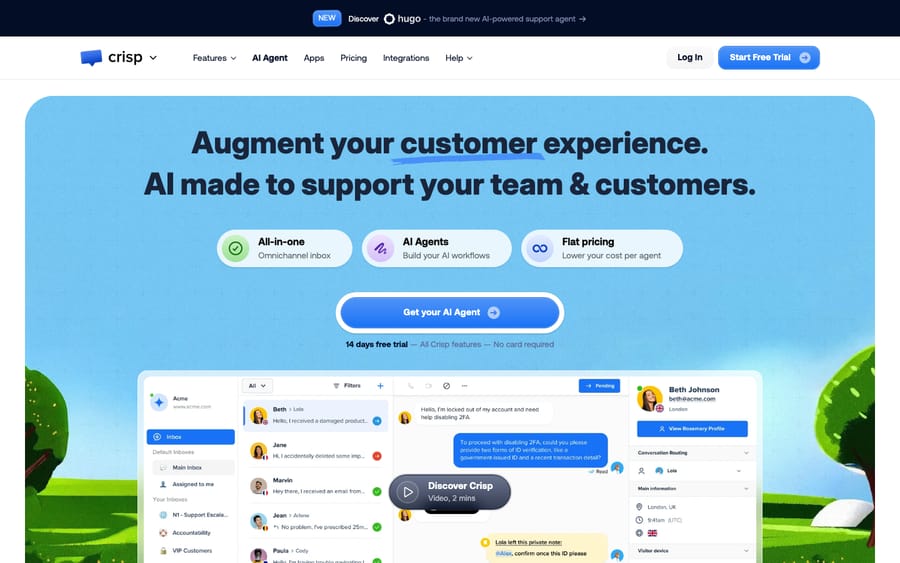
Crisp is a well-liked live chat and shared-inbox tool with a free plan and flat per-workspace pricing of $45, $95 or $295 a month, so you pay one price for the team rather than per agent. Teams usually leave when those tiers gate the seats, channels or AI they need.
Key takeaways
- Tidio is the closest like-for-like Crisp alternative, with a free plan, Starter at $29 a month and Growth from $59, plus Lyro AI from $32.50 a month.
- Crisp prices each workspace flat in US dollars: Mini at $45 a month with 4 seats, Essentials at $95 with 10 seats and Plus at $295 with 20 or more.
- The most-cited Crisp complaint on Capterra is never-ending conversations, where old threads from a returning customer get pulled into new ones instead of starting fresh.
- Intercom seats cost $29, $85 or $132 a month billed annually plus $0.99 per Fin outcome, while Gorgias bills by ticket volume from $10 a month for 50 tickets up to $900 for 5,000.
- Macha ranks first for teams that want the AI agent set up and run for them: on a helpdesk Macha runs on, the Macha team builds and runs it for about $0.40 a ticket, setup and a dedicated success manager included.

The best Crisp alternatives in 2026 are Macha (the AI agent set up and run for you on the helpdesk you move to, about $0.40 a ticket), Tidio (closest like-for-like, free plan then $29 a month), Intercom (strongest AI, Fin at $0.99 per outcome), Freshchat, Chatwoot, Help Scout, Front, Zendesk and Gorgias. Which one fits depends on why you are leaving Crisp, whose flat plans run $45, $95 and $295 a month per workspace.
| Tool | G2 / Capterra (approx.) | Pricing model | Best for | vs Crisp |
|---|---|---|---|---|
| Macha | Our product (not rated here) | ~$0.40/ticket, from $299/mo for 750 tickets; setup included | Teams that want the AI agent set up and run for them | AI agent on your helpdesk, not a chat tool; done for you |
| Tidio | 4.6 / 4.7 | Free; $29 to $300+/mo + Lyro AI | SMB chat + AI on a budget | More AI (Lyro); priced by conversations |
| Intercom (Fin) | 4.5 / ~4.4 | $29 to $132/seat + Fin $0.99/outcome | SaaS, AI-first deflection | Stronger AI; per-seat + usage |
| Freshchat | 4.4–4.5 / ~4.1 | Free (10 agents); $19–$79/agent/mo | Omnichannel chat in Freshworks | Per-agent; deeper omnichannel |
| Chatwoot | 4.5 / n/a | Self-host free; $19–$99/agent cloud | Open-source / data control | Own your data; per-agent cloud |
| Help Scout | 4.6 / 4.6 | ~$25–$75/user/mo + AI $0.75/resolution | Email-led support, simplicity | Per-user; AI per resolution |
| Front | 4.7 / 4.5 | $25–$105/seat/mo | Collaborative shared inbox | Inbox-first; per-seat |
| Zendesk | 4.3 / 4.4 | $19–$115+/agent/mo + AI per resolution | Scaling omnichannel teams | Far deeper; per-agent, pricier |
| Gorgias | 4.6 / 4.7 | $10–$900/mo (ticket-based) + AI $0.90–$1.00 | Shopify / DTC ecommerce | Ecommerce-native; ticket-priced |
Prices checked on each vendor's pricing page on 24 September 2026; ratings are approximate G2 and Capterra figures from mid-2026. Crisp's own plans: Free (2 seats), Mini $45 (4 seats), Essentials $95 (10 seats), Plus $295 (20+ seats) per month per workspace.
So why look for Crisp alternatives? Usually one of a few specific reasons: the flat plans gate the seats and channels you need behind the next tier up; the AI and automation feel lighter than the new AI-first tools; or you have outgrown a tool built for small teams and want deeper reporting, ecommerce integrations or omnichannel ticketing. A recurring Crisp gripe in reviews is "never-ending conversations" (old threads getting pulled into new ones for the same customer), which grates once volume climbs.
For each alternative below we cover what it is, who it wins for, its pricing model, its G2 and Capterra ratings with what users say, and how it differs from Crisp. Crisp's English and French pricing pages both list plans in US dollars as of September 2026, so the comparison is now dollar to dollar.
Why do teams look for a Crisp alternative?
Crisp isn't broken; it's a specific tool. The fair, recurring reasons teams shop around:
- The flat plans gate what you need. Crisp's model is elegant but rigid: Mini ($45/mo) includes 4 seats, Essentials ($95/mo) 10 and Plus ($295/mo) 20 or more, with additional agents at $10 a month each. Channels such as WhatsApp and Instagram start on Essentials, so needing one channel can mean jumping a whole tier.
- AI and automation feel lighter. Crisp has a chatbot and an AI suite, but teams chasing serious deflection often want the more mature AI agents in Intercom (Fin), Tidio (Lyro), or the helpdesk platforms.
- AI credits and reporting depth. Each paid Crisp plan includes a fixed AI credit allowance ($5, $25 or $75 a month, which Crisp sizes at around 90, 450 and 1,350 automated conversations), and reporting runs out of road faster than in a full helpdesk.
- "Never-ending conversations." The single most-cited Crisp complaint on Capterra is that you can't easily start a separate conversation with a returning customer; old threads get dragged into new ones.
Update (September 2026): Salesforce completed its acquisition of Fin, the company formerly called Intercom, on 10 September 2026, in a deal worth about $3.6 billion. Fin keeps selling Intercom and the Fin agent at $0.99 per outcome, and Salesforce cites a 76% average resolution rate. Worth weighing in any long-term Intercom or Fin decision.
None of this makes Crisp a bad pick. It makes it great for cost-conscious small teams that live in live chat, and worth replacing if your bottleneck is seats, AI depth, ecommerce, or true ticketing. Keep your reason in mind; it decides which tool below actually fixes it.
How did we compare them?
We focused on tools an SMB Crisp team could realistically move to: live chat and messaging platforms first, plus shared-inbox and helpdesk options for teams that have outgrown pure chat. For each we pulled live pricing from the vendor's own pages (or cited third-party trackers where pricing is quote-only), the current G2 and Capterra star ratings with approximate review counts as a real-user signal, and we read through review sentiment for recurring praise and complaints. G2's review pages are bot- and login-walled (they return a 403 to automated fetches), so verbatim quotes come from Capterra and from aggregate G2 sentiment, attributed where a reviewer is named. Ratings are approximate and from mid-2026; prices were re-checked on vendor pages on 24 September 2026. Confirm on each vendor's page before you sign. We make Macha and rank it first for teams that want the AI agent set up and run for them; it has no third-party rating or review quote below.
What are the 9 best Crisp alternatives?
1. Macha: the done-for-you AI agent for teams moving to a helpdesk
What it is: An AI agent layer that runs on top of Zendesk, Freshdesk, Gorgias, Front, HubSpot or Intercom. It isn't a live chat tool or a helpdesk, and it doesn't integrate with Crisp. Its agents read the customer's question, pull from connected data and your help center, draft replies, tag and route, resolve routine tickets inside your existing workflow, and hand off to a human with context. Who it's for: If your real frustration with Crisp is AI and deflection rather than the chat itself, and you're moving to one of those helpdesks anyway, Macha is the AI on that desk, set up and run for you. Pricing: About $0.40 a ticket, from $299 a month for 750 tickets, billed per ticket (one charge per thread, however many steps) rather than per seat or per workspace. There's no free plan; the trial is $50 of free usage (about 125 tickets), no credit card. vs Crisp: Crisp bundles a fixed AI credit allowance into each flat plan ($5, $25 or $75 a month) and leaves building the bot to you. Macha is a separate agent on your helpdesk that the Macha team builds, tests and tunes.
Done for you: You connect your helpdesk and the tools your answers come from, about 15 minutes of work. The Macha team then analyzes about a month of your past tickets, builds the knowledge base and the agent, tests it on a sample of those tickets, and runs it in safe mode, with drafts as internal notes in your helpdesk, until the drafts are right. It goes live in under a week, on the trial and every plan. The $0.40 a ticket includes that setup and a dedicated success manager who handles your changes after go-live: new categories, instruction changes, new tools.
Pros: nobody on your team builds or tunes the agent; per-ticket billing doesn't jump a tier when you add a seat or a channel; the agent acts inside the helpdesk instead of adding another tool to watch. Watch-outs: no free plan (the trial is $50 of usage); it works on top of a helpdesk, so it doesn't replace Crisp's chat widget or connect to Crisp; and it's only as good as the data and knowledge behind it. See how the layer works on Zendesk.
2. Tidio: the closest like-for-like, with stronger AI
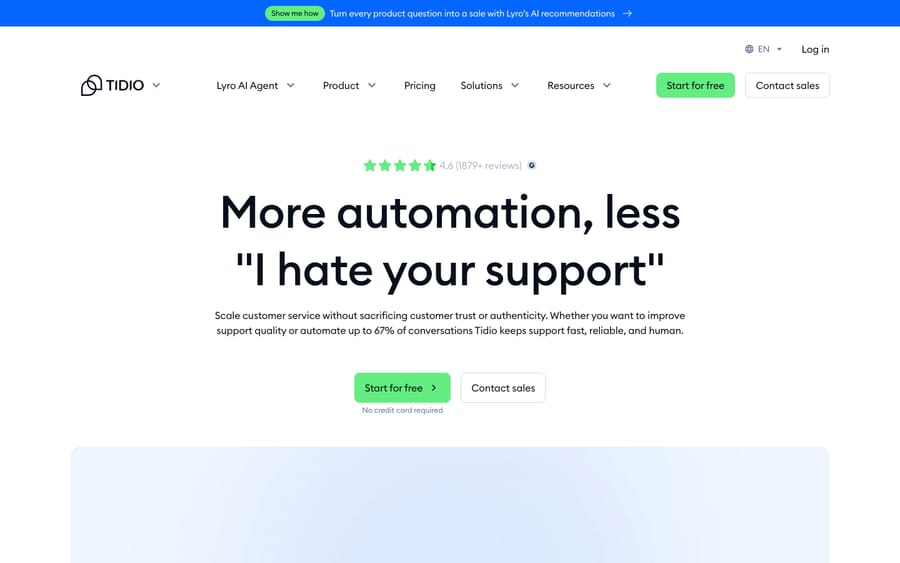
What it is: An SMB-favorite live chat and chatbot platform with Lyro, its AI agent, plus a lightweight ticketing system. It occupies almost exactly Crisp's slot (small-team chat) but leans harder into AI deflection. Who it's for: Small businesses and ecommerce stores that want Crisp-style live chat plus a capable AI agent without enterprise pricing. Pricing: A free plan, then Starter ($29/mo, or $24.17/mo billed yearly) and Growth (from $59/mo, or $49.17/mo billed yearly), then Plus from $300/mo plus usage and a custom Premium plan. Lyro AI is a separate add-on from $32.50/mo for 50 Lyro conversations. The old $749 Tidio+ plan no longer appears on the pricing page. Ratings: G2 4.6/5 (~1,800 reviews), Capterra 4.7/5 (~590); ease of use is the most-praised trait. As one Small-Business reviewer wrote on Capterra: "Tidio is super easy to use, with Lyro AI integration and a simple ticketing system that makes handling customer support fast and stress-free for my company." vs Crisp: Similar audience and feel, but Tidio's Lyro AI is more prominent and it prices by plan and conversation volume rather than flat per workspace. The watch-out: Tidio's December 2024 repricing drew billing complaints on both review sites, and the jump from Growth to Plus at $300 is steep. See where it sits among the best live chat software.
3. Intercom (with Fin AI): the AI-first, chat-led platform
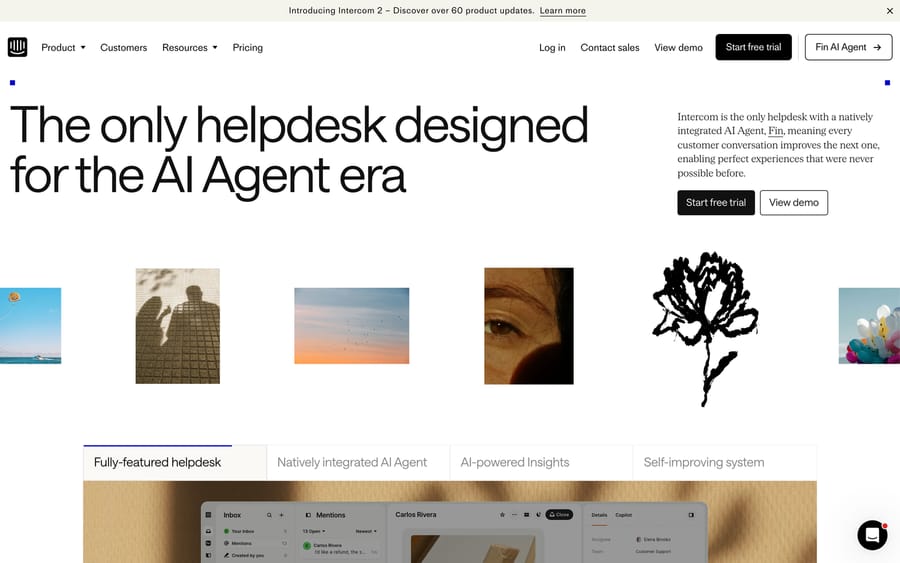
What it is: A messenger-first support and engagement platform whose Fin AI agent is one of the most-cited per-resolution products on the market. Strong at in-app chat, proactive messaging, and product-led support. Who it's for: SaaS and digital-first companies that want best-in-class AI deflection and a polished messenger, and can stomach modular pricing. Pricing: Seats run $29 (Essential), $85 (Advanced) and $132 (Expert) per seat/month billed annually (Intercom has also shown $19 for Essential in a pricing test), with Fin charged at $0.99 per outcome on top, so your real bill scales with volume. The 50-outcome monthly minimum applies only when Fin runs on a help desk other than Intercom. Ratings: G2 4.5/5 (~3,000 reviews). Pricing is the dominant complaint. vs Crisp: A far stronger AI agent and messenger, but the opposite of Crisp's flat predictability: per-seat plus usage means costs are hard to forecast. As one Capterra reviewer (Head of Product, 2–10 employees) put it: "Basic functionality is very expensive and we just can't justify the amount when there are other tools on the market with better functionality at over half the cost." Best when AI deflection is the priority and budget is flexible.
4. Freshchat: the omnichannel chat in the Freshworks stack
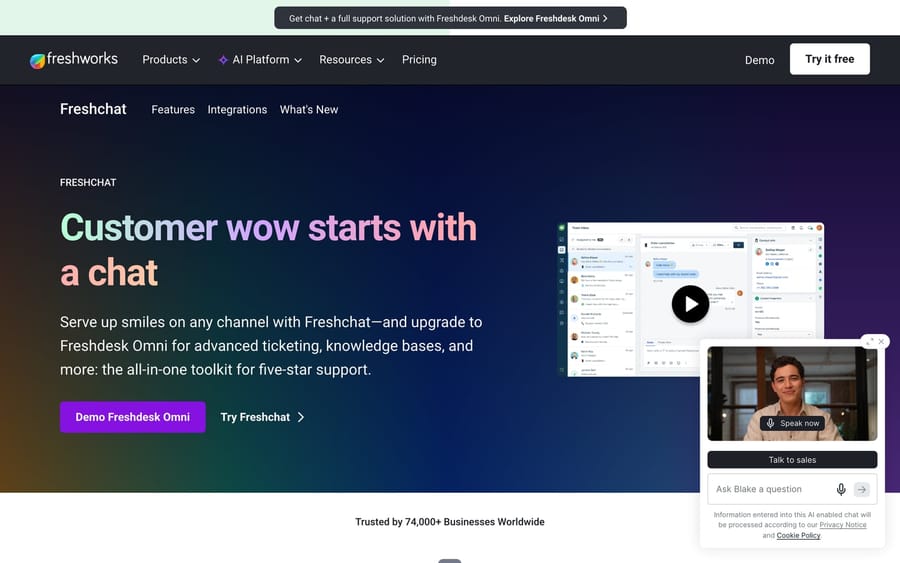
What it is: Freshworks' messaging product (live chat, WhatsApp, social, and bots) that plugs into Freshdesk and the wider Freshworks suite for omnichannel support. Who it's for: Teams that want Crisp-style chat with deeper omnichannel reach, especially anyone already on Freshdesk or Freshsales. Pricing: A free plan for up to 10 agents, then Growth $19, Pro $49, Enterprise $79 per agent/month billed annually, unlike Crisp's flat workspace model. The Freddy AI Agent includes the first 500 sessions, then costs $49 per 100 sessions. Ratings: G2 ~4.4–4.5/5; Capterra sentiment is solid but more mixed (~4.1), with some flags on support responsiveness and cost relative to peers. vs Crisp: More channels and tighter integration into a full helpdesk suite, but the per-agent pricing can overtake Crisp's flat plans as you add seats. The pull is strongest if you're already in the Freshworks ecosystem.
5. Chatwoot: the open-source option
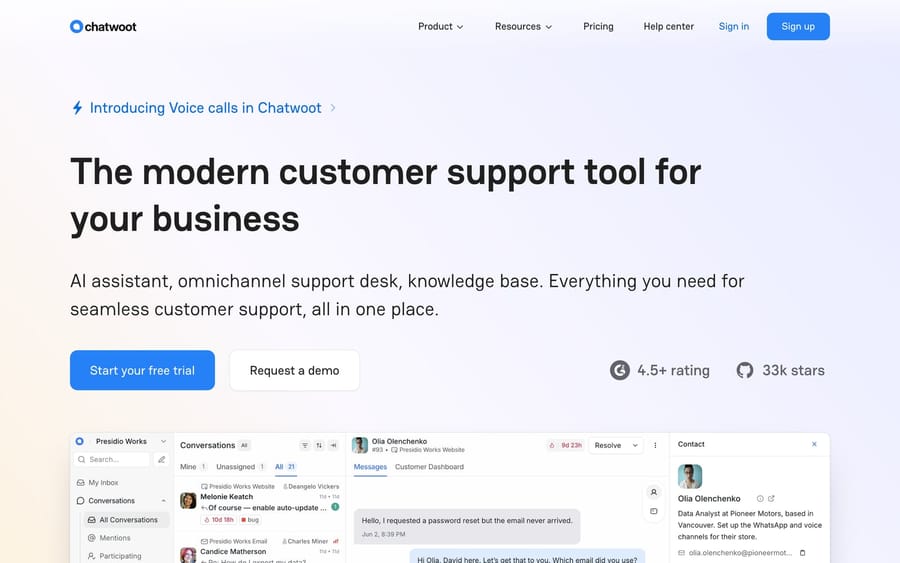
What it is: An open-source customer engagement platform (live chat, shared inbox, and omnichannel) that you can self-host for free or run on Chatwoot's cloud. Its Captain AI suite runs on credits. Who it's for: Technical teams that want to own their data, customize deeply, or avoid per-seat SaaS pricing, and are comfortable self-hosting. Pricing: Self-hosted Community Edition is free (MIT-licensed, you pay only for infrastructure). Cloud runs Hacker (free), Startups $19, Business $39, Enterprise $99 per agent/month (annual), with monthly Captain AI credit allowances. Ratings: G2 4.5/5. Reviewers praise it as genuinely cost-effective and private; the recurring asks are a more polished UI for new users and stronger AI/reporting. As one Small-Business reviewer put it on G2: "Chatwoot just works and does everything that a small/startup team would want from an on-site chat support component. Implementation is quick and easy; integration is even easier." vs Crisp: The standout difference is data ownership and zero license cost if you self-host, something no other tool here offers. The trade-off is that you operate it yourself, and the cloud tier is per-agent rather than flat-per-workspace.
6. Help Scout: the simpler, email-led inbox
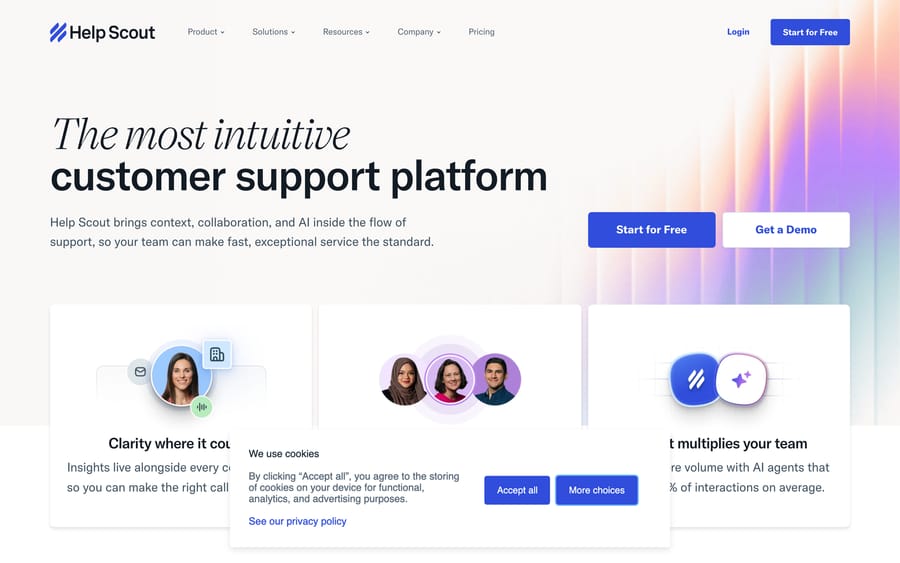
What it is: A clean, conversation-style helpdesk built around a shared inbox, knowledge base (Docs), and live chat (Beacon), with AI layered in. It hides the "ticket" machinery to feel like email. Who it's for: Small and mid-sized teams, especially SaaS and services, whose support is more email- than chat-led, and who want fast onboarding with a warm customer experience. Pricing: For new signups it's per user: a Free plan for up to 5 users and 1 inbox, then Standard $25, Plus $45, Pro $75 per user/month (billed annually), with AI Answers an add-on at $0.75 per resolution. The older contacts-based plans (e.g. $50 for 100 contacts) are now legacy, retained only for existing customers, so don't budget around them. Ratings: G2 4.6/5 and Capterra 4.6/5, consistently praised for ease of use. As Stacey B., a Customer Support Manager, wrote on Capterra: "This software is incredibly easy to use! The macro search function was amazing." vs Crisp: Help Scout now prices per user (like most tools here) rather than Crisp's flat per-workspace plans, with AI billed per resolution on top, so your cost scales with team size and AI volume rather than staying flat. Help Scout is also more email-first where Crisp is chat-first.
7. Front: the collaborative shared inbox
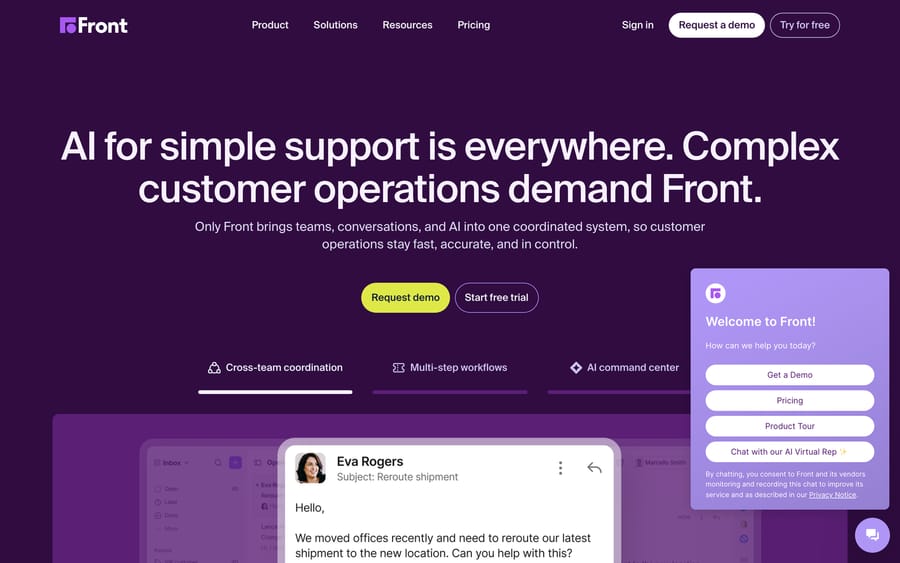
What it is: A shared-inbox platform that blends email, chat, SMS, and social into one collaborative workspace with internal comments, assignments, and shared drafts, plus AI features on top. Who it's for: Operations-heavy and high-touch teams (logistics, finance, B2B services) where support is a team sport and conversations need real collaboration. Pricing: Per-seat, Starter $25 (up to 10 seats), Professional $65 (up to 50 seats), Enterprise $105 per seat/month billed annually. Ratings: G2 4.7/5 (~2,400 reviews), among the highest here, and Capterra ~4.5/5. The most-cited con is Outlook two-way sync limitations. A Small-Business reviewer on Capterra captured the appeal: "Tagging my colleagues in the emails and asking them to check my drafts was a game changer. Really great for communication and collaboration." vs Crisp: Feels like a souped-up shared inbox rather than a chat-first widget, which collaborative teams love. It's per-seat and pricier per head, so it wins on collaboration depth, not on Crisp's flat affordability. For more, see the best shared inbox software.
8. Zendesk: the scale-up omnichannel platform
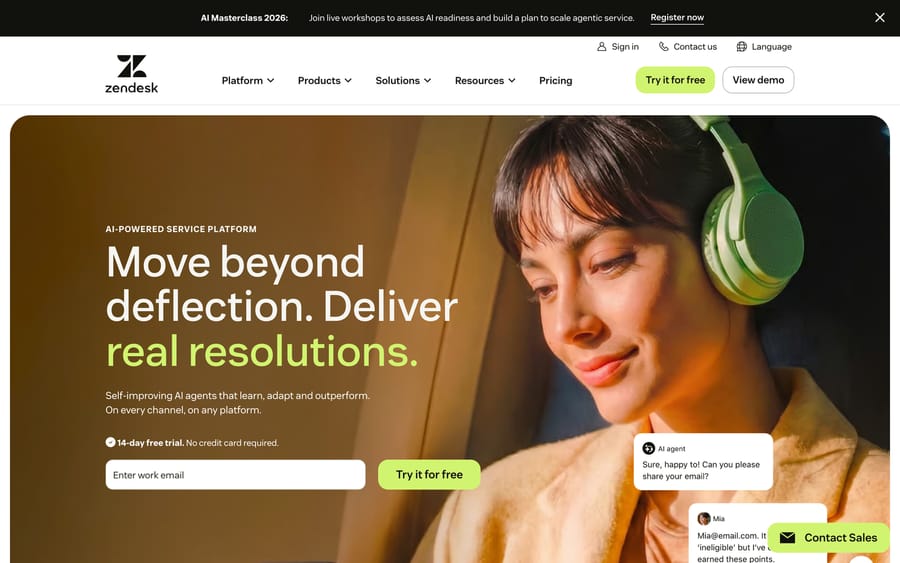
What it is: The category's heavyweight: a deep, extensible support platform with omnichannel ticketing, a mature marketplace, robust reporting, and native AI agents (built partly on the acquired Ultimate and Forethought technology). Who it's for: Teams that have outgrown SMB chat and want serious configurability, analytics, and a vast app ecosystem, with the budget to match. Pricing: Suite plans run roughly $19 (Support Team) to $115/agent/month (Suite Professional) and up, billed annually; AI agents are included and billed per automated resolution ($1.50 committed or $2.00 pay-as-you-go on Zendesk's pricing page), and Copilot is $50/agent/month on top. Ratings: G2 4.3/5, Capterra 4.4/5. The recurring complaint is pricing complexity and add-ons that weren't budgeted for. vs Crisp: Vastly more powerful and extensible, but also far pricier and per-agent, the opposite end of the spectrum from Crisp's flat SMB plans. This is an upgrade for teams whose problem is depth, not cost.
9. Gorgias: the ecommerce specialist
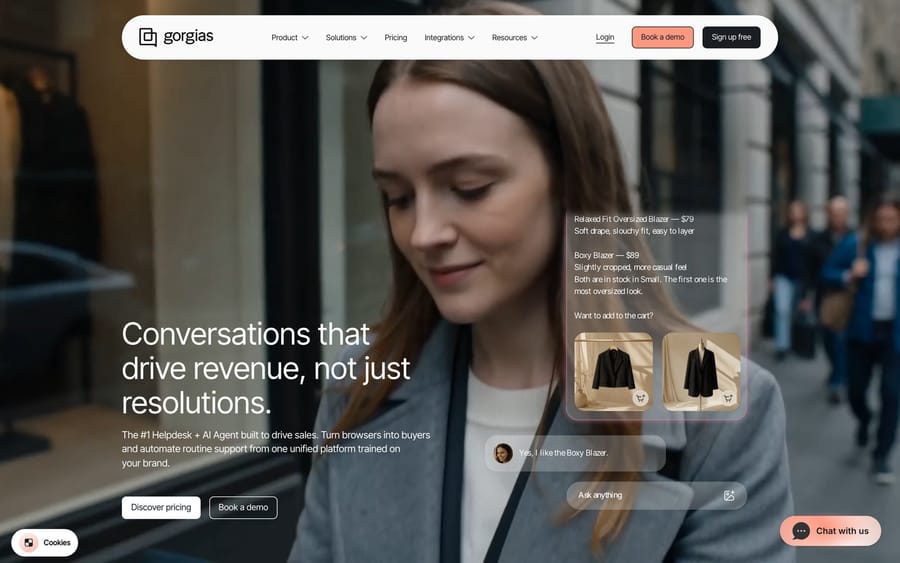
What it is: The dominant Shopify-era helpdesk, purpose-built for ecommerce. It pulls order, refund, and subscription data into the conversation, and its AI Agent resolves WISMO, returns, and product questions natively. Who it's for: Shopify, BigCommerce, and DTC brands whose support is mostly order-related and who run live chat alongside email and social. Pricing: Billed on monthly ticket volume, not seats: Starter $10, Basic $60 (300 tickets), Pro $360 (2,000), Advanced $900 (5,000) per month on monthly billing, with the AI Agent charged per automated interaction ($1.00 on monthly plans, $0.90 on annual). Ratings: G2 4.6/5 (~800 reviews), Capterra 4.7/5 (~600). As one Small-Business reviewer noted on G2: "Having all our channels (Shopify, email, and social) in one place is a game changer and lets us reply faster with more context." vs Crisp: Far better for retail conversations out of the box, with deep store integrations Crisp doesn't match, but the ticket-volume pricing and ecommerce focus make it a specialist, not a general SMB chat replacement.
How do you choose the right Crisp alternative?
- Name your real reason for leaving. AI on the support queue, set up and run for you → Macha on the helpdesk you move to. Seats gated by flat tiers → a flexible per-agent tool (Freshchat). Email-led simplicity → Help Scout. AI depth → Intercom or Tidio. Data control → Chatwoot. Ecommerce → Gorgias. Scale and reporting → Zendesk. Collaboration → Front. Don't switch to fix a problem you don't have.
- Model the total cost at your size. Crisp's flat plans are predictable; per-seat and per-user tools (Front, Zendesk, Freshchat, Help Scout) plus AI usage charges (Intercom's Fin, Help Scout's AI Answers) can be cheaper or far pricier depending on your agent count and volume. Do the math at your actual numbers.
- Match the tool to your channel mix. Chat- and product-led? Tidio or Intercom. Email-led? Help Scout or Front. Omnichannel? Freshchat or Zendesk. Order-driven retail? Gorgias.
- Weigh migration cost honestly. Moving means re-embedding widgets, migrating history, and retraining. Worth it for a structural problem, overkill for a single feature gap.
- Pilot on real conversations. Run your shortlist on live chats and tickets, and measure resolution rate, CSAT, and first-response time against your Crisp baseline before committing.
What do users say about these tools?
Across these tools the patterns are consistent. Tidio and Help Scout win on ease of use (Help Scout's Stacey B.: "incredibly easy to use"). Intercom is the most-praised AI but the most-criticized on price. Chatwoot is loved for cost and data control, with new-user UI as the main ask. Front rates highest on collaboration (G2 4.7) with Outlook sync the main gripe. Gorgias owns ecommerce sentiment (Capterra 4.7). And Crisp itself holds a solid 4.5/5 on both G2 and Capterra, with setup speed its biggest praise and "never-ending conversations" its most-cited frustration, exactly the kind of thing that pushes growing teams to look around.
Frequently asked questions
What is the best Crisp alternative in 2026? If AI on your support queue is the reason, Macha, which we make and rank first: the Macha team sets up and runs the agent on your helpdesk at about $0.40 a ticket, which includes setup and a dedicated success manager who handles your changes. Beyond that it depends on why you're leaving. Tidio is the closest like-for-like with stronger AI; Intercom leads on AI deflection; Help Scout wins on simplicity and email-led support; Chatwoot is best for open-source data control; Front for collaborative inboxes; Freshchat for omnichannel in the Freshworks stack; Zendesk for scaling depth; and Gorgias for ecommerce.
Why do teams leave Crisp? Usually because the flat per-workspace plans gate the seats or channels they need behind the next tier, the AI feels lighter than newer tools, or they've hit the "never-ending conversations" limitation as volume grows. Crisp remains excellent for small, chat-led teams on a budget.
What's the cheapest Crisp alternative? Chatwoot's self-hosted Community Edition is free (you pay only for hosting), making it the cheapest if you can self-host. Among hosted tools, Freshchat (free for up to 10 agents, then from $19/agent/month) and Tidio (free plan, then $29) are the most budget-friendly. Remember to add AI costs when comparing.
Is Crisp's flat pricing actually cheaper? Often, yes, for small teams. Crisp's Essentials at $95/month includes 10 seats, where per-seat tools would charge per head. But once you need more seats, specific channels, or heavier AI, the flat plans force a tier jump, and a per-agent or usage-based tool can become more economical. Model it at your real team size.
Can I add AI to Crisp instead of switching? Crisp has its own chatbot and AI features. If you want a more capable AI agent, the AI-first platforms above (Intercom, Tidio) are the move. Note that Macha, our AI agent layer, works on Zendesk, Freshdesk, Gorgias, Front, HubSpot or Intercom, not Crisp, so it's only relevant if you're moving to one of those helpdesks anyway. If you are, the Macha team sets the agent up and runs it for you, on the trial and every plan.
Which Crisp alternative should you pick?
The best Crisp alternative is the one that fixes your specific reason for looking. Macha is the top pick if you want the AI on your support queue set up and run for you; Tidio is the closest swap with better AI; Intercom the AI-first leader; Help Scout the simplicity pick; Chatwoot the open-source, data-control choice; Front the collaborative inbox; Freshchat the Freshworks-native omnichannel option; Zendesk the scale-up platform; and Gorgias the ecommerce specialist. Crisp's flat per-workspace pricing is genuinely hard to beat for small chat-led teams, so pin down your real friction (seats, AI, channels, or scale), model the total cost at your team size, and pilot on live conversations before you migrate.
Pricing re-checked on vendor pages on 24 September 2026; ratings from mid-2026. Live chat and helpdesk pricing changes fast, so confirm current terms on each vendor's site before buying.