Intercom
 Shopify
 Stripe
 Slack
Slack Notion
 Google Workspace
 Confluence

What Are the Best Gorgias Integrations in 2026, and Which Can an AI Agent Act In?


Most ecommerce teams on Gorgias need a store connection first, then returns, tracking, subscription and marketing apps that put order context in the ticket. The 16 integrations below are grouped by the support job each one removes, with a table of which apps an AI agent can actually take actions in.
Key takeaways
- The best Gorgias integrations start with the store connection, Shopify, BigCommerce or Magento, all built by Gorgias, followed by Loop Returns or AfterShip for post-purchase tickets.
- As of 28 September 2026, five apps carry the Gorgias App Store's Preferred Partner badge: Aircall, Attentive, Loop Returns, Postscript and Recharge.
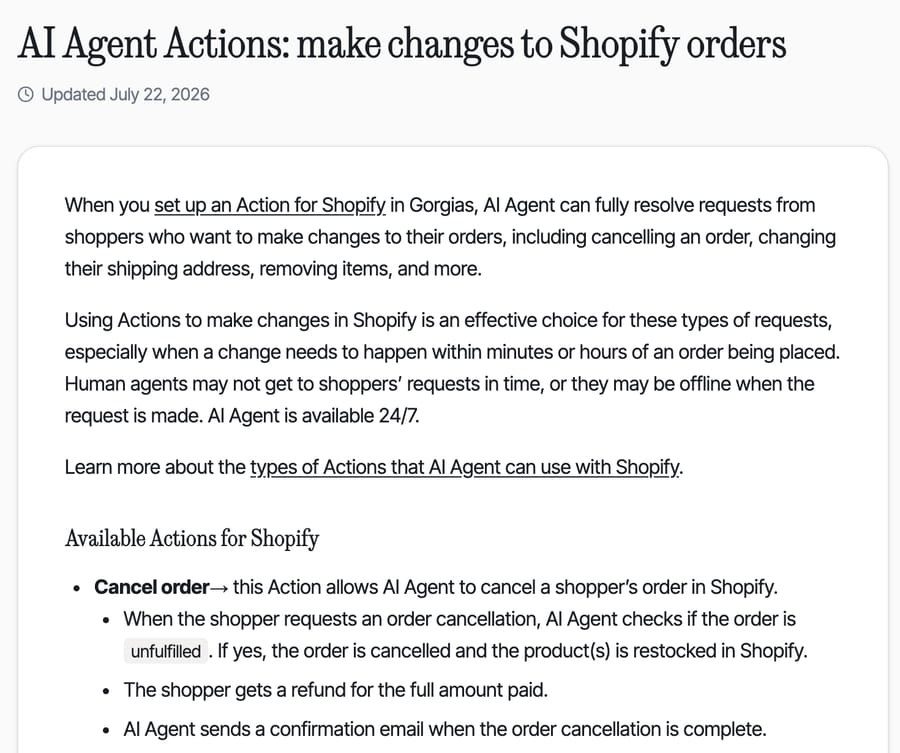
- Gorgias AI Agent has 6 documented Shopify Actions, including cancel order and edit shipping address, and 10 Recharge Actions that mostly need a single active subscription.
- Recharge's API has no pause endpoint, so Gorgias AI Agent pauses a Recharge subscription by moving the next charge date instead.
- Loop Returns holds 4.6 out of 5 across 443 Shopify App Store reviews, but its Label API is OAuth-only, so an AI agent layer can process returns without creating labels.

The Gorgias integrations most ecommerce support teams need are a store connection (Shopify, BigCommerce or Magento, all built by Gorgias), then Loop Returns or AfterShip for post-purchase tickets, Recharge for subscriptions and Klaviyo for marketing context. Below are 16 picks grouped by the job they do, with what each does, who it suits, whether Gorgias (native) or a partner (third-party) built it, and how to add it from the Gorgias App Store (checked September 2026). New to the platform? Start with what is Gorgias and the Gorgias customer service platform overview, then come back to wire it up.
Which Gorgias integrations matter most, at a glance?
| Integration | Category | Built by | What it brings to Gorgias |
|---|---|---|---|
| Shopify | Ecommerce | Gorgias (native) | Order history, edit/refund orders in-ticket |
| BigCommerce | Ecommerce | Gorgias (native) | Order + customer context in sidebar |
| Magento / Adobe Commerce | Ecommerce | Gorgias (native) | Store order context in-ticket |
| Klaviyo | Marketing | Third-party | Marketing/engagement context + actions |
| Recharge | Subscriptions | Third-party | Manage subscriptions/billing in-ticket |
| Yotpo / Okendo | Reviews & UGC | Third-party | Reviews into tickets; loyalty signals |
| Smile.io | Loyalty | Third-party | Loyalty tier/points next to ticket |
| Loop Returns | Returns | Third-party | Approve/track returns & exchanges |
| AfterShip | Shipping | Third-party | Live tracking, WISMO answers |
| ShipBob | Fulfillment | Third-party | Fulfillment status context |
| Slack | Comms | Third-party | Ticket alerts + team collaboration |
| Attentive | SMS | Third-party | Conversational SMS as tickets |
| Gorgias Voice | Phone | Gorgias (native) | Calls inside the help desk |
| Aircall | Phone | Third-party (partner) | Auto-tickets per call, dialer context |
| Zapier / Make | Automation | Third-party iPaaS | No-code workflows to 5,000+ apps |
| Triple Whale | BI & Analytics | Third-party | Gorgias data in ecommerce analytics |
Pricing for third-party and partner apps is set by each vendor and may depend on your Gorgias plan. Confirm on the app's App Store listing before installing.
Which Gorgias apps can an AI agent take actions in?
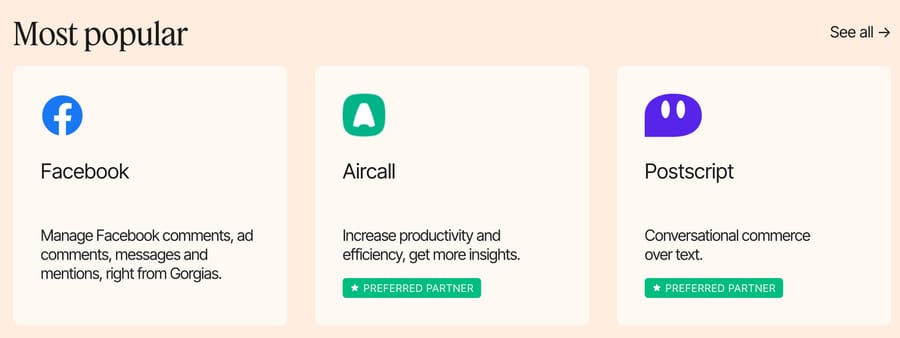
The Gorgias App Store publishes no install counts, so its own signals are editorial. When we checked it on 28 September 2026, the store's Featured row shows Attentive and Loop Returns, its Most popular row shows Facebook, Aircall and Postscript, and five apps carry the Preferred Partner badge: Aircall, Attentive, Loop Returns, Postscript and Recharge. Two more, Corso and LateShipment.com, carry Trusted Partner. Those badges tell you who has a commercial relationship with Gorgias (our map of Shopify apps an AI support agent can work with covers the wider app ecosystem). They don't tell you how many stores run the app, which is why the table below also carries each app's Shopify App Store rating and review count, the closest public usage proxy.
The columns that matter for Black Friday planning are the last two. A sidebar widget lets a human click Skip or Approve. An AI agent can do the same thing through one of four routes: Gorgias's prebuilt AI Agent Actions, which exist for a short list of apps; a custom Action you build yourself in Gorgias as an HTTP request against the app's API, which Gorgias says needs familiarity with HTTP requests or a developer; an AI agent layer calling the app's public API with a static credential; or nowhere, when the API needs an OAuth flow, an expiring token or a plan the store isn't on. The vendors' incentive shapes this list. Gorgias prebuilds Actions where they cut the most tickets it bills as resolved conversations (orders, subscriptions, 3PL cancels), and app vendors gate their write APIs behind the plans that bigger brands buy.
| App | Gorgias App Store signal (28 Sept 2026) | Shopify App Store (25 Sept 2026) | What its API lets an AI agent do | Gorgias AI Agent Actions | Route for an agent layer such as Macha |
|---|---|---|---|---|---|
| Shopify | Built by Gorgias | Gorgias's own app 4.3/5, 705 reviews | Orders, customers, products, refunds | 6: cancel order, edit shipping address, remove item, replace item, reship for free, add order note | Macha's built-in Shopify connector: search and get orders and products, get customer, Create Refund |
| Recharge | Preferred Partner | 4.8/5, 3,123 reviews | Skip, unskip, cancel (reason required), next charge date, address, frequency or variant; no pause endpoint | 10, including cancel, pause (moves the next charge date), skip, frequency and charge date; most need a single active subscription | Custom API tool (X-Recharge-Access-Token) |
| Loop Subscriptions | Listed | 5.0/5, 765 reviews | Skip next, pause, cancel, reschedule, frequency, swap, address | Skip, cancel, pause and resume for single-subscription shoppers | Custom API tool (X-Loop-Token, Loop PRO plan only) |
| Klaviyo | Listed | 4.7/5, 3,326 reviews | Subscribe, bulk unsubscribe, suppress profiles | None documented | Custom API tool sending the private key and the revision header |
| Attentive | Featured, Preferred Partner | 4.7/5, 111 reviews | Unsubscribe, subscribe, privacy delete request | None documented | Custom API tool (private-app Bearer key) |
| Postscript | Most popular, Preferred Partner | 4.7/5, 1,207 reviews | Unsubscribe, redact, update subscriber | None documented | Custom API tool, Postscript Enterprise plans only |
| Loop Returns | Featured, Preferred Partner | 4.6/5, 443 reviews | Process, cancel or close a return; draft returns are plan-gated | 2: send the returns portal link, return shipping status | Custom API tool for returns; not feasible for labels (Label API is OAuth-only) |
| AfterShip Tracking | Listed | 4.6/5, 1,504 reviews | Create, update and retrack shipments; read status | Tracking data feeds AI Agent's order-status answers | Custom API tool (as-api-key, Premium plan and above) |
| Yotpo | Listed | Reviews 4.8/5, 4,627; Loyalty 4.7/5, 968 | Loyalty: adjust points, redeem, remove VIP tier | None documented | Loyalty: custom API tool (X-GUID + X-API-KEY). Reviews: not feasible today, the token expires |
| Okendo | Listed | 4.8/5, 1,426 reviews | Update a review, post a reply | None documented | Custom API tool, Okendo Enterprise API only |
| Smile.io | Listed | 4.9/5, 4,604 reviews | Create a points transaction, redeem points | None documented | Custom API tool (Bearer key) |
| ShipBob | Listed | 4.3/5, 286 reviews | Cancel order, change address, hold or release, create return | 2 Support Actions: get order info, cancel order (not once shipped) | Custom API tool (non-expiring personal access token) |
Sources: Gorgias App Store (gorgias.com/apps, read 28 September 2026); Gorgias's own docs for Shopify Actions, Recharge Actions, Loop Subscriptions Actions, Skio Actions, Loop Returns shipping status and ShipBob and ShipStation Support Actions; each vendor's API reference and Shopify App Store listing, read 25 September 2026. "Custom API tool" means the connection Macha's team sets up during onboarding with the app's static key; it is included on every Macha plan. We haven't run every write action live against each vendor, so treat a row as "documented", and test on a real order before peak.
Two patterns stand out. First, Gorgias AI Agent already does the most common subscription and order changes itself, so a store that lives entirely in Gorgias should switch those Actions on before buying anything else. Gorgias also prebuilds Support Actions for 3PLs: ShipStation gets order info, address updates and cancels, and ShipBob gets order info and cancels. Second, past that list the question becomes who builds and maintains the connection. Marketing consent ("stop texting me"), loyalty points and returns processing have documented APIs but no prebuilt Action, so on Gorgias alone someone on your team writes the HTTP request, the headers and the prompt logic. An agent layer earns its place when you'd rather have that built for you. The returns apps comparison goes app by app.
How were these Gorgias integrations picked?
The Gorgias App Store lists 100+ apps across 16 categories plus Featured, Popular and New collections, including AI, Automation, BI & Analytics, Ecommerce, ERP & Accounting, Loyalty & Retention, Marketing, Phone, Quality Assurance, Returns & Exchanges, Reviews & UGC, Shipping & Fulfillment, SMS and Subscriptions. We didn't try to list them all. We listed the ones ecommerce support teams actually reach for, organized so you can jump straight to the job you're solving. The bar for inclusion:
- It's live on the Gorgias App Store (or is a native Gorgias capability) as of September 2026.
- It maps to a real ecommerce support job: order management, marketing context, subscriptions, reviews and loyalty, returns, shipping, internal comms, voice, automation, or analytics.
- It earns an agent's screen real estate: it removes a tab or a manual step, not just a logo.
One thing we flag throughout: who built each app. Some are built by Gorgias (truly native: Shopify, BigCommerce, Magento, plus Gorgias's own Voice and SMS products); most of the rest are built by the partner vendor (Klaviyo, Recharge, Loop, Aircall, and so on), and a few are reached through iPaaS platforms like Zapier and Make. We call out each so you know what you're trusting with your customer and order data.
How to add an app from the App Store
The install flow is the same for almost everything below, so we won't repeat it per app. In Gorgias, go to Settings → App Store (or Integrations), search for the app, click to open the listing, and Add / Install: most ask you to authenticate the other tool (an API key, OAuth login, or store admin) and choose what data to sync into the ticket sidebar. Gorgias-native channels and products (Voice, SMS, AI Agent) are configured under Settings rather than installed as third-party apps.
Which ecommerce platforms connect to Gorgias?
If you connect only one thing to Gorgias, it's your store, because it turns "where's my order?" from a tab-switch into a glance.
1. Shopify (native, by Gorgias)
What it does: Shopify is Gorgias's deepest, most-used integration. It surfaces a customer's full order history right beside the ticket and lets agents edit and cancel orders, process refunds, and duplicate orders without leaving the conversation. It also powers automation: Gorgias can detect order-status questions and answer them with live Shopify data, and Gorgias AI Agent can cancel an unfulfilled order, edit its shipping address, remove or replace an item, reship for free or add an order note on its own. (Gorgias for Shopify) Who it's for: Any Shopify or Shopify Plus store. Native vs third-party: Native, built and maintained by Gorgias. What users say: Gorgias's own app on the Shopify App Store ("Gorgias: AI, Helpdesk & Chat") carries 4.3/5 across 705 reviews, with 82% five-star and 10% one-star ratings (checked September 2026). The praise centers on the Shopify tie-in itself: agents answer "where's my order?" without switching tabs because order, refund and cancellation controls sit inside the ticket. The most common gripe is that pricing climbs quickly with ticket volume. (Shopify App Store reviews)
2. BigCommerce (native, by Gorgias)
What it does: The BigCommerce integration brings order and customer data into the ticket sidebar so agents on a BigCommerce store get the same order-context experience Shopify users do: order lookups, customer details, and history at a glance. Who it's for: Stores running on BigCommerce instead of Shopify. Native vs third-party: Native, built by Gorgias.
3. Magento / Adobe Commerce (native, by Gorgias)
What it does: The Magento (Adobe Commerce) integration connects your store so order and customer information appears alongside tickets, giving agents context for support on a Magento storefront. Who it's for: Mid-market and enterprise stores on Magento/Adobe Commerce. (WooCommerce stores also have an App Store integration if you're on WordPress.) Native vs third-party: Native, built by Gorgias.
Which marketing, subscription and loyalty apps work with Gorgias?
Knowing what a customer bought, what campaigns they got, and how loyal they are changes how you answer them. These put marketing and loyalty context in the ticket.
4. Klaviyo (third-party)
What it does: Klaviyo is the email and SMS platform behind many Shopify stores (4.7/5 across 3,326 Shopify App Store reviews, read 25 September 2026). Connected to Gorgias, it lets agents see a customer's email/SMS engagement, segments, and purchase behavior next to the ticket so replies are personalized, and Gorgias documents a macro that subscribes a customer to a Klaviyo list with one click. Who it's for: The very common Shopify + Klaviyo store that wants support replies informed by marketing history. Native vs third-party: Third-party (built by Klaviyo). What users say: On the Shopify App Store, Phillip J Gordon Digital Art Prints (20 August 2026) wrote that Klaviyo's "support has been responsive and genuinely helpful"; the sharpest recent complaint, from Thrift Goblin (September 2026), is about account suspensions: "One violation, even an honest one, and you are packing up."
5. Recharge (third-party, subscriptions)
What it does: Recharge runs subscription billing for Shopify stores (4.8/5 across 3,123 Shopify App Store reviews). The Gorgias integration lets agents view and manage subscriptions, process cancellations, and resolve billing questions directly inside the ticket, so an agent can offer a skip before processing the cancel. Recharge is also one of the few apps where Gorgias AI Agent has its own Actions: ten of them, from skip and cancel to changing the charge date, most of which run only when the shopper has a single active subscription. Recharge's API has no pause endpoint, so the AI Agent's pause works by moving the next charge date (see which subscription apps let an AI agent skip, pause and cancel). Who it's for: Subscription and replenishment brands. (Loop Subscriptions is a separate, also-listed option with its own AI Agent Actions.) Native vs third-party: Third-party, built by Recharge, and one of the five apps carrying Gorgias's Preferred Partner badge.
6. Yotpo & Okendo (third-party, reviews & loyalty)
What it does: Yotpo (reviews and loyalty) and Okendo (reviews and UGC) connect customer-generated content to support. With Okendo, for example, you can create a Gorgias ticket from a product review so an agent follows up on negative feedback fast; Yotpo brings review and loyalty signals into the support view. Who it's for: Brands that run reviews/UGC and loyalty as part of CX and want a feedback loop into support. Native vs third-party: Third-party, built by the review/loyalty vendors.
7. Smile.io (third-party, loyalty)
What it does: Smile.io powers points-and-rewards loyalty programs (4.9/5 across 4,604 Shopify App Store reviews; compare other loyalty apps an AI agent can check points in). Connected to Gorgias, it displays a customer's loyalty tier and points next to their ticket, so agents can recognize VIPs and nudge engagement during a conversation. The widget shows points, but an agent still adjusts them in Smile's admin unless something calls Smile's API. Who it's for: Stores running a Smile.io rewards program that want loyalty visible at the point of support. Native vs third-party: Third-party, built by Smile.io.
Which returns and shipping apps answer post-purchase tickets?
For a store, a huge share of tickets are post-purchase: "where is it?" and "I want to send it back." These answer those before an agent has to dig.
8. Loop Returns (third-party)
What it does: Loop Returns handles returns and exchanges for Shopify brands. The Gorgias integration lets agents see and act on return and exchange requests inside the ticket: approve a return, check status, or steer a customer toward an exchange instead of a refund, automating much of the back-and-forth. Who it's for: Shopify brands with meaningful return volume that want returns handled in-conversation. Native vs third-party: Third-party, built by Loop. What users say: Loop is one of the better-reviewed apps in the ecosystem: 4.6/5 across 443 Shopify App Store reviews, 88% of them five-star (checked September 2026). The praise is that it turns refund requests into exchanges and lets teams "close tickets faster" by surfacing refund and shipping status in the same window agents reply from. (Loop App Store reviews)
9. AfterShip (third-party, tracking)
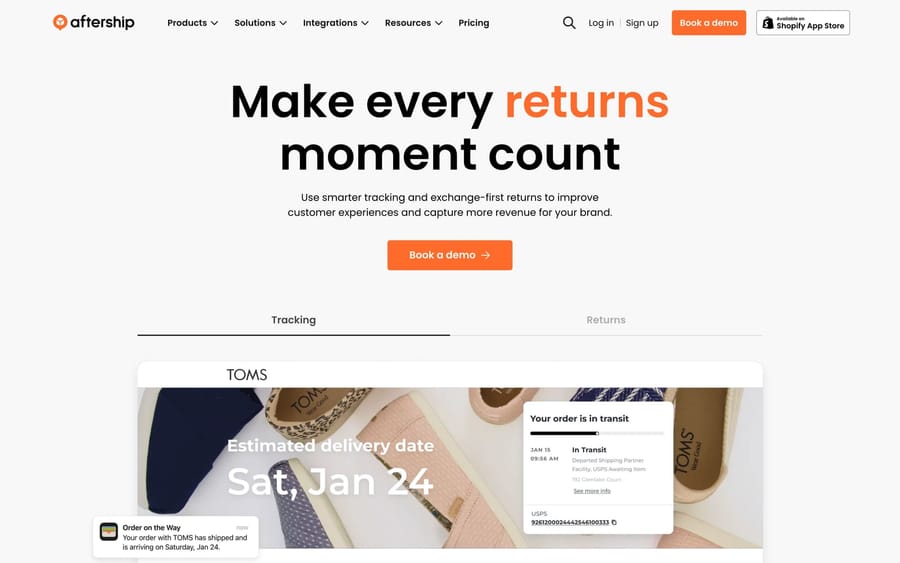
What it does: AfterShip automates shipment tracking with proactive, branded delivery updates. In Gorgias it surfaces live tracking so an agent (or an automation) can answer "where's my order?" with a real status instead of asking the customer to check their email. AfterShip's Returns Center is also listed for returns. Who it's for: Any store where WISMO ("where is my order?") is a top ticket driver. Native vs third-party: Third-party, built by AfterShip.
10. ShipBob (third-party, fulfillment)
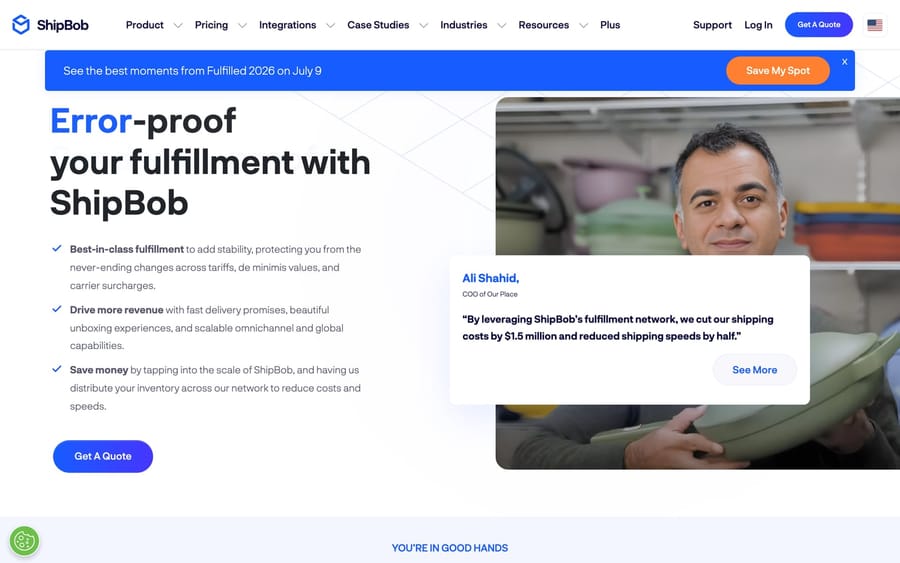
What it does: ShipBob is an end-to-end fulfillment provider; the Gorgias integration brings fulfillment and shipping context toward the ticket so agents can speak to order fulfillment status for stores that outsource the warehouse. ShipBob's API also allows cancel, address change and hold before the order ships, with a personal access token, which matters in the hours after a Black Friday order lands. Who it's for: Brands using ShipBob (or similar 3PLs) for fulfillment. Native vs third-party: Third-party, built by ShipBob.
How do Slack and SMS connect to Gorgias?
These keep your team, and your customers, connected on the channels they already use.
11. Slack (third-party)
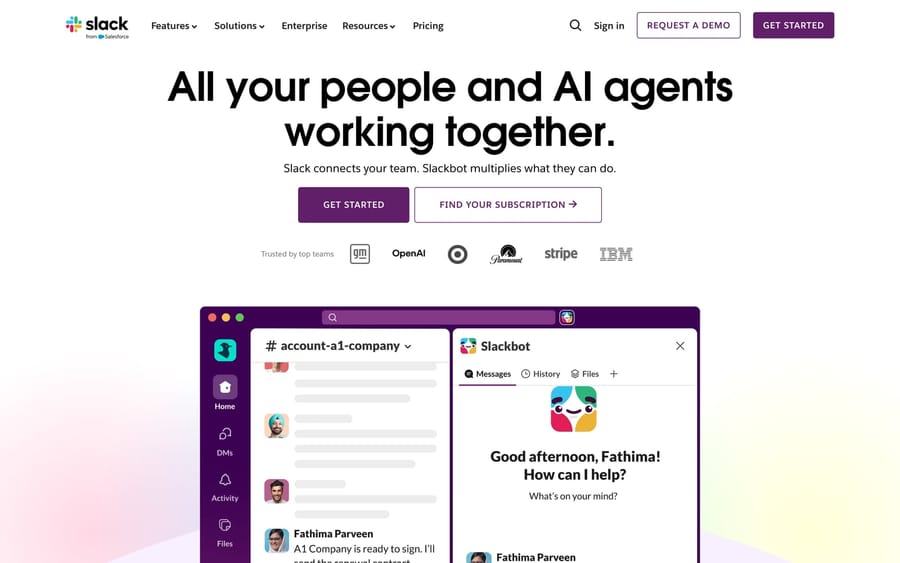
What it does: The Slack integration posts Gorgias ticket notifications into channels, lets teams share files and context, and supports triggers and Slack actions to automate workflow hand-offs, so internal escalations happen where your team already talks instead of in a notes field. Who it's for: Teams that run internal comms in Slack and want ticket alerts and quick collaboration there. Native vs third-party: Third-party, and one of the first connections most teams set up.
12. Attentive (third-party, SMS)
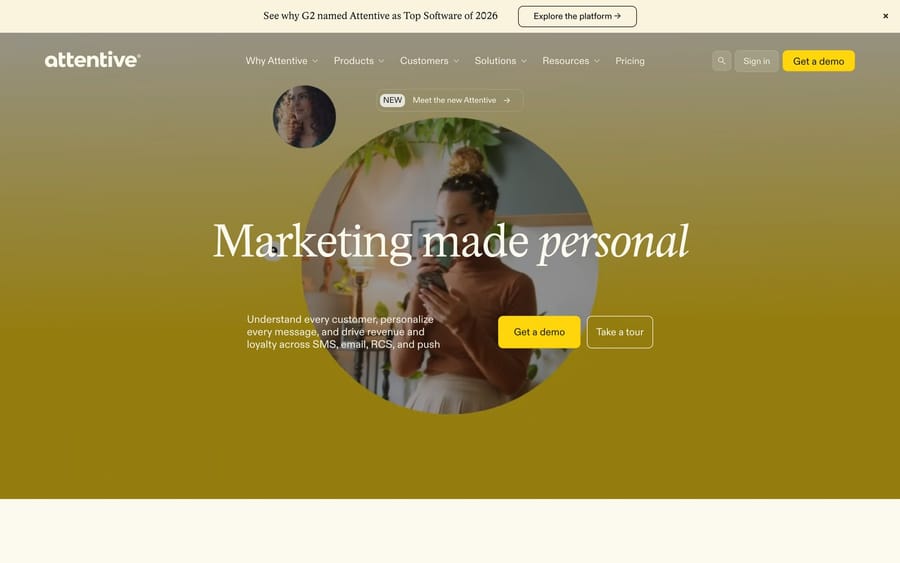
What it does: Attentive is an SMS marketing platform and one of Gorgias's five Preferred Partners. In Gorgias's SMS category it ties conversational SMS into the help desk so two-way text with customers is handled as tickets alongside email and chat. (Gorgias also offers its own native SMS channel if you'd rather not add a vendor.) Who it's for: Stores where SMS is a real marketing and support channel; for opt-out handling by an AI agent, see which email and SMS apps can process "stop texting me". Native vs third-party: Third-party, built by Attentive; Gorgias SMS is the native alternative.
What are the phone options for Gorgias?
Phone is still a primary channel for plenty of ecommerce brands, especially higher-AOV ones. These tie calls to tickets.
13. Gorgias Voice (native, by Gorgias)

What it does: Gorgias Voice is Gorgias's own built-in phone product. It handles calls inside the help desk so voice conversations become tickets with the same customer and order context as every other channel, with no third-party telephony vendor required. Who it's for: Teams that want phone support native to Gorgias. Native vs third-party: Native: a Gorgias product, configured in Settings rather than installed.
14. Aircall (third-party, partner)
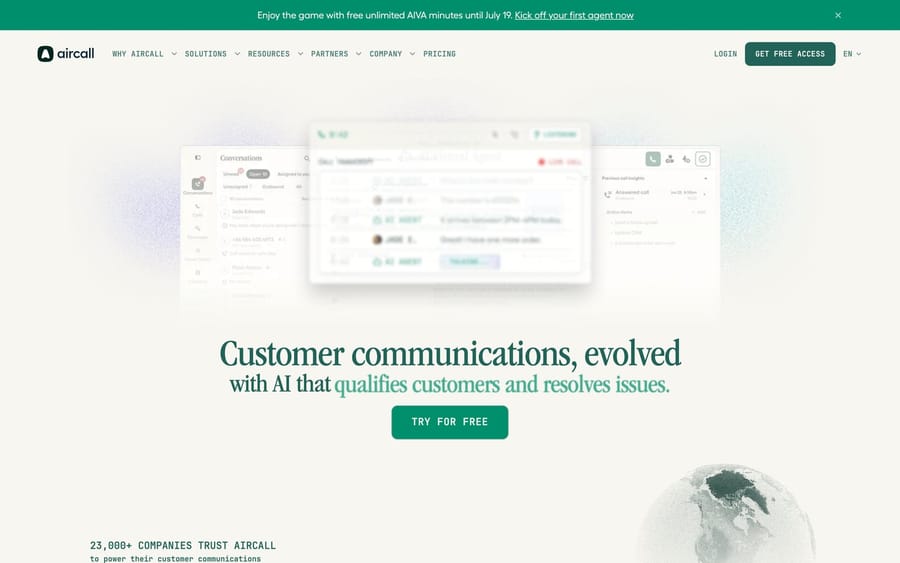
What it does: Aircall is a cloud phone system listed as a Gorgias preferred partner. The integration auto-creates a ticket for every call, shows Gorgias customer info (name, email, notes) in the Aircall dialer, and syncs tags and call comments back to the ticket, so nothing falls through after the customer hangs up. Who it's for: Teams already using Aircall (or weighing it against Gorgias Voice) that want calls logged as tickets. Native vs third-party: Third-party, built by Aircall. If phone is a primary channel, run a pilot on your own call volume before committing.
How do you connect Gorgias to apps with no dedicated integration?
When no dedicated app exists for a tool you use, a no-code automation platform bridges the gap, connecting Gorgias to thousands of apps you'd never find a marketplace tile for.
15. Zapier & Make (third-party iPaaS)
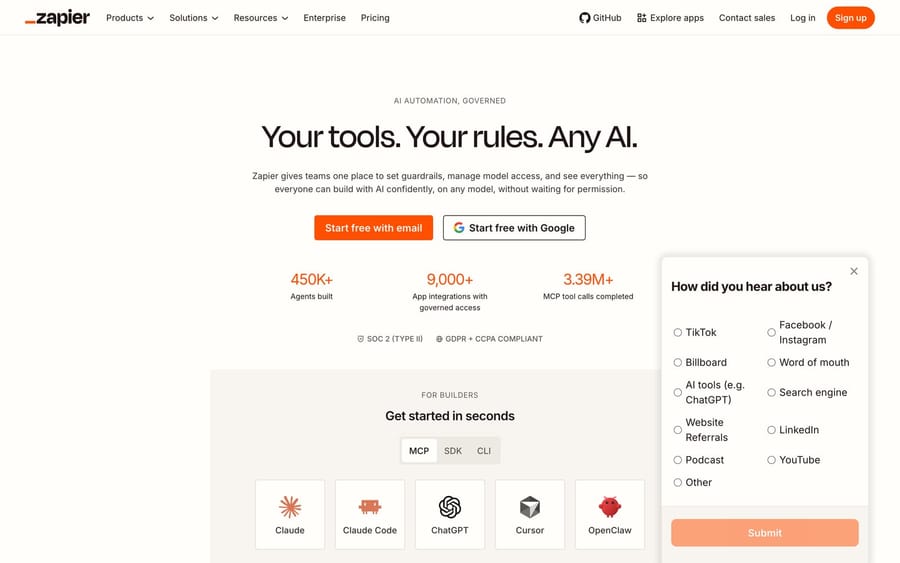
What it does: Zapier and Make are no-code integration platforms. Gorgias events, new ticket, status change, tag added, act as triggers, and either tool can create/update tickets or fan data out to 5,000+ other apps (CRMs, Google Sheets, spreadsheets, internal tools). Make adds a visual workflow builder; both require no code. Who it's for: Teams that need to connect Gorgias to a long tail of tools without a dedicated app, or to automate multi-step back-office workflows. Native vs third-party: Third-party iPaaS. Zapier has a first-party Gorgias listing; Make is typically reached via its own platform/the Gorgias API. You build the connection yourself, and pricing is per-task/per-operation on the iPaaS side.
Which analytics tools read Gorgias data?
Once tickets are flowing, you'll want to see them next to revenue and CX data. Gorgias has a dedicated BI & Analytics category.
16. Triple Whale & CX analytics (third-party)
What it does: Triple Whale lets you view your Gorgias data inside Triple Whale's ecommerce analytics, putting support volume next to marketing and revenue metrics. The category also includes CX-data and feedback-analysis tools like PureProfit.ai, Percepto.CX, ClientZen, and Syncly that mine ticket data for trends. Who it's for: Data-driven teams that want support metrics in the same dashboard as store performance. Native vs third-party: Third-party, built by the analytics vendors.
Which AI tools can resolve Gorgias tickets?
The fastest-moving category in the store is AI. Gorgias has its own AI Agent, available on every plan and billed only when it resolves a conversation, and there's a separate class of AI agent layers that connect on top of a help desk to resolve tickets end to end.
Several AI-resolution platforms in this space do not connect to Gorgias at all, so check before you shortlist one. Macha, the one we build, has a built-in Gorgias connector, and we've kept it off the numbered list above because it's our own product, not because it doesn't fit. On Gorgias your native path to AI resolution is the Gorgias AI Agent, plus third-party AI apps and agent layers that explicitly list Gorgias support. (Macha runs on Zendesk, Freshdesk, Gorgias, Front, HubSpot or Intercom, so an agent layer like Macha is an option here. It reads the ticket through the Gorgias connector, looks the order up with its built-in Shopify connector, and reaches apps such as Loop Returns, Smile.io or Klaviyo through custom API tools that Macha's team sets up during onboarding and keeps monitoring. Pricing is per ticket, from $299 a month for 750 tickets, rather than per resolved conversation, and you can start with $50 of free usage, no credit card required.)
Macha fits teams on Gorgias whose ticket mix runs past Gorgias's prebuilt Actions (points adjustments, SMS opt-outs, returns processing) and who don't want to build and maintain custom HTTP Actions themselves. If your volume is mostly order status and single-subscription skips, Gorgias AI Agent's own Actions cover it.
In what order should you add Gorgias integrations?
You don't need sixteen. Start where your tickets and your team actually spend time:
- Connect your store first: Shopify, BigCommerce, or Magento. This is the most useful install by a wide margin; order context in the ticket changes every conversation.
- Wire up your top post-purchase drivers: AfterShip for WISMO and Loop for returns, if shipping and returns dominate your queue.
- Add subscriptions: Recharge (or Loop Subscriptions), but only if you actually sell subscriptions; it's a churn-saver at the point of cancellation.
- Layer in marketing and loyalty context: Klaviyo, Smile.io, Yotpo/Okendo: when personalization or VIP handling matters to your brand.
- Match your channels: Slack for internal comms, Attentive or Gorgias SMS for text, Gorgias Voice or Aircall for phone.
- Prefer native, add third-party deliberately, and use Zapier/Make for the long tail. Gorgias-built apps (Shopify, BigCommerce, Magento) are best-maintained; partner apps are usually solid but add a vendor, so check reviews. Use an iPaaS for anything without a dedicated tile.
Every integration should remove a tab an agent currently opens or a step they currently do by hand. If it doesn't, skip it.
Frequently asked questions
What are the best Gorgias integrations to start with? Your store integration first: Shopify, BigCommerce, or Magento, because it puts order data in every ticket. Then add AfterShip (tracking) and Loop (returns) if post-purchase questions dominate, Recharge if you sell subscriptions, and Klaviyo for marketing context. Add Slack for internal comms and a voice option (Gorgias Voice or Aircall) if phone is a real channel.
Does Gorgias integrate with Shopify? Yes, and it's Gorgias's deepest integration. The native Shopify app shows full order history beside the ticket and lets agents edit and cancel orders, issue refunds, and answer order-status questions with live data, without leaving Gorgias.
Does Gorgias have a Klaviyo integration? Yes. The Klaviyo integration surfaces a customer's marketing engagement, segments, and purchase behavior in the ticket, and a Gorgias macro can add the customer to a Klaviyo list. It's built by Klaviyo (third-party).
Where do I find and install Gorgias apps? In the Gorgias App Store, reachable inside Gorgias via Settings → App Store (or Integrations). Open a listing, click Add/Install, and authenticate the other tool. Native Gorgias products (Voice, SMS, AI Agent) are configured under Settings rather than installed.
Native Gorgias app vs third-party, does it matter? Somewhat. Apps built by Gorgias (Shopify, BigCommerce, Magento) tend to be the most tightly integrated and best-maintained. Partner-built apps (Klaviyo, Recharge, Loop, Aircall, and most of the list) are typically capable but add a vendor and sometimes a cost, so check the listing's reviews, the maintainer, and pricing before relying on one.
Are Gorgias integrations free? Many App Store apps are free to add; you still pay for the other product's own plan (Klaviyo, Recharge, Loop, Aircall, etc.). Some capabilities depend on your Gorgias plan, iPaaS tools like Zapier/Make bill per task/operation, and Gorgias's own Voice and SMS add-ons are priced by call and text volume, and the Gorgias AI Agent is billed per resolved conversation. Always confirm on the listing.
Which Gorgias apps can an AI agent take actions in? Gorgias AI Agent has documented Actions for Shopify (six, including cancel order and edit shipping address), Recharge (ten, mostly for single-subscription shoppers), Loop Subscriptions and Skio, plus return status and portal links for Loop Returns. It also has prebuilt Support Actions for ShipStation and ShipBob, and you can build your own Action as an HTTP request to any app with an API. Apps with a documented API and a static key, such as Smile.io, Attentive or Loop Returns processing, can also be reached by an agent layer through a custom API tool; Yotpo Reviews and Loop's Label API can't, because their auth needs an expiring token or OAuth.
Can I add AI that resolves Gorgias tickets, not just assists? On Gorgias, your native route is the Gorgias AI Agent, billed per resolved conversation, plus third-party AI apps that explicitly support Gorgias in the App Store. Third-party agent layers vary in what they support, so pick a tool that actually lists Gorgias. Macha is one that does: its built-in Gorgias connector reads and writes the same tickets your team does (see Macha on Gorgias).
What is the short list for a new Gorgias account?
The best Gorgias integrations are the ones that erase a tab or a manual step in an ecommerce conversation: connect your store (Shopify/BigCommerce/Magento) first, then your post-purchase stack (Loop for returns, AfterShip for tracking), Recharge for subscriptions, Klaviyo/Smile.io/Yotpo/Okendo for marketing and loyalty context, Slack and Attentive for comms, Gorgias Voice or Aircall for phone, Zapier/Make for the long tail, and Triple Whale to see it all next to revenue. Lead with Gorgias-native apps, add partner apps deliberately, and confirm pricing on each listing. And if AI resolution is on your roadmap, choose a tool that actually connects to your help desk. On Gorgias that's the Gorgias AI Agent, a Gorgias-listed AI app, or an agent layer with a built-in Gorgias connector such as Macha.
Integrations checked against the Gorgias App Store, September 2026; App Store signals re-read 28 September 2026 and Shopify App Store ratings 25 September 2026. Vendors update apps and pricing periodically, so confirm details on each App Store listing before installing.
Add AI agents to your Gorgias
Macha reads the ticket, drafts the reply and takes the action, inside the Gorgias you already run.