
 Shopify
 Stripe
 Slack
Slack Notion
 Google Workspace
 Confluence

What Are the Best Tidio Alternatives in 2026? 8 Tools Compared


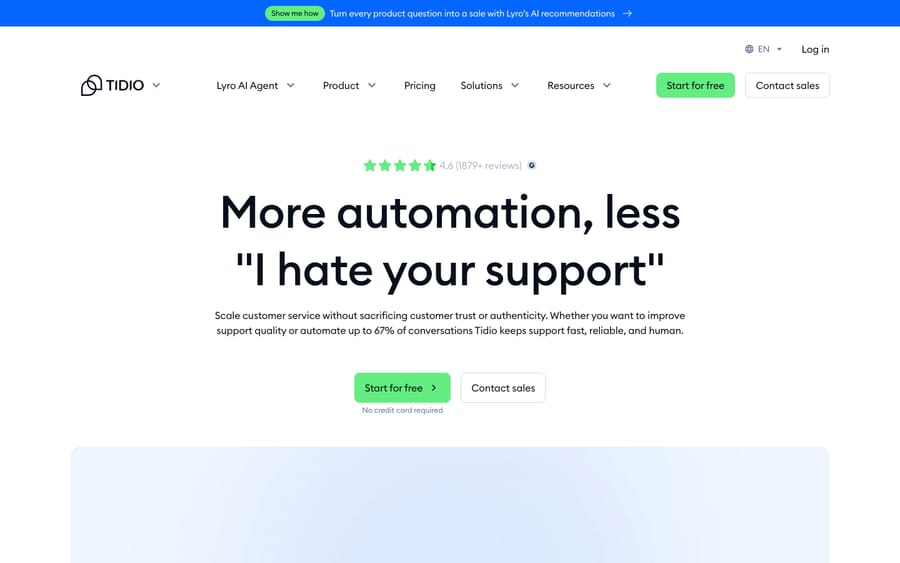
Tidio is one of the easiest ways to get live chat and an AI chatbot on a site, but its billable-conversation pricing, Lyro add-on and usage-based Plus plan push many growing teams to look elsewhere. These eight alternatives each fix a different reason for leaving, with prices checked on vendor pages in September 2026.
Key takeaways
- Crisp, Intercom, Freshchat, Chatwoot, Help Scout, Gorgias, Zendesk and LiveChat are the eight strongest Tidio alternatives in 2026, and Drift is excluded because Salesloft is sunsetting it.
- Tidio meters billable conversations, sells extra Lyro AI capacity as an add-on from $32.50 a month, and prices its Plus plan from $300 a month plus usage.
- Crisp charges a flat fee per workspace rather than per seat or conversation, from $45 to $295 a month, with AI credits included on every paid tier.
- Intercom seats cost $29 to $132 a month billed annually, and its Fin AI agent adds $0.99 per outcome on top.
- Gorgias bills on ticket volume from $10 a month for 50 tickets to $900 a month for 5,000 tickets, with AI Agent billed at $0.85 to $1.00 per automated interaction.

The best Tidio alternatives in 2026 are Crisp (flat $45 to $295 a month per workspace), Intercom with Fin, Freshchat, Chatwoot, Help Scout, Gorgias, Zendesk and LiveChat; which one fits depends on why you're leaving Tidio. Most teams leave over pricing: Tidio meters billable conversations, sells extra Lyro AI capacity as an add-on from $32.50 a month, and its Plus plan starts at $300 a month plus usage (tidio.com/pricing, checked 24 September 2026).
Below: the eight tools worth shortlisting, plus a note on Drift, which is being shut down, so you don't walk into a dead end. For each we cover what it is, who it wins for, its current pricing model, its G2/Capterra rating with an attributed user quote, and how it differs from Tidio. Prices were re-checked on each vendor's pricing page on 24 September 2026; ratings were gathered in June 2026.
How do the top Tidio alternatives compare?
| Tool | Rating | Pricing model | Best for | vs Tidio |
|---|---|---|---|---|
| Crisp | G2 4.5/5 (~189) | Flat per workspace, $45–$295/mo (AI credits included) | SMBs wanting predictable, all-in pricing | Flat workspace fee, not per-conversation |
| Intercom (Fin) | G2 4.5/5 (~2,900) | $29–$132/seat/mo billed annually + Fin $0.99/outcome | SaaS, AI-led deflection at scale | Stronger AI + messenger; far pricier |
| Freshchat | G2 4.5/5 · Capterra 4.1/5 | Free (10 agents), then $19–$79/agent/mo + Freddy AI | Multichannel SMB in the Freshworks stack | Per-agent, deeper helpdesk ties |
| Chatwoot | G2 4.5/5 | Open-source (free self-host) / cloud $0–$99/agent | Technical teams wanting data control | Own your data; you run the infra |
| Help Scout | G2 4.6/5 · Capterra 4.6/5 | Free (5 users), then $25–$75/user/mo + AI Answers $0.75/resolution | Human-first support + email + chat | Lower per-resolution AI cost than rivals; inbox-led, not chat-led |
| Gorgias | G2 4.6/5 (~547) | Ticket volume, $10–$900/mo + AI per automated interaction | Shopify / DTC ecommerce | Ecommerce-native; order data in the ticket |
| Zendesk | G2 4.3/5 (~6,837) | Suite from $55/agent/mo (Enterprise + Copilot quote-only) + AI per resolution | Teams outgrowing chat into full helpdesk | Far deeper + pricier; AI billed on top |
| LiveChat | G2 4.5/5 · Capterra 4.6/5 | $19–$79/agent/mo billed annually | Sales-led, conversion-focused live chat | Chat-first polish; AI is a separate product |
Update (September 2026): Salesforce completed its acquisition of Fin, the company formerly called Intercom, on 10 September 2026, in a deal announced in June at about $3.6 billion (Salesforce press release). Fin is still sold at $0.99 per outcome. Worth weighing in any long-term Intercom/Fin decision.
Prices checked on vendor pricing pages on 24 September 2026; ratings from June 2026. Verify before buying. Drift is being sunset (see below) and is not recommended.
Why do teams look for a Tidio alternative?
Tidio isn't broken. But a few recurring, fair complaints push teams to look elsewhere, and it's worth naming yours precisely, because some are solvable without switching.
- The December 2024 pricing restructure stung. Tidio rebuilt its plans around new AI features, and multiple long-running customers reported their bills roughly doubled under the new tiers — some with little warning. One Capterra reviewer summed up the common gripe: scaling to advanced features "you need the PRO plan, which is nearly 5x more expensive." If your renewal jumped, you're not imagining it.
- Conversation-based billing is hard to predict. Tidio meters "billable conversations": Starter ($24.17 a month billed annually) includes 100, and Growth (from $49.17 a month billed annually) starts at 250. A good month for your marketing is a more expensive month for your support tool.
- Lyro AI is a separate add-on, and it's capped. Free and Starter include only 50 one-off Lyro conversations. Beyond that, the standalone Lyro AI Agent add-on starts at $32.50 a month for 50 conversations, and Tidio's Premium tier, which guarantees a 50% Lyro resolution rate, is priced on request. For teams that want AI on every conversation, the real bill climbs.
- The jump to Plus is still a step. Plus starts at $300 a month plus monthly usage, with custom seats and conversation volume. That's lower than the $749 Plus price reviewers complained about in 2025, but it's a new billing shape: a base fee plus usage rather than a fixed tier.
None of this makes Tidio a bad tool. It makes it a specific one — excellent for small teams that want fast, friendly chat plus a capable starter AI, weaker if your bottleneck is predictable pricing, bundled AI economics, or room to scale without a tier cliff. Keep your real reason in mind; it determines which alternative below actually fixes your problem.
How did we compare the alternatives?
We focused on currently-selling tools a Tidio team could realistically move to: SMB live-chat-plus-AI-chatbot platforms, an open-source option, a couple of full helpdesks, and the ecommerce specialist that many Tidio-on-Shopify stores graduate to. For each we pulled live pricing from the vendor's own pages (re-checked 24 September 2026) (or cited third-party trackers where pricing is quote-only), the current G2 and Capterra star ratings with approximate review counts as a real-user signal, and we read through review sentiment for recurring praise and complaints. The verbatim quotes come from Capterra, which serves them publicly. Prices are vendor-set and change often, so confirm on each vendor's page before you sign.
What are the 8 best Tidio alternatives?
1. Crisp — the flat-fee SMB favourite
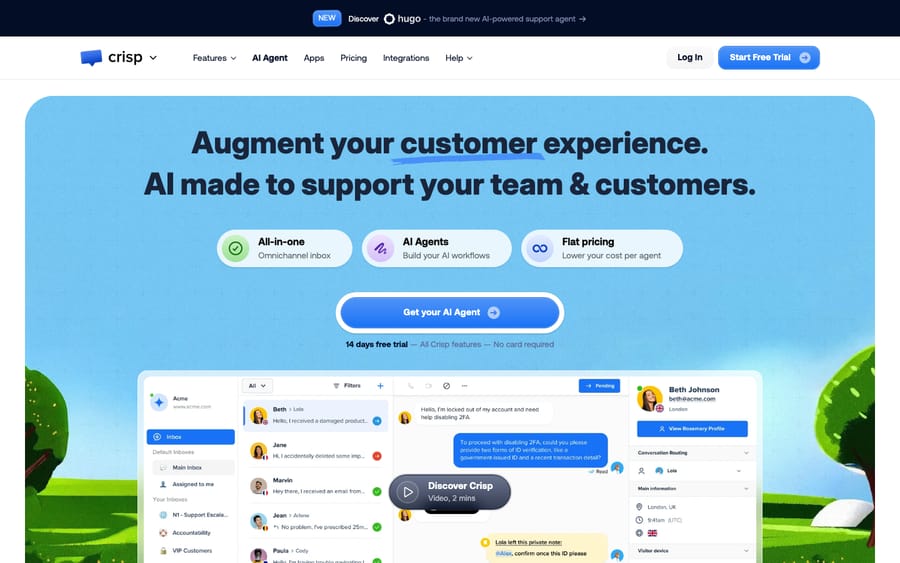
What it is: An all-in-one business messaging suite — live chat, chatbot, shared inbox, knowledge base, and an AI agent — sold at a flat price per workspace rather than per seat or per conversation. Who it wins for: Small teams that loved Tidio's simplicity but want a predictable monthly bill they can forecast, with more seats included. Pricing: Free (2 seats, no AI credits); Mini $45/month (4 seats, $5 of AI credits), Essentials $95/month (10 seats, $25 of AI credits), Plus $295/month (20 seats, $75 of AI credits) per workspace, with custom Enterprise (crisp.chat/pricing). The flat-rate model means cost doesn't spike with conversation volume. Rating: G2 4.5/5 (~189 reviews), with support quality singled out repeatedly.
"It's value for money already bringing us a 40% reduction in queries due to their AI." — Leandi M., Product Manager & Conversational AI (Leisure/Travel & Tourism), Capterra, March 2026
How it differs from Tidio: The headline difference is billing — Crisp charges a flat workspace fee with AI credits included on paid tiers, the opposite of Tidio's per-conversation metering and separate Lyro add-on. The watch-out: a few reviewers report Crisp's own prices stepping up sharply at the top tiers, and its mobile app lags the desktop experience.
2. Intercom (with Fin AI) — the AI-first scale option
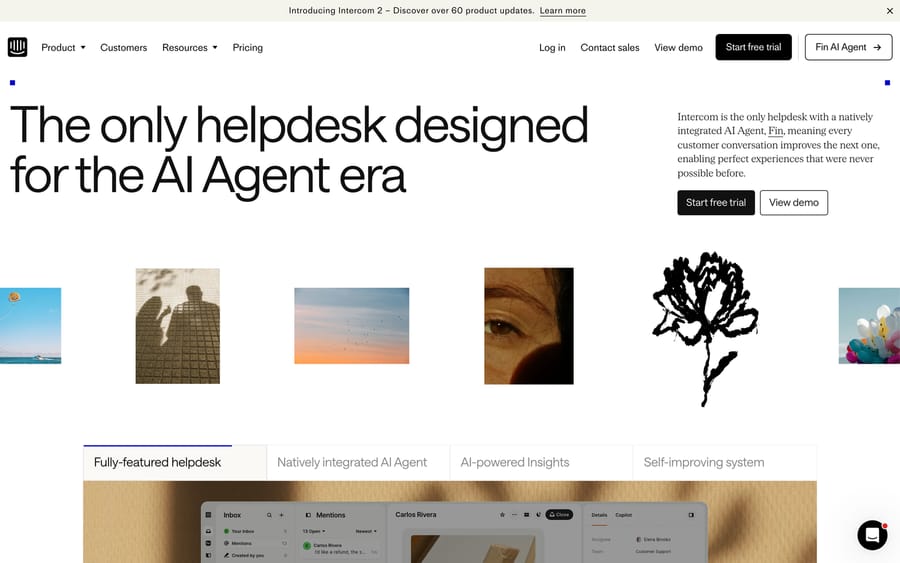
What it is: A messenger-first support platform whose Fin AI agent is among the most-cited per-resolution products on the market. Salesforce completed its acquisition of Fin on 10 September 2026 and cites a 76% average resolution rate. Who it wins for: SaaS and digital-first companies whose support skews to in-app chat and email, and who want best-in-class AI deflection rather than a starter chatbot. Pricing: Seats run $29 (Essential), $85 (Advanced), $132 (Expert) per seat/month billed annually (Intercom has also shown $19 for Essential in a pricing test), with Fin charged at $0.99 per outcome on top. The 50-outcome monthly minimum applies only when Fin runs on a help desk other than Intercom. Your real bill scales with both seats and volume. Rating: G2 4.5/5 across ~2,900 reviews.
"Their AI agent, Fin, charges about $0.99 per resolution, which adds up quickly at scale." — Marc G., Director (Computer Software), Capterra
How it differs from Tidio: A genuinely stronger messenger and a more capable AI agent — the upgrade Tidio teams reach for when Lyro's ceiling and caps start to bite. The trade-off is cost and predictability: Intercom's modular seat-plus-resolution pricing is notoriously hard to forecast and lands well above Tidio at any real volume. Best when AI deflection is the priority, not the budget.
3. Freshchat — the multichannel pick in the Freshworks stack
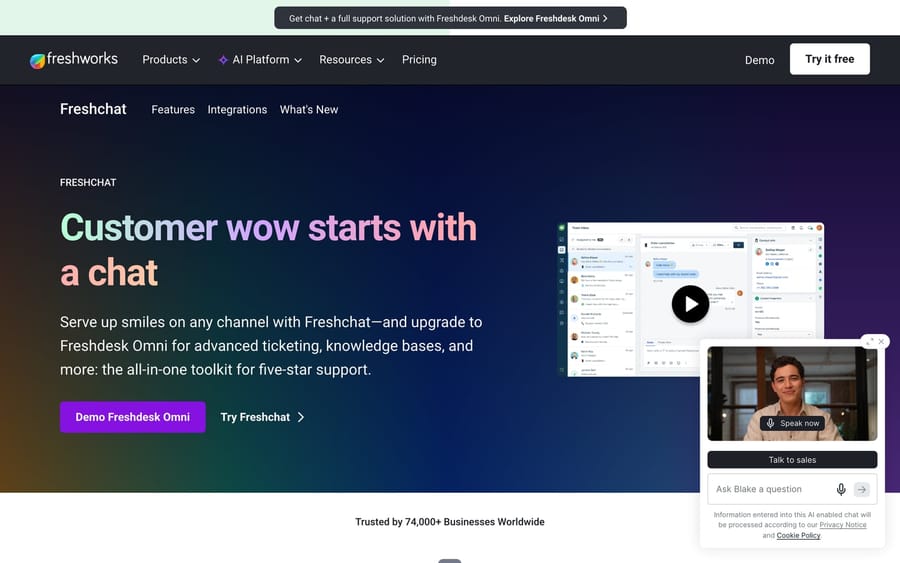
What it is: Freshworks' messaging product — live chat, chatbots, and multichannel (WhatsApp, Instagram, email) with the Freddy AI agent, tightly tied to Freshdesk and the wider Freshworks suite. Who it wins for: Growing SMBs that want more channels than Tidio comfortably handles, especially anyone already using Freshdesk or Freshsales. Pricing: Free for up to 10 agents, then Growth $19, Pro $49, Enterprise $79 per agent/month billed annually. The Freddy AI Agent comes with 500 sessions as a one-time allowance per account, then costs $49 per 100 sessions; Freddy AI Copilot is $29 per agent/month on Pro and Enterprise (Freshchat pricing). Rating: G2 4.5/5, but a more middling Capterra 4.1/5 (~220 reviews) — and a March 2026 multi-day outage reported by at least one account is a fair reliability caveat.
"One of its biggest strengths is how it brings conversations from multiple channels into a single interface." — Vaishnava S., Instructional Designer (Design), Capterra
How it differs from Tidio: Per-agent rather than per-conversation pricing, broader channel coverage, and a stronger pull into a full helpdesk if you're in the Freshworks ecosystem. The flip side is that it can feel heavier than Tidio for a tiny team that just wants a chat widget.
4. Chatwoot — the open-source, own-your-data choice
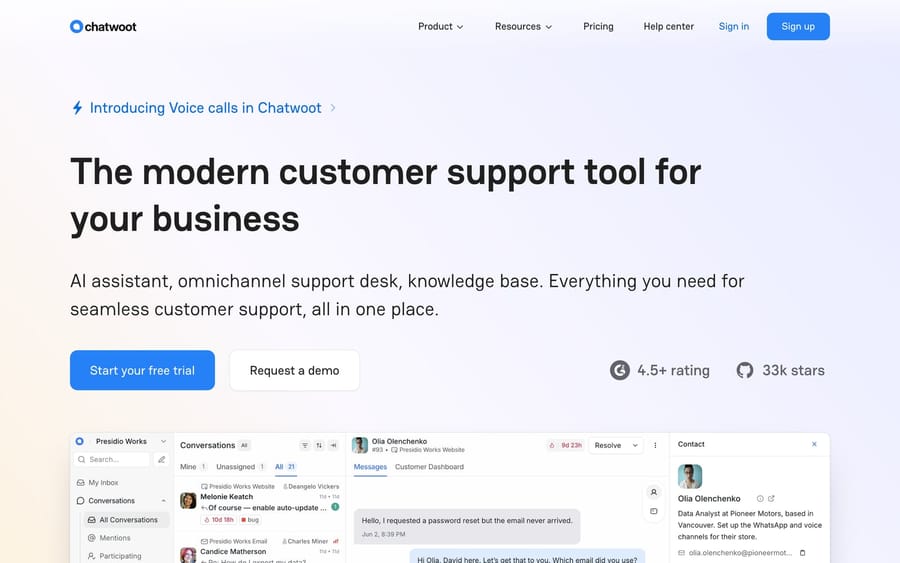
What it is: An open-source customer engagement suite (live chat, shared inbox, multichannel, plus its Captain AI) you can self-host for free or run as a managed cloud product. Around 32,000 GitHub stars and a large self-hosting community. Who it wins for: Technically capable teams who want full control of their data and infrastructure — privacy-sensitive, regulated, or simply cost-driven teams comfortable running their own stack. Pricing: Community Edition is free to self-host (you pay only for infrastructure and your engineers' time). Cloud runs Free (Hacker, up to 2 agents and 500 conversations a month), $19 (Startups), $39 (Business), $99 (Enterprise) per agent/month. Captain AI includes 300 to 800 credits a month depending on plan, then $20 per 1,000 credits (chatwoot.com/pricing). Rating: G2 4.5/5 — praised for cost-effectiveness and data ownership, with a UI that newer users sometimes find takes adjusting to.
"As an open source platform it is very cost effective… the privacy concerns are over as the businesses can self host the platform." — Aman G., verified G2 reviewer, December 2024
How it differs from Tidio: It's the anti-SaaS option — no per-conversation meter and no vendor lock-in, but the "free" self-hosted version trades licence cost for real engineering overhead (SMS/WhatsApp delivery fees, backups, monitoring, upgrades). Pick it for control, not for zero effort.
5. Help Scout — the human-first support platform
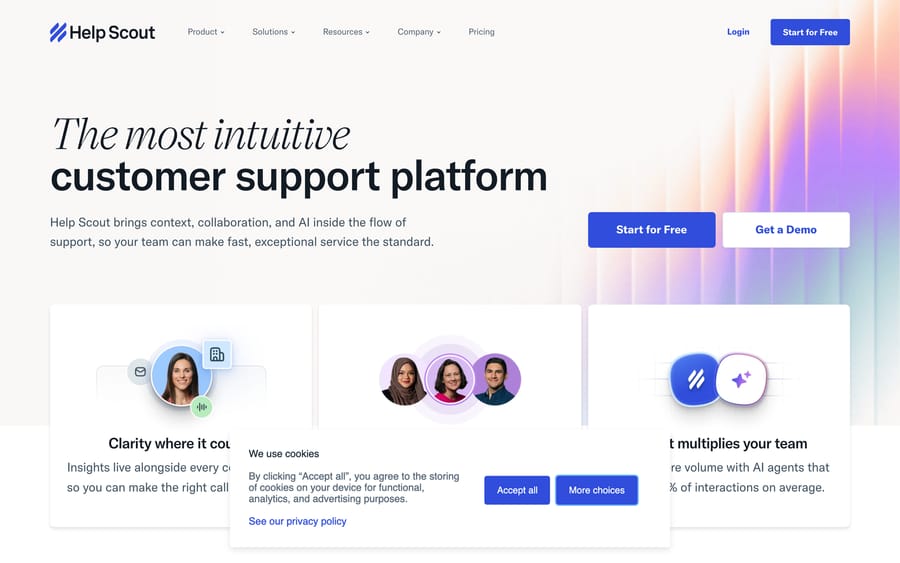
What it is: A clean, conversation-style support platform built around a shared inbox, knowledge base (Docs), and the Beacon widget for help content and live chat, with AI features layered in. It deliberately downplays "ticket" machinery to feel like email. Who it wins for: Small and mid-sized teams — especially SaaS and services — whose support is more email-and-help-content than constant live chat, and who want a warm customer experience with predictable, low-cost AI. Pricing: A Free plan for up to 5 users, then per-user plans: Standard $25, Plus $45, Pro $75 per user/month billed annually, with AI Answers metered at $0.75 per resolution as an add-on (helpscout.com/pricing). Help Scout does meter its AI like almost every tool here, but its per-resolution rate is lower than Fin's $0.99 per outcome or Gorgias's $0.85–$1.00 per automated interaction, and you can cap monthly AI spend. Rating: G2 4.6/5 and Capterra 4.6/5 — consistently praised for ease of use.
"Help Scout has a clean, intuitive interface that doesn't overwhelm users with unnecessary complexity." — Krystal M., People Operations (IT Services), Capterra, April 2026
How it differs from Tidio: Help Scout is inbox-led where Tidio is chat-led — if proactive website chat and a visual bot builder are your core need, Tidio fits better; if email, help content, and a calmer human-first workflow matter more, Help Scout wins — and while it meters AI like Tidio's Lyro, its per-resolution AI cost undercuts the priced-per-resolution rivals.
6. Gorgias — the ecommerce specialist

What it is: The dominant Shopify-era helpdesk, purpose-built for ecommerce. It pulls order, refund, and subscription data into the conversation, and its AI Agent resolves WISMO, returns, and product questions natively across chat and email. Who it wins for: Shopify, BigCommerce, and DTC brands whose support is mostly order-related — the natural next step for a Tidio-on-Shopify store that's outgrown a generic widget. Pricing: Billed on monthly ticket volume, not seats — from $10/month (50 tickets) up to $900/month (5,000 tickets), billed monthly (annual billing lowers Basic, Pro and Advanced to $50, $300 and $750). AI Agent is included on every plan and billed per automated interaction, $0.85–$1.00 depending on plan (gorgias.com/pricing). Rating: G2 4.6/5 (~547 reviews); note a more mixed 4.3/5 on the Shopify App Store, where billing and support complaints surface.
"Charging per ticket instead of per user allowed nearly everyone in our company to use it freely." — Frank A., Head of Digital (Business Supplies & Equipment), Capterra, March 2026
How it differs from Tidio: Far deeper for retail conversations out of the box, with native order context Tidio can't match — but it's a specialist. If you're not in ecommerce, it's the wrong tool; and like Tidio, its costs (tickets plus per-resolution AI) can climb at peak season.
7. Zendesk — the upgrade into a full helpdesk
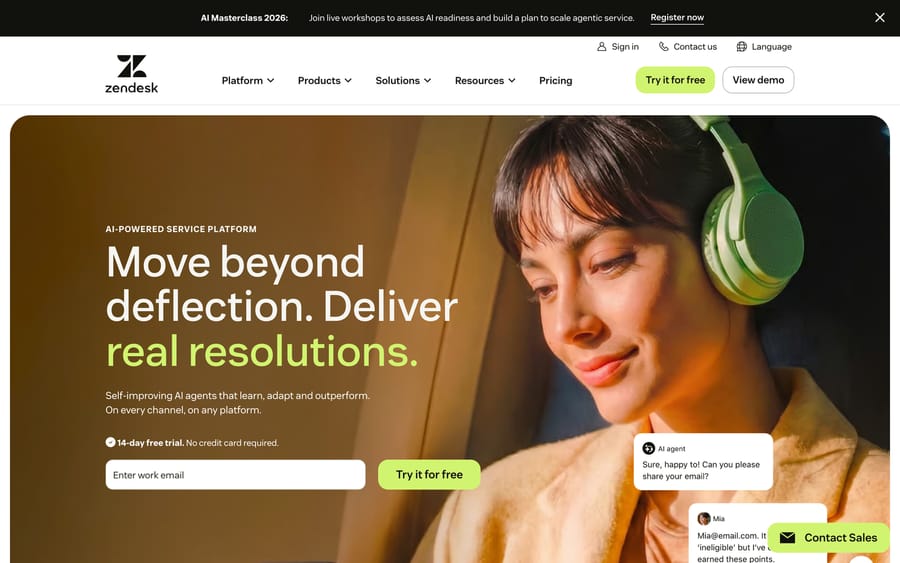
What it is: The category heavyweight — a deep, extensible support platform with omnichannel ticketing, a mature marketplace, robust reporting, and native AI agents. Who it wins for: Teams that have outgrown live chat and need a full helpdesk: complex routing, SLAs, deep reporting, and a large app ecosystem — with the budget to match. Pricing: Zendesk's pricing page lists Suite Team at $55 and Suite Professional at $115 per agent/month billed annually, with Suite Enterprise + Copilot quote-only. AI agents are included in every plan and billed per automated resolution, at $1.50 committed or $2.00 pay-as-you-go per the page's plan comparison table. The same table includes 5 automated resolutions per agent a month on Support Team and Suite Team and 10 on Suite Professional; Zendesk's help center describes this as a monthly AI allowance of $2, $5 or $10 per seat by plan, since 18 May 2026. Copilot is $50 per agent/month on Suite Professional and above (zendesk.com/pricing). Rating: G2 4.3/5 across ~6,837 reviews — one of the largest review bases in the category.
"My overall experience with Zendesk Suite has been very positive… advanced configurations will take your time to learn and then implement." — Ifra S., Zendesk Developer (Information Technology & Services), Capterra
How it differs from Tidio: A different weight class. Zendesk trades Tidio's afternoon setup and SMB pricing for enterprise depth and an enterprise bill. It's overkill for a small store that just needs chat, and exactly right for a team whose real problem is that Tidio can't scale into structured, multichannel support.
8. LiveChat — the conversion-focused chat workhorse
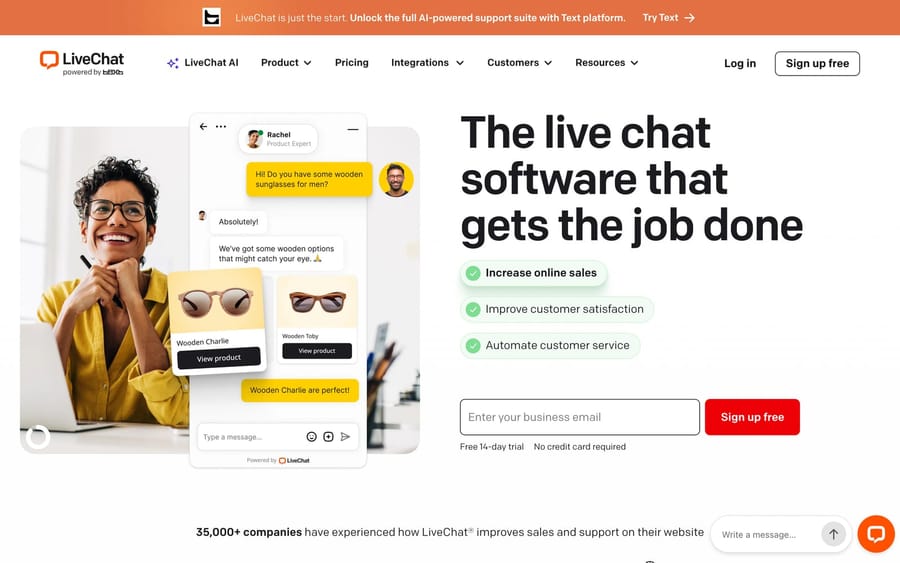
What it is: A polished, dedicated live chat platform built for speed and sales — fast agent tools, rich messaging, and tight integrations, with AI (ChatBot) sold as a companion product. Who it wins for: Sales- and conversion-led teams that want best-in-class human live chat on the website and treat AI as secondary. Pricing: $19 (Starter), $49 (Team), $79 (Business) per agent/month billed annually ($25, $59 and $89 billed monthly), with custom Enterprise and a 14-day free trial (livechat.com/pricing). Rating: G2 4.5/5 and Capterra 4.6/5 (~1,700 reviews), with reviewers praising measurable conversion lift even at a premium price.
"We were able to generate additional sales when we started using this app because our customers don't need to call us anymore." — Amytha Grace V., Sales & Customer Service Associate (Retail), Capterra
How it differs from Tidio: LiveChat is the more refined live chat experience, but its AI lives in a separate product (ChatBot) rather than bundled like Lyro — so for an all-in-one chat-plus-AI starter, Tidio is more cohesive, while LiveChat wins if human chat quality and conversion are your priority.
Should you migrate to Drift?
No. If Drift appears on your shortlist, cross it off. In March 2026, Clari + Salesloft (which acquired Drift for ~$500M in 2024) announced Drift's sunset, referring existing customers to 1mind as its successor — this followed a serious September 2025 OAuth security breach affecting hundreds of organizations. The product pages are still live and no hard end-of-life date is public, but moving onto a tool that's actively winding down is the opposite of what a Tidio switch should achieve.
Can you add AI agents to a help desk instead of switching chat tools?
We build an AI product, so we'll be upfront about where it fits — and where it doesn't.
Macha is an AI agent layer that runs on top of an existing help desk, and it connects to Zendesk, Freshdesk, Gorgias, Front, HubSpot or Intercom. It does not integrate with Tidio. So if you're committed to Tidio, Macha isn't your answer, and we won't pretend otherwise. The reason it's worth a mention here: a fair number of teams shopping for Tidio alternatives are outgrowing SMB live chat altogether and moving up to a full help desk. If your shortlist already includes Zendesk or another desk Macha supports, then instead of paying for each vendor's native AI on top, you can run Macha's agents on that help desk. They read the customer's actual question, pull from your connected data and help center, resolve routine tickets inside your existing workflow, and hand off to a human with full context when unsure. Macha bills per ticket, from $299 a month for up to 750 tickets, with setup and monitoring by the Macha team included.
The watch-out: it's only as good as the data and knowledge you connect, and it's irrelevant unless you're on a desk Macha supports. If you're staying on lightweight chat, one of the eight tools above is the right move. You can see how the layer works on a helpdesk, or try it with $50 of free usage, no credit card required.
What do real users say about Tidio and its alternatives?
Ratings give you the average; reviews tell you why. The pattern across these tools is consistent: SMB chat platforms score high on ease of use and low on pricing transparency, while the full helpdesks trade simplicity for depth.
Tidio itself holds G2 4.6 / Capterra 4.7, with ease of setup the most-praised attribute and pricing the most-cited complaint after the December 2024 restructure:
"The chatbot builder is intuitive and flexible, which made it simple to automate FAQs and lead capture." — Carl R., Managing Director (Financial Services), Capterra, June 2025
"To scale up and unlock advanced features, you need the PRO plan, which is nearly 5x more expensive." — Verified Reviewer, Senior Marketing Manager (Electrical/Electronic Manufacturing), Capterra, June 2025
On the alternatives, Crisp users repeatedly credit support and value ("the tool is awesome, the support team very reactive," — Simon C., CTO, IT Services, Capterra), Help Scout is praised for an uncluttered interface, and Gorgias reviewers like ticket-based billing that lets the whole team chip in. The recurring cross-tool lesson: read the pricing-model reviews, not just the star average — that's where the surprises live.
How do you choose the right Tidio alternative?
- Name your real reason for leaving. If it's the price hike or unpredictable conversation billing, look at flat-fee Crisp or per-agent Freshchat. If it's data control, Chatwoot. If it's AI ceiling, Intercom. If you've simply outgrown chat, Zendesk or Help Scout. If you're ecommerce, Gorgias. Don't switch platforms to fix a single feature.
- Match the billing model to your volume. Per-conversation (Tidio), per-workspace (Crisp), per-agent (Freshchat, LiveChat, Zendesk), per-ticket (Gorgias), and per-resolution AI (Intercom, Gorgias) reward very different usage shapes. Model your real numbers, not the sticker price.
- Count the AI cost separately. Almost every tool here meters or add-ons its AI (Lyro add-on, Fin per outcome, Gorgias per automated interaction, Help Scout AI Answers per resolution, Freddy sessions, Zendesk automated resolutions). Add it to the base plan before you compare.
- Weigh migration honestly. Moving chat tools means re-embedding widgets, rebuilding bot flows, and retraining — worth it for a structural problem, overkill for one gripe.
- Pilot on real traffic. Run your shortlist on live conversations and measure deflection, CSAT, and response time against your Tidio baseline before you commit.
Frequently asked questions
What is the best Tidio alternative in 2026? There's no single winner — it depends on why you're leaving. Crisp is the best like-for-like SMB swap with predictable flat pricing; Intercom leads on AI deflection at scale; Freshchat suits multichannel teams in the Freshworks stack; Chatwoot wins for data control; Help Scout for human-first email-and-chat support; Gorgias owns ecommerce; Zendesk is the full-helpdesk upgrade; and LiveChat is the conversion-focused chat specialist. Avoid Drift, which is being sunset.
Why did my Tidio bill go up? Tidio restructured its pricing in December 2024 around its new AI features, and many existing customers reported their bills roughly doubling under the new tiers — some without much notice. Tidio also bills on "conversation" volume and sells extra Lyro AI capacity as an add-on from $32.50 a month, so costs can rise with both traffic and AI usage. If predictability matters, a flat-fee tool like Crisp is worth a look.
How much does Tidio cost in 2026? Tidio has a Free plan with 50 billable conversations, Starter at $24.17 a month and Growth from $49.17 a month (both billed annually), Plus from $300 a month plus usage, and a custom-priced Premium plan. Extra Lyro AI capacity starts at $32.50 a month.
What is the cheapest Tidio alternative? Chatwoot is effectively free if you self-host the open-source Community Edition (you pay for infrastructure and engineering time). Among hosted tools, Freshchat (free up to 10 agents, then $19/agent) and LiveChat (from $19/agent) are the most budget-friendly entry points. Remember to add AI costs when comparing — the base price is rarely the final number.
Which Tidio alternative has the best AI chatbot? For raw AI deflection, Intercom's Fin is the most-cited per-resolution agent on the market, with Gorgias strongest for ecommerce-specific resolution. Both are pricier and meter AI per outcome or per automated interaction. For a deeper look at AI specifically, see our guide to the best AI chatbot for customer service.
Do I have to leave Tidio to get better AI? If you're staying on Tidio, your AI options are Lyro plus its add-on packs. The "AI layer on your existing tool" route — like Macha — only applies if your help desk is one Macha connects to (Zendesk, Freshdesk, Gorgias, Front, HubSpot or Intercom); it does not integrate with Tidio. If you're already moving up to one of those helpdesks, you can add AI agents there instead of paying for each vendor's native AI on top.
For more on the broader market, see our roundups of the best live chat software and the best AI chatbot for customer service, or read how an AI agent layer on Zendesk works.
Pricing re-checked on vendor pages on 24 September 2026; ratings and review quotes gathered June 2026. Live-chat and AI pricing in this category changes fast, so confirm current terms on each vendor's site before buying.