
 Shopify
 Stripe
 Slack
Slack Notion
 Google Workspace
 Confluence

Freshdesk vs LiveAgent (2026): Which Is Cheaper and Better for SMBs?


LiveAgent suits small teams where phone support is central, with a native call center from its $29 Medium plan, while Freshdesk suits teams that want deeper automation and a larger ecosystem from $19 per agent. Both prices are annual billing, checked on each vendor's pricing page in September 2026.
Key takeaways
- LiveAgent's Medium plan costs $29 per agent per month on annual billing and includes a native call center, while Freshdesk sells phone support as a separate Freshworks contact center product.
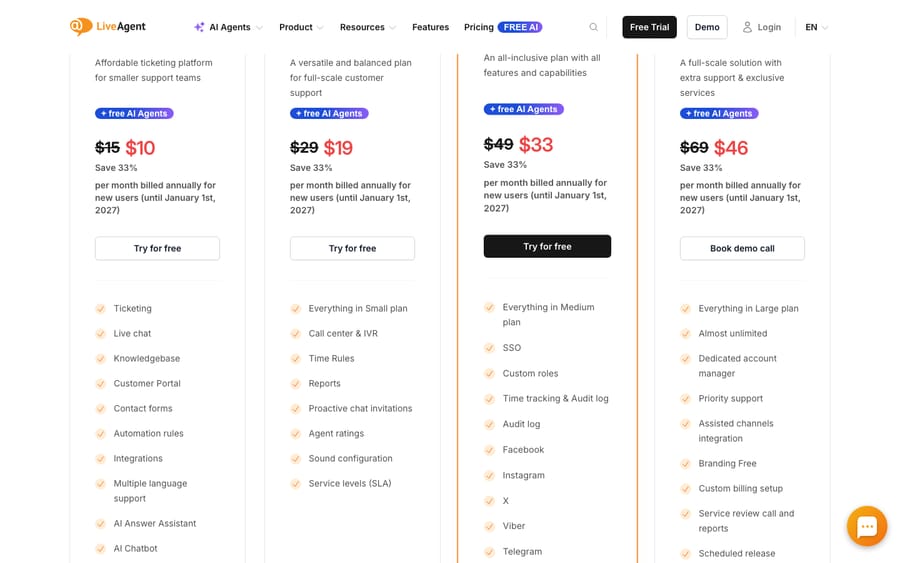
- LiveAgent's annual per-agent prices are Small $15, Medium $29, Large $49 and Enterprise $69, up from the $10 to $46 promotional rates shown earlier in 2026.
- Freshdesk's plans cost $19 for Growth, $55 for Pro and $89 for Enterprise per agent per month on annual billing, and the pricing page no longer shows a free plan.
- Freshdesk's Freddy AI Agent includes 500 sessions once per account and then charges $49 per 100 sessions, while LiveAgent includes its AI Answer Assistant and chatbot on every paid plan.
- LiveAgent charges $39 a month for each social channel such as Facebook or WhatsApp on its lower plans, so check which channels sit on which tier before comparing totals.

Pick LiveAgent if phone support is central: its Medium plan costs $29 per agent per month on annual billing and includes a native call center plus a free AI chatbot, while Freshdesk sells voice as a separate Freshworks product. Pick Freshdesk if you want deeper automation and a larger ecosystem, starting at $19 per agent per month for Growth.
| Freshdesk | LiveAgent | |
|---|---|---|
| Best for | SMBs that want polished ticketing, strong automation, and a large app ecosystem | SMBs where phone support is central and budgets are tight |
| Entry price | Growth $19/agent/mo (annual); no free plan on the pricing page, 14-day trial | Small $15/agent/mo (annual), $19 monthly; no free plan, 30-day trial |
| Top tier | Enterprise $89/agent/mo (annual) | Enterprise $69/agent/mo (annual), $85 monthly |
| AI | Freddy AI Agent: 500 sessions once per account, then $49 per 100; Copilot $29/agent/mo | AI Answer Assistant and AI Chatbot included on every paid plan |
| Phone | Separate product (Freshdesk Contact Center, formerly Freshcaller) | Native call center from Medium ($29) up |
| Ease/admin | Clean UI, fast onboarding; some depth on higher plans | Intuitive daily use; steeper initial setup |
Prices checked on each vendor's pricing page on 24 September 2026. Both change often, so confirm before you buy.
How much do Freshdesk and LiveAgent cost in 2026?
Pricing is where the two tools diverge most, and both vendors revise it often.
LiveAgent uses four flat per-agent tiers. LiveAgent's pricing page now lists Small at $15, Medium at $29, Large at $49 and Enterprise at $69 per agent per month on annual billing, or $19, $35, $59 and $85 billed monthly. The 33% promotion that ran earlier in 2026 (Small $10, Medium $19, Large $33, Enterprise $46) no longer appears on the page. There's no free plan, but there is a 30-day trial with no credit card. The AI Answer Assistant and AI Chatbot are included on every paid tier, and the native call center starts at Medium. Social and messaging channels (Facebook, X, Viber, WhatsApp) are $39 a month each on the lower plans; the Large plan includes them.
Freshdesk sits higher at the top. Per Freshworks' Freshdesk pricing, the plans are Growth at $19, Pro at $55 and Enterprise at $89 per agent per month on annual billing. The pricing page no longer shows a free plan; new sign-ups get a 14-day trial of Enterprise, and Freshworks runs a separate Free program that covers up to 2 agents for 6 months. AI is metered: every account gets 500 Freddy AI Agent sessions as a one-time allowance, then pays $49 per 100 sessions. Freddy Copilot is an optional add-on at $29 per agent per month, billed annually. The headline entry price looks friendly, but AI and the higher automation tiers add up as you scale.
The practical read: for a small team that needs phone support, LiveAgent's Medium plan at $29 with voice included is usually cheaper than assembling the same coverage on Freshdesk, where telephony is a separate Freshworks contact center product with its own price. For a team that doesn't need voice but wants room to grow into deep automation, Freshdesk's ladder is more natural.
Which has better features and AI?
Both cover the SMB essentials: shared inbox, ticketing, knowledge base, live chat and a self-service portal. The differences are at the edges.
Freshdesk is the more feature-dense platform. Reviewers on G2 consistently praise its clean UI, fast onboarding and breadth of automation. Its knowledge base and community tooling are more advanced than LiveAgent's, and its analytics, often called shallow on lower tiers, go deeper on Pro and Enterprise. Freddy can draft replies, summarize threads and run an autonomous agent, but once the 500 free sessions are gone, every 100 AI conversations cost $49.
LiveAgent's headline is a native call center built into the product rather than bolted on. For a team where phone is a primary channel, that's a structural advantage, since most competitors treat voice as a paid extra. LiveAgent also includes its AI Answer Assistant and chatbot at no extra charge. Its universal inbox pulls email, chat, social and calls into one view. The trade-offs, per user reviews, are a steeper initial learning curve, a thinner mobile app, and add-on fees for social channels on the cheaper plans.
If your interest is less "which help desk" and more "how do I automate the tickets once they land," read our primer on AI agents for customer service before you commit to either platform's native AI.
Which is better at automation and workflows?
Automation is Freshdesk's clearer strength. It ships flexible rule-based automations: assignment by keyword, ticket property or customer segment; SLA policies with reminders and escalations; and dispatcher rules that scale as your process matures. That depth is a big part of why Freshdesk suits teams whose workflows will get more complex.
LiveAgent has capable automation too: rules, time triggers and SLA support. Service levels start on Medium (5 SLA rules), rising to 50 on Large and 100 on Enterprise. For many small teams that's enough. But if you're modelling branching routing across many groups and products, Freshdesk gives you more room. LiveAgent's automation is sufficient and easy; Freshdesk's is deeper and more configurable, at the cost of more setup.
Either way, native rule engines hit a ceiling when a request needs a decision or a lookup rather than a routing move. That's the gap between deterministic workflows and AI that takes action, which we unpack in building an AI agent from scratch vs a platform.
Which is easier to set up and run?
Freshdesk wins on first-run experience. Reviewers often say they got productive in two or three days, and the admin console is approachable for non-technical owners. The flip side is that some capabilities, such as advanced reporting, custom objects and skills-based routing, sit on the pricier plans.
LiveAgent is intuitive once configured, and its agent interface helps new hires ramp quickly, but several reviews flag a steeper initial learning curve as you wire up channels, departments and rules. Neither tool is hard to run. Freshdesk gets you to productive a bit faster out of the box, while LiveAgent pays back a little upfront work with a lot of channel coverage.
How do support and integrations compare?
Freshdesk benefits from the broader Freshworks ecosystem and a large marketplace, plus integrations with tools SMB teams already use (Slack, Teams, Outlook and more). Its weak spot in review sentiment is billing: auto-renewal on deleted seats and difficulty downgrading annual plans come up repeatedly, so read the contract terms.
LiveAgent earns strong marks for responsive support, with priority support and a dedicated account manager on the Enterprise tier. Its ecosystem is smaller than Freshworks', and some channel integrations and add-ons carry extra cost. For a team that values fast human support and a bundled feature set over a large marketplace, that's a fair trade.
What are the pros and cons of each?
Freshdesk pros: polished, fast-to-learn UI; deep automation and routing; large ecosystem and integrations; strong SMB value at Growth. Cons: no free plan on the pricing page; voice is a separate product; AI is metered after a one-time 500 sessions; advanced reporting gated to higher plans; billing and renewal friction in reviews.
LiveAgent pros: native call center bundled from Medium; flat, predictable per-agent pricing; AI Answer Assistant and chatbot included; omnichannel universal inbox; responsive support. Cons: no free plan; steeper initial learning curve; thinner mobile app; $39-a-month social channel add-ons on lower plans; smaller ecosystem.
Which should you choose?
- Phone support is core to your team, budget matters: choose LiveAgent. A native call center on the $29 Medium plan, with AI included, is hard to beat.
- You want room to grow into deep automation: choose Freshdesk. The $19 Growth plan is a clean on-ramp, and the automation and reporting depth is there when you need it.
- Automation and ecosystem breadth are your priority: lean Freshdesk for its routing depth, marketplace and Freshworks integrations.
- You want predictable per-agent pricing: lean LiveAgent, but check which channels sit on which plan, since social channels cost extra below Large.
- You're a tiny team on a shoestring: LiveAgent's Small tier at $15 is the cheapest paid entry; Freshdesk's Free program (2 agents for 6 months) is worth asking about. Pick on whether you need voice.
How do you automate tickets on whichever help desk you pick?
This is a help-desk-versus-help-desk decision, and both are solid choices. The bigger lever on cost per ticket usually isn't which inbox you buy; it's how much of the volume you can resolve automatically once tickets land. That's where an AI agent layer that sits on top of your help desk comes in, rather than replacing it. Macha connects to Freshdesk to read your tickets, follow your workflows, take actions with custom tools, and resolve or draft answers. Pricing is one plan by ticket volume, starting at $299 a month for up to 750 tickets, with setup and monitoring by the Macha team included. If you land on Freshdesk, our Macha for Freshdesk guide walks through how that connection works.
FAQ
Is LiveAgent cheaper than Freshdesk? Usually, yes. LiveAgent's Small plan is $15 per agent per month on annual billing against $19 for Freshdesk Growth, and LiveAgent's Enterprise tier ($69) costs less than Freshdesk Enterprise ($89). LiveAgent also bundles a call center from Medium and includes its AI, so teams that need phone support usually pay less overall. Confirm on each vendor's pricing page.
Does Freshdesk have a free plan? Not on the pricing page as of September 2026. New sign-ups get a 14-day Enterprise trial, and Freshworks runs a separate Free program covering up to 2 agents for 6 months.
Does Freshdesk include a call center? Not natively in the core help desk the way LiveAgent does. Freshdesk telephony comes through Freshworks' separate contact center product (formerly Freshcaller), which adds cost. LiveAgent builds voice into the product from its Medium plan up.
Which is better for a small business? Both target SMBs well. Choose Freshdesk if you want deep automation and a big ecosystem; choose LiveAgent if phone support is central and you want flat per-agent pricing with AI included.
Do both offer AI features? Yes. Freshdesk offers Freddy AI Agent (500 one-time sessions, then $49 per 100) and Freddy Copilot at $29 per agent per month; LiveAgent includes an AI Answer Assistant and chatbot on all paid tiers. For workflow-aware automation that takes actions, many teams add a dedicated AI agent layer on top.
Can I connect Macha to Freshdesk or LiveAgent? Macha connects to Zendesk, Freshdesk, Gorgias, Front, HubSpot or Intercom, including Freshdesk, to add an AI agent layer on top of your existing help desk. It does not connect to LiveAgent, and it is not a help desk itself.
Ready to see how an AI agent handles your Freshdesk tickets? Start a free trial or compare plans on our pricing page.