
 Shopify
 Stripe
 Slack
Slack Notion
 Google Workspace
 Confluence

Zendesk vs Freshdesk (2026): Which Is Cheaper and Which Is Better? Freshdesk vs Zendesk Pricing Compared


Freshdesk undercuts Zendesk on every seat, $55 against $115 on the mid plan, while Zendesk wins on routing, analytics, voice and scale. The bigger difference is AI billing: Zendesk charges per verified resolution and Freshdesk charges per session, resolved or not.
Key takeaways
- Freshdesk costs $19, $55 and $89 an agent a month on annual billing ($23, $66 and $107 monthly), against Zendesk's $55 for Suite Team and $115 for Suite Professional ($69 and $149 monthly), with Zendesk Enterprise quote-only.
- Zendesk bills AI agents at $1.50 per verified resolution on a committed volume or $2.00 pay-as-you-go, minus a monthly per-seat allowance of $2 to $10.
- Freshdesk gives 500 free Freddy AI Agent sessions once per account, then charges $49 per 100 sessions, whether or not the AI resolves the conversation.
- A 20-agent team on the mid plan with Copilot and 1,000 AI conversations a month pays about $4,700 on Zendesk and about $2,170 on Freshdesk at list price.
- If AI resolution is the real gap, Macha adds an AI agent on top of either desk with no migration, set up and run for you by the Macha team at about $0.40 a ticket, with a dedicated success manager on the trial and every plan.

Freshdesk is cheaper than Zendesk at every tier, $19, $55 and $89 an agent a month against Zendesk's $55 and $115 for Suite Team and Suite Professional (Enterprise is quote-only), and it is faster to set up; Zendesk wins on automation, analytics, voice and enterprise scale. The AI bill is where they really differ: Zendesk charges $1.50 to $2.00 per verified resolution, while Freshdesk sells Freddy AI Agent sessions at $49 per 100 whether or not the AI resolves anything.
| Checked 9 October 2026, annual billing | Zendesk | Freshdesk |
|---|---|---|
| Entry plan | Support Team $19 (ticketing only), Suite Team $55 | Growth $19; a Free program for 2 agents runs 6 months |
| Mid plan | Suite Professional $115 | Pro $55 |
| Top plan | Suite Enterprise, Talk to Sales | Enterprise $89 |
| Agent-side AI | Copilot $50 an agent a month | Freddy AI Copilot $29 an agent a month (Pro and Enterprise) |
| Autonomous AI | $1.50 per verified resolution committed, $2.00 pay-as-you-go, minus a $2 to $10 per-seat allowance | 500 sessions once per account, then $49 per 100 sessions |
| Billed on | Resolutions the AI verifies | Every session, resolved or not |
Which should you pick, Zendesk or Freshdesk?
| If you are… | Pick |
|---|---|
| An SMB or startup that wants to be live this week | Freshdesk ($19 Growth, fast setup) |
| A budget-conscious email/chat-first team | Freshdesk |
| A high-volume team with complex, multi-team routing | Zendesk |
| Voice/contact-center-heavy support | Zendesk |
| An enterprise needing deep analytics + multi-brand at 1,000+ agents | Zendesk |
| Stuck mainly because your AI doesn't resolve enough | Neither switch. Add an AI layer (more below) |
How we compared: we checked seat and add-on prices against each vendor's own pricing page and help center on 9 October 2026 (Zendesk's committed per-resolution rate displayed in pounds for us that day, so the $1.50 figure is from our 24 September check), with third-party figures flagged; features are checked against the products; and the user sentiment below comes from G2, Capterra and Gartner Peer Insights reviews. Macha is our own product, and we flag that wherever it comes up.
Zendesk vs Freshdesk pricing: how much does each cost in 2026?
On seats, Freshdesk is clearly cheaper, whichever way round you compare them. Here are both vendors' list prices per agent a month, on annual and on monthly billing, read on their own pricing pages on 9 October 2026:
| Tier | Zendesk, annual | Zendesk, monthly | Freshdesk, annual | Freshdesk, monthly |
|---|---|---|---|---|
| Entry | Support Team $19 (ticketing only) · Suite Team $55 | $25 · $69 | Growth $19 | $23 |
| Mid | Suite Professional $115 | $149 | Pro $55 | $66 |
| Top | Suite Enterprise Talk to Sales (last published at $169) | Talk to Sales | Enterprise $89 | $107 |
| Agent copilot | Copilot $50 an agent | n/a | Freddy AI Copilot $29 an agent (Pro and Enterprise) | $35 |
| AI agent | $1.50 per verified resolution committed, $2.00 pay-as-you-go | same | 500 sessions once per account, then $49 per 100 | same |
Sources: Zendesk pricing and Freshdesk pricing, checked 9 October 2026 with US pricing shown. Both sites change the currency by location, and both change prices, so confirm before you sign. Freshdesk's free plan is no longer on its pricing page. It survives as a Free program for up to two agents, free for 6 months, switched on from Admin > Account > Plans and Billing. New sign-ups get a 14-day trial of the Enterprise plan.
Three things stand out in the table:
- The entry plans are not equivalent. Freshdesk Growth at $19 is a usable help desk: ticketing and a shared inbox, a customer portal and knowledge base, reporting, and the 500 trial Freddy AI Agent sessions. Zendesk's $19 Support Team is email ticketing only, so most teams start Zendesk at Suite Team ($55), which adds AI agents, the knowledge base, omnichannel routing, messaging, live chat and telephony.
- The mid tier is where the gap is widest. Freshdesk Pro ($55) adds multilingual support, custom dashboards, intelligent routing, multiple SLA policies and external collaborators. Zendesk Suite Professional ($115) adds skills-based routing, an IVR phone menu and more built-in AI tools. For 20 agents that is $1,100 a month against $2,300, a gap of $14,400 a year before any AI.
- Monthly billing costs more on both. Freshdesk's monthly prices run about 20% above annual ($23, $66, $107). Zendesk's run about 25% to 32% above ($25, $69, $149). If you will not commit for a year, the mid-tier gap grows to $83 an agent a month.
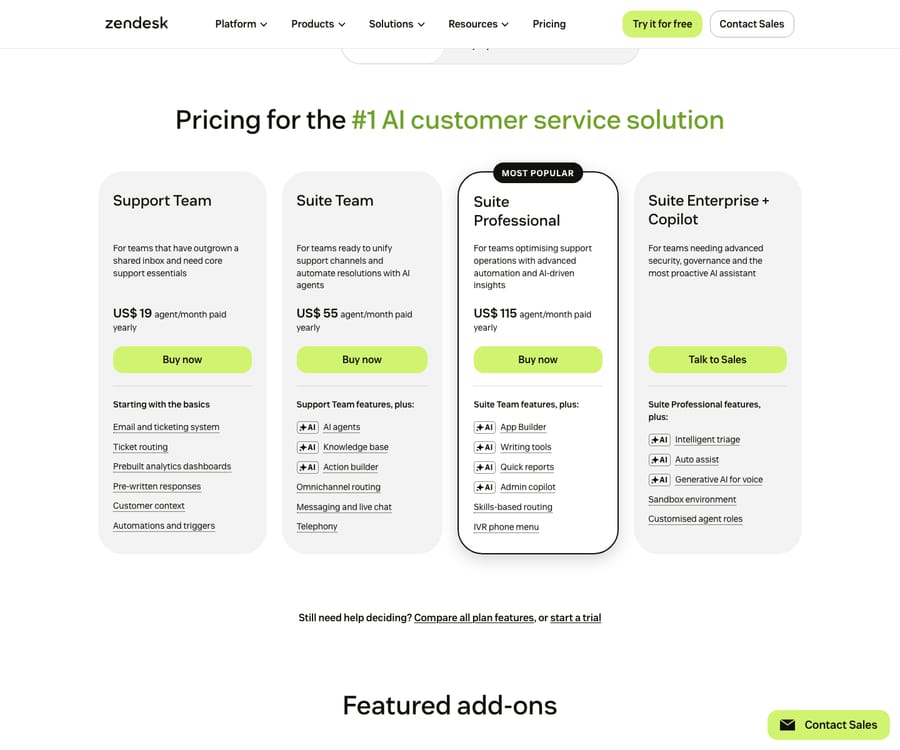
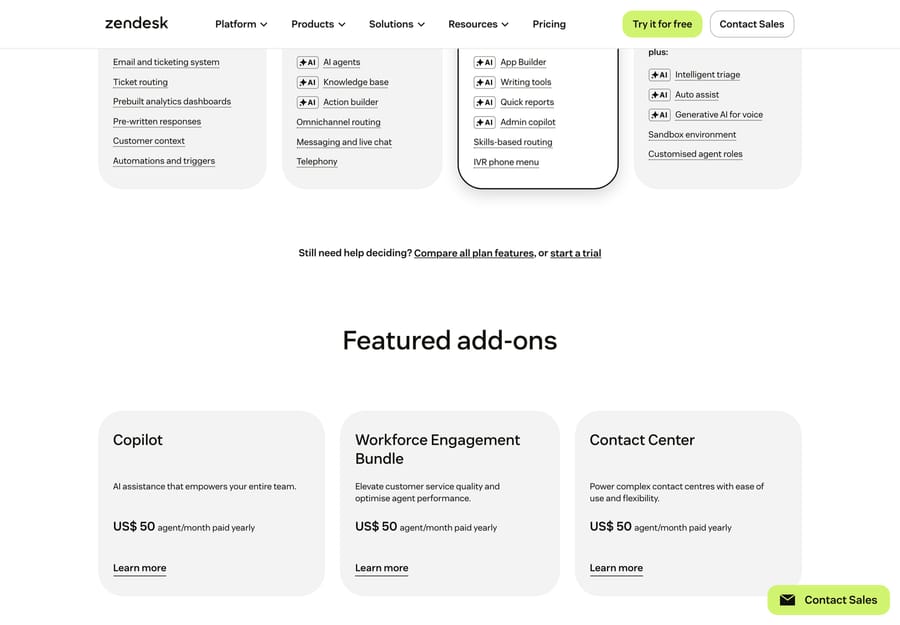
Beyond the seat plans, Zendesk sells its AI and contact-center tools as per-agent add-ons, billed yearly: Copilot and the Workforce Engagement Bundle at $50 each, Contact Center at $83 (all re-read on 9 October 2026). Freshdesk's add-ons are smaller: day passes for occasional agents ($2, $7 or $12 a day by plan), connector app tasks at $80 per 5,000 and MCP actions at $15 per 1,000.
So far, advantage Freshdesk. The seat price is not where the two really diverge, though. The AI billing model is, and most comparisons skip it.
How does each vendor bill for AI?
Both vendors sell two kinds of AI: a copilot that drafts replies for a human, and an AI agent that answers customers directly. They charge for the autonomous part in completely different ways:
- Zendesk charges a $50 an agent a month Copilot add-on (Suite Professional and above) and, for autonomous work, $1.50 per verified resolution on a committed volume or $2.00 pay-as-you-go. Since 18 May 2026 only a verified resolution bills, one that passes Zendesk's own LLM check; assisted escalations and unconfirmed "contained" resolutions are free. Each seat earns a monthly resolution allowance in dollars: $2 on Team plans, $5 on Suite Growth and Professional, $10 on Suite Enterprise, capped at $5,000 a year, with no rollover.
- Freshdesk charges per session. Every plan, Growth included, gets 500 free Freddy AI Agent sessions, but the pricing FAQ says that is "limited to once per account", a trial allowance rather than a monthly one. After that, sessions cost $49 per 100, about $0.49 each, sold in packs valid for your billing cycle. An email session is a 72-hour window from the customer's first email. Freddy AI Copilot is $29 an agent a month on annual billing ($35 monthly) and only on Pro and Enterprise. Sessions bill per attempt, resolved or not.
That distinction matters more than the seat price. Zendesk earns only when its AI resolves, which is cleaner, but stacks a $50 Copilot seat on top and charges three to four times more per unit. Freshdesk's per-session model means you pay even when the AI fails, so a high-volume workload with a low resolution rate gets expensive quickly. Whichever you choose, model the AI cost at your real ticket volume, not the seat price. Our Zendesk AI pricing breakdown has five worked Zendesk examples.
What does a 20-agent team pay each month?
Here is roughly what a 20-agent team on the mid plan pays per month at list price, with 1,000 AI conversations a month:
| Zendesk (Suite Professional) | Freshdesk (Pro) | |
|---|---|---|
| Seats (20) | 20 × $115 = $2,300 | 20 × $55 = $1,100 |
| Agent-assist AI | + 20 × $50 Copilot = $1,000 | + 20 × $29 Freddy Copilot = $580 |
| Autonomous AI (1,000 a month) | 1,000 verified resolutions × $1.50 = $1,500, minus 20 × $5 allowance = $1,400 | 10 packs of 100 sessions × $49 = $490 |
| Rough monthly total | $4,700 | $2,170 |
Illustrative list-price math, not a quote. Your real cost depends on volume, commitments and discounts. Two assumptions do a lot of work here. First, the Zendesk line assumes all 1,000 conversations are verified resolutions; if only 600 verify, the AI line drops to $800. Second, the Freshdesk line bills all 1,000 sessions whatever happened in them, and it ignores the one-time 500 free sessions, which cover part of the first month only. Before 18 May 2026 a Suite Professional seat came with 10 free resolutions a month; today it comes with $5, which buys 3 at the committed rate. Older comparisons that net out 200 free resolutions for this team are out of date.
The shape matters more than the exact figure. At this volume Freshdesk is less than half the price, because its seats, its copilot and its per-session rate are all cheaper. The catch is what you're billed for: Freshdesk charges per attempt, so as sessions scale into the tens of thousands a month you pay for every miss too. Zendesk bills only verified resolutions but at $1.50 to $2.00 each, plus the $50 Copilot seat. Neither is cleanly aligned with the tickets you actually get off your team's plate, which is the gap a per-ticket AI layer (below) addresses. Model it at your real volume and your expected resolution rate.
Which one wins on features?
| Capability | Winner | Why |
|---|---|---|
| Ticketing & agent workspace | Zendesk | More unified single-pane workspace; side conversations keep multi-team threads on one ticket |
| Omnichannel (email/chat/voice/social/WhatsApp) | Zendesk | Channels are more deeply native; Freshdesk often needs the bundled Omni suite to match |
| Automation & routing | Zendesk | Granular triggers/automations + skills-based routing; Freshdesk's rules are simpler (and easier) but less capable |
| Native AI | Zendesk (slight) | Both are mid-tier on real autonomy; Zendesk adds AI voice and bills only verified resolutions |
| Knowledge base & self-service | Tie | Both strong; Freshdesk's is cleaner to manage, Zendesk adds AI-assisted content |
| Reporting / analytics | Zendesk (Explore) | Far more customizable at scale; Freshdesk analytics is easier but shallower |
| Integrations / marketplace | Zendesk | Larger, more mature app ecosystem |
| Ease of setup & admin | Freshdesk | Live in ~1–2 weeks with a gentler learning curve vs. Zendesk's month-plus |
| Voice / call center | Zendesk | More mature native telephony + AI voice; Contact Center is a $83 add-on |
| Scalability | Zendesk | Built for multi-brand, 1,000+ agents and complex routing |
The pattern holds across the table: Freshdesk optimizes for getting a capable support desk running quickly and cheaply; Zendesk optimizes for depth and control once your operation gets complicated.
Which differences will your agents feel day to day?
- Multi-team tickets. Zendesk's side conversations let an agent loop in a teammate, a supplier or another department on a thread attached to the ticket, without forwarding chaos. That is a real advantage for cases that bounce between teams. Freshdesk's shared ownership and linked tickets cover the basics but feel lighter when many hands touch one issue.
- Routing. At volume, Zendesk's skills-based routing (match tickets to agents by language, product or expertise) and granular triggers outclass Freshdesk's dispatch and round-robin rules. Routing a handful of categories, you won't notice. Routing dozens across regions, you will.
- Setup time. Freshdesk's simplicity is a feature: most teams are productive in 1–2 weeks with little admin. A full Zendesk Suite configuration (triggers, SLAs, routing, multi-brand) typically takes a month or more and often wants an admin or partner. Budget for it.
- Ecosystem. Zendesk has the bigger, older marketplace, partner network and developer API surface, which enterprise buyers value. Freshworks' is smaller but sits inside a wider suite (CRM and IT service management), which suits teams that want one vendor across functions. Freshworks also publishes its own Freshdesk vs Zendesk guide; it argues its own case, so read it next to neutral reviews.
- Voice. If phone support matters, Zendesk's native Talk / Contact Center is more mature, with AI voice; Freshdesk's telephony (via the bundled Omni/Freshcaller path) works but is shallower. This is one of the clearer Zendesk wins for contact-center teams.
None of these flips the headline. They tell you where the price gap buys you something. If your support is simple and email/chat-first, you're paying Zendesk's premium for depth you may not use. If it's complex and multi-channel, that depth is the point.
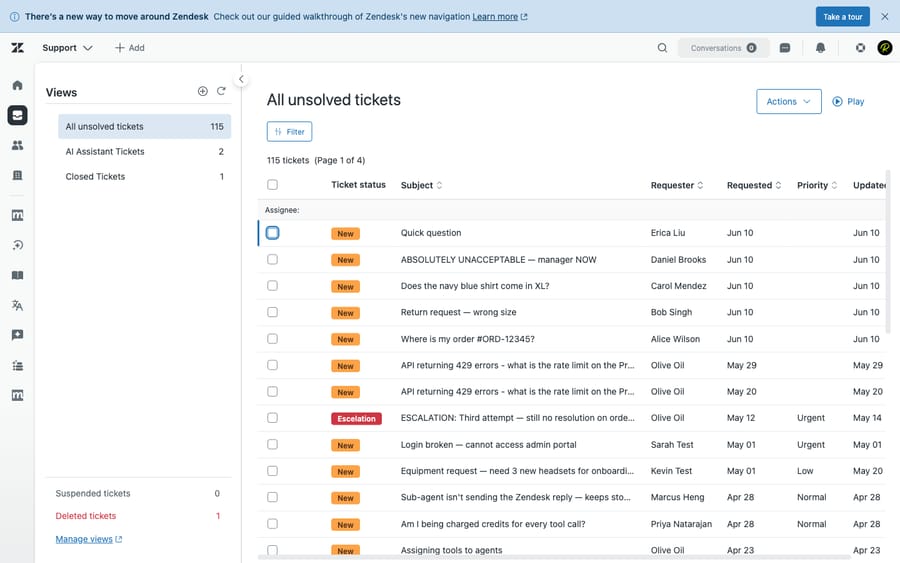
Above: a live Zendesk Support instance we set up for this comparison. The Views sidebar is where Zendesk's routing and triggers pay off: queues like "AI Assistant Tickets" or per-region filters are trivial to build, and that flexibility is part of what the premium over Freshdesk's lighter dispatch rules buys.
What are the strengths and weaknesses of each?
Zendesk strengths: deepest automation and skills-based routing; the strongest analytics of the two (Explore); the more mature native voice and contact center; scales cleanly to enterprise and multi-brand; the larger marketplace. Zendesk weaknesses: expensive and add-on-heavy (the $50 Copilot seat plus per-resolution billing stack up); steeper learning curve and longer implementation; opaque pricing (Enterprise is sales-only).
Freshdesk strengths: lower seat cost and a 6-month free program for two agents; fast, intuitive setup; a clean all-in-one feel with solid ticketing and KB out of the box; quick-to-deploy prebuilt AI agents. Freshdesk weaknesses: shallower automation and analytics at scale; per-session Freddy billing at $49 per 100 charges for failed attempts, and Copilot is locked out of the Growth tier; reported performance friction at very large, complex scale.
What do users say about Zendesk and Freshdesk?
Spec sheets only get you so far. Here's how the two land with customers (ratings read in mid-2026, not re-read for this update; review counts are approximate because the review sites block scraping):
| G2 | Capterra | Gartner Peer Insights | |
|---|---|---|---|
| Zendesk | 4.3 / 5 (~6,700 reviews) | 4.4 / 5 (~4,080) | 4.4 / 5 (~930) |
| Freshdesk | 4.4 / 5 (~3,700 reviews) | 4.5 / 5 (~3,440) | n/a |
Both are well liked. On G2's head-to-head page at the same mid-2026 reading, Freshdesk also scored about 8.6 for ease of setup against Zendesk's 8.0. Freshdesk edges Zendesk slightly on satisfaction, mostly on ease and value, while Zendesk's scores reflect a deeper but heavier product. The recurring themes:
- Zendesk is praised for feature depth, scalability across channels, and strong automation and knowledge base; dinged for high, tier-gated pricing, a steep learning curve and, pointedly, its own support quality. One reviewer: "Strong value for money considering the wide range of features… ticketing, automation, analytics, and omnichannel support" (Ifra S., Zendesk developer, Capterra, Dec 2025). Another was blunt: "Their support is some of the worst I've ever experienced… the admin portal is buggy" (Katie Y., Head of Customer Success, Capterra, Mar 2025).
- Freshdesk is praised for its clean interface, fast setup and cost against Zendesk; dinged for occasional bugs and crashes (especially the mobile and Freshchat apps), limited customization for advanced workflows, and shallower reporting. "User-friendly and offers great features like multi-channel support" (Nitish P., developer, Capterra, Jan 2025), though support specialists note rough edges like "the Fresh Chat mobile app keeps crashing without any reason" (Sofiya B., Capterra).
The reviews mirror the feature analysis: Freshdesk wins on simplicity and value; Zendesk wins on depth, at the cost of complexity and price.
Who is each help desk for?
- SMBs, startups, lean teams → Freshdesk. The $19 Growth plan and fast setup are hard to beat when you want to clear a queue without a project plan.
- Mid-market, scaling → a real toss-up. Stay on Freshdesk Pro ($55) if simplicity and cost matter most; move to Zendesk if you're hitting routing or analytics ceilings and expect complexity to grow.
- Enterprise / complex ops → Zendesk. Multi-brand, 1,000+ agents, sophisticated routing, mature voice and Explore analytics.
- Voice-heavy or many-hands-on-one-ticket → Zendesk.
- Budget-first, email/chat support → Freshdesk.
Does either help desk's AI resolve enough tickets?
The vendor pages won't say it plainly: on autonomous resolution, both Zendesk and Freshdesk underdeliver against the marketing. Neither publishes an independent resolution rate, and third-party figures swing so widely by use case that any single headline number deserves suspicion. Most tickets still reach a human. Both are also weak on uncertainty handling (what the bot does when it isn't sure), and both are better at answering from a knowledge base than at taking API-driven actions across your other systems (orders, refunds, account changes) without heavy custom work.
That changes the decision. If your only real complaint about your help desk is that its AI doesn't resolve enough tickets, switching from Zendesk to Freshdesk (or back) won't fix it. You'd trade one mid-tier native bot for another and rebuild all your automations in the process.
What a lot of teams do instead: keep the help desk that fits the team and add a dedicated AI agent layer on top of it. A layer like Macha runs on top of Zendesk or Freshdesk, handles multi-turn conversations, takes API-backed actions, and gives you explicit control over when it escalates, with no migration. Macha is the done-for-you option: the Macha team analyses your past tickets, builds the knowledge base and the agent on your existing help desk, and runs it in safe mode, with drafts as internal notes, until the drafts are right. It bills per ticket rather than per session or per resolution, about $0.40 a ticket from $299 a month for 750, which includes setup and a dedicated success manager who handles your changes, on the trial and every plan. The honest caveat: a layer is still another vendor and integration to manage, it only performs as well as the knowledge base behind it, and the per-ticket price adds up at high volume. It adds to your desk bill rather than replacing it. (More on native AI vs. an AI layer, and how to automate Freshdesk with AI.)
What does migrating between them cost?
If you're moving from one to the other, the subscription is the easy part. Migration tools (Help Desk Migration and similar, typically $500–$2,000) move tickets, contacts, attachments, custom fields and knowledge-base articles reasonably well. What they don't move is your business logic:
- Automations, triggers, SLA policies and routing use different models in each tool, and all of it gets rebuilt by hand.
- Ticket IDs change, which breaks external links and references.
- Audit trails and historical reports generally don't carry over.
Budget most of the effort for rebuilding rules and re-testing automations, plus a few weeks of agent ramp on the new interface. It's doable. Just don't let "the data migrates fine" convince you the whole switch is easy.
Frequently asked questions
Is Freshdesk cheaper than Zendesk? On seats, yes. Freshdesk undercuts Zendesk at every comparable level ($19/$55/$89 vs. $55/$115/Talk to Sales on annual billing, or $23/$66/$107 vs. $69/$149 monthly, checked 9 October 2026). With AI added the gap narrows but holds at moderate volume: in our 20-agent example Freshdesk comes to about $2,170 a month and Zendesk about $4,700.
Does Freshdesk still have a free plan? Not on the pricing page. Existing accounts can switch to the Free program, which covers up to two agents for 6 months, from Admin > Account > Plans and Billing.
Is Zendesk better than Freshdesk? For deep automation, analytics, native voice and enterprise scale, yes. For speed to launch, simplicity and cost, Freshdesk usually wins. "Better" depends on whether your constraint is complexity or budget.
Which is easier to set up? Freshdesk, clearly. Most teams are live in 1–2 weeks with little training. A full Zendesk configuration often takes a month or more.
Do I have to switch help desks to get better AI? No. If AI resolution is your only real gripe, an AI agent layer like Macha adds autonomous AI on top of Zendesk or Freshdesk without a migration. You keep your desk, data and configuration, and the Macha team sets up and runs the first agents for you, at about $0.40 a ticket with a dedicated success manager included.
Should I switch from Freshdesk to Zendesk? Only for a concrete limit: native voice, very complex routing, or enterprise-scale analytics. If Freshdesk already handles your workflows, the price gap ($55 against $115 a seat on the mid tiers) and the rebuild work usually argue against switching for its own sake.
Can I migrate from Zendesk to Freshdesk (or vice-versa) without losing data? Tickets, contacts and KB articles migrate well with standard tools. Automations, SLAs, routing and ticket IDs do not, so plan to rebuild those.
Is the AI the real problem, not the help desk? Choose Freshdesk for a capable, cheap desk running fast; choose Zendesk for routing, Explore analytics, native voice and scale. Then see how Macha adds autonomous AI agents on top of either, with no migration. $50 of free usage, no credit card required. Start Trial.