Intercom
 Shopify
 Stripe
 Slack
Slack Notion
 Google Workspace
 Confluence

Front vs Gorgias (2026): Which Help Desk Should You Choose?


Front and Gorgias both turn customer messages into a shared queue with AI on top, but Front is a per-seat shared inbox for B2B and ops teams while Gorgias is a per-ticket help desk for Shopify brands. The right pick depends on whether your support scales with headcount or with order volume.
Key takeaways
- Gorgias suits Shopify and DTC brands with order-heavy tickets, while Front suits B2B, services and ops teams that collaborate on client conversations.
- Front charges $25 to $105 per seat per month on annual billing, while Gorgias charges by ticket volume starting at $10 a month for 50 tickets, with unlimited users.
- Gorgias AI Agent costs $0.90 per automated interaction on annual plans or $1.00 monthly, and each interaction also counts as a billable helpdesk ticket.
- Front's Autopilot AI starts at $0.05 per conversation, with Copilot at $20 per seat per month below Enterprise, which costs $105 per seat; Gorgias' top published tier is $900 a month for 5,000 tickets.
- Macha runs on both Front and Gorgias, and the Macha team builds and runs the AI agent for you at about $0.40 a ticket, with setup and a dedicated success manager included.

Choose Gorgias if you run a Shopify or DTC store, and Front if you're a B2B, services or ops team. Front is a collaborative shared inbox billed per seat ($25, $65 or $105 a seat a month, annual), built for teams who treat support as part of a client relationship. Gorgias is a Shopify-native ecommerce help desk billed by ticket volume (from $10 a month for 50 tickets, unlimited users), with order actions and revenue tracking in every ticket.
| Front | Gorgias | |
|---|---|---|
| Category | Collaborative shared inbox / customer ops | Ecommerce help desk |
| Best fit | B2B, services, ops, relationship support | Shopify/DTC ecommerce brands |
| Center of gravity | Conversation tied to a relationship | Ticket tied to an order |
| Signature feature | Shared inbox, @mentions, internal comments | Native Shopify order actions + revenue tracking |
| Pricing model | Per seat / month | Per ticket volume (unlimited users) |
| Entry price | $25/seat/mo (Starter, annual) | $10/mo (Starter, 50 tickets) |
| Top published tier | $105/seat/mo (Enterprise) | $900/mo (Advanced, 5,000 tickets); Enterprise custom |
| AI pricing | Add-ons: Autopilot from $0.05/conversation; Copilot $20/seat/mo | AI Agent $0.90 per automated interaction on annual plans, $1.00 monthly (also counts as a ticket) |
| G2 rating | 4.7 / 5 (~2,429 reviews, June 2026 reading) | 4.6 / 5 (~547 reviews, June 2026 reading) |
Prices checked on front.com/pricing and gorgias.com/pricing on 24 September 2026. G2 ratings are from our June 2026 reading; G2 blocks automated checks, so confirm the live figures there.
A disclosure: Macha, which publishes this, makes an AI agent layer that runs on top of Zendesk, Freshdesk, Gorgias, Front, HubSpot or Intercom, including both tools here. We're not a third help desk in this race, so whichever you pick we fit on top of it. The one aside about where we fit is at the end.
How did we compare Front and Gorgias?
We took plan names and prices from the official pricing pages for Front and Gorgias, cross-checked against third-party pricing breakdowns (Lindy, Chatarmin, eesel) where the official pages omit detail. For real-user signal we used G2 aggregate ratings, review counts, and recurring pros/cons, with an attributed reviewer quote for each tool. Prices were rechecked on both official pages on 24 September 2026. Pricing in this space changes often, so confirm current rates before you budget. Our next review is scheduled for December 2026.
What is the core difference between Front and Gorgias?
Front is organized around collaboration. Its mental model is a shared inbox: your team's email, chat, SMS, and social land in one place where teammates can comment internally, @mention each other, assign messages, and draft replies together without forwarding threads or jumping into a separate chat tool. It feels like email with superpowers, which is exactly why account managers, client-services teams, logistics/ops desks, and B2B support functions gravitate to it. The unit of work is a conversation tied to a relationship.
Gorgias is organized around ecommerce. Its mental model is a ticket connected to an order. The headline feature is a best-in-class Shopify (and BigCommerce/Magento) integration: an agent can see order history, issue a refund, edit or cancel an order, and track shipments without leaving the ticket, and Gorgias attributes revenue generated through support conversations. The unit of work is a ticket tied to a transaction.
That single split, relationship-centric collaboration vs. transaction-centric commerce, drives nearly every other difference, including the pricing model.
What is Front?
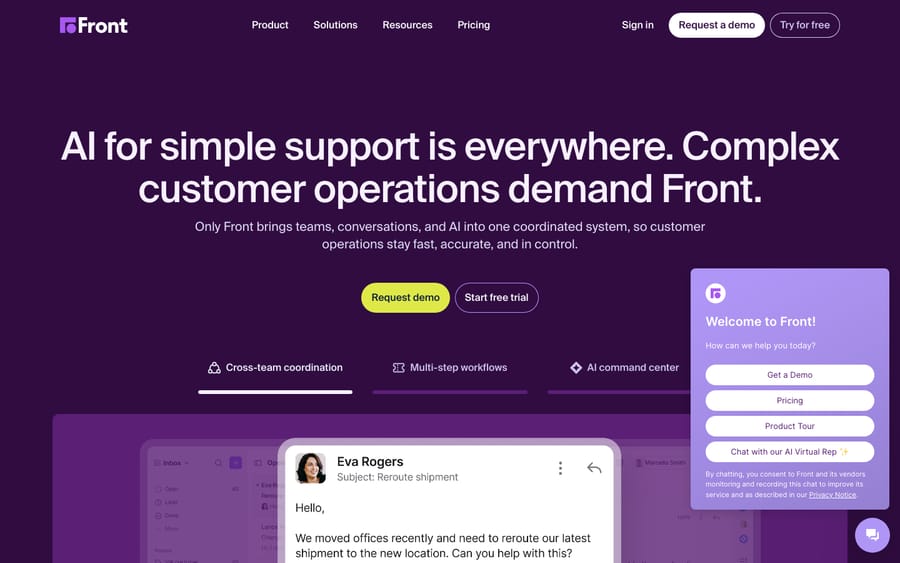
Front is a customer communication platform built on a shared inbox. It unifies email, chat, SMS, WhatsApp, and social into team inboxes where conversations can be assigned, commented on, and resolved collaboratively. Core strengths:
- Shared inboxes with internal collaboration: @mentions, internal comments, shared drafts, and clear assignment so a team works one queue instead of forwarding emails.
- Omnichannel conversations: email, chat, SMS, social, and messaging in one view (omnichannel unlocks on higher tiers).
- Rules and automations: routing, macros, SLA rules, and workflow automation to move conversations without manual triage.
- Analytics and AI: team and conversation analytics, plus an AI layer (Copilot, Autopilot, Smart QA/CSAT) for drafting, deflection, and quality scoring.
Front shines for B2B, professional-services, and ops teams where support is relationship-driven and several people often touch one account. For a deeper cost breakdown, see Front pricing explained.
What is Gorgias?

Gorgias is a help desk built specifically for ecommerce. Where Front thinks in conversations and relationships, Gorgias thinks in tickets connected to orders and revenue. Core strengths:
- Deep ecommerce integrations: view, refund, edit, cancel, and track Shopify/BigCommerce/Magento orders directly inside a ticket; the Shopify integration is its most-praised feature.
- Revenue tracking: attributes sales influenced by support (chat-driven and proactive conversations), so support is measured as a revenue lever, not just a cost center.
- Macros, rules, and intent detection: automation tuned for high-volume DTC questions (where's my order, returns, exchanges) to clear repetitive tickets fast.
- AI Agent: an autonomous bot that resolves ecommerce queries across email, chat, and SMS.
Gorgias shines for Shopify and DTC brands drowning in order-related questions who want commerce actions and AI resolution in one place. For the full cost picture, see Gorgias pricing explained.
How do Front and Gorgias pricing compare?
Front and Gorgias bill on different axes: Front by seat, Gorgias by ticket volume.
Front charges per seat per month (annual billing):
- Starter: $25/seat/mo · shared inbox, ticketing, AI Topics, basic analytics, knowledge base. Limited to a single channel type and a max of 10 seats.
- Professional: $65/seat/mo · omnichannel, macros, advanced analytics, multiple workspaces, SSO/SCIM. Up to 50 seats.
- Enterprise: $105/seat/mo · unlimited seats, smart/unlimited automation rules, custom roles, and AI Copilot, Smart QA, and Smart CSAT included.
Front's AI is mostly an add-on stack below Enterprise: Autopilot (the autonomous bot) from $0.05 per conversation, Copilot $20/seat/mo, Smart QA $20/seat/mo, Smart CSAT $10/seat/mo. The model is predictable if you know your headcount: your bill scales with agents.
Gorgias charges per ticket volume, with unlimited users on every plan (help desk prices, monthly billing; annual is cheaper):
- Starter: $10/mo · 50 billable tickets a month.
- Basic: $60/mo ($50 annual) · 300 tickets.
- Pro: $360/mo ($300 annual) · 2,000 tickets.
- Advanced: $900/mo ($750 annual) · 5,000 tickets, the highest published tier.
- Enterprise: custom.
The pricing page also shows bundles with AI Agent interactions included, such as Starter at $40 a month with 30 automated interactions.
The Gorgias AI Agent costs $0.90 per automated interaction on annual plans and $1.00 on monthly plans, and Gorgias' pricing FAQ says each AI Agent interaction also counts as a helpdesk ticket, so an automated resolution is billed twice. If the shopper still reaches a human within 72 hours, Gorgias charges only the ticket. Tickets over your plan quota run $0.40 each on Starter and Basic and $0.36 on Pro and Advanced.
The practical takeaway: Front's cost tracks your team size; Gorgias' cost tracks your ticket volume. A 3-person team handling 8,000 ecommerce tickets a month will find Gorgias' unlimited-users model attractive, but should model the per-ticket-plus-AI math carefully. A 25-person B2B services team with moderate ticket volume will find Front's per-seat model simpler to forecast. (Watch the per-resolution AI metering on Gorgias and the per-conversation Autopilot meter on Front; both add up.)
How do Front and Gorgias handle AI?
Both have leaned hard into AI, but in keeping with their positioning.
- Gorgias AI Agent is built to autonomously resolve ecommerce queries (order status, returns, exchanges) across email, chat, and SMS, using its order data to actually take action. It's priced per resolution, which aligns cost with outcomes but, as reviewers note, can get expensive at volume (and the double-counting as a ticket compounds it). Gorgias lists email, chat and SMS as the channels AI Agent runs on.
- Front's AI splits into Autopilot (autonomous deflection, per conversation), Copilot (agent-assist: drafting, summaries), and Smart QA/CSAT (quality and satisfaction scoring). It's tuned more toward helping a human team work faster and consistently than toward fully autonomous retail deflection, fitting for relationship-heavy support.
Net: if your goal is autonomous deflection of repetitive order questions, Gorgias' AI Agent is purpose-built for that. If your goal is making a collaborative team faster and more consistent, Front's Copilot-led stack fits better. Either way, budget AI as a separate line item; it's the most common source of "the bill was higher than the sticker" on both.
What do users say about Front and Gorgias?
Aggregate sentiment lines up with the "different tools, different jobs" framing.
- Front: 4.7/5 on G2 across roughly 2,429 reviews at our June 2026 reading. The standout theme is collaboration. As one verified G2 reviewer put it: "What I like best about Front is how it brings email and team collaboration together in one place. The shared inboxes, internal comments, and clear assignment of messages help our team stay organized and aligned without needing to forward emails or rely on external chat tools." The most common watch-out: advanced automation and AI features are gated to higher tiers, and the ticketing is less ecommerce-specialized than a purpose-built retail desk.
- Gorgias: 4.6/5 on G2 across roughly 547 reviews at the same reading (Gorgias' G2 seller page now shows 582 reviews across its products). Reviewers consistently praise the Shopify integration as best-in-class; one G2 reviewer called it "an incredibly convenient helpdesk solution for eCommerce businesses, thanks to its powerful integration with platforms like Shopify." The most frequent criticisms: pricing feels high for startups, the ticket-plus-AI billing can surprise teams at scale, and analytics and automation can feel rigid without tuning.
Net: both are well-liked, Front edges Gorgias slightly on raw rating across a far larger review base, and the recurring complaint on both is AI/usage pricing stacking on top of the base plan.
Who should choose Front, and who should choose Gorgias?
- Choose Gorgias if you run a Shopify or DTC ecommerce brand and most of your tickets are order-related (WISMO, returns, refunds, exchanges). You want order actions inside the ticket, revenue attribution, and autonomous AI deflection, and your ticket volume, not headcount, is the thing that scales.
- Choose Front if you're a B2B, services, agency, or ops team where support is relationship-driven and multiple teammates touch the same accounts. You want a true shared inbox with internal collaboration, predictable per-seat pricing, and AI that makes your humans faster.
- Borderline? If you sell physical products online, lean Gorgias. If your "tickets" are really client conversations and projects, lean Front. The Shopify-actions question usually settles it: if you'd use refund/edit-order-in-ticket every day, that's Gorgias' home turf.
- Either way, model the usage cost. Gorgias' per-resolution AI (double-counted as a ticket) and Front's per-conversation Autopilot both stack on top of the base plan.
Where does an AI layer like Macha fit?
One honest aside, scoped narrowly: Macha is an AI agent layer that runs on top of Front and Gorgias (it works on Zendesk, Freshdesk, Gorgias, Front, HubSpot or Intercom), so it isn't a third help desk in this decision; it's the AI layer you can add to whichever one you pick. Whichever way this comparison lands, Macha's AI agents connect to your knowledge and resolve conversations inside the desk you chose: see Macha on Front or Macha on Gorgias. It's also done for you: the Macha team analyzes your past tickets, builds the knowledge base and the agent in Front or Gorgias, and runs it in safe mode, with drafts as internal notes, until the drafts are right. It costs about $0.40 a ticket, from $299 a month for 750 tickets, and that includes the setup and a dedicated success manager who handles your changes after go-live. Macha isn't a replacement for either desk's native AI so much as an alternative to it: run both and keep whichever resolves more. If that's relevant to your stack, you can start with $50 of free usage (about 125 tickets), no credit card.
Frequently asked questions
What's the main difference between Front and Gorgias? Front is a collaborative shared inbox built for B2B, services, and ops teams: email and conversations worked together with internal comments and assignments. Gorgias is a Shopify-native ecommerce help desk where tickets connect to orders, with refunds/edits inside the ticket and revenue tracking. Front is relationship-centric; Gorgias is commerce-centric.
Is Gorgias only for Shopify? Gorgias also supports BigCommerce and Magento, but its deepest, most-praised integration is with Shopify, and it's overwhelmingly used by Shopify/DTC brands. If you're not running an online store, Gorgias' core advantages mostly don't apply.
Which is cheaper, Front or Gorgias? They bill differently, so it depends on your shape. Front is per seat ($25/$65/$105 per seat per month, annual), so cost tracks headcount. Gorgias is per ticket volume (from $10/mo for 50 tickets, unlimited users), so cost tracks ticket count, plus $0.90 to $1.00 per AI Agent interaction that also counts as a ticket. A small team with high ticket volume often prefers Gorgias' model; a larger team with moderate volume often prefers Front's predictability.
Can Front handle ecommerce support? It can handle ecommerce conversations, but it lacks Gorgias' native order actions (refund/edit/cancel in-ticket) and revenue tracking. For order-heavy Shopify support, Gorgias is purpose-built; Front fits better when support is relationship- and collaboration-driven.
How does each one price AI? Gorgias charges $0.90 per AI Agent interaction on annual plans ($1.00 monthly), and each interaction also counts as a billable ticket. Front sells AI as add-ons: Autopilot from $0.05/conversation, Copilot at $20/seat/mo, plus Smart QA/CSAT, with Copilot and QA/CSAT included on Enterprise. Budget AI separately on both.
Prices checked on Front's and Gorgias' official pricing pages on 24 September 2026; G2 ratings from our June 2026 reading. Next review: December 2026.
Add AI agents to your Gorgias
Macha reads the ticket, drafts the reply and takes the action, inside the Gorgias you already run.