Intercom
 Shopify
 Stripe
 Slack
Slack Notion
 Google Workspace
 Confluence

Intercom vs Front (2026): Which Should You Choose?


Intercom is an AI-first messenger for SaaS teams built around Fin at $0.99 per outcome, while Front is a shared email inbox for B2B and ops teams priced from $25 a seat. Salesforce completed its acquisition of Fin, the company formerly called Intercom, on 10 September 2026.
Key takeaways
- Intercom suits SaaS and product-led teams that support users inside their app, while Front suits B2B, operations and logistics teams that collaborate on customer email.
- Intercom's Fin AI Agent costs $0.99 per outcome on top of seats, while Front's Autopilot is priced from $0.05 per conversation, with third parties estimating about $0.89 per resolution.
- Salesforce agreed to buy Fin, formerly Intercom, on June 15, 2026 in a deal reported at $3.6 billion and completed the acquisition on 10 September 2026.
- Front's Starter plan costs $25 a seat but caps teams at 10 seats and one channel type, while Intercom's seats run $29, $85 and $132 billed annually, with Copilot $29 per agent extra.
- On either platform, Macha can run an AI agent the Macha team builds and runs for you, billed per ticket at about $0.40 with setup and a dedicated success manager included.

Choose Intercom if you're a SaaS or product-led company that supports users inside your app and wants the most proven AI agent (Fin, $0.99 per outcome, on seats from $29 a seat billed annually). Choose Front if you're a B2B, operations or logistics team that collaborates on customer email; its shared inbox starts at $25 a seat on Starter (capped at 10 seats and one channel type) and $65 on Professional. Intercom is a messenger with AI at its center. Front is a shared inbox with AI added on.
| Intercom | Front | |
|---|---|---|
| Built around | In-app Messenger + Fin AI Agent | Shared email inbox + collaboration |
| Best-fit company | SaaS / product-led | B2B, ops, logistics, services |
| Seat price (annual) | $29 / $85 / $132 | $25 / $65 / $105 |
| AI agent | Fin: $0.99 per outcome | Autopilot: from $0.05 per conversation |
| Owner | Salesforce (since 10 September 2026) | Independent |
One disclosure: Macha, which publishes this, makes an AI agent layer that runs on top of Zendesk, Freshdesk, Gorgias, Front, HubSpot or Intercom rather than replacing any of them. We don't compete with either product here, and the one Macha aside is at the end.
How did we compare Intercom and Front?
We took plan names and prices from the official pricing pages for Intercom and Front, rechecked on 24 September 2026, and cross-checked the AI meters against secondary breakdowns because neither vendor puts every number on one page. For user sentiment we used G2 and Capterra ratings, review counts and recurring pros and cons, with attributed reviewer quotes. Where a figure isn't published on an official page (Front's Autopilot per-resolution rate, for one), we flag it as an estimate. Our next review is scheduled for December 2026.
What's the core difference between Intercom and Front?
This split drives almost everything below.
Intercom is messenger-first. Its center is the Messenger, the chat widget inside your web or mobile app. A customer or logged-in user opens chat, Fin answers, and if it can't, a human picks up in the same conversation, tied to that user's product data. The model is product → user: it works best when your customers are inside a SaaS app and you want to support, onboard and message them there.
Front is inbox-first. Its center is email, in a shared, collaborative form. Messages from email, SMS, social and chat land in shared inboxes; teammates assign, comment internally and draft together without forward-and-CC chains. The model is team → account: it works best when several people manage the same customers (a dispatcher, an account manager and a support rep all touching one client), and email is how the work gets done.
Talk to users inside an app versus collaborate on customer email as a team explains why their pricing ladders, AI and happiest customers look so different.
What does Intercom offer?
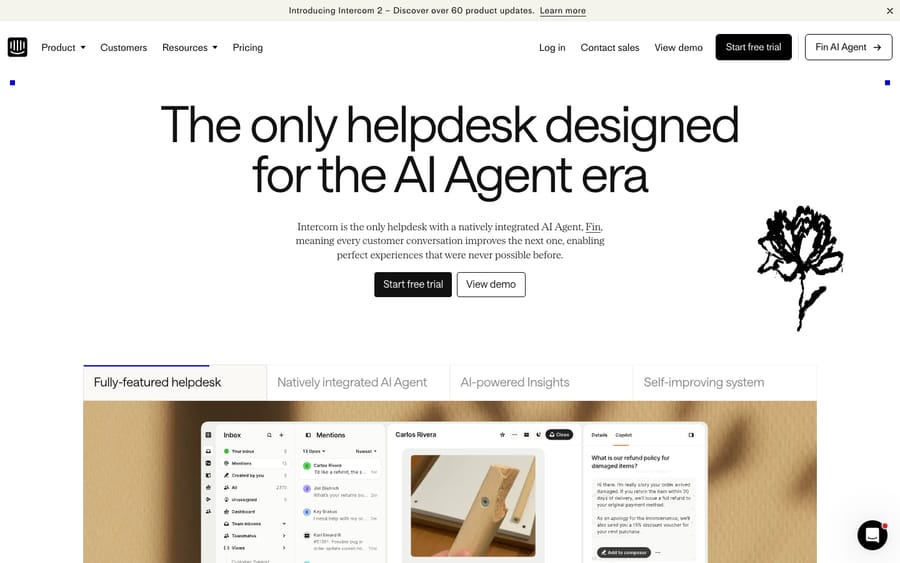
Intercom is the AI-first customer service platform built around its Messenger and Fin AI Agent, which is included on every seat plan. Core strengths:
- Fin AI Agent: an autonomous agent that resolves questions from your help content and connected data and hands off to humans when it can't. Salesforce cites a 76% average resolution rate for Fin.
- The Messenger: an in-app and website chat widget with bots, product tours and proactive messaging.
- Inbox + Copilot: a shared agent workspace where Copilot drafts replies and summarizes threads for your human agents.
- Tickets, Help Center and reporting: full ticketing, a knowledge base that feeds Fin, and analytics built around resolution and CSAT.
- Product-led tooling: outbound messages, tours and customer-data targeting aimed at SaaS growth teams.
Ownership: the company behind Intercom now calls itself Fin. Salesforce agreed to buy it on June 15, 2026 in a deal reported at $3.6 billion, and Salesforce completed its acquisition of Fin on 10 September 2026. The pricing page hasn't changed since. If you're signing a multi-year contract, expect the roadmap to lean toward the Salesforce ecosystem.
What does Front offer?
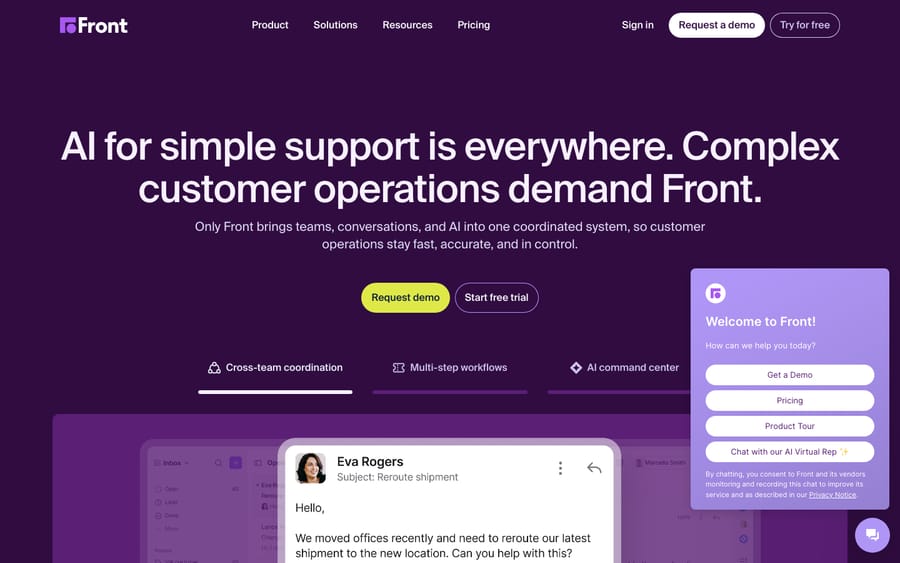
Front is a customer-ops platform that makes a shared inbox feel like the email your team already knows. Core strengths:
- Shared inboxes: email, SMS, social and chat in team inboxes with clear ownership and assignment.
- Internal comments: discuss a message inline, draft together and @-mention teammates without forwarding or a side chat.
- Workflow and rules: routing, SLAs, tagging and automation for relationship-heavy, multi-touch accounts.
- Front AI: Autopilot (an AI agent for automated resolution), Copilot for agent assist, and Smart QA and Smart CSAT, all included on Enterprise except Autopilot.
- Ops fit: popular with logistics, B2B services and operations teams where several people handle the same customers.
Front's known weak spot is self-service and knowledge base: it's an inbox, not a help-center-first product, and its AI agent has less deployment history than Fin.
How do Intercom and Front compare side by side?
| Intercom | Front | |
|---|---|---|
| Category | AI-first customer messenger | Collaborative shared inbox / customer ops |
| Center of gravity | In-app Messenger + Fin | Shared email inbox + collaboration |
| Best-fit company | SaaS / product-led | B2B, ops, logistics, services |
| Signature features | Fin AI Agent, Messenger, tours, Copilot | Shared inboxes, internal comments, rules |
| AI agent | Fin: $0.99 per outcome | Autopilot: from $0.05 per conversation (~$0.89 per resolution per third parties, flagged) |
| Agent assist | Copilot $29/agent/mo (annual) | Copilot $20/seat/mo add-on, included in Enterprise |
| Entry price (annual) | $29/seat (Essential) | $25/seat (Starter, up to 10 seats, 1 channel type) |
| Top published tier (annual) | $132/seat (Expert) | $105/seat (Enterprise) |
| Self-service / KB | Strong (Help Center feeds Fin) | Weaker: inbox-first, not KB-first |
| G2 rating | 4.5 / 5 (~3,855 reviews, June 2026) | 4.7 / 5 (~2,400+ reviews, June 2026) |
| Capterra rating | n/a | 4.5 / 5 (286 reviews, June 2026) |
| Best for | SaaS teams wanting top-tier AI in-app | Teams collaborating on customer email |
Prices from official pricing pages on 24 September 2026; ratings from G2 and Capterra as of our June 2026 check.
How much do Intercom and Front cost?
Both bill per seat with an annual discount, and on both the AI agent is a separate meter on top of seats, which is where bills surprise people.
Intercom (annual, per seat/month):
- Essential: $29 a seat billed annually · shared inbox, ticketing, Help Center, Messenger. Intercom has also shown $19 in a pricing test.
- Advanced: $85 · workflows, multiple team inboxes, assignment rules, richer reporting, and 20 free Lite seats.
- Expert: $132 · the most advanced collaboration, security and management features, and 50 free Lite seats.
- Fin AI Agent: $0.99 per outcome · an outcome counts when the customer confirms the answer resolved it, doesn't ask for more help, or Fin completes a workflow. Fin also runs standalone on another help desk, where a 50-outcome monthly minimum applies.
- Copilot: $29/agent/mo (annual; $35 monthly), with 10 free Copilot conversations per agent each month.
Front (annual, per seat/month):
- Starter: $25 · shared inbox and basic ticketing, capped at 10 seats and a single channel type (email, Front Chat or SMS).
- Professional: $65 · omnichannel, advanced automation and analytics, up to 50 seats.
- Enterprise: $105 · unlimited seats, advanced permissions and reporting, with Copilot, Smart QA and Smart CSAT included.
- Autopilot (AI agent): officially "starting at $0.05 /conversation"; secondary sources put full resolutions near $0.89 each (third-party figure, not on Front's page; get a quote). Copilot $20/seat, Smart QA $20/seat and Smart CSAT $10/seat are add-ons below Enterprise.
Two things stand out. First, Front's entry tier has real limits: the $25 Starter caps you at 10 seats and one channel type, so growing teams land on Professional at $65 quickly. Second, the two AI agents price close together per resolution ($0.89 to $0.99), so the cheaper AI is usually the one that resolves more of your tickets, not the one with the lower unit rate. Both meters also share an incentive worth naming: the vendor earns more as the agent handles more of your volume, so neither has a reason to cap usage for you. For the full breakdowns, see Intercom pricing explained and Front pricing explained.
Is Fin or Front's Autopilot the better AI agent?
This is where the two really diverge.
Intercom's Fin is the more mature of the two. It resolves from your Help Center and connected sources, handles multi-step conversations, and has years of deployment behind it. The trade-offs are the ones reviewers raise constantly: at $0.99 per outcome it gets expensive at volume, and like any LLM agent it can stumble on complex, very specific queries and need a human. If your volume is high and your content is good, Fin is a strong answer out of the box.
Front's Autopilot is newer. It works inside the collaborative inbox Front teams already use, and its usage-based pricing can suit teams that want to start small. It has less of a track record than Fin, and Front's weaker knowledge-base story means more upfront work to give the AI good content. For teams whose value is collaboration rather than deflection, that's an acceptable trade; for AI-resolution-first buyers, Fin is still the benchmark.
Net: Fin wins on maturity and resolution depth; Autopilot wins on living inside a collaborative inbox, and the per-resolution economics are close enough that fit matters more than the meter.
What do users say about Intercom and Front?
Review sentiment follows the "different tools, different teams" split.
- Intercom: 4.5/5 on G2 across roughly 3,855 reviews when we checked in June 2026. Reviewers praise Fin's fast, accurate answers and the polish of the Messenger. The two recurring criticisms are cost (the seat price plus the per-outcome meter "adds up rapidly" at scale, per G2 reviewers) and occasional AI misfires on complex queries. People like it and find it expensive in roughly equal measure.
- Front: 4.7/5 on G2 across ~2,400+ reviews, and 4.5/5 on Capterra over 286, as of the same check. Users love the collaborative shared inbox: one Capterra reviewer, Julie R., called the unified inbox "an amazing tool that makes getting communications out super efficient," and G2 reviewers repeatedly describe the shared inbox and internal comments as a "game-changer" for keeping teams aligned. The common complaints: pricing that "is quite steep" (Capterra's Tamir H.), rules and automation depth that "only goes so far," and AI and advanced features gated to higher tiers.
Front edges Intercom on rating, partly because its niche delights a focused user base. Both share the same headline complaint: price, especially once AI is stacked on.
Who should choose Intercom, and who should choose Front?
- Choose Intercom if you're a SaaS or product-led company that supports users inside your app and wants the most proven AI agent. You value Fin, the in-app Messenger, tours and proactive messaging, and you can budget seats plus per-outcome AI. Weigh the Salesforce ownership if you're signing multi-year.
- Choose Front if you're a B2B, operations, logistics or services team where several people work the same customer relationships over email. You want a shared inbox that feels like email, internal comments instead of forwards, and workflow built for multi-touch accounts, with AI as an add-on rather than the headline.
- Lean Intercom for AI-first deflection; lean Front for collaboration-first ops. If the goal is resolving as many tickets as possible automatically, Fin is more proven. If the goal is letting a team work the same accounts without stepping on each other, Front is built for it.
- Either way, budget AI as its own line. Fin's per-outcome charge and Front's Autopilot and Copilot add-ons are the usual reason the bill beats the sticker.
Where does an AI layer like Macha fit?
Up front: Macha isn't a help desk and it isn't an Intercom or Front alternative. Macha is an AI agent layer that runs on top of Zendesk, Freshdesk, Gorgias, Front, HubSpot or Intercom, so it never replaces the platform you pick here. Fin and Autopilot are the native AI options on each.
It's worth a mention for one reason. The question behind "Intercom vs Front" is often "how do I get strong AI resolution without a per-resolution bill that grows with every ticket the AI touches?" Macha bills per ticket, not per resolution: one conversation is one charge however many messages it takes, from $299 a month for up to 750 tickets on the pricing page, about $0.40 a ticket. The agent does the step-by-step work (reading a ticket, pulling an answer, drafting a reply, tagging, routing) inside the help desk you already run, and you don't build it yourself: the Macha team analyzes your past tickets, builds the knowledge base and the agent, and runs it in safe mode, with drafts as internal notes, until the drafts are right. The per-ticket price includes that setup and a dedicated success manager who handles your changes after go-live. There's $50 of free usage (about 125 tickets) with no credit card if you want to watch it work first. If the native AI already covers your volume, skip this section.
Frequently asked questions
What's the main difference between Intercom and Front? Intercom is an AI-first customer messenger built around in-app chat and the Fin AI agent, best for SaaS and product-led companies. Front is a collaborative shared inbox built around email and teamwork, best for B2B, operations and logistics teams where several people manage the same accounts.
Is Intercom or Front cheaper? Entry tiers are close: Intercom Essential is $29 a seat billed annually and Front Starter is $25 a seat, but Front's Starter caps you at 10 seats and one channel type, so growing teams move to $65 Professional. Both charge for AI separately: Fin at $0.99 per outcome, Front's Autopilot from $0.05 per conversation (third parties estimate about $0.89 per full resolution). Total cost depends mostly on AI volume.
Is Fin or Front's Autopilot the better AI agent? Fin is more mature and proven for autonomous resolution, and Salesforce cites a 76% average resolution rate, but it costs $0.99 per outcome and can misfire on complex queries. Autopilot is newer and lives inside Front's collaborative inbox with usage-based pricing: a good fit for collaboration-first teams, less proven for pure deflection.
Did Salesforce buy Intercom? Yes. The company, now called Fin (formerly Intercom), agreed to the deal on June 15, 2026, at a reported $3.6 billion, and Salesforce completed its acquisition of Fin on 10 September 2026. Intercom's published pricing hasn't changed since, but expect the roadmap to align more with Salesforce over time.
Which has better team collaboration, Intercom or Front? Front. Shared inboxes, internal comments and clear assignment are its core differentiator and what reviewers praise most. Intercom has a capable shared inbox too, but its strengths lean toward in-app messaging and AI.
Does Fin work with Front? Fin can run standalone on a help desk other than Intercom at $0.99 per outcome, with a 50-outcome monthly minimum. Check Fin's list of supported help desks before planning on it.
Which should you pick if you're still unsure?
Start from how your team works. If most conversations start inside your product and you want the most proven AI agent, pick Intercom and budget seats plus Fin's per-outcome meter, with Salesforce as the new owner. If most conversations are email threads several teammates share, pick Front, start on Professional if you need more than one channel type, and treat AI as an add-on. Confirm every rate on the official pricing pages before you sign.
Prices current as of 24 September 2026 from Intercom's and Front's official pricing pages; ratings from G2 and Capterra as of June 2026. Front's Autopilot per-resolution rate is a third-party estimate. Next review: December 2026.
Add AI agents to your Front
Macha reads the conversation, drafts the reply and takes the action, inside the Front you already run.