Intercom
 Shopify
 Stripe
 Slack
Slack Notion
 Google Workspace
 Confluence

Gladly vs Gorgias (2026): Which Is Better for Your Brand?


Gorgias suits most Shopify and DTC stores, starting at $10 a month for 50 tickets and billing by ticket volume rather than seats. Gladly suits larger high-LTV consumer brands with voice teams, at an estimated floor near $1,800 a month.
Key takeaways
- Gorgias suits most Shopify stores and starts at $10 a month for 50 tickets, while Gladly suits larger high-LTV brands with an estimated $1,800 monthly floor.
- Gladly publishes no pricing, and third-party estimates put its Hero plan near $180 per user a month with a 10-seat minimum, billed annually.
- Gorgias AI Agent is sold as a prepaid block, $190 for 190 interactions on Pro, with each interaction past the block costing $1.50.
- A Gorgias Pro store on monthly billing pays $360 for the help desk plus $190 for AI, or $550 a month, before overage.
- Macha runs on Gorgias and is billed per ticket from $299 a month for up to 750 tickets, but Macha does not integrate with Gladly.

Gorgias fits most Shopify and DTC stores: it starts at $10 a month for 50 tickets and bills by ticket volume, not seats. Gladly fits larger, high-lifetime-value consumer brands with a real voice operation: it publishes no prices, and third-party estimates put its Hero plan near $180 per user a month with a 10-seat minimum, a floor of about $1,800 a month. Gladly organizes support around one lifelong customer conversation; Gorgias organizes it around ecommerce tickets with order data inside.
| Gladly | Gorgias | |
|---|---|---|
| Category | People-centered CX platform, now pitched as "Commerce AI" | Ecommerce-first help desk |
| Organized around | One lifelong customer Conversation | Tickets (with order context) |
| Best-fit brand | High-LTV retail, apparel, beauty, travel | Shopify / DTC ecommerce stores |
| Channels | Voice, email, SMS, chat, social (native) | Email, chat, SMS, WhatsApp, social; voice and SMS as add-ons |
| AI agent | Gladly AI (formerly Sidekick) | Gorgias AI Agent |
| Pricing model | Per user / month, seat minimums, annual | Per ticket tier (not per seat) + prepaid AI interactions |
| Entry price | ~$180/user/mo, 10-seat min (~$1,800/mo), third-party estimate | $10/mo Starter (50 tickets) |
| AI cost | ~$0.60 per conversation (third-party estimate), quote-only | $30 for 30 interactions on Starter/Basic, $190 for 190 on Pro, $530 for 530 on Advanced; $1.50 each after |
| Pricing transparency | Quote-only (no public prices) | Published tiers on site |
Gladly prices are third-party estimates (Gladly publishes none); Gorgias prices are from its official pricing page, checked 24 September 2026.
One disclosure up front: Macha, the company publishing this, makes an AI agent layer that runs on top of Zendesk, Freshdesk, Gorgias, Front, HubSpot or Intercom. It does not integrate with Gladly, and it isn't a help desk, so we're not a hidden third option in the table above. We'll keep the comparison even-handed and save the one aside about where we fit for the end.
How did we compare Gladly and Gorgias?
We pulled Gorgias plan names and prices from its official pricing page and its billing documentation. Gladly publishes no public pricing (its pricing page still routes you to a demo), so its figures come from third-party estimates (Hiver, Kustomer and eesel, collected in June 2026) and are flagged as approximate throughout. Positioning and feature claims are drawn from each vendor's own product pages. For user sentiment we summarize the recurring themes in public G2 and Capterra reviews; we don't quote star ratings because we couldn't re-check them on the day of this update. Pricing in this category moves quickly, and our next review is scheduled for December 2026. For more on Gladly's AI specifically, see our Gladly AI explainer.
What is the core difference between Gladly and Gorgias?
This is the whole decision, so it's worth slowing down on.
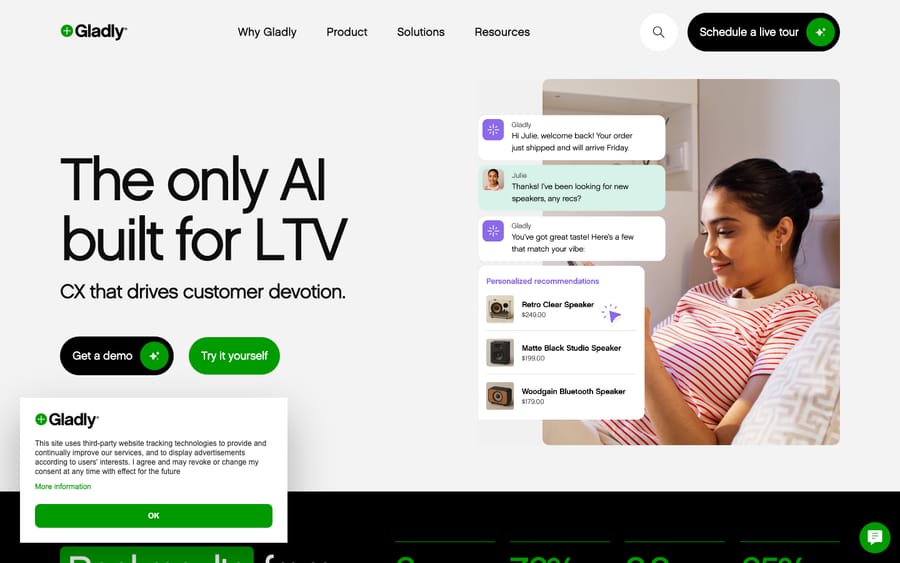
Gladly puts the customer at the center, not the ticket. Every interaction a person has with your brand (voice, email, SMS, chat, social) lands on one persistent Conversation timeline that runs for the life of the relationship. There are no duplicate tickets to merge and no "let me pull up your account," because the account is the conversation. Gladly now leads its homepage with "Commerce AI for every customer moment" and a Commerce Agent that sells as well as serves, and its customer logos (Crate & Barrel, Nordstrom, Ulta Beauty, TUMI, UGG, Tory Burch, Hoka, Rothy's, Breeze Airways) show who it's for: consumer brands where lifetime value is high enough that relationship-driven, voice-forward service pays for itself. (For the full breakdown, see our guide to what Gladly is.)
Gorgias puts the ecommerce order at the center. It's a ticket-based help desk built first for Shopify (and BigCommerce, Magento) stores. Its signature move is surfacing the customer's order history inside the ticket so an agent can see purchases, issue a refund or edit an order without leaving the conversation. Gorgias is built for the high-volume, transactional side of online retail ("where is my order," returns, discount codes) and prices itself for stores of every size, from a solo founder to a large DTC brand.
That single split, relationship platform vs. ecommerce ticketing tool, drives almost every difference below, including how each one charges you.
Which is cheaper, Gladly or Gorgias?
The two pricing models are so different that comparing sticker prices directly is misleading. You have to model your own volume.
Gorgias bills by ticket tier, not by agent. For ecommerce that's often an advantage: you can add seasonal agents without your subscription changing. The published ladder, checked 24 September 2026:
- Starter: $10/mo · 50 tickets, monthly billing only; $0.40 per extra ticket.
- Basic: $60/mo ($50/mo annual) · 300 tickets; $0.40 per extra ticket.
- Pro: $360/mo ($300/mo annual) · 2,000 tickets; $0.36 per extra ticket. Gorgias calls it the most popular tier.
- Advanced: $900/mo ($750/mo annual) · 5,000 tickets; $0.36 per extra ticket.
- Enterprise: custom · for volumes beyond 5,000 tickets.
The catch is the AI Agent line, which is separate. Each plan now includes a prepaid block of automated interactions billed on top of the help desk price: $30 for 30 on Starter and Basic, $190 for 190 on Pro and $530 for 530 on Advanced, which works out to $1.00 each on monthly billing and $0.90 on annual. Past the block, each automated interaction costs $1.50. Gorgias's pricing page also says each automated interaction counts as one help desk ticket, so an AI-resolved ticket is billed twice: once against your ticket allowance and once as an automation fee. A Pro store on monthly billing pays $360 plus $190, or $550 a month, before any overage. Budget AI as its own line item.
Gladly bills per user per month, with steep seat minimums, and doesn't publish a price. Its pricing page routes you to a demo, so every figure below is a third-party estimate, not official:
- Hero: ~$180/user/mo, ~10-seat minimum → roughly a $1,800/mo floor ($21,600/yr).
- Superhero: ~$210/user/mo, ~45-seat minimum → roughly a $9,450/mo floor ($113,400/yr).
- Annual contracts, with voice and SMS billed separately and the AI agent priced on usage (one estimate puts the older Sidekick at about $0.60 per conversation, charged whether or not it resolves).
That seat-minimum floor is the headline: Gladly is structurally a mid-market-and-up purchase. Some trackers cite lower per-seat figures and sources disagree, so treat the list estimate as a starting point for negotiation. Either way, a sub-10-agent store isn't the customer. Gorgias, by contrast, will take a one-person shop at $10 a month.
The practical takeaway: for a small or mid-size ecommerce store, Gorgias is far cheaper to start and scales with tickets, not headcount. For a larger consumer brand with a big voice and messaging operation, Gladly's bundle (voice, messaging, AI and payments on one platform) can be competitive against stitching together a cheaper inbox plus separate phone and AI vendors, but only at real scale. Run the math on your actual channel and contact mix; the sticker prices won't tell you the answer.
How does Gladly AI compare with Gorgias AI Agent?
Both platforms lead with AI, and both make resolution claims you should treat as best-case marketing. Real deflection depends on your content, catalog and return policies.
Gladly AI (formerly Sidekick) is the AI layer for self-service and automation. It answers customers in on-brand language to resolve high-volume inquiries (WISMO, returns, exchanges) and can take actions across connected systems, not just answer questions. When a conversation needs a human, it hands off with full context onto that same lifelong timeline, which is where Gladly's data model pays off: the agent inherits everything. Gladly's newer Commerce Agent extends the same engine to shopping assistance, recommending products and recovering carts. Gladly AI is configured around the brand's voice in plain-English guides and priced on usage.
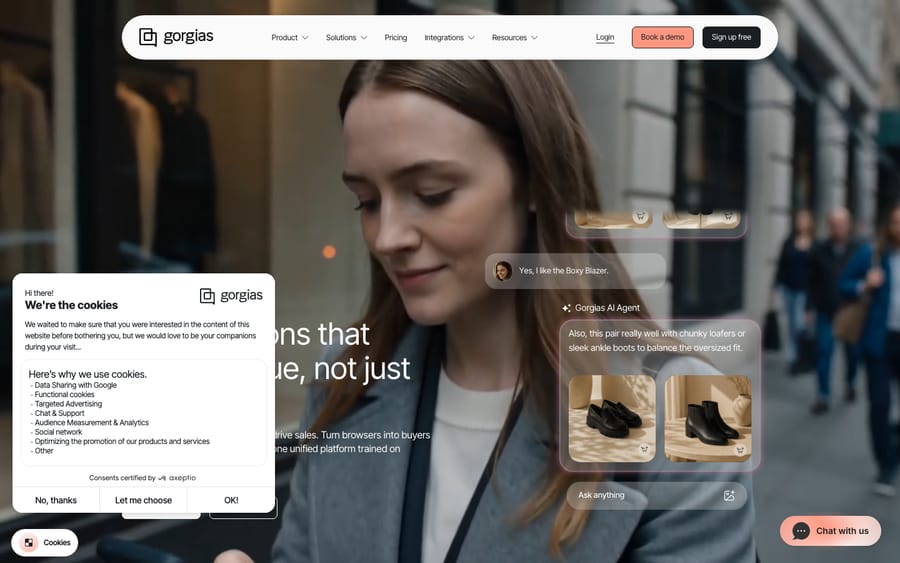
Gorgias AI Agent (formerly Automate) is tuned for ecommerce out of the box. It plugs into Shopify data to resolve order-status, tracking, return and address-change requests on its own, and it's wired into Gorgias's macros and automation rules. Its advantage is published, per-interaction pricing: you can see the cost before you buy. Its watch-out is the same: at volume, the $1.50 overage plus the ticket that each AI interaction also consumes is what pushes Gorgias bills above the base plan.
The clean distinction: Gladly AI is a relationship-and-voice-aware AI on a premium platform; Gorgias AI Agent is an ecommerce-transaction AI with metered, published pricing. Channel coverage follows the same logic. Gladly treats voice as a native channel (it matters for retail and travel), while Gorgias is strongest in chat, email and ecommerce messaging, with voice sold as an add-on.
What do users say about Gladly and Gorgias?
Both tools are well reviewed on G2 and Capterra; the criticisms are the useful part.
Gladly: reviewers consistently praise the customer-centric model: one conversation, full history, no ticket sprawl. Agents describe the conversation view as faster to work in than a ticket queue, with knock-on gains in SLAs. The recurring watch-outs: admin and workflow setup can feel repetitive (some actions take more steps than they should), occasional slow loading, and reporting that feels limited for large teams wanting granular analytics. None are dealbreakers, but they're real friction.
Gorgias: one of the most reviewed help desks in ecommerce. Reviewers like the deep Shopify integration (seeing order history, issuing refunds and editing orders without leaving the ticket) and flexible macros and automation that handle high volumes without losing personalization. The dominant complaint is cost, with reviewers calling it expensive relative to the market, a sentiment driven largely by the ticket-plus-AI model that raises the bill at scale.
Net: Gladly users praise the experience and grumble about setup and reporting; Gorgias users praise Shopify depth and grumble about the bill. Both patterns match the positioning.
Which should you choose for your brand?
There's no universal winner; there's a right answer per brand.
- Choose Gladly if you're a high-LTV consumer brand (premium retail, apparel, beauty, hospitality, travel) with a significant voice and messaging operation and a team of at least ~10 agents. You want one lifelong relationship per customer, native voice, and service that blends into commerce, and you can absorb a premium, quote-only contract.
- Choose Gorgias if you run a Shopify or DTC ecommerce store of almost any size and want order data, macros and an AI agent with published pricing inside the ticket. It's the practical, fast-to-start choice for online retail; just model the AI block and overage fees before you scale.
- Lean Gorgias on price and ecommerce depth; lean Gladly on relationship depth, voice and enterprise consumer experience.
- Smallest stores: Gorgias wins almost by default. Gladly's estimated 10-seat minimum prices out anyone under ~10 agents.
- Largest, voice-heavy brands: Gladly's all-in platform often justifies its premium where a ticket-metered tool would feel transactional.
If you're weighing these against the broader field, our roundup of the best help desk for ecommerce maps where each tool wins across the category.
Where does an AI agent layer fit?
Both Gladly AI and Gorgias AI Agent are good at deflecting predictable, high-volume questions. But plenty of tickets sit in the middle: they need a specific answer pulled from your docs, past conversations or another system, resolved right there in the thread. That tier is where a dedicated AI agent layer like Macha operates. It runs on top of the help desk you already use, reads the customer's actual question, draws on your connected knowledge, resolves the issue in the same thread, and escalates to a human with full context when it isn't confident.
The scope for this comparison: Macha connects to Zendesk, Freshdesk, Gorgias, Front, HubSpot or Intercom. It does not integrate with Gladly today, and it is never a replacement for your help desk. So if you land on Gladly, lean on its native AI for automation. If you land on Gorgias, Macha can run on it and is billed per ticket rather than per interaction, from $299 a month for up to 750 tickets, with setup and monitoring by the Macha team included. The trial comes with $50 of free usage and no credit card.
Frequently asked questions
What's the main difference between Gladly and Gorgias? Gladly is a people-centered customer service platform built around one lifelong conversation per customer, aimed at high-LTV retail, beauty and travel brands with a strong voice operation. Gorgias is an ecommerce-first, Shopify-native help desk built around tickets with order data, aimed at online stores of any size. Gladly optimizes for the relationship; Gorgias optimizes for the ecommerce transaction.
Which is cheaper, Gladly or Gorgias? For most teams, Gorgias. It starts at $10 a month and bills by ticket tier rather than per seat. Gladly is quote-only, with third-party estimates around $180 to $210 per user per month and steep seat minimums (roughly a $1,800 a month floor). Gorgias's AI Agent block ($190 for 190 interactions on Pro, then $1.50 each) can raise its real cost meaningfully at scale.
Does Gorgias integrate with Shopify better than Gladly? Yes. Gorgias is Shopify-native and surfaces order history, refunds and order edits directly inside the ticket, which is its core strength. Gladly integrates with ecommerce systems too, but its design centers on the customer relationship and omnichannel (especially voice) rather than being built around the Shopify order object.
Gladly AI vs. Gorgias AI Agent: which is better? They're tuned for different jobs. Gladly AI, formerly Sidekick, is a relationship-and-voice-aware AI that can take actions across systems and hand off with full context on the customer timeline. Gorgias AI Agent is an ecommerce-transaction AI wired into Shopify with published per-interaction pricing. Pick based on whether your priority is relationship depth (Gladly AI) or ecommerce automation with a visible price (Gorgias AI Agent).
Is Gladly or Gorgias better for a small business? Gorgias, in almost every case. Gladly's seat minimums effectively price out teams under about 10 agents, while Gorgias takes a one-person store at $10 a month and scales by ticket volume. Gladly becomes compelling at mid-market scale and above, especially for voice-heavy consumer brands.
Do Gladly or Gorgias work with Macha? Gorgias yes, Gladly no. Macha is an AI agent layer that connects to Zendesk, Freshdesk, Gorgias, Front, HubSpot or Intercom; it does not integrate with Gladly. On Gladly, use the native Gladly AI.
How should you make the final call?
Gladly vs. Gorgias is a choice between two philosophies, not two versions of one product. Gladly bets on the relationship: one lifelong conversation, native voice, premium per-seat pricing and a clear fit for high-LTV consumer brands. Gorgias bets on the ecommerce transaction: Shopify-native tickets, order data in the inbox, published ticket-and-AI pricing and a fast on-ramp for stores of any size. Model the AI fees and seat minimums against your real volume before you sign, because the sticker price is rarely the final bill.
Vendor positioning and Gorgias prices checked 24 September 2026 on each company's own pages; Gladly prices are third-party estimates (Gladly publishes none). Confirm both before budgeting. Next review: December 2026.
Add AI agents to your Gorgias
Macha reads the ticket, drafts the reply and takes the action, inside the Gorgias you already run.