Intercom
 Shopify
 Stripe
 Slack
Slack Notion
 Google Workspace
 Confluence

What Is Gladly? Features, Pricing and Who It's For (2026)


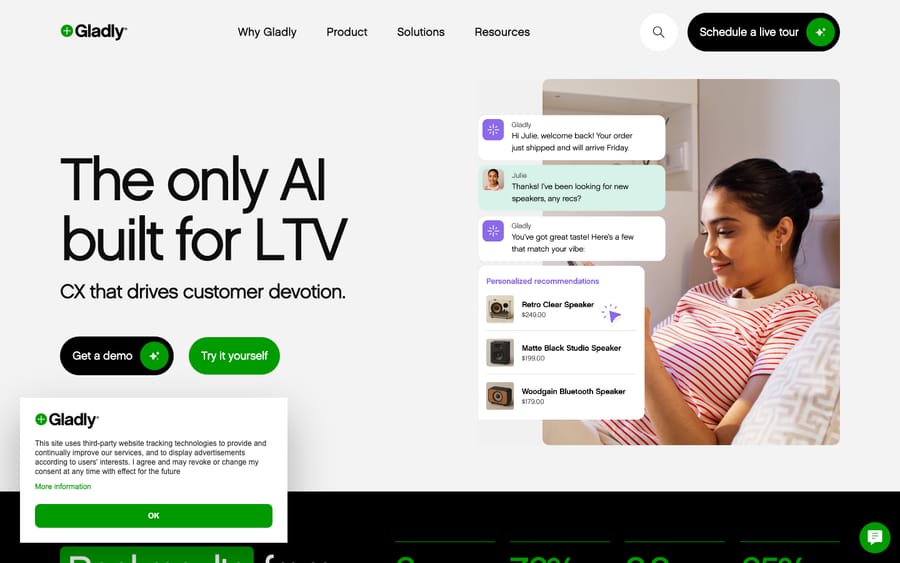
Gladly is a customer service platform for consumer brands that keeps every call, email, text, chat and social message from one customer on a single lifelong conversation instead of separate tickets. Since May 2026 it sells itself as an agentic commerce platform, with one AI agent for both shopping help and service, and it still publishes no prices.
Key takeaways
- Gladly is a customer service platform that files every voice, email, SMS, chat and social message from one customer onto a single lifelong conversation instead of separate tickets.
- Gladly repositioned as an agentic commerce platform at Gladly Connect Live on 6 May 2026, selling one AI agent, the Gladly Commerce Agent, for both shopping help and service.
- Gladly publishes no prices, and third-party estimates put its Hero package near $180 per user a month with a 10-seat minimum on annual contracts, plus usage-based AI and telephony.
- Charlie Besecker is Gladly's current CEO, while co-founder Joseph Ansanelli, who led the company from its 2014 founding until 2025, is now executive chairman.
- Gladly's People Match is a patented routing engine that sends each customer to the best-suited team member based on history, status, sentiment and skill.

Gladly is a customer service platform for consumer brands that files every call, email, text, chat and social message from one shopper onto a single lifelong conversation instead of opening a new ticket each time. Since its Gladly Connect Live conference on 6 May 2026 it sells itself as an agentic commerce platform ("Commerce AI for every customer moment"), with one AI agent that handles both shopping help and service. It doesn't publish prices; third-party estimates put its seats around $180 per user a month with a 10-seat minimum. Everything below was checked against Gladly's own site on 24 September 2026; if you want the AI side in more depth, see Gladly AI explained.
| Question | Answer (checked 24 September 2026) |
|---|---|
| What it is | Customer-centric service platform with a commerce AI agent |
| Data model | One lifelong conversation per customer, no tickets |
| Channels | Voice, email, SMS, chat, social, all native |
| AI agent | Gladly AI / Gladly Commerce Agent (formerly Sidekick) |
| Leadership | CEO Charlie Besecker; co-founder Joseph Ansanelli is executive chairman |
| Published pricing | None; demo request only |
| Reported seat price | ~$180 per user a month, ~10-seat minimum (third-party estimate) |
| Built for | Retail, apparel, beauty and travel brands |
Who makes Gladly?
Gladly is built by Gladly, Inc., and the company's history explains the product's opinionated design:
- Gladly was founded in 2014 by Joseph Ansanelli, Michael Wolfe and Dirk Kessler. Ansanelli ran the company as CEO until 2025 and is now co-founder and executive chairman. Charlie Besecker, who joined as president in 2024, is the current CEO (Gladly about page).
- It's a venture-backed company with backing from investors including Greylock, New Enterprise Associates (NEA) and GGV Capital. Reported total funding varies by source: figures from roughly $113M to $208M+ appear across Crunchbase, Tracxn and trade press, and Gladly doesn't publish a number. Treat the exact figure as approximate. The point stands: this is an independent, well-funded player, not a side product of a bigger suite.
- Gladly was built deliberately for consumer brands (retail, apparel, beauty and travel), where a single customer's lifetime value is high enough that personal service pays for itself.
Gladly isn't a general-purpose ticketing tool that later added a "customer view." The customer-centric data model is the foundation, which is both its biggest strength and the clearest filter for whether it suits you.
How is Gladly different from a ticket-based help desk?
One design decision explains Gladly, and everything else follows from it.
A traditional help desk organizes work around tickets. A customer emails, a ticket is created; they call next week, a second ticket is created; they DM on Instagram, a third. The agent and the customer both end up re-explaining context that the system never connected.
Gladly organizes work around people. Each customer has one persistent Conversation that runs for the life of the relationship, and every interaction across every channel lands on that single timeline. Gladly's documentation puts "Customers, not tickets, at the center," so an agent opening a conversation sees the person's complete history, preferences and past contacts without making them repeat anything. A chat this morning sits directly beneath a phone call from last quarter. Gladly's current marketing calls this "Lifelong Customer Memory."
In practice there are no tickets to merge, no duplicate threads, and no "let me pull up your account." The account is the conversation.
What does Gladly do?
Underneath the philosophy, Gladly is a full customer service platform. Here's what it includes.
1. All channels, built in, on one timeline
Gladly ships voice, email, SMS/text, live chat and social messaging natively, not as separate add-on products that sync imperfectly. Every channel feeds the same customer timeline, so the medium is a detail and the relationship is the constant. Voice is a first-class channel here (a notable difference from messaging-first tools), which matters for the retail and travel brands Gladly targets.
2. People Match®: routing built around relationships
People Match® is Gladly's patented routing engine. Instead of dumping contacts into a generic queue, it connects each customer to the team member best suited to help based on history, status, sentiment and skill: a VIP or a visibly upset customer goes to the right person, a billing question to a billing expert, a Spanish-language chat to a Spanish-speaking agent. The aim is continuity and the right match, not the next available person.
3. Gladly AI (formerly Sidekick): the AI agent
Gladly's AI layer was sold for years as Sidekick. The product is now branded Gladly AI, and the homepage leads with the Gladly Commerce Agent: one agent meant to cover the whole relationship, from product questions before a purchase to "where is my order?" (WISMO), returns and exchanges after it. Gladly's own framing is that "a shopping AI can't handle the return" and "a service bot can't help you buy," so it sells a single agent for both. The agent can take action across connected systems (processing a return, for example) and hands off with full context when a conversation needs a person.
The 6 May 2026 announcements pushed this further. Agentic Commerce extends the agent to pre-purchase engagement and to AI platforms such as ChatGPT, Perplexity and Gemini. The AI Performance Loop adds agents built automatically from your documentation, testing at scale, automated monitoring and an Insights Agent for conversation analytics (Gladly press release).
A caveat on the numbers. Gladly's homepage now quotes commerce outcomes (+19% conversion, +$34 average order, 41% of carts saved) rather than the resolution rate it used to lead with. Treat headline figures as best-case marketing: real results depend on your content quality, catalog, return policies and how repetitive your contact mix is.
4. The agent workspace (Hero, now Team)
The agent-facing application, historically Gladly Hero and now marketed with features like Team Assist, is where human agents work. It surfaces the full customer timeline, the active conversation, customer intelligence and intent, and the tools to respond on any channel from one screen. Features like VIP recognition and policy-override prompts show up here, which fits Gladly's preference for empowered agents over rigid scripts.
5. Payments and commerce
For retail brands, Gladly leans into the transaction. Chat Payments let agents collect payment inside a chat while helping with a product question or purchase, so a service conversation can become a sale without sending the customer to another tool. With the Commerce Agent on top, this is the clearest expression of Gladly's "service drives revenue" thesis.
6. Reporting and insights
Gladly reports on conversation volume, channel mix, agent performance, resolution and CSAT, plus revenue-oriented metrics (like revenue per conversation) that fit its lifetime-value framing. As with most platforms, the deepest analytics and integrations sit in higher tiers and paid add-ons.
Who is Gladly for?
Gladly's design points at consumer brands where customer lifetime value is high and the experience is part of the product. Its homepage logos read accordingly: Crate & Barrel, Nordstrom, Ulta Beauty, TUMI, UGG, Tory Burch, Hoka, Rothy's and Breeze Airways, which is retail, apparel, beauty and travel.
It's a strong fit if you:
- Run a B2C, retail, ecommerce or hospitality/travel brand where repeat purchases and loyalty drive the business.
- Care about a personal, relationship-first experience across phone, chat, text and social, and want voice handled natively.
- Want service and commerce to blend (assisted shopping, in-chat payments) rather than living in separate stacks.
It's a weaker fit if you:
- Are a B2B, IT or internal-support team. Gladly isn't built around tickets, SLAs, assets and approval workflows the way an ITSM or classic B2B help desk is.
- Are price-sensitive or very small. Gladly is a premium platform with seat minimums (more below).
- Just want a simple shared inbox. The customer-centric model is more platform than lightweight tool.
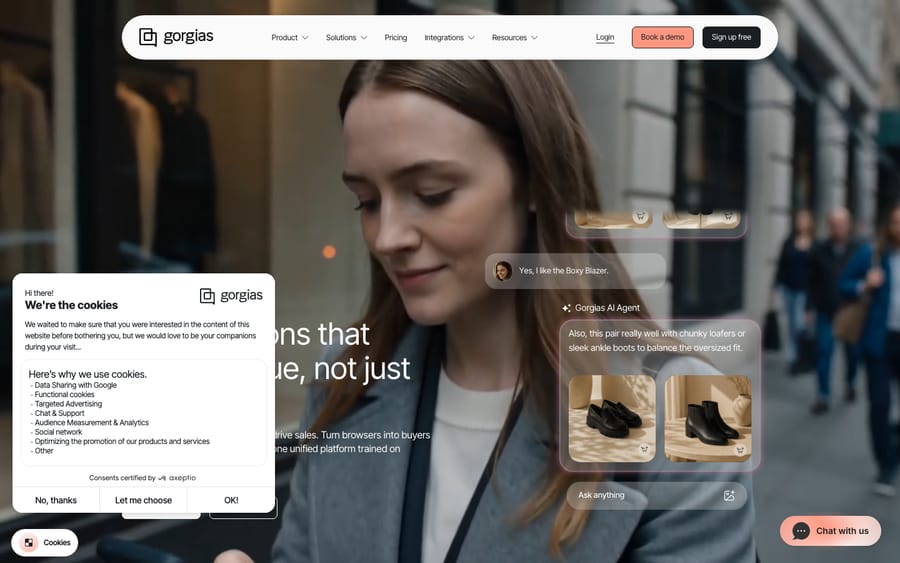
If you're weighing it against ecommerce-focused peers, our guide to the best help desk for ecommerce maps where each tool wins. For contrast, here's Gorgias, an ecommerce-first competitor whose Shopify-native angle differs from Gladly's relationship-and-LTV framing.
How much does Gladly cost?
Gladly does not publish prices. Its pricing page still lists no numbers or plan names on 24 September 2026 and routes you to a demo, so anyone quoting exact figures relies on customer reports and analyst estimates. With that caveat, the third-party consensus (ringly.io, hiverhq.com, G2) looks like this:
| Plan (per third-party estimates) | Approx. price | Notes |
|---|---|---|
| Hero package | ~$180 / user / month | Roughly a 10-seat minimum (≈ $1,800/mo floor); annual contract |
| Superhero package | ~$210 / user / month | Higher seat minimum reported (≈ 45 seats); annual contract |
| AI conversations | ~$0.60 per AI conversation | Usage-based, on top of seats (reported under the Sidekick name) |
| Voice / SMS | usage-based (e.g. ~$0.06/min, per-message SMS) | Carrier/usage fees billed separately |
Three things to flag:
- These are estimates, not official Gladly pricing, and they predate the 2026 commerce repositioning. Confirm any number with Gladly before budgeting.
- The model is per-seat on annual contracts with seat minimums, plus usage-based AI and telephony. Per-seat pricing means Gladly earns more as your team grows, while the AI charge grows with automated volume, so you pay on both sides as you scale.
- Because it bundles voice, messaging, AI and payments, the all-in comparison can look different from a cheaper inbox plus separate phone and AI vendors. Run the math on your real channel mix.
If the price or the model isn't a fit, our roundup of the best Gladly alternatives walks through where each rival is stronger.
What are Gladly's strengths and limits?
Strengths: a genuinely different, customer-centric data model (one lifelong conversation, no ticket sprawl); native omnichannel including first-class voice; patented People Match routing; an AI agent that takes real actions and covers both shopping and service; commerce features (assisted shopping, in-chat payments) most support tools lack; and a clear focus on lifetime value for consumer brands.
Limits: it's a premium, quote-only platform with seat minimums and annual contracts; it's purpose-built for B2C, retail and travel, so it's a poor fit for B2B, IT or internal support; its AI outcome figures are best-case; and the platform depth means real implementation effort, not a five-minute switch.
Where does an AI agent layer like Macha fit?
Gladly's AI, like every platform's built-in AI, is good at the predictable, high-volume questions (WISMO, returns) and at assisting agents. Plenty of tickets sit in the middle: they need a specific answer pulled from your docs, past conversations or another system, resolved in the thread. That tier is where a dedicated AI agent layer like Macha works.
Macha isn't a help desk and isn't a Gladly replacement. It runs on top of the help desk you already use: it reads the customer's question, draws on your connected knowledge and ticket history, replies in the same thread, and escalates to a human with context when it isn't confident.
For Gladly users specifically: Macha does not integrate with Gladly today. It runs on Zendesk, Freshdesk, Gorgias, Front, HubSpot or Intercom. If you're on Gladly, use its built-in AI. If you're on one of those desks and your ticket mix is mostly repetitive questions your help center could answer, Macha is priced per ticket (from $299 a month for 750 tickets, with setup by the Macha team included), and you can start with $50 of free usage, no credit card required.
Frequently asked questions
What is Gladly in simple terms? Gladly is an AI-powered customer service platform built around the customer rather than the ticket. Every interaction a person has with your brand, across voice, email, text, chat and social, lives on one lifelong conversation timeline, so agents and AI always have full context. It's made by Gladly, Inc., founded in 2014 and now led by CEO Charlie Besecker.
Is Gladly a help desk or a CRM? It's a customer service platform, closer to a help desk than a CRM, but with a customer-centric model that feels CRM-like. It organizes around people and their full history instead of tickets. It doesn't replace a sales CRM, but it centralizes the service relationship.
What is Gladly Sidekick? Sidekick was the earlier name for Gladly's AI agent. It's now sold as Gladly AI, led by the Gladly Commerce Agent, which answers service questions like "where is my order?" and returns, helps shoppers before they buy, takes actions in connected systems, and hands off to a human with full context when needed.
What is People Match in Gladly? People Match® is Gladly's patented routing engine. It matches each customer to the best-suited agent based on history, status (for example VIP), sentiment and the skills needed, rather than dropping them into a generic queue.
How much does Gladly cost? Gladly doesn't publish prices; you have to request a quote. Third-party estimates put its Hero package around $180/user/month with a ~10-seat minimum on annual contracts, a higher Superhero tier around $210/user/month, plus usage-based AI (~$0.60 per AI conversation) and telephony charges. Treat these as approximate and confirm with Gladly.
Who is Gladly best for? Consumer brands in retail, ecommerce, apparel, beauty and travel/hospitality, where customer lifetime value is high and a personal, omnichannel experience matters. Its customers include Crate & Barrel, Nordstrom, Ulta Beauty, UGG and Breeze Airways. It's a weaker fit for B2B, IT or internal support.
What did Gladly announce in 2026? At Gladly Connect Live on 6 May 2026, Gladly announced Agentic Commerce (AI across pre-purchase and post-sale, including on ChatGPT, Perplexity and Gemini), an AI Performance Loop for building, testing and monitoring agents, and a human-and-AI collaboration model where the AI escalates approvals and exceptions to staff.
Should you shortlist Gladly?
Shortlist it if you're a consumer brand with a high-value repeat customer, meaningful phone volume, and a budget that starts around $1,800 a month on third-party estimates before AI and telephony. Gladly's bet is that support should be organized around customers, not tickets, and its 2026 move into commerce AI extends that bet to the sale itself. B2B and IT teams that live in tickets and SLAs should look elsewhere, as should anyone who needs a published price before a demo.
Checked against Gladly's website, pricing page, about page and May 2026 press release on 24 September 2026. Gladly does not publish pricing; all prices here are third-party estimates. Confirm current figures with Gladly before relying on them.
Simple per-ticket AI pricing
One thread with one person is one charge, however many replies it takes.