Intercom
 Shopify
 Stripe
 Slack
Slack Notion
 Google Workspace
 Confluence

Gorgias vs Zendesk for Shopify (2026): Which Help Desk Should Your Store Use?


For most Shopify stores Gorgias is the better help desk, because it bills per ticket and lets agents refund, cancel and edit orders inside the ticket. Zendesk suits stores scaling toward enterprise, with per-agent pricing, broader channels and deeper routing and governance.
Key takeaways
- Gorgias suits most Shopify stores because it bills per ticket, from $10 a month for 50 tickets, and handles refunds, cancellations and order edits inside the ticket.
- Zendesk Suite costs $55 per agent a month for Team and $115 for Professional billed yearly, and its Shopify app handles refunds and cancellations from the sidebar while order edits still mean opening Shopify.
- Gorgias AI Agent costs about $1.00 per automated interaction on monthly billing, and an AI-resolved ticket is also charged the normal ticket fee.
- A 6-person Shopify team handling 250 tickets a month pays $60 on Gorgias Basic versus about $330 on Zendesk Suite Team.
- On either desk, Macha can add an AI agent that the Macha team builds and runs for you, about $0.40 a ticket with setup and a dedicated success manager included.

For most Shopify stores, Gorgias is the better fit: it bills per ticket (from $10 a month for 50 tickets) rather than per agent, and agents can refund, cancel and edit orders inside the ticket. Zendesk wins when you are scaling toward enterprise, with many brands and channels, complex routing, strict SLAs and a large integration ecosystem, at $55 to $115 per agent a month on the Suite plans shown on its pricing page.
| Gorgias | Zendesk | |
|---|---|---|
| Pricing model | Per ticket: $10 (50) to $900 (5,000) a month | Per agent: Suite Team $55, Suite Professional $115 (billed yearly) |
| Shopify order actions in the ticket | Refund, cancel, edit, duplicate, subscriptions | Refunds and cancellations from the sidebar app |
| AI pricing | About $1.00 per automated interaction, plus the ticket | Per automated resolution; Copilot $50/agent/month |
| Best for | Small-to-mid DTC teams, order-centric support | Large, multi-brand or non-ecommerce operations |
This guide breaks down positioning, Shopify integration depth, pricing (the models are completely different), AI, automation, real-user ratings, and a clear "who should choose what." A disclosure first: Macha, the company publishing this, makes an AI agent layer that runs on top of Zendesk, Freshdesk, Gorgias, Front, HubSpot or Intercom. We'll keep this even-handed and save our one honest aside for the end, and to be clear, Macha is not a help desk, so we have no stake in either side of the comparison.
How did we compare Gorgias and Zendesk?
We pulled plans, prices, and ticket allotments from the official Gorgias pricing page and Zendesk pricing page, cross-checked against Capterra, eesel, Lindy, Chatarmin, Ringly, and Voiceflow. For real-user signal we used recurring pros and cons on G2 and Capterra. Prices and the Shopify app details were re-checked on the vendors' own pages on September 24, 2026. Pricing in this space moves fast, so confirm current rates before you budget.
What is the core difference between Gorgias and Zendesk?
This is the whole decision for a Shopify store, so slow down here.
Gorgias is an ecommerce help desk. It's built around the online store: deep, native integrations with Shopify (plus BigCommerce, Magento and WooCommerce) put order history, tracking, and refund/cancel/edit actions directly inside the ticket, so an agent can fix an order without leaving the conversation. Its pricing is per ticket, not per agent, a model designed for stores where conversation volume, not headcount, is the real cost driver.
Zendesk is an enterprise-scale omnichannel platform. It centralizes email, chat, phone, social, and messaging into one ticketing system for any kind of support team, with mature routing, SLAs, reporting, and a marketplace Zendesk puts at 1,800+ apps, partners and integrations. It's channel-agnostic and industry-agnostic. Its pricing is per agent, the way most help desks bill, and it scales in depth and configurability far beyond what most Shopify stores need on day one.
That single split, ecommerce specialist vs. enterprise generalist, drives almost every difference below.
What does Gorgias do well for Shopify stores?
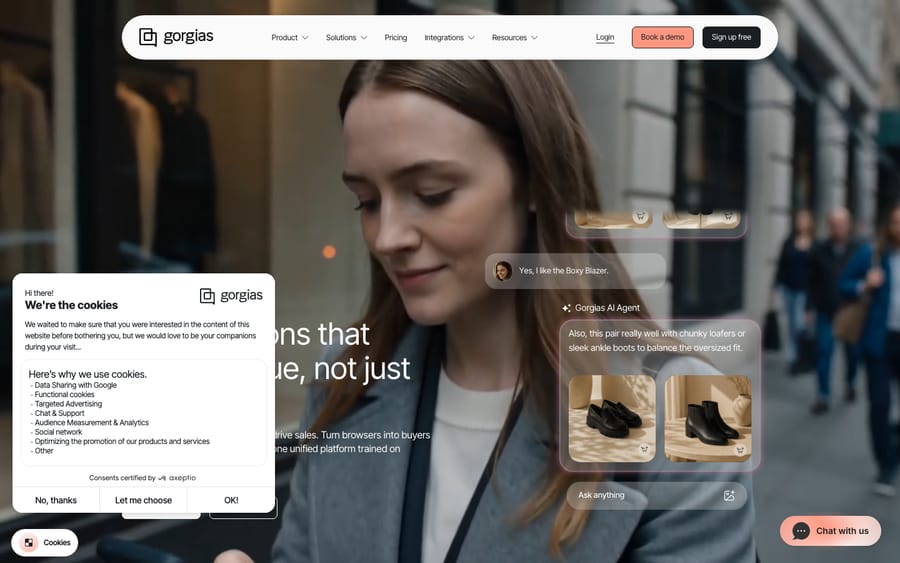
Where Zendesk thinks in generic tickets, Gorgias thinks in orders, customers, and stores.
Core strengths:
- Native Shopify (and BigCommerce/Magento) integration. Full order history, tracking, and one-click refunds, cancellations, edits, and even new orders live right inside the ticket. This is the single biggest reason DTC operators choose it.
- Per-ticket pricing with up to 500 user seats (on Basic and above, per its comparison table). Because you pay for tickets, not seats, you can let the whole team (warehouse, marketing, founders) into the tool without per-seat costs.
- Fast onboarding. A one-click Shopify install and pre-built macro templates mean most stores go live within a week; Gorgias' "50 in 50" program targets 50% automation in 50 days.
- Ecommerce-tuned automation and revenue tracking. Macros, rules, on-store chat, pre-sales help, and the ability to attribute support-driven sales.
The trade-off: it's narrow by design. Phone is a paid Voice add-on rather than part of the base plan, and there are fewer general-purpose/B2B features, a smaller integration catalog than Zendesk, and a pricing model that can climb quickly as ticket volume rises (more on that next). For the deeper Shopify-specific breakdown, see our Gorgias for Shopify guide.
What does Zendesk do well, and what does it cost a Shopify store?
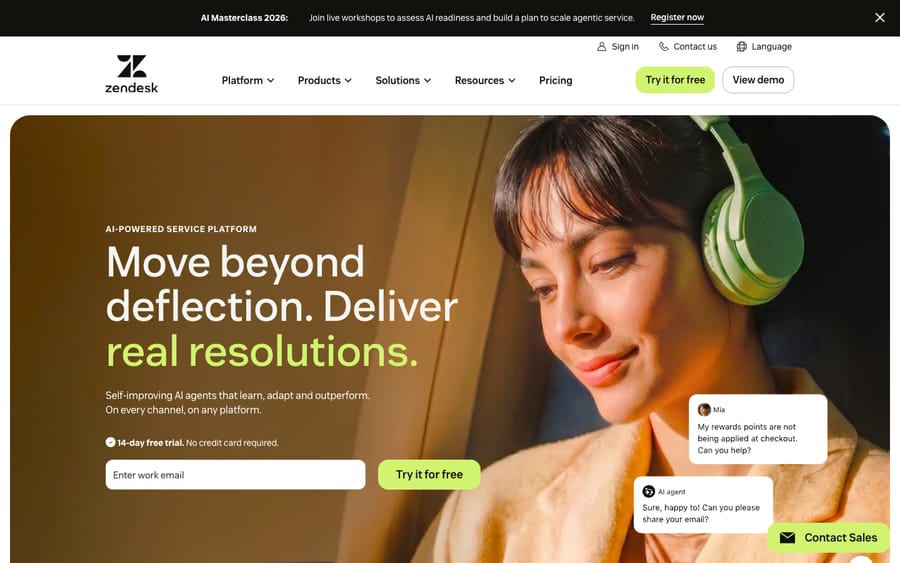
Zendesk is the incumbent enterprise help desk. Its job is to pull every channel a customer might use into one ticketing system, then resolve those tickets with deep automation, routing, and reporting.
Core strengths:
- True omnichannel at scale, including native voice and telephony, with mature SLA management, skills-based routing, and advanced analytics (Explore).
- The largest ecosystem: 1,800+ apps, partners and integrations, plus an API for custom builds.
- Configurability and governance that suit larger or multi-brand operations: granular roles, audit logs, and enterprise security.
- A Shopify integration, built by Zendesk, that surfaces customer and order data in the agent sidebar and, per its Shopify App Store listing, lets agents "Process refunds and cancellations, directly from the Zendesk Support sidebar app."
The trade-off for a Shopify store: ecommerce isn't the core experience. Zendesk's Shopify app covers refunds and cancellations, but for order edits, duplicate orders or subscription changes agents typically open a separate Shopify tab. Setup also tends to take longer (often 2–4 weeks to configure properly), and the per-agent pricing gets expensive fast for small teams. Zendesk earns its keep at scale, not on a five-person store.
Which has the deeper Shopify integration?
For a Shopify merchant, this section may settle it.
Gorgias is action-oriented. Order history, tracking, subscriptions, refunds, cancellations, and order edits all happen inside the ticket. An agent reads the customer's message, sees the exact order, and resolves it (refund issued, order edited) without ever leaving the conversation. For a high-volume DTC brand, that saves real time per ticket and is precisely why most Shopify operators pick it.
Zendesk covers the common actions, not the long tail. Its Shopify app surfaces the customer's orders in a sidebar and handles refunds and cancellations there. For edits, subscriptions and anything more specialized, the agent usually jumps into Shopify admin and comes back. That tab-switching is a minor annoyance on a few tickets and a real productivity tax across thousands.
If your support is order-centric and you want agents acting on orders without context-switching, Gorgias' native depth is the advantage. If orders are just one input among many channels and systems, and you value Zendesk's routing, reporting, and breadth more than in-ticket order actions, a sidebar limited to refunds and cancellations is an acceptable trade.
Which is cheaper for a Shopify store, Gorgias or Zendesk?
This is where the two diverge most, and it's the part most likely to surprise you. Gorgias bills per ticket; Zendesk bills per agent. That makes a direct apples-to-apples comparison impossible: your cheaper option depends entirely on your ticket volume and your team size.
Gorgias (per month; ticket allotment in parentheses):
- Starter, $10/mo (50 tickets, max 3 seats).
- Basic, $60/mo monthly, $50/mo annual (300 tickets, 500 seats).
- Pro, $360/mo monthly, $300/mo annual (2,000 tickets).
- Advanced, $900/mo monthly, $750/mo annual (5,000 tickets).
- Enterprise, custom (5,000+ tickets). Annual billing is roughly two months free (~16%). Ticket overage is $0.40 per extra ticket on Starter and Basic and $0.36 on Pro and Advanced.
Zendesk Suite (per agent/month, billed annually):
- Suite Team, $55 · unified channels and AI agents for small teams.
- Suite Professional, $115 · skills-based routing, IVR phone menus, admin copilot and AI quick reports.
- Suite Enterprise + Copilot, contact sales. Suite Growth ($89 in earlier lineups) no longer appears on the public pricing page.
- Monthly billing runs higher. Copilot, the add-on that replaced Advanced AI, is $50/agent/month billed yearly, on Suite Professional and above.
Two things stand out. First, Gorgias rewards small teams with modest ticket volume; Zendesk's per-seat model punishes them. A 6-person Shopify store doing 250 tickets a month pays $60 flat on Gorgias Basic, versus ~$330/mo on Zendesk Team (6 × $55). But flip the variables: a 6-person team buried in 6,000 tickets/month lands on Gorgias Advanced ($750 a month annual, plus about $360 of overage for the extra 1,000 tickets) versus the same ~$330 on Zendesk, where headcount, not ticket count, sets the price.
Second, Gorgias' AI Agent has a pricing quirk worth flagging. You add a prepaid block of automated interactions (about $1.00 each on monthly billing, about $0.90 annual; $190 for 190 on Pro, for example), then pay $1.50 per interaction past the block. Gorgias's billing docs also charge "both a ticket fee + automation fee" when AI Agent resolves a ticket without a human handover, so an AI resolution hits your bill twice. Zendesk's AI agents are also outcome-based, billed per automated resolution: its pricing page lists $1.50 committed and $2.00 pay-as-you-go, and each seat earns a small monthly allowance (5 included resolutions per agent on Suite Team and 10 on Suite Professional in the pricing table, which Zendesk's help center has described as a dollar amount per seat since 18 May 2026). That sits on top of an already higher per-seat base. Budget AI as its own line on either platform. For the full Gorgias breakdown, see Gorgias pricing explained.
How do Gorgias AI Agent and Zendesk AI compare?
Both ship AI, but it shows up differently.
- Gorgias AI Agent is tuned for ecommerce: it pulls order status, handles returns, and resolves store-specific questions using native Shopify context. It's strong on chat and in-store scenarios, and it's quick to stand up given the one-click data connection. The catches are the per-resolution-plus-ticket pricing above, and that it's narrower in scope.
- Zendesk AI spans AI agents (autonomous deflection/resolution), agent-assist copilot features, and analytics, with deeper configurability and a wider channel footprint. The Copilot add-on ($50/agent/month) unlocks the strongest agent-assist pieces, which adds to the bill.
Net: Gorgias AI is narrower but deeply ecommerce-aware out of the box; Zendesk AI is broader and more configurable but sits behind a heavier price and a longer setup. Either way, the AI line item is the most common source of "the bill was higher than the sticker" on both.
How do they compare side by side?
| Gorgias | Zendesk | |
|---|---|---|
| Category | Ecommerce/Shopify-native help desk | Enterprise-scale omnichannel platform |
| Best fit | DTC / Shopify stores, order-centric support | Scaling/enterprise, multi-channel, complex ops |
| Pricing model | Per ticket (500 seats on Basic+) | Per agent |
| Entry price | $10/mo (Starter, 50 tickets) | $55/agent/mo (Suite Team, annual) |
| Higher tiers | $60 / $360 / $900 (Basic/Pro/Advanced) | $115 Suite Professional; Enterprise + Copilot via sales |
| Shopify integration | Native, deep, refunds/edits/orders in-ticket | Sidebar app with refunds and cancellations |
| Native phone/voice | Voice add-on | Yes, built in |
| Time to launch | ~1 week (one-click install, macro templates) | ~2–4 weeks to configure properly |
| Integration ecosystem | Ecommerce-focused, smaller catalog | 1,800+ apps, partners and integrations |
| AI | AI Agent (~$1.00/interaction monthly, also billed as a ticket) | AI agents (per automated resolution) + Copilot ($50/agent/mo) |
Rates checked September 24, 2026 on official pricing pages. Confirm before budgeting, since pricing changes often.
What do users say about Gorgias and Zendesk?
Aggregate sentiment reinforces the "specialist vs. enterprise" framing.
- Gorgias. Reviewers on G2 and Capterra praise the Shopify depth and the per-ticket model, which lets people outside the support team use the tool without buying seats. The most frequent criticisms are cost at higher ticket volumes and feature gaps for more complex, non-ecommerce workflows.
- Zendesk. The standout themes are scalability and breadth, with reviewers praising how it organizes tickets, macros and reporting for high-volume teams. On the Shopify App Store its own Shopify app rates 3.5 out of 5 from 92 reviews. Common watch-outs: it can feel heavy and complex for small teams, takes longer to set up, and gets expensive as you add seats and AI.
Net: both are well-liked. Gorgias draws a smaller, more specialized DTC user base; Zendesk's far larger review pool reflects its broad, enterprise reach.
Which should you choose?
- Choose Gorgias if you run a Shopify (or BigCommerce/Magento) DTC store, your support is order-centric, and you want native order actions inside the ticket, ecommerce-tuned AI, fast onboarding, and no per-seat pricing. For most small-to-mid Shopify stores, it's the better, cheaper, faster fit.
- Choose Zendesk if you're scaling toward enterprise, multiple brands or channels, strict SLAs and routing, advanced reporting, native voice, a huge integration ecosystem, and governance needs, and ecommerce is one part of a bigger support operation rather than the whole thing.
- It comes down to volume vs. headcount (and complexity). Small team, order-centric, modest tickets → Gorgias' per-ticket model and native Shopify depth win. Larger team, many channels, heavy configuration → Zendesk's per-seat platform earns its keep. Run your real numbers both ways.
- Budget AI separately on either platform, and on Gorgias remember the AI-resolution-also-counts-as-a-ticket quirk.
Where does an AI layer like Macha fit?
One narrow, honest aside: whichever of the two you land on, if you want stronger AI resolution than the built-in bot, Macha is an AI agent layer that runs on top of your existing help desk, connecting to your knowledge and automating ticket work action by action.
To be clear about scope: Macha is an AI layer on top of whichever help desk you pick. It isn't a Zendesk or Gorgias alternative. So this aside sits alongside the comparison rather than inside it, and we won't pretend otherwise. Macha is also done for you on either desk: the Macha team analyzes your past tickets, builds the knowledge base and the agent, and runs it in safe mode, with drafts as internal notes in your help desk, until the drafts are right. It bills per ticket, about $0.40 a ticket from $299 a month for 750 tickets, and that price includes the setup and a dedicated success manager who handles your changes after go-live. If you'd like to see the automation work before committing, there's $50 of free usage (about 125 tickets), no credit card.
Frequently asked questions
Is Gorgias or Zendesk better for Shopify? For most Shopify stores, Gorgias: its native Shopify integration lets agents issue refunds and edit or cancel orders inside the ticket, and it's faster and cheaper to launch for a small team. Zendesk is better when you're scaling toward enterprise with many channels, strict SLAs, and a need for its larger ecosystem; its Shopify app handles refunds and cancellations but not the deeper order edits.
What's the real difference between Gorgias and Zendesk? Gorgias is an ecommerce-native help desk built around the online store and billed per ticket. Zendesk is an enterprise-scale omnichannel platform that suits any industry and is billed per agent. Gorgias is the ecommerce specialist; Zendesk is the broad, configurable generalist.
Which is cheaper, Gorgias or Zendesk? It depends on ticket volume vs. team size. Gorgias bills per ticket ($10–$900/mo, with 500 seats on Basic+), so it's cheaper for teams with modest ticket volume. Zendesk bills per agent ($55–$115/agent/mo on the public Suite plans), so it can be cheaper for small teams buried in high ticket volume. Run both models on your real numbers.
Does Zendesk integrate with Shopify like Gorgias does? Partly. Zendesk's own Shopify app shows customer and order data in the agent sidebar and lets agents process refunds and cancellations there. For order edits, duplicates or subscription changes, agents typically open Shopify; Gorgias performs those actions inside the ticket.
How does Gorgias AI Agent pricing work? You prepay a block of automated interactions at about $1.00 each on monthly billing (about $0.90 annual), then pay $1.50 per interaction past the block, and a ticket the AI resolves also carries the normal ticket fee, so it can affect your bill twice. Zendesk's AI agents are also outcome-based (billed per automated resolution) on top of the per-seat plan, with the Copilot add-on at $50/agent/month.
So which is better for Shopify?
Gorgias vs. Zendesk for Shopify isn't "which help desk is better" but "which job are you hiring it for." Gorgias is the ecommerce specialist: if you're a Shopify DTC store living in orders and refunds, its native integration, fast onboarding, and per-ticket model are hard to beat for small-to-mid teams. Zendesk is the enterprise generalist: broader channels (including native voice), the largest ecosystem, deep routing and reporting, and the configurability to run support at scale across brands and industries. Match the tool to your business model, run your real volume-vs-headcount numbers both ways, budget AI as its own line, and confirm every rate on the official pricing pages before you commit, they change often.
Vendor details checked September 24, 2026 on the official Gorgias and Zendesk pricing pages, Gorgias's billing docs and the Shopify App Store. Next review: December 2026.
Add AI agents to your Zendesk
Macha reads the ticket, drafts the reply and takes the action, inside the Zendesk you already run.