Intercom
 Shopify
 Stripe
 Slack
Slack Notion
 Google Workspace
 Confluence

Help Scout vs Intercom (2026): Which Help Desk Should You Choose?


Help Scout is a simple, email-first help desk for small and growing teams, starting at $25 per user a month with a free plan for up to 5 users. Intercom is an AI-first messenger platform for scale-ups, starting at $29 a seat billed annually plus its Fin AI agent at $0.99 per outcome.
Key takeaways
- Help Scout suits small, email-first teams at $25 per user a month with a free plan for 5 users, while Intercom suits scale-ups from $29 a seat billed annually.
- Help Scout AI Answers costs $0.75 per resolution after a 3-month free trial and is documented only in Beacon web chat, answering from knowledge rather than taking actions.
- Intercom's Fin AI agent costs $0.99 per outcome, and its 50-outcome monthly minimum applies only when Fin runs on a help desk other than Intercom.
- On Intercom, Macha is an AI agent layer the Macha team sets up and runs in safe mode for you, at about $0.40 a ticket from $299 a month with a dedicated success manager included; it does not connect to Help Scout.
- Salesforce agreed on June 15, 2026 to acquire Fin, Intercom's parent company, for about $3.6 billion and completed the deal on September 10, 2026.

Choose Help Scout if you want a simple, email-first help desk at $25 per user a month (with a free plan for up to 5 users), and choose Intercom if you want an AI-first messenger platform from $29 a seat billed annually plus its Fin AI agent at $0.99 per outcome. The decision is less a feature fight than a question of what kind of company you are: do you want the lightweight tool that gets out of the way, or the larger platform you'll grow into and budget around?
| Help Scout | Intercom | |
|---|---|---|
| Entry price | Free (5 users), then $25/user/mo | $29/seat/mo billed annually (Essential) |
| Top published tier | $75/user/mo (Pro, 10-user minimum) | $132/seat/mo (Expert) |
| Customer-facing AI | AI Answers, $0.75 per resolution | Fin, $0.99 per outcome |
| Vendor-claimed AI resolution rate | 70% | 76% average |
| Best for | Small and growing teams, email-first | Scale-ups running in-app chat and AI at volume |
One disclosure up front: Macha, the company publishing this, makes an AI agent layer that runs on top of Zendesk, Freshdesk, Gorgias, Front, HubSpot or Intercom. We do not integrate with Help Scout, and we're a layer rather than a help desk, so neither of these is a competitor of ours. We'll keep it even-handed and save the single aside about where we fit for the end.
How did we compare them?
We pulled plan names and prices from the official Help Scout and Intercom pricing pages (re-checked September 24, 2026), and cross-checked AI pricing against Help Scout's docs and Fin's pricing pages. For real-user signal we used G2 and Capterra aggregate ratings, review counts, and recurring pros/cons, with an attributed reviewer quote where one was available. The rating figures are from a June 2026 read; the rating sites block automated checks, so we did not refresh them. Pricing in this category changes often and AI is billed by usage, so confirm current rates before you budget. Our next review is scheduled for December 2026.
Who is each one built for?
The fastest way to understand these two is to look at who each was designed for.
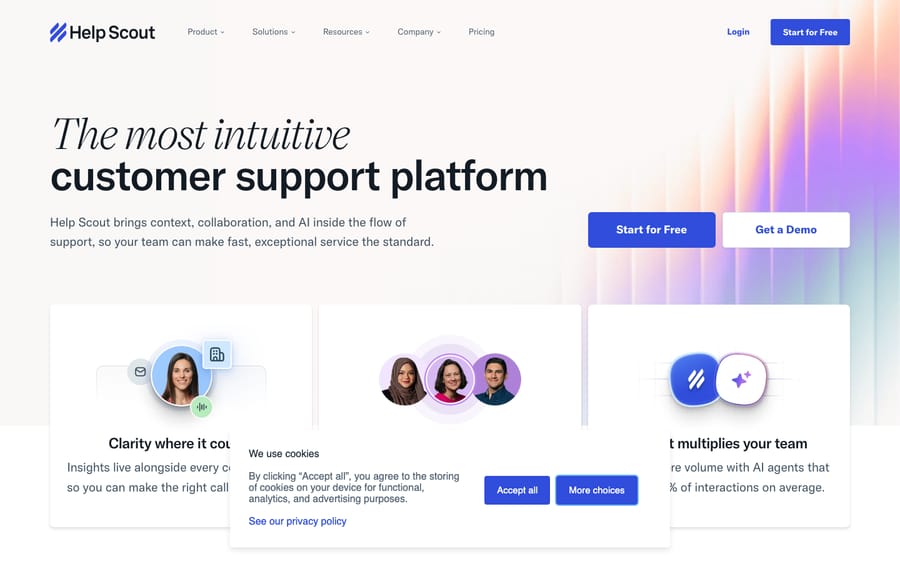
Help Scout is the "invisible help desk." It started as a shared inbox that looks and feels like regular email, so customers get a personal reply rather than an obvious "Ticket #48213" autoresponder. It bundles a knowledge base (Docs), a chat and help widget (Beacon), saved replies, and reporting, without a steep learning curve. The whole product is optimized for small-to-mid support teams that value simplicity and a human tone over configurability.
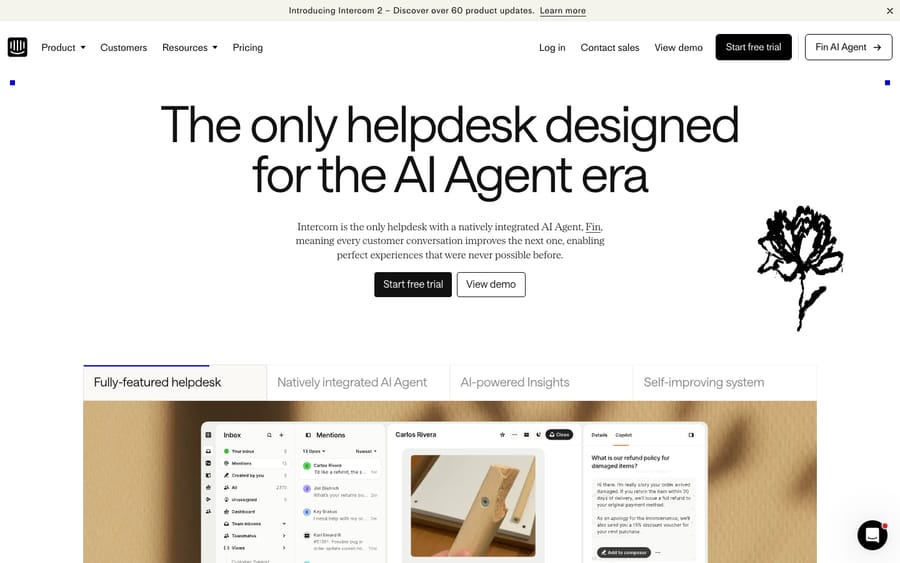
Intercom is the "platform you scale into." Its center of gravity is the Messenger, the in-app and website chat bubble, surrounded by tickets, a help center, outbound messaging, product tours, and a heavy automation layer. Its headline act is Fin, an autonomous AI agent that Intercom pushes as the front line of support. Intercom is built for scale-ups and larger companies that want depth, omnichannel reach, and aggressive AI, and have the budget and ops maturity to run it.
That difference colors everything below. Help Scout competes on time-to-value and tone; Intercom competes on capability and AI ambition.
How much do Help Scout and Intercom cost?
This is where the two diverge most, and not just on the number.
Help Scout (per user / month):
- Free: $0 · up to 5 users, 1 inbox, 1 Docs site, 100 contacts a month. A genuine on-ramp for a tiny team.
- Standard: $25/user/mo · up to 25 users; the core shared inbox, Docs, Beacon, basic workflows and SLA.
- Plus: $45/user/mo · up to 50 users; more inboxes, advanced workflows and SLAs, unlimited AI drafts.
- Pro: $75/user/mo · unlimited users (10-user minimum), maximum limits, advanced security.
Annual billing takes 16% off the seat price. AI Answers, the customer-facing bot, is metered separately at $0.75 per resolution after a 3-month free trial. The pricing is easy to read: seat price × people, plus a small per-resolution meter if you turn the bot on. The watch-out is the per-seat cliff: Help Scout caps users per tier, so crossing a threshold (a 26th agent on Standard, say) moves you to the next plan and a higher per-user rate. (Older contact-based plans are legacy, retained for existing accounts only; new signups get the per-user model above.) Full detail in our Help Scout pricing explained guide.
Intercom (per seat / month, billed annually):
- Essential: $29/seat/mo · the inbox, Messenger, help center, and basic ticketing. Intercom has also shown $19 on this plan in a pricing test.
- Advanced: $85/seat/mo · automation, multiple teams, and 20 free Lite seats.
- Expert: $132/seat/mo · advanced security and SLAs, and 50 free Lite seats.
The pricing page no longer lists separate monthly seat rates, so budget from the annual figures and ask sales about month-to-month. On top of seats, Fin AI Agent is $0.99 per outcome (a resolution, or a procedure handoff), charged at most once per conversation, with escalations that produce no outcome not billed. The 50-outcome monthly minimum applies only when Fin runs on a help desk other than Intercom. Copilot, the agent-assist add-on, is $29 per agent a month billed annually or $35 monthly. Do the arithmetic before signing: five Advanced seats ($425) plus 300 Fin outcomes ($297) comes to $722 a month, before Copilot or other add-ons. Our Intercom pricing explained breakdown walks through more scenarios.
Net: Help Scout is cheaper and easier to forecast; Intercom costs more and varies with AI volume, but you're buying a bigger platform and a more capable AI agent.
How does Help Scout AI compare with Intercom's Fin?
Both lean on AI, with very different ambition.
Help Scout AI is pragmatic and bundled. Agent-assist features (AI-drafted replies, summaries, and tone, length and translation edits) come included on paid plans. The autonomous, customer-facing piece is AI Answers, the Beacon chat bot, which answers from your Docs and listed public URLs and bills only when it resolves a session without escalation. The trade-offs: Help Scout documents AI Answers only in Beacon (web chat), not email or social, and it answers from knowledge sources rather than taking actions, so it can't look up an order, issue a refund, or update a record. Help Scout's self-service page says AI Answers resolves 70% of requests, which is a vendor figure, not a guarantee.
Intercom's Fin is the more capable and more autonomous agent. It works across channels, can follow multi-step "procedures," and take actions, which is why Intercom positions it as the actual first responder rather than a deflection widget. Salesforce cites a 76% average resolution rate for Fin. Your own number depends mostly on how good your knowledge base is. Fin is also sold standalone, so you can run it on top of another help desk.
The short version: if you want a capable bot that's cheap and bundled, Help Scout AI is plenty. If AI resolution is the centerpiece of your support strategy and you'll invest in the knowledge base to feed it, Fin is the stronger (and pricier) engine.
Corporate note (September 2026): Intercom renamed the company to Fin in May 2026 (the help-desk product keeps the "Intercom" name). On June 15, 2026 Salesforce signed a definitive agreement to acquire Fin for about $3.6 billion, and the acquisition completed on September 10, 2026. Fin's $0.99 rate is unchanged since the deal closed, but if long-term roadmap independence matters to you, it's worth factoring in.
Is simplicity or power the deciding factor?
This is the real fault line, so it deserves its own section.
Help Scout optimizes for simplicity. Teams are typically live in hours, not weeks; the interface doesn't overwhelm; and the human, email-like tone is deliberate. The cost of that simplicity is a ceiling: fewer advanced automations, lighter reporting, and less channel breadth than the heavyweight platforms.
Intercom optimizes for power. You get the Messenger, outbound and proactive messaging, product tours, deep workflow automation, and Fin. The cost of that power is complexity and price: a steeper learning curve, more configuration, and a bill that moves with AI volume.
Neither is "better." A 6-person SaaS support team will likely find Intercom heavier than they need; a 60-person org running in-app chat with aggressive AI will likely find Help Scout too light.
How do they compare side by side?
| Help Scout | Intercom | |
|---|---|---|
| Best described as | Simple, human, email-first help desk | Premium AI-first messenger + support platform |
| Built for | SMB / growing support teams | Scale-ups and larger companies |
| Center of gravity | Shared inbox + Docs | Messenger + Fin AI |
| Entry price | $25/user/mo (Free tier available) | $29/seat/mo (billed annually) |
| Top published tier | $75/user/mo (Pro) | $132/seat/mo (Expert) |
| Customer-facing AI | AI Answers, Beacon bot, $0.75/resolution | Fin, $0.99/outcome, multi-channel, actions |
| AI resolution (vendor-claimed) | 70% | 76% average (Salesforce) |
| AI scope | Web chat, answers from knowledge | Omnichannel, can run procedures and actions |
| Pricing predictability | High: seat price + small meter | Lower: seats + outcomes + add-ons stack |
| Learning curve | Low | Moderate to high |
| G2 rating (June 2026) | ~4.4/5 (~435 reviews) | ~4.5/5 (~3,855 reviews) |
| Capterra rating (June 2026) | ~4.6/5 | ~4.5/5 (~1,133 reviews) |
| Best for | Teams who want simple, affordable, human support | Teams who want an AI-led platform at scale |
Prices re-checked September 24, 2026 on the official pricing pages; ratings from G2 and Capterra as read in June 2026. AI is usage-billed and pricing changes often, so confirm before budgeting.
What do users say about Help Scout and Intercom?
Aggregate review sentiment tracks the positioning neatly.
- Help Scout: ~4.4/5 on G2 (~435 reviews) and ~4.6/5 on Capterra. The recurring praise is simplicity and the human feel: clean interface, fast onboarding, a tone customers don't experience as "ticketed." One verified Capterra reviewer, Dustin D. (Consumer Services, 2+ years), put it well: "The main reason I went with them over others was the still small business feel you can give your customers even with dozens of employees being involved in customer interaction." The common watch-outs are reporting depth, lighter advanced features, and the per-seat cost cliffs as you grow.
- Intercom: ~4.5/5 on G2 (~3,855 reviews) and ~4.5/5 on Capterra (~1,133 reviews, ease-of-use ~4.4). Reviewers consistently praise the modern UI, the Messenger, and Fin's automation. The dominant criticism, paraphrased from recurring G2 and Capterra themes, is cost and pricing complexity: "capable, but expensive, and the per-resolution plus add-on pricing makes the bill hard to forecast." Several SMB reviewers note it's more platform than they needed.
Net: both are well-liked. Intercom rates marginally higher on a far larger review base, while Help Scout's smaller base skews toward "loved for its simplicity." The shared signal: Help Scout wins on ease and price predictability; Intercom wins on capability, with cost as its consistent complaint.
Who should choose which?
- Choose Help Scout if you're an SMB or growing team that wants simple, affordable, human-feeling email-first support. You value fast onboarding and predictable per-seat billing, a Free tier helps, and a bundled web-chat bot that answers from your Docs covers your AI needs. Reporting depth and advanced automation aren't dealbreakers.
- Choose Intercom if you're a scale-up or larger company that wants an AI-led platform: in-app Messenger, omnichannel, deep automation, and an aggressive AI agent (Fin) as your first responder. You have the budget and the ops maturity to manage a more complex tool, and a knowledge base good enough to feed the AI.
- Lean Help Scout for cost predictability, Intercom for AI ambition and breadth. If forecasting the bill matters more than maximal capability, Help Scout; if AI resolution is your core strategy, Intercom.
Where does an AI layer like Macha fit?
One narrow aside: if your AI ambitions outgrow a bundled bot and you're on Zendesk, Freshdesk, Gorgias, Front, HubSpot or Intercom (Macha doesn't connect to Help Scout), Macha is an AI agent layer that runs on top of your existing help desk, Intercom included. It's the done-for-you option: the Macha team analyzes your past tickets, builds the knowledge base and the agent, and runs it in safe mode, with drafts as internal notes in your help desk, until the drafts are right. It bills per ticket: one charge per thread, however many steps an agent takes along it (understanding a ticket, retrieving an answer, drafting a reply, tagging, routing), rather than per seat or per resolution. That's about $0.40 a ticket, from $299 a month for 750 tickets, which includes the setup and a dedicated success manager who handles your changes.
To be clear about scope: Macha does not integrate with Help Scout, and it's a layer rather than a help desk, so it isn't a third option in this comparison. If you want to watch the automation before committing, there's $50 of free usage, no credit card required. If you're choosing between Help Scout and Intercom, pick the one that fits your size and AI ambition above; that's the real decision here.
Frequently asked questions
What's the main difference between Help Scout and Intercom? Help Scout is a simple, human, email-first help desk built for SMB and growing teams; Intercom is a premium, AI-first messenger and support platform built for scale-ups and larger companies. Help Scout optimizes for simplicity and predictable pricing; Intercom optimizes for capability, omnichannel reach, and an aggressive AI agent (Fin).
Which is cheaper, Help Scout or Intercom? Help Scout is generally cheaper and easier to forecast: per-user plans at $25/$45/$75 per month plus AI Answers at $0.75 per resolution, with a Free tier. Intercom starts at $29 a seat billed annually, and seats plus Fin at $0.99 per outcome and add-ons such as Copilot push the real bill well past the seat price; five Advanced seats and 300 Fin outcomes come to $722 a month.
Is Help Scout AI as good as Intercom's Fin? They aim at different jobs. Help Scout AI Answers is a bundled web-chat bot that answers from your knowledge (Help Scout claims 70% of requests resolved), cheap and easy to run. Intercom's Fin is an omnichannel agent that can run multi-step procedures and take actions, with a 76% average resolution rate cited by Salesforce, heavily dependent on your knowledge base. Fin does more; Help Scout AI is simpler and cheaper.
Does the Salesforce acquisition affect Intercom? On June 15, 2026, Salesforce signed a definitive agreement to acquire Fin (Intercom's parent company) for about $3.6 billion, and completed the acquisition on September 10, 2026. Fin's pricing has not changed since the deal closed, but the acquisition may shape the long-term roadmap, which is worth weighing if vendor independence matters to you.
Can Help Scout and Intercom both connect to Macha? Intercom yes, Help Scout no. Macha is an AI agent layer that runs on top of Zendesk, Freshdesk, Gorgias, Front, HubSpot or Intercom, and it does not integrate with Help Scout. Either way it's a layer on your help desk rather than a replacement for one, so choose between Help Scout and Intercom on fit first.
What should you check before you commit?
Help Scout vs Intercom comes down to simplicity vs capability, and predictable cost vs maximal AI. Before you sign, check three things: how many seats you'll have in a year (Help Scout's tier caps and Intercom's per-seat rates both scale with headcount), how many conversations an AI agent would resolve each month (that sets the Fin or AI Answers bill), and whether your knowledge base is good enough to feed either bot. Then confirm every rate on the official pricing pages, because in this category they change often.
Prices re-checked September 24, 2026 against the official Help Scout and Intercom pricing pages and Fin's pricing; resolution rates from Help Scout's self-service page and Salesforce's September 10, 2026 announcement; ratings from G2 and Capterra as read in June 2026 (rating pages are bot-walled, so figures are cited from research, not screenshotted). Next review: December 2026.
Add AI agents to your Intercom
Macha reads the conversation, drafts the reply and takes the action, inside the Intercom you already run.