Shopify
 Stripe
 Slack
Slack Notion
 Google Workspace
 Confluence

Freddy AI Copilot vs an AI Agent Layer on Freshdesk: What's the Difference in 2026?


Freddy AI Copilot helps a Freshdesk agent write faster, while an AI agent layer answers the ticket itself and takes it out of the queue. They are billed on different meters: Copilot per agent seat, the Freddy AI Agent per session, and Macha per ticket.
Key takeaways
- Freddy AI Copilot drafts, summarizes and rewrites replies for a human agent to send, while an AI agent layer reads the ticket, calls your systems and posts the reply itself.
- Freshdesk lists Freddy AI Copilot at $29 per agent per month billed annually, and only the Pro and Enterprise plans can add it.
- The Freddy AI Agent gives each account 500 sessions once, then charges $49 per 100 sessions whether or not a session ends in a resolution.
- Macha runs on top of Freshdesk and charges per ticket, from $299 a month for 750 tickets, with every tool call and reply inside a ticket covered and setup by the Macha team and a dedicated success manager included.

Freddy AI Copilot drafts, summarizes and rewrites replies for a human agent to send, and costs $29 per agent per month billed annually on Freshdesk Pro and Enterprise; an AI agent layer reads the ticket, calls your systems and posts the reply itself, so the ticket leaves the queue. The first makes people faster. The second removes work from them, and the two are billed on different meters.
| Option | What it does | How it's priced (checked 24 Sept 2026) |
|---|---|---|
| Freddy AI Copilot | Drafts, rewrites and summarizes for an agent to review and send | $29/agent/month billed annually, Pro ($55/agent) and Enterprise ($89/agent) only |
| Freddy AI Agent | Customer-facing bot that answers without a human on the reply | 500 free sessions once per account, then $49 per 100 sessions |
| Macha (AI agent layer) | Agents on top of Freshdesk that read, call tools and reply | Per ticket: $299/month for 750 tickets, about $0.40 each, with setup and a dedicated success manager included |
What is the difference between assist and autonomous AI?
The clearest way to think about AI on a help desk is a three-way split: deflection, resolution and automation. Most confusion comes from collapsing them.
- Agent assist (a copilot) makes a human faster. It drafts, it summarizes, it rewrites, but a person reviews and sends every word. The ticket still consumes an agent's time; you're buying speed, not headcount relief.
- Autonomous resolution (an AI agent) handles a ticket without a human on the reply. It reads the request, decides an action, and executes, closing simple tickets end to end.
- Automation (orchestration) is the broader category both live under: software taking real steps in your stack, from posting a reply to fetching an order status to tagging and routing.
Freshdesk's Freddy maps neatly onto the first two. Freddy Copilot is agent assist. The Freddy AI Agent is autonomous resolution. Knowing which one you're evaluating tells you both what it can do and how you'll pay for it.
What does Freddy Copilot do well?
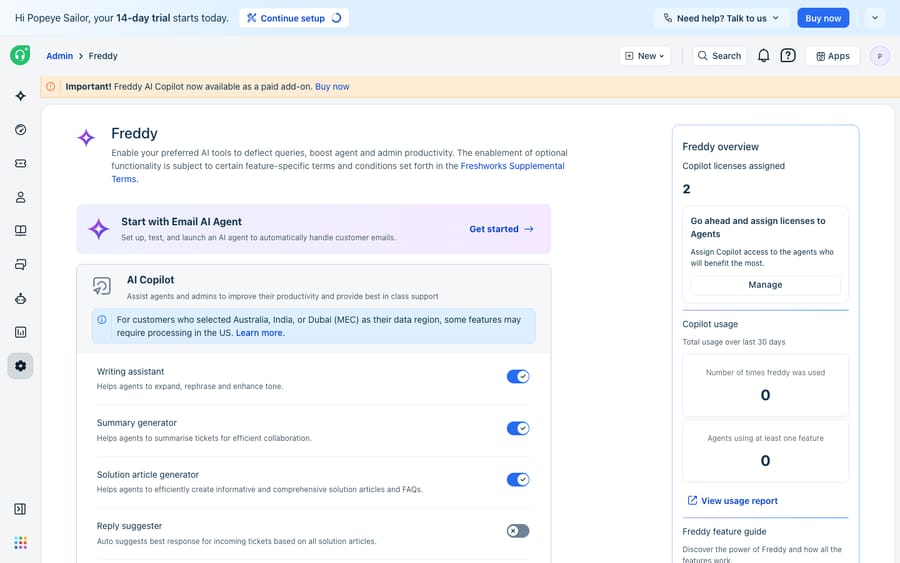
Freddy Copilot is a solid agent-assist tool, and for teams that live inside Freshdesk all day it removes real friction. According to Freshworks' Freddy AI add-ons documentation, Copilot lets agents "draft and refine responses using AI-assisted suggestions" and "generate ticket summaries and solution articles" directly inside the ticket they're working. In practice that covers a handful of useful jobs:
- Reply drafting: a suggested response the agent edits and sends, so a blank reply box becomes a first draft.
- Tone and rewrite: make a draft warmer, firmer, or shorter without retyping it.
- Thread summaries: condense a long back-and-forth so a reassigned agent is caught up in seconds.
- Translation: handle a ticket in a language the agent doesn't speak.
- Suggested fields and next steps: propose a priority, type, or next action to cut manual triage.
How much does Freddy Copilot cost?
The pricing reflects what it is. Freshdesk's pricing page lists Freddy AI Copilot as a per-agent add-on at $29 per agent per month billed annually, available on the Pro and Enterprise plans only (Pro is $55 and Enterprise $89 per agent per month billed annually; Growth, at $19, can't add it). Freshworks doesn't list a separate monthly-billing rate for the add-on, so confirm it in your own account. You license it per seat and can assign the Copilot role to a subset of agents rather than the whole team, which keeps the cost sane on larger rosters. That per-agent meter is the tell: you're paying to make people faster, not to remove work from their queue.
Where does a copilot stop?
The limit is structural rather than a knock on the feature. A copilot's output always lands in front of an agent who has to read it, judge it, and click send. That's the whole point of assist, since a human stays in the loop, but it also means every copilot-drafted ticket still occupies a person. If your queue is 2,000 tickets a week and a copilot makes each one 30% faster to answer, you've bought back time, but you have not removed the ticket from a human's plate. The password reset, the "where's my order," the "how do I export my data": a copilot drafts each of them well and a human still sends each of them.
Two other gaps matter. First, a copilot suggests but doesn't act on your systems: it can propose a reply about an order, but it can't call your order API, read the live status, and put the real tracking number in the message. Second, the Freddy AI Agent, the autonomous side that can close tickets alone, is billed per session. Freshworks gives each account 500 sessions once (not every month), then charges $49 per 100 sessions, per the add-ons documentation. A session is counted whether or not the conversation ends in a resolution, so the number to model is your own resolution rate on your own tickets before you assume autonomous AI is cheaper than a copilot at your volume.
What does an AI agent layer add on top of Freshdesk?
This is the seam a dedicated AI agent layer fills. The broader category of AI agents for customer service exists to do the part a copilot can't: take a ticket, reason about it, call the tools needed to answer, and post the reply autonomously, while still handing off cleanly to a human when it's out of depth.
Macha is one such layer, and the positioning matters: it runs on top of the Freshdesk you already use as a native connector. It is not a help desk replacement and it doesn't touch your existing routing, SLAs, or agent seats. You connect Macha to Freshdesk with your subdomain and API key, and it reads and writes the same tickets your team already works: get and search tickets, add public replies or internal notes, update status and priority, search contacts and solution articles. The difference from a copilot is that a Macha agent doesn't stop at a suggestion. When a trigger fires, it acts.
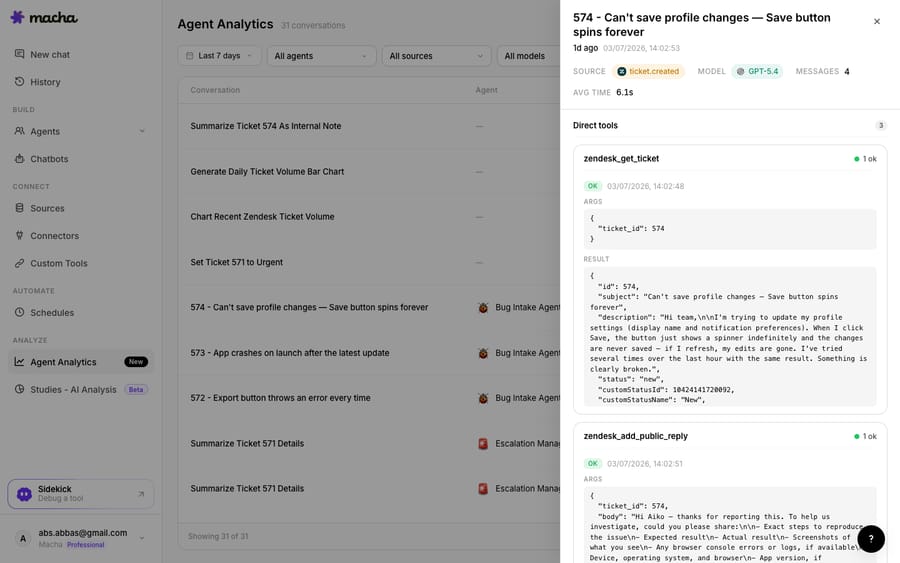
In the screenshot above (taken on a Zendesk connection; the Freshdesk connector has the same get-ticket and add-reply steps), a Bug Intake Agent fires on a new ticket, calls a get-ticket tool to pull the full context, and then calls an add-public-reply tool to post its response. No agent clicked send. That's the line between assist and autonomous: the copilot hands a human a draft; the agent takes the action. Because Macha agents can call custom tools that turn a REST API into something the agent can invoke, they can also look up a live order status, check an account, or update a record before writing the reply. If you want the mechanics of wiring that up on Freshdesk specifically, we walk through it in how to automate Freshdesk with AI, and the case for going beyond Freddy sits alongside it.
One more thing to be precise about: Macha's connector is for Freshdesk specifically, not Freshchat, Freshservice, or Freshcaller. And Macha is priced per ticket, not per resolution or per session: one plan from $299/month for 750 tickets, with each ticket charged once however many tool calls, replies or lookups it takes. That's about $0.40 a ticket, and it includes the setup: the Macha team analyzes your past Freshdesk tickets, builds the knowledge base and the agent, and runs it in safe mode, with drafts as internal notes, until the drafts are right. After go-live, a dedicated success manager who handles your changes, such as a new category, an instruction change or a new tool. Pricing tracks volume rather than an outcome that varies by ticket. The full breakdown is on the pricing page.
How do Copilot and an AI agent layer compare side by side?
The two aren't really competitors, and many teams run both, but it helps to see the split clearly.
| Freddy Copilot (assist) | AI agent layer (autonomous) | |
|---|---|---|
| Primary job | Help a human write faster | Resolve the ticket without a human on the reply |
| Human in loop | Always: agent reviews and sends | Only on handoff / low confidence |
| Acts on your systems | Suggests text; doesn't call your APIs | Calls custom tools (order status, account lookups) and posts the reply |
| Removes the ticket from a queue | No: the agent still handles it | Yes, for tickets it can close end to end |
| Priced on | Per agent seat ($29/agent/mo billed annually, Pro/Enterprise) | Per ticket, from $299/mo for 750 (Macha) / per session (Freddy AI Agent) |
| Best for | Complex, judgment-heavy tickets a human should own | High-volume repetitive tickets that don't need a human |
The practical division of labour: point autonomous agents at the repetitive, tool-answerable tickets so they leave a human's queue entirely, and keep a copilot for the judgment-heavy tickets your agents should be the ones sending. You're matching the tool to the ticket. If you're weighing whether to assemble this yourself or adopt a platform, the build-versus-buy tradeoff is worth reading before you commit engineering time.
Which do you need first?
A simple sequence:
- Sort your last 500 tickets into repetitive vs judgment-heavy. If a large slice is "reset password," "where's my order," "how do I do X", that's autonomous-agent territory.
- If most volume is repetitive, an AI agent layer buys back the most, because it removes tickets from queues rather than speeding them up. With Macha you don't build that layer yourself: the Macha team sets it up on the trial and every plan, at about $0.40 a ticket.
- If most volume is nuanced (billing disputes, escalations, bespoke troubleshooting), a copilot buys back more, because it makes the humans who must handle those faster.
- Many teams end up running both: an agent layer clearing the repetitive tail, Copilot helping the humans on everything else.
FAQ
Is Freddy Copilot the same as the Freshdesk AI agent? No. Freddy Copilot is agent assist: it drafts replies, summarizes threads, and rewrites tone for a human to review and send. The Freddy AI Agent is the autonomous, customer-facing bot that answers tickets without a human on the reply. They're separate add-ons, priced differently (Copilot per agent seat, the AI Agent per session).
How much does Freddy AI Copilot cost? Freshdesk's pricing page lists it at $29 per agent per month billed annually, on the Pro and Enterprise plans only. It's licensed per seat and can be assigned to a subset of agents. Freshworks doesn't publish a separate monthly rate for the add-on, so confirm it against your own Freshdesk account.
How much does the Freddy AI Agent cost? Each account gets 500 sessions once, on Growth, Pro or Enterprise, and after that sessions cost $49 per 100. The 500 are a one-time allowance, not a monthly one.
Does an AI agent layer replace Freshdesk? No. A layer like Macha runs on top of the Freshdesk you already use. It connects as a native connector via your subdomain and API key, reads and writes the same tickets, and leaves your routing, SLAs, and seats untouched. It adds autonomous resolution; it doesn't replace your help desk.
How is Macha priced compared to Freddy's session model? Macha charges per ticket: one plan from $299/month for 750 tickets, about $0.40 each, with every tool call and reply inside a ticket covered by that one charge, rather than per resolution or per session. That price includes setup by the Macha team and a dedicated success manager who handles your changes. You pay for volume handled, not for an outcome that varies ticket to ticket. See the pricing page for the full breakdown.
Can I run Copilot and an AI agent layer together? Yes, and most teams should. Point the autonomous agent layer at high-volume repetitive tickets so they leave the queue entirely, and keep Copilot for the judgment-heavy tickets your human agents should own. They solve different halves of the same problem.
Want to see autonomous resolution on your own tickets instead of just faster drafts? Start a free trial of Macha and connect it to your Freshdesk in minutes. The Macha team builds your first agent and runs it in safe mode until the drafts are right.