Shopify
 Stripe
 Slack
Slack Notion
 Google Workspace
 Confluence

AI Vision: Your Agents Can Now Read Ticket Image Attachments


Customers don't describe their problem. They screenshot it.
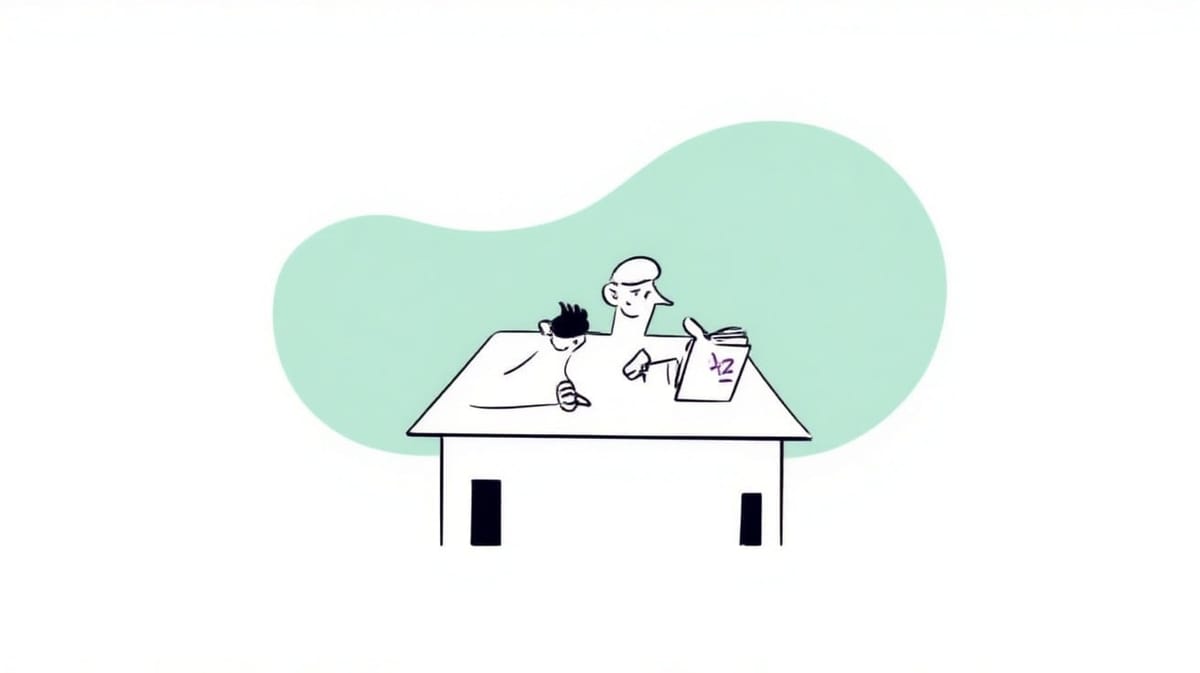
The error dialog, the cracked product, the receipt with the order number, the checkout page that won't advance — it all arrives as a .png stapled to a ticket. And until now, that attachment was a wall your AI agent couldn't see through. It could read every word of the ticket body and still miss the single most important thing in the conversation, because the most important thing was a picture.
As of the April 17, 2026 release, Macha agents can read those images. When an agent encounters an image attachment on a Zendesk ticket, it downloads the file, encodes it, and sends it to a vision-capable model for analysis. The agent can describe a screenshot, pull the text out of it, identify a product, or parse a receipt — and then act on what it found, using the same tools it already has. This post walks through how it works, which models support it, the honest limits, and why it matters more than it sounds.
Why this is a bigger deal than "the bot can see pictures"
Here's the part that surprises people: most AI agents can't read attachments, and the helpdesks themselves are upfront about it.
Zendesk's own documentation states it plainly: their native AI agents "process only the text in conversations and tickets. The AI doesn't scan the attached files and media in conversations." (Zendesk help). The attachment is preserved for a human to open after escalation — but the AI is blind to it.
Gorgias built a Vision feature, which is genuinely good, but it's email-only: their docs note that "AI Agent cannot use Vision in chat conversations," and it won't touch PDFs, DOCX, or video (Gorgias docs).
So the baseline across the category is: a customer attaches the one image that explains everything, and the AI either ignores it or kicks the whole ticket to a human. That's the gap. A meaningful share of "AI couldn't resolve this" outcomes aren't reasoning failures — they're perception failures. The agent never saw the evidence.
Because Macha is an AI agent layer that sits on top of your Zendesk rather than a feature inside one helpdesk's roadmap, vision is something we can add to the agent itself — and it now reads the attachments your helpdesk's own AI skips.
What the agent can actually do with an image
Vision isn't a party trick that returns "I see a photo of a screen." A Macha agent uses the image the way a support rep would — as evidence to act on. Concretely, it can:
- Read text out of a screenshot — an error message, an order confirmation, a tracking page, a settings screen. This is OCR plus context: it understands what kind of screen it's looking at, not just the characters.
- Describe a product photo — a damaged item, a wrong color, a missing part — so a returns or warranty flow has something to reason about.
- Identify a product from a picture against your catalog knowledge.
- Parse a receipt or invoice — pull the order number, date, total, or line items into a structured form the rest of the workflow can use.
The important word is then. Once the agent has read the image, it's back in normal territory: it can look up the order, check a custom field, draft a reply, set the priority, or route the ticket. Vision plugs into the tools the agent already has. A customer sends a photo of a cracked mug with "this arrived broken" and nothing else; the agent reads the damage and the order number printed on the packing slip in the same image, confirms the order, and starts the replacement — without a human ever opening the file.
This is the difference between seeing and acting. Plenty of tools can caption an image. The value is an agent that captions the image and then does the next four things because of what it read.
Supported formats and models
Vision works on the image types customers actually send: JPEG, PNG, GIF, and WebP. When the agent hits one of these on a ticket, it handles the download and base64 encoding automatically — there's nothing to configure on the attachment side.
What you do choose is the model, because vision only runs on vision-capable models. As of this release, those are:
| Model | Vision | Notes |
|---|---|---|
| GPT-5.4 Mini | ✅ | Default mini model; 400K context (3× GPT-5 Mini), shipped same day |
| GPT-5 Mini | ✅ | — |
| GPT-4o Mini | ✅ | — |
| Claude Sonnet 4.5 | ✅ | Strong on dense screenshots and document-style images |
| Claude Sonnet 4 | ✅ | — |
| Groq models | ❌ | Gracefully return a "not supported" message — no hard error |
The Groq behavior is deliberate. If you've picked a fast Groq model for cost or latency and a ticket happens to carry an image, the agent doesn't crash or silently drop the attachment — it tells you the model can't see it. That's the safe failure mode you want: a clear signal, not a quiet gap.
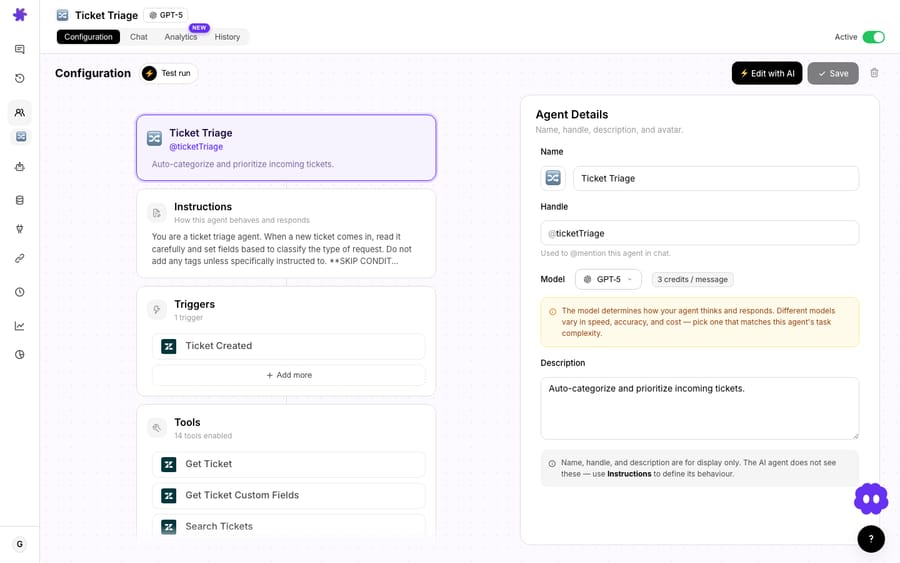
Picking the model is the whole setup. Choose a vision-capable model on the agent, and image reading is on for every Zendesk ticket that agent touches.
What it costs
Vision doesn't bolt a separate "image fee" onto your bill. An image rides along inside the model's normal per-message credit cost — the same way a longer text message does. Macha's credits are per AI action, priced by model (roughly 0.5–9 credits depending on the model you pick), and a message that happens to include an image is still one message to the model.
The practical lever is the same one you already manage: model choice. GPT-5.4 Mini, for example, runs at 1.25 credits per message and reads images at that rate — so vision is "free" in the sense that there's no surcharge, but it isn't free in the sense that you're paying for the model call either way. As always, the current numbers live on the pricing page, and credits are consumed per action, not per resolution.
Honest limits — when not to lean on it
Vision is a real capability, not magic. A few things to keep in mind:
- Images only — not documents. This release reads image attachments (JPEG/PNG/GIF/WebP). PDFs, DOCX, and spreadsheets go through a different path. (Macha's Freshdesk connector, for instance, extracts text from PDF, DOCX, XLSX, CSV, and TXT attachments — that's document text extraction, not image vision.) If a customer attaches a PDF receipt rather than a screenshot of one, that's the document path, not this feature.
- Bad inputs make bad reads. A blurry, cropped, or low-light photo will produce a lower-confidence read, exactly like it would for a human. Vision doesn't invent detail that isn't legible in the pixels — and you don't want it to.
- Model-dependent. If your agent is on a Groq model, there's no vision. Match the model to the work: if a queue is image-heavy, put it on a vision-capable model.
- It's perception, not authority. Reading a number off a receipt is a starting point, not proof. For anything consequential — refunds, account changes — keep vision as the input to a tool that verifies (look the order up, check the system of record) rather than treating the photo as the source of truth. The agent should confirm what it read, not act blindly on it.
- Zendesk today. Vision shipped on the Zendesk connector first. The download-and-encode utility behind it was built to be shared, so Freshdesk and Slack can add image reading with a single function call — but as of this release, it's Zendesk tickets.
Used well, vision shrinks the "escalate because the AI can't see the attachment" bucket. Used carelessly — trusting a blurry photo for a refund — it's a new way to be confidently wrong. The watch-out is the same as for any agent action: pair perception with verification.
How it fits the rest of the agent
What makes this useful isn't the vision call in isolation — it's that it lands inside an agent that already has hands. The same agent that now reads the screenshot can read the ticket's custom fields (with their real labels, not raw IDs), look up the order, update the subject line, post a reply, or route the ticket. The image becomes one more input to a workflow that was already capable of acting.
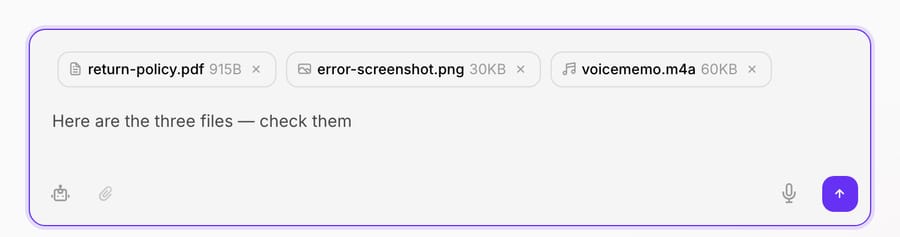
If you're building agents on Macha, the move is simple: for any queue where customers send screenshots, receipts, or product photos — billing, returns, technical support, anything visual — assign a vision-capable model and let the agent see what your customers are actually showing it.
FAQ
Does Macha's AI read image attachments on Zendesk tickets? Yes. As of the April 17, 2026 release, when a Macha agent encounters a JPEG, PNG, GIF, or WebP attachment on a Zendesk ticket, it downloads and encodes the image and sends it to a vision-capable model. The agent can describe screenshots, read text in images, identify products, and parse receipts.
Which models support vision? GPT-5.4 Mini, GPT-5 Mini, GPT-4o Mini, Claude Sonnet 4.5, and Claude Sonnet 4. Groq models don't support vision and return a clear "not supported" message rather than failing.
Can it read PDFs or Word documents? Not through this feature — this reads image files. Document attachments (PDF, DOCX, XLSX, CSV, TXT) go through a separate text-extraction path on supported connectors.
Does reading an image cost extra credits? No separate surcharge. An image rides inside the model's normal per-message credit cost; credits are per AI action and priced by model. See the pricing page for current rates.
Does Zendesk's own AI read attachments? No — per Zendesk's documentation, their native AI agents process only text and don't scan attached files or media in conversations. That's part of why reading the image at the agent layer is useful.
Will vision come to Freshdesk and Slack? The image download-and-encode utility was built to be reusable across connectors specifically so that Freshdesk and Slack can add image reading with a single function call. As of this release it's live on Zendesk.
Try it
If your customers send screenshots and your AI can't see them, you're escalating tickets that didn't need a human. Start a 7-day free trial, no credit card required, connect Zendesk, put an agent on a vision-capable model, and let it read what's actually in the attachment. For the full setup, see the docs, or read more on the Macha blog.
Written by Abbas (Customer Support & AI, Macha) · Reviewed by Ankeet Guha (Co-founder & CTO) · Published 2026-06-24 · Last updated 2026-06-24.
Resolve tickets automatically with AI agents
Macha's AI agents work on top of the help desk you already use — no code.