Shopify
 Stripe
 Slack
Slack Notion
 Google Workspace
 Confluence

Analysing Thousands of Support Tickets With AI: A Practical Guide


Every support team is sitting on an archive that quietly answers the questions the team keeps asking out loud. What share of our volume is really billing? How many people are actually asking for refunds? Which issues are genuinely urgent versus just loud? The answers are in the tickets — but no one has the hours to read ten thousand of them, and the tags were never applied consistently enough to trust.

This is the problem support ticket analysis at scale solves: reading every ticket in a window, not a sample, and turning a messy queue into structured, countable facts. For years that meant either expensive manual coding or a separate analytics platform you had to pipe your data into. AI changed the economics — a model can read and classify a hundred thousand tickets in the time it takes a person to read a hundred, and it applies the same logic to every one.
This guide covers how to do it well: the methods, what's actually worth measuring, the failure modes, and a real worked example. To keep it concrete, I ran an analysis over 57 tickets inside Macha Studies — Macha's batch-analysis tool that sits on top of the helpdesk you already use — and I'll show you exactly what came back.
Why analyse tickets in bulk at all
Manual tagging and dashboards tell you what an agent remembered to label. Bulk analysis tells you what's actually in the queue. The payoff shows up in four places:
- Roadmap and staffing decisions. If 40% of your window touches billing, that's a staffing and tooling signal you can't get from gut feel.
- Backfilling structure. Years of inconsistently-tagged tickets become cleanly categorised in one pass — no agent re-tagging marathon.
- Measuring change. Run the same analysis over two date ranges and compare: did the new help-doc actually cut "how do I reset my password" tickets?
- Feeding automation. Once you know what's common, repetitive, and well-understood, you know what's worth handing to an AI agent — and what's too rare to bother.
That last point matters for how you should think about this. Analysis and automation are two halves of the same loop: you measure the queue to decide what to automate, then measure again to see if it worked.
Manual vs AI: the two methods
There are really only two ways to analyse a queue, and most teams have tried the first.
Manual coding — an analyst reads tickets and tags them against a rubric — is accurate and nuanced, but it doesn't scale and it drifts. Two people tag the same ticket differently; the same person tags differently on a Friday. Industry write-ups put manual classification at roughly 30–90 seconds per ticket (figure widely cited across vendor guides; treat as approximate), which makes reading even a few thousand tickets a multi-day project nobody has time for.
AI analysis reads the full text — subject, description, the whole conversation — and applies one consistent rubric to every record. The trade-off flips: you gain consistency and speed, and you give up a little of the human judgement on genuinely ambiguous edge cases. The mitigation is good prompt design and a small test run before you commit (more on both below).
There's a third category worth naming so you can rule it in or out: dedicated customer-intelligence platforms (Sentisum, Unwrap, Enterpret and similar) ingest tickets alongside reviews, calls and surveys into one taxonomy. They're powerful if cross-channel voice-of-customer is your job. If your job is "answer a specific question about my helpdesk queue this afternoon," that's a heavier lift than you need. The guide that ranks for this topic, eesel's support-ticket-analysis post, leans on the same standard service metrics — FRT, ART, CSAT, FCR — which are worth tracking continuously but answer a different question than "what's in these tickets."
What to actually measure
The mistake is treating "analyse the tickets" as one question. It's many, and the useful ones are specific. Group them like this:
| Question type | Example | Best answer shape |
|---|---|---|
| Classification | Is this billing-related? | Yes/No flag |
| Categorisation | Which bucket: shipping, returns, technical? | Single choice |
| Scoring | How urgent, 1–5? | Number |
| Extraction | One-line summary; the product mentioned | Short text |
| Multi-label | Which features came up? | Multiple choice |
The reason the shape matters is that it determines whether you can aggregate the answer afterwards. A free-text "urgency: pretty high" can't be charted; a 1–5 number can. Decide the shape up front and the report builds itself.
Doing it: a real run inside Studies
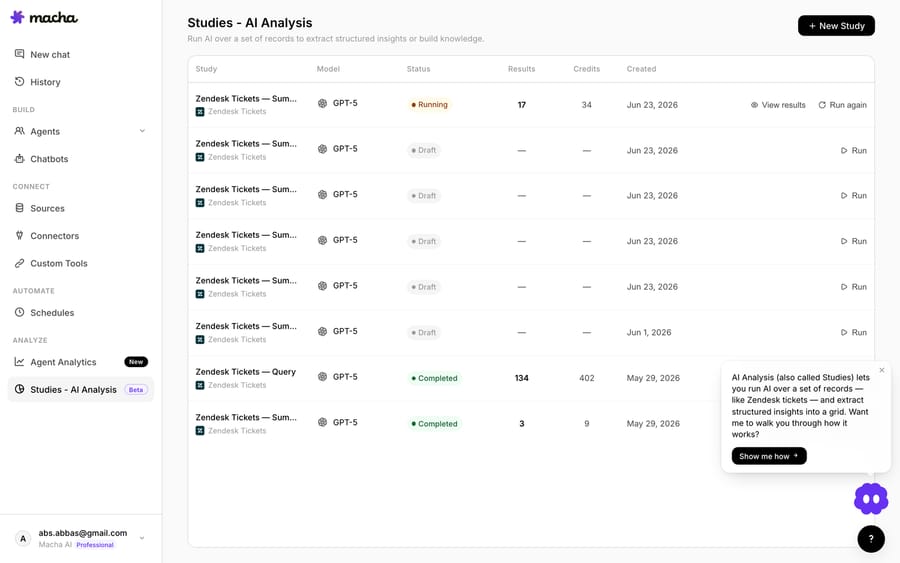
Here's the part most guides skip — actually doing it, end to end, with the bill in view. Studies is structured around four steps, Source → Scope → Extract → Review, and it's deliberately built so you never kick off an expensive run blind.
1–2. Source and scope
The first source is Zendesk Tickets (more record types are on the way). You scope with a Zendesk search query plus an optional date range, then choose which fields the AI gets to see — subject, description, status, priority, tags, custom fields, and the full comment thread. Narrowing the fields keeps the model focused and the cost down: if a question only needs the subject and first message, don't feed it the entire thread.
3. Extract — define your columns
This is the heart of it. Each column you add becomes a question the AI answers for every ticket, and you pick the answer type that matches the shape from the table above — Yes/No, Single/Multiple choice, Number, or Short/Long text. Each column takes optional guidance so the model knows exactly how to decide, plus an overall instructions box for tone and edge cases.
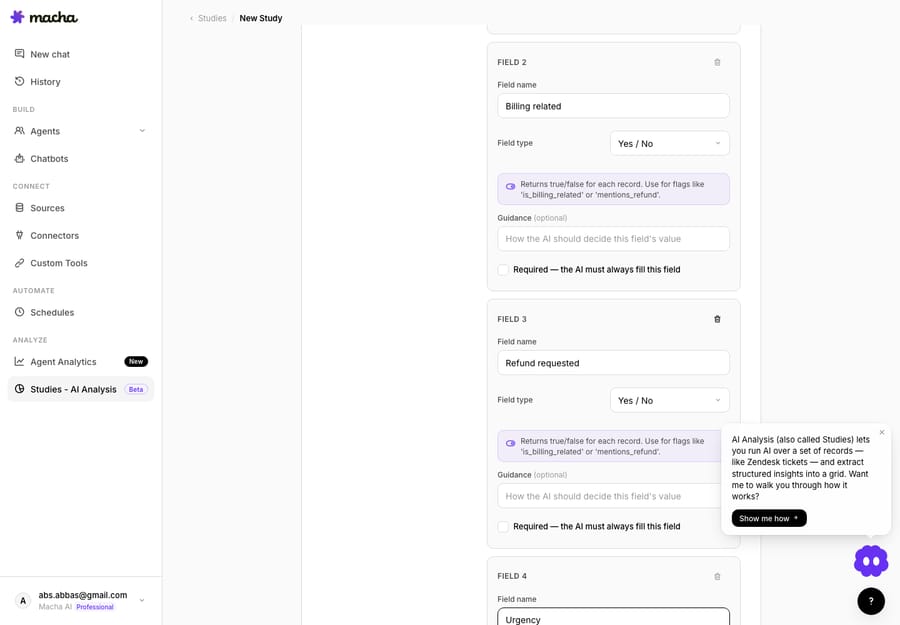
I defined four columns: a one-line Summary (short text), two Yes/No flags — Billing related and Refund requested — and a 1–5 Urgency number.
4. Review — see the cost before you commit
Before anything runs, Studies makes you look at the bill. It shows the exact matching record count, the credit cost per record (it depends on the model — credits are charged per AI action, default GPT-5.4 Mini at 1 credit, 0.5–9 by model), and the total, then asks you to confirm explicitly. Nothing is charged until you do.
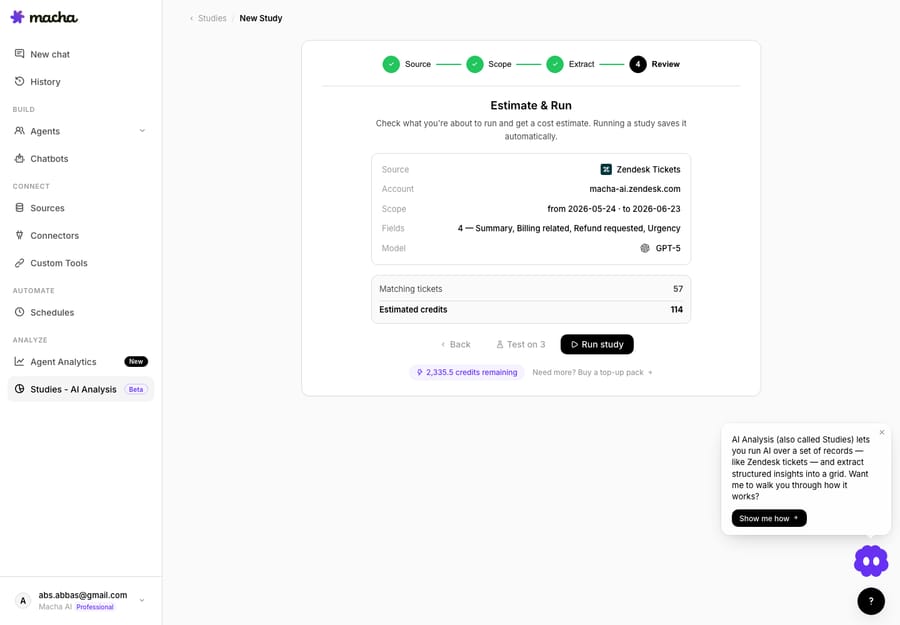
I scoped to the last 30 days on our test Zendesk, on GPT-5 at 2 credits per record. The estimate came back at 57 records / 114 credits, I confirmed, and results streamed in as the model worked. It finished at 57 of 57 processed, 0 errors.
A few guardrails sit around this, and they're the difference between a tool you trust on a big batch and one you don't:
- Test runs sample 10–50 records first so you can validate your schema and guidance before committing — and they're flagged so they don't clutter your history.
- Cancel anytime — cancellation is graceful, and credits are deducted per successful record, never up front. Errored and cancelled rows cost nothing.
- A hard 20,000-record cap per run keeps costs predictable; for bigger jobs, split by date range.
- Every run keeps a frozen snapshot of its config, schema and model — editing the Study later never rewrites past runs.
Reading the results
The grid — one row per ticket, one column per question — is just raw material. The Report view is where bulk analysis earns its name: every reportable column becomes a visual. Yes/No and choice columns become bar charts with counts and percentages; Number columns become histograms with min / mean / median / max. Click any bar to drill into the matching tickets.
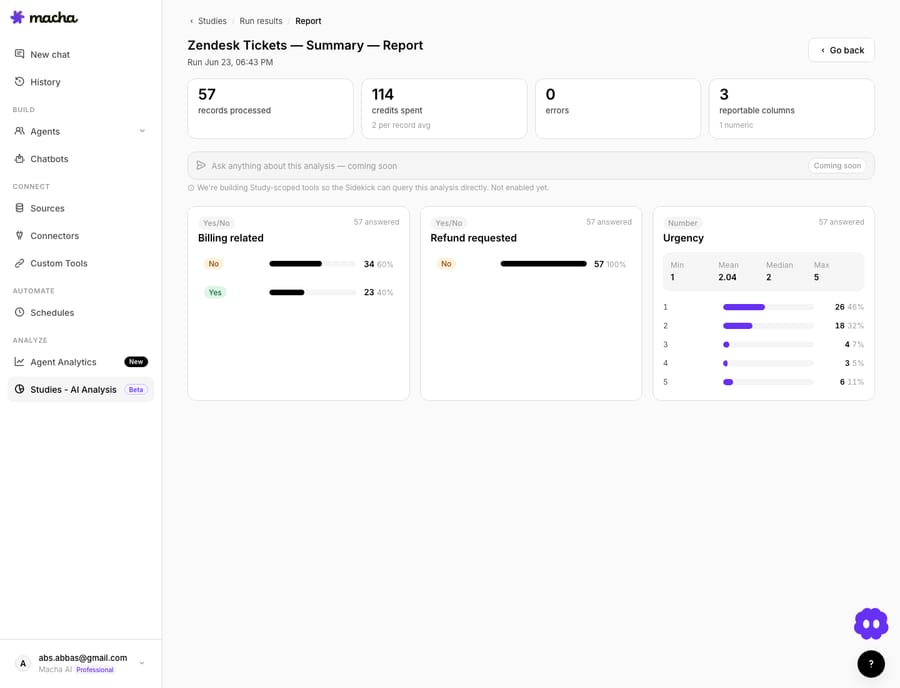
Here's what those 57 tickets actually said:
| Column | Result |
|---|---|
| Billing related | No 34 (60%) · Yes 23 (40%) |
| Refund requested | No 57 (100%) · Yes 0 |
| Urgency (1–5) | min 1 · mean 2.04 · median 2 · max 5 — 46% at level 1, with an 11% tail at level 5 |
That's a real read on a queue in a few minutes. Billing is a big slice — 40% of this window touched payments, invoices or charges, a strong signal that a billing-capable agent (or a Stripe connection) would earn its keep. Not a single ticket was an outright refund request, so a refund-automation flow would sit idle here. And urgency is low-to-moderate on average (2.04) but carries a real tail — 11% landed at the top of the scale, exactly the tickets you'd want routed fast. Those are decisions — staffing, routing, which agent to build first — you'd otherwise make on instinct.
Closing the loop: analysis into agent knowledge
The step that turns a one-off report into a system: a completed run can be pushed to a Knowledge Source. Each result row becomes a document, indexed through Macha's embeddings pipeline — so the structured insights from your analysis become searchable context your agents draw on during live tickets. You analyse the past, then the present agents use what you learned. That's the half of "analysis at scale" that pure dashboards can't do, because Macha is the same layer running your live agents on top of Zendesk and Freshdesk — not a separate analytics silo.
Watch-outs: when not to do this
Bulk AI analysis is the right tool less often than the hype suggests. Be honest about the edges:
- It costs real credits. Big batches add up — the estimate-and-confirm gate exists precisely so it's never a surprise, but run a test sample first and don't analyse fields the question doesn't need.
- Garbage rubric, garbage output. A vague "is this important?" column produces vague answers. The quality ceiling is your guidance, not the model. Spend the five minutes on a tight test run.
- Ambiguous, high-stakes judgement still wants a human. For legal, safety or nuanced tone calls on individual tickets, AI classification is a first pass, not the verdict.
- It's a point-in-time snapshot, not live monitoring. A Study reads the window you scoped; it doesn't watch the queue in real time. For continuous tagging, that's an agent's job, not a Study's.
- Plan gating. Studies and the Report view are Professional and Enterprise features — Trial and Starter accounts see an upgrade card.
For most teams the first analysis pays for itself the moment it kills one "I think most of our tickets are about X" assumption that turns out to be wrong.
FAQ
How many tickets can AI realistically analyse at once? A single Studies run handles up to 20,000 records; for larger archives you split by date range and run in passes. The model reads every ticket in scope, not a sample.
Is AI ticket analysis accurate enough to trust? For classification, categorisation and scoring against a clear rubric, yes — the consistency is often better than manual tagging because the same logic applies to every record. Validate with a 10–50 record test run before the full batch, and keep a human in the loop for genuinely ambiguous, high-stakes calls.
What does it cost to analyse tickets this way? It's credit-based, priced per record by the model you choose, and you see the exact total before you confirm — billed only for records that process successfully. See the pricing page for plans; credits are per AI action, not per ticket "resolved."
Can I do this without leaving my helpdesk? That's the point. Studies runs on top of the helpdesk you already use — you scope tickets with a normal Zendesk search query, and the results can flow back as agent knowledge. No separate data pipeline.
Manual tagging vs AI — which should I use? Use a test-validated AI run for anything over a few hundred tickets, where speed and consistency win. Keep manual review for small, high-judgement samples and for spot-checking the AI's edge cases.
Try it
If you've ever wanted a straight answer to "what's actually in our support queue," an analysis at scale gives you one in minutes instead of weeks. Start a 7-day free trial, no credit card required, connect Zendesk, and run your first Study — or read the Studies docs for the full walkthrough. For a deeper, screenshot-by-screenshot look at a single run, see our companion piece on running an AI analysis across thousands of tickets.
Written by Abbas (Customer Support & AI, Macha) · Reviewed by Ankeet Guha (Co-founder & CTO) · Published 2026-06-24 · Last updated 2026-06-24.
Resolve tickets automatically with AI agents
Macha's AI agents work on top of the help desk you already use — no code.