
 Shopify
 Stripe
 Slack
Slack Notion
 Google Workspace
 Confluence

What Is the Best Help Desk for Startups in 2026? 8 Tools and Their Startup Programs


Intercom's Early Stage program takes 93% off year one for startups under 15 employees and $10M raised, and Zendesk gives funded startups at least 6 months of Suite Professional free. We compared eight help desks on startup programs, pricing checked on 24 September 2026, AI costs and G2 ratings.
Key takeaways
- Intercom's Early Stage program gives 93% off in year one, with 300 Fin outcomes a month, to startups with fewer than 15 employees and up to $10M in funding.
- Zendesk for Startups gives funded companies up to Series B the Suite Professional plan plus Copilot free for 6 months, extendable to 2 years through partners, for up to 50 agents.
- Freshdesk no longer lists a free plan; paid plans start at Growth for $19 an agent, and Freddy Copilot costs $29 an agent on Pro and Enterprise only.
- Help Scout's Startup Program gives 6 months free on the Plus plan to tech startups incorporated less than 2 years ago with under $1M ARR.
- Tidio's free plan includes 50 Lyro AI conversations as a one-time allowance, after which monthly Lyro conversations are an add-on starting at $32.50 a month.
The best help desk for a startup in 2026 is usually the one whose startup program you qualify for: Intercom takes 93% off year one for companies under 15 employees and $10M raised, and Zendesk gives funded startups at least 6 months of Suite Professional free. After that, match the tool to your channel: Tidio for free website chat, Help Scout for simple email, Pylon or Plain for B2B support in Slack, Front for a shared team inbox. Prices below were checked on each vendor's page on 24 September 2026.
| Tool | Best for | Startup program | Starting price | G2 rating |
|---|---|---|---|---|
| Intercom | Product-led SaaS | Early Stage: 93% off yr 1, 300 Fin outcomes/mo | $29/seat (annual) + $0.99 per Fin outcome | 4.5 / 5 |
| Tidio | Free AI website chat | Free plan (50 Lyro conversations, one-time) | Free, then $29/mo | 4.6 / 5 |
| Freshdesk | All-around value | Freshworks for Startups (by application); Free program for 2 agents, 6 months | $19/agent | 4.4 / 5 |
| Help Scout | Simple, email-first | 6 months free Plus (<2 yrs, <$1M ARR) | Free, then $25/user | 4.4 / 5 |
| Zendesk | Scale path | 6 months to 2 years free Suite Professional + Copilot (funded up to Series B) | $19/agent (Suite from $55) | 4.3 / 5 |
| Pylon | B2B Slack support | None published | $59/seat (third-party figure) | 4.7 / 5 |
| Plain | Developer/API-first B2B | 50% off Horizon: $6k flat for 12 months, 10 seats | $35/seat (AI included) | Limited reviews |
| Front | Collaborative inbox | None on the pricing page | $25/seat | 4.7 / 5 |
Prices are per seat or agent per month on annual billing unless noted. Startup programs need an application and have eligibility rules (funding stage, employee count, ARR), so confirm against each vendor's current page. G2 ratings are from our June 2026 review; review-base sizes vary from about 100 (Pylon) to 6,700+ (Zendesk), so a higher average on a smaller base isn't directly comparable to a slightly lower one on thousands.
If you're a small business rather than a venture-backed startup (steadier volume, no funding stage to qualify for credits), the priorities flip toward total cost and simplicity. We cover that audience separately in the best help desk for small business. For the full market across every segment, see the best help desk software.
What makes a help desk right for a startup?
Four things separate a startup-friendly help desk from a generic one:
- A real startup program. Several major vendors give an early-stage, funded company months free or a steep first-year discount. It's the biggest lever on early cost, and it's easy to miss. We flag every program below, and say so where a vendor doesn't publish one.
- A scale path. The tool you adopt at five tickets a day should still work at five hundred. Free tiers that cap hard, or simple tools you'll outgrow in a year, can cost more in migration pain than they save.
- Product-led / in-app fit. SaaS startups support customers inside the product (in-app messenger), in Slack or Teams (B2B), or on the website (chat). The right help desk matches your channel, not the other way round.
- AI priced sanely. AI deflection matters most when your team is tiny. But AI pricing models differ widely (per outcome, per seat, per conversation, or included), and that difference dominates the bill as you grow.
How we compared. We first verified every price and startup program against the vendor's official pages in June 2026 and re-checked them on 24 September 2026 (per seat or agent per month, annual billing unless noted). Ratings come from G2 and Capterra, and we ran Zendesk hands-on in a live test account to set a baseline. We're an AI layer that runs on top of help desks, not a help desk you'd switch to, so Macha is deliberately not a numbered option; there's a note on where it fits at the end.
Which 8 help desks are best for startups?
1. Intercom: best for product-led SaaS startups (and the best startup program)
Update (September 2026): Salesforce completed its acquisition of Fin, the company that renamed itself from Intercom on 12 May 2026, on 10 September 2026 in a deal worth about $3.6 billion. Fin keeps selling to existing customers, and the $0.99 per-outcome price hasn't changed. Worth weighing in any long-term Intercom or Fin decision.
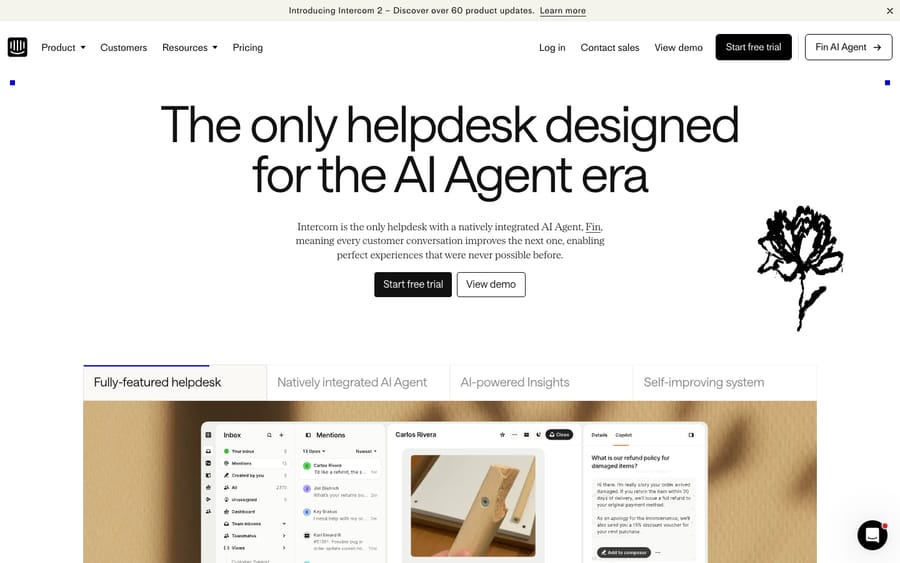
Intercom is the default for funded, product-led SaaS companies: a polished in-app messenger, proactive messaging, and the Fin AI agent, which Salesforce says averages a 76% resolution rate. Its Early Stage program is also the most generous on this list.
- Startup program: 93% off in year one, 50% in year two and 25% in year three, with 300 Fin outcomes a month included in year one (150 in year two, 75 in year three). Eligibility: not already an Intercom customer, fewer than 15 employees and up to $10M in funding (intercom.com/early-stage).
- Pricing (standard): Essential $29 a seat billed annually (Intercom has also shown $19 in a pricing test), Advanced $85, Expert $132, plus Fin at $0.99 per outcome.
- Who it's for: product-led SaaS startups where chat and in-app are the primary channels and AI deflection is a day-one priority.
- The catch: once the discount steps down, two levers move at once (seats and per-outcome Fin charges), so the bill gets hard to predict as you grow. The incentive is plain: Intercom earns more as Fin handles more conversations.
- What users say: reviewers praise the AI and experience, "offers customers a great and efficient support experience while saving our internal team countless hours", while the recurring counterpoint is cost creep: "the cost seems to be high and it keeps continuing to increase" (Capterra).
- G2: 4.5 / 5 (2,900+ reviews).
2. Tidio: best free AI chat to start with
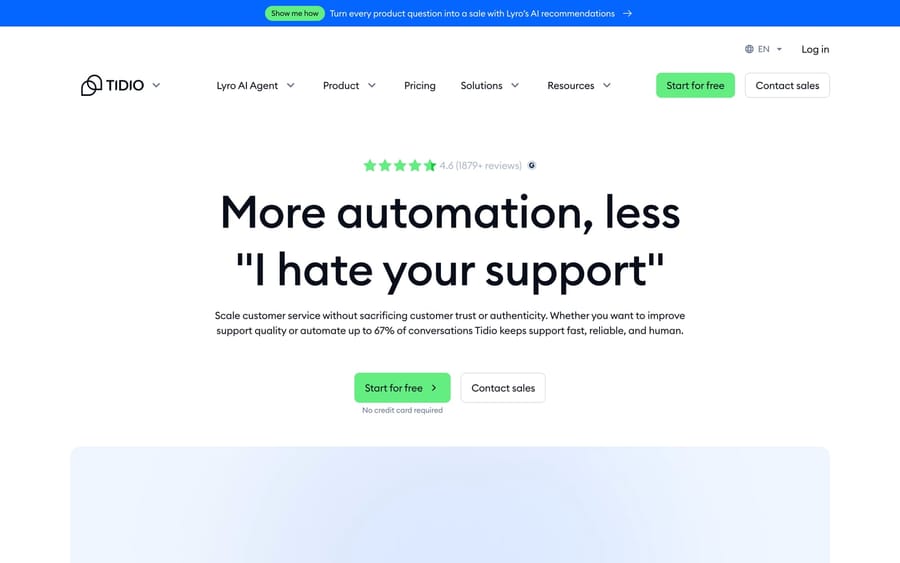
If your support is website chat and you want to try AI deflection on a $0 budget, Tidio is the fastest start here. Its Lyro AI agent is available on the free plan, so a pre-revenue startup can test it on real questions immediately.
- Startup program: no formal VC program. The entry point is the free plan: 50 billable conversations a month, 10 seats, and 50 Lyro AI conversations as a one-time, lifetime allowance.
- Pricing: Free, then Starter $29/mo ($24.17 billed annually), Growth from $59/mo ($49.17 annually), Plus from $300/mo plus usage. Monthly Lyro conversations are a separate add-on from $32.50/mo (tidio.com/pricing).
- Who it's for: early SaaS and e-commerce startups that live on website chat and want AI without a procurement cycle.
- The catch: the 50 free Lyro conversations don't refresh, so any real traffic pushes you onto the Lyro add-on quickly. Tidio bills conversations only when a human agent replies, so plan and AI costs move separately.
- What users say: reviewers like how easily it switches between bot automation and human takeover, and how quickly Lyro cuts repetitive work.
- G2: 4.6 / 5 (1,880+ reviews).
3. Freshdesk: best all-around value
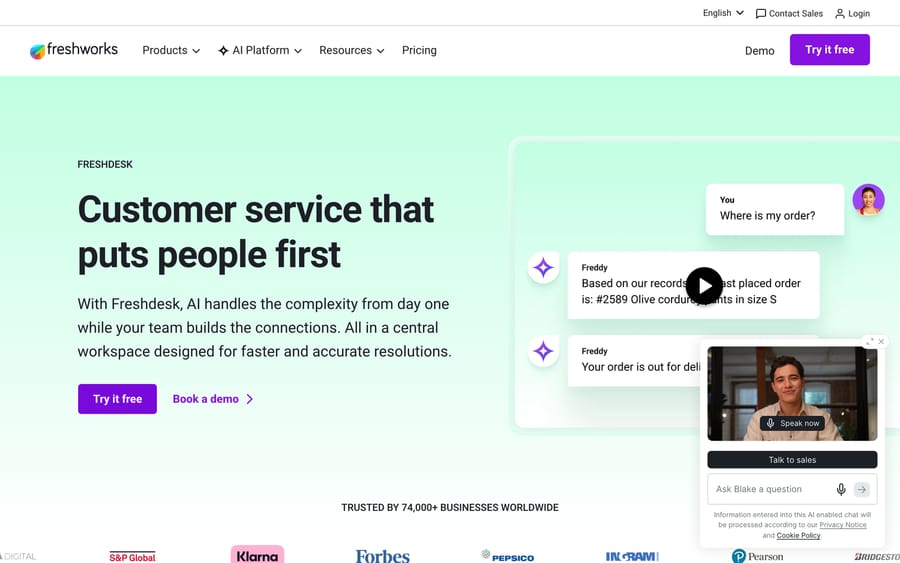
Freshdesk is the most balanced "real help desk" for a startup that wants ticketing, a knowledge base, multichannel and Freddy AI without enterprise overhead, and its list prices undercut Zendesk's Suite plans.
- Startup program: Freshworks for Startups gives credits to eligible early-stage companies by application; Freshworks doesn't publish the terms on its pricing page. Separately, a Free program covers up to 2 agents for 6 months. There's no free plan on the pricing page anymore.
- Pricing: Growth $19/agent, Pro $55, Enterprise $89 (annual). Every plan gets 500 Freddy AI Agent sessions once per account, then $49 per 100 sessions. Freddy Copilot is $29/agent, on Pro and Enterprise only (freshworks.com/freshdesk/pricing).
- Who it's for: startups that want a full-featured, familiar help desk with a clear scale path.
- The catch: the customer-facing AI is metered on top once the 500 starter sessions run out, and Copilot plus custom reporting both need Pro at $55.
- What users say: reviewers praise the interface, automation and centralized workspace, while noting deeper reporting and advanced workflows may need a higher tier.
- G2: 4.4 / 5 (3,700+ reviews).
4. Help Scout: best for simple, email-first support
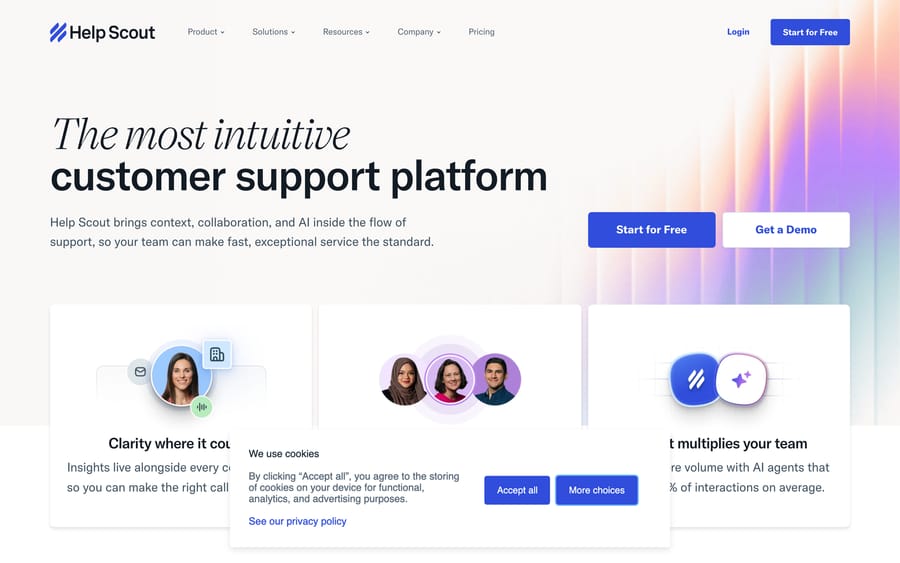
If you want the least overhead possible, a clean shared inbox rather than a "ticketing system", Help Scout is the easiest tool here to live in. Customers never see ticket numbers; your team sees a tidy conversation view.
- Startup program: the Startup Program gives 6 months free on the Plus plan to new customers that are tech startups incorporated less than 2 years ago with under $1M ARR (helpscout.com/startups).
- Pricing: Free (up to 5 users, 100 contacts a month), then Standard $25/user, Plus $45, Pro $75 with a 10-user minimum. Those are monthly rates; annual billing takes 16% off. AI Answers is usage-based at $0.75 per resolution, with a 3-month free trial for new accounts.
- Who it's for: small startup teams (especially non-technical founders) who want to be productive the same day, with usage-based AI that's cheap at low volume.
- The catch: lighter on advanced routing, workflows and reporting, so a fast-scaling, complex operation can outgrow it.
- What users say: "Clear and intuitive design… beginners don't need instructions to get started" (Capterra); reviewers single out simplicity and quality of support.
- G2: 4.4 / 5 (Capterra 4.6).
5. Zendesk: best scale path (with a strong startup program)
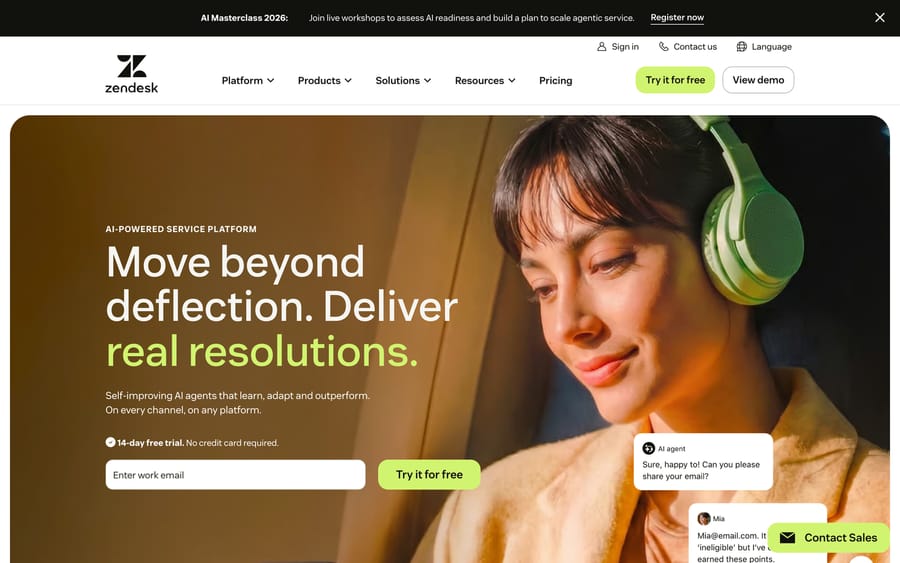
Zendesk is the incumbent because it scales to thousands of agents. For a startup that knows it's going to grow fast and never wants to replatform, adopting Zendesk early through its startup program is a defensible bet.
- Startup program: Zendesk for Startups gives new customers the Suite Professional plan plus Copilot free for 6 months, extended up to 2 years through partner referrals, for up to 50 agents. Eligibility: outside funding from angel through Series B, a company under 10 years old, and fewer than 250 employees (50 or fewer without a partner referral) (zendesk.com/startups).
- Pricing (standard): Support Team $19/agent; the Suite plans most teams want are Suite Team $55 and Suite Professional $115 (annual), with Enterprise by quote. Copilot is $50/agent on Suite Professional and above. AI agents are billed per automated resolution; Zendesk's pricing page lists $1.50 committed or $2.00 pay-as-you-go.
- Who it's for: startups optimizing for a long runway on one platform: heavy roadmaps, omnichannel ambitions, eventual enterprise needs.
- The catch: after the free window, cost climbs fast at small seat counts, and the configuration depth (triggers, SLAs, admin center) is a tax on a tiny team.
- What users say: reviewers rate ease of use highly for day-to-day agent work, but a common refrain is that "pricing can be expensive for smaller teams," especially for advanced features.
- G2: 4.3 / 5 (6,700+ reviews).
6. Pylon: best for B2B SaaS startups doing support in Slack
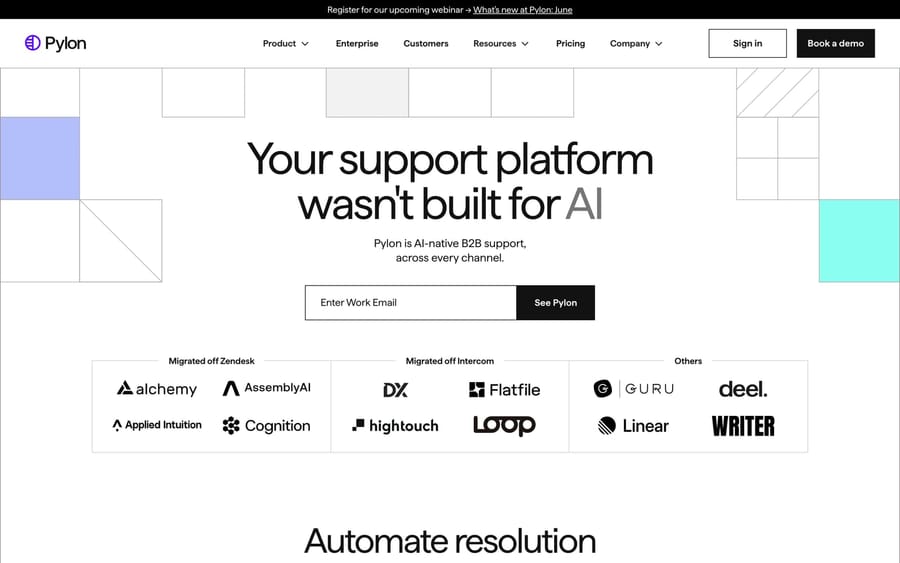
Pylon is built for the B2B SaaS pattern where customers talk to you in shared Slack or Teams channels, not a ticket portal. It pulls every channel into one support backend with an AI-native workflow, and it's become a common default for technical B2B startups.
- Startup program: none published. Pylon's pricing page now leads to a demo form rather than a price list.
- Pricing: as reported by Featurebase (July 2026): Starter $59/seat, Professional $89/seat, Enterprise $139/seat (annual), with a 3-seat minimum on Starter and Professional and 7 on Enterprise. AI Assistants add $50/seat. Confirm on a sales call.
- Who it's for: B2B SaaS startups whose customers expect high-touch support in Slack or Teams, with account context preserved.
- The catch: priced above email-first tools, seat minimums apply, and AI is an add-on, so real cost runs well above the headline once channels and AI stack on.
- What users say: "Pylon allows us to synthesize every support channel we have — most importantly Slack — into one shared support backend"; reviewers repeatedly call the Slack integration a "game-changer."
- G2: 4.7 / 5 (one of the highest-rated B2B support tools, though on a smaller ~100-review base).
7. Plain: best for developer/API-first B2B startups
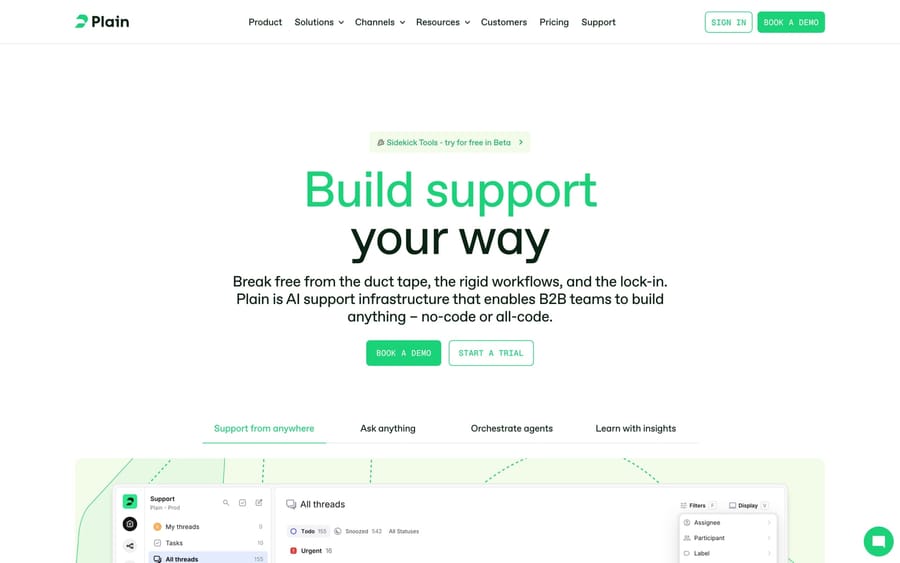
Plain is the newest entrant here and the most opinionated: API-first, Slack-native, with the Ari AI agent included on every plan, so there are no per-resolution charges. It's aimed at technical B2B teams that want to build support into their own product and tooling.
- Startup program: 50% off the Horizon plan, a $6k flat fee for 12 months with 10 seats, for VC-backed startups with up to $5M in funding and a support team of 10 or fewer (plain.com/startups).
- Pricing: Foundation $35/seat, Horizon $299/mo with 3 seats included ($99 per extra seat), Frontier custom. Ari is included on all plans. 7-day free trial, no card.
- Who it's for: developer-led B2B startups that want transparent pricing, deep integrations (Slack, Linear), and AI without metered fees.
- The catch: a newer product with a smaller public review base, and the API-first approach assumes engineering appetite. It's not the pick for a non-technical founder who wants a turnkey inbox.
- What users say: reviewers praise the "seamless integration with tools like Slack and Linear" and the developer-first API; some would prefer workload-based rather than per-seat pricing.
- G2: positive sentiment, but a limited public review base, so judge it on a trial rather than star count.
8. Front: best for a collaborative team inbox
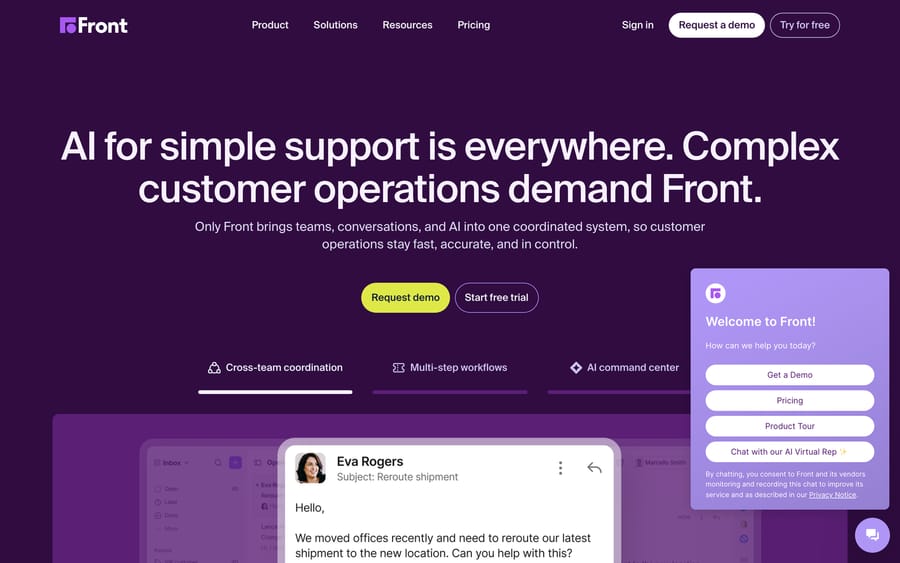
Front is the pick when support is a team sport: several people triaging shared inboxes (support@, hello@, billing@) across email, chat, SMS and social, with internal comments and assignments on top of real messages. It feels like email, so adoption is fast.
- Startup program: none listed on Front's pricing page today, and front.com/startups now redirects there. Ask sales if a discount matters.
- Pricing: Starter $25/seat (single channel, up to 10 seats), Professional $65 (up to 50 seats), Enterprise $105 (annual). Copilot is a $20/seat add-on (included on Enterprise) and Smart QA is Enterprise only; the Autopilot agent bills each conversation once: $0.05 triage, $0.39 handoff or $0.89 resolution (front.com/pricing and Front's Autopilot pricing, as of October 2026).
- Who it's for: startups where several people work the same mailboxes and want collaboration without CC'ing each other.
- The catch: the cheap Starter tier is single-channel and seat-capped, so true omnichannel jumps to $65/seat, and AI below Enterprise is mostly paid add-ons.
- What users say: reviewers highlight how it channels communication and engages the right agents on time; the shared-inbox collaboration is the recurring win.
- G2: 4.7 / 5 (2,429 reviews).
How do you choose the right help desk for your startup?
Start from your channel and stage, not a feature checklist:
- Product-led SaaS, chat/in-app first, AI is day one → Intercom (take the Early Stage discount), or Tidio if you need a free start.
- You want a full help desk cheap, with a clear scale path → Freshdesk (Growth at $19, and apply to Freshworks for Startups).
- You want the simplest possible tool, fast → Help Scout (6 months free Plus if you qualify).
- You're certain you'll scale hard and never want to replatform → Zendesk (at least 6 months free via Zendesk for Startups).
- B2B SaaS, customers live in Slack/Teams → Pylon, or Plain if you're developer-led and want API-first with AI included.
- Support is a shared-inbox team effort → Front.
Three rules save startups real money. Apply for the startup program before paying anything; it's the biggest lever on year-one cost. Model total cost at your projected seat count, not today's, because the AI billing model (per outcome vs. per seat vs. included) dominates as you grow. And don't adopt a tool you'll outgrow in a year just because it's free now; migration is expensive when you're moving fast.
Do you need an AI-first help desk, or AI on top of one?
A lot of startup teams think they need the most "AI-first" help desk they can find, when the real goal is to deflect repetitive volume early so two founders aren't drowning in tickets. Those are separable. You can buy a help desk for its AI, or pick the help desk that fits your channel and add an AI agent layer on top.
That second path is where Macha fits, and it's why Macha isn't a numbered option above: it's an AI agent layer that runs on top of Zendesk, Freshdesk, Gorgias, Front, HubSpot or Intercom (see Macha on your help desk), not a help desk you'd switch to. A startup on one of those desks can add agents that draft replies, triage, look up account data and resolve repetitive tickets, grounded in its knowledge base and systems, without a migration. Pricing is one plan by ticket volume, from $299 a month for up to 750 tickets, billed per ticket rather than per message or per seat, with setup and monitoring by the Macha team included. The fit test: if you've landed on one of those desks and your gap is automation rather than the desk itself, a layer is cheaper than a replatform. If you're on Pylon or Plain, use their built-in AI. You can try Macha with $50 of free usage, no credit card required.
Frequently asked questions
What is the best help desk for a startup? It depends on your channel and stage. Product-led SaaS startups gravitate to Intercom (with its Early Stage discount); budget-conscious teams pick Freshdesk or Help Scout; B2B startups doing support in Slack pick Pylon or Plain; teams certain they'll scale hard adopt Zendesk through its startup program.
Which help desks have a startup program or free credits? Intercom (Early Stage: 93% off year one plus 300 Fin outcomes a month), Zendesk (Suite Professional plus Copilot free for 6 months to 2 years, funded up to Series B), Help Scout (6 months free Plus for companies under 2 years old and $1M ARR), Plain (50% off Horizon for VC-backed startups with up to $5M) and Freshworks (credits by application). Most require an application and proof of funding or stage.
What's the cheapest help desk for a startup? Tidio (free plan with 50 conversations a month and 50 one-time Lyro AI conversations) and Help Scout (free for up to 5 users and 100 contacts a month) are the strongest $0 starts. Freshdesk no longer lists a free plan, though its Free program covers 2 agents for 6 months. After that, Freshdesk Growth ($19/agent), Plain ($35/seat with AI included) and the startup programs above are the lowest real-world cost.
What's the best help desk for a SaaS startup? For product-led B2C/PLG SaaS, Intercom (in-app messenger plus Fin AI) is the standard. For B2B SaaS where customers talk to you in Slack or Teams, Pylon or Plain fit better. Match the tool to where your customers actually message you.
Do I have to migrate help desks to get good AI? No. If your only gap is AI deflection, an AI agent layer like Macha adds agents on top of Zendesk, Freshdesk, Gorgias, Front, HubSpot or Intercom with no migration and no rebuilt config. Pick the help desk that fits your channel first, then layer AI separately.
What's the bottom line?
The best startup help desk fits your channel, qualifies you for a startup program, and won't need replacing when you scale. Choose Intercom for product-led SaaS and the biggest early-stage discount; Tidio for a free chat start or Freshdesk for a cheap full help desk; Help Scout for the simplest path; Zendesk if you're built to scale hard; Pylon or Plain for B2B Slack-native support; and Front for a collaborative shared inbox. Apply for the startup program before you pay, model cost at your future seat count, and treat the AI question separately from the help desk question.
On Zendesk, Freshdesk, Gorgias, Front, HubSpot or Intercom? See how Macha adds AI agents on top of your existing help desk to deflect repetitive volume early, with no migration. $50 of free usage, no credit card required. Learn more.