Shopify
 Stripe
 Slack
Slack Notion
 Google Workspace
 Confluence

How Do Macha Agents Generate XLSX, CSV, PDF and DOCX Files? The File Tools Connector


Macha's File Tools connector lets an AI agent build a spreadsheet, CSV, PDF or Word file straight from live helpdesk, Stripe or Shopify data. Nobody pastes data in, and the file can build itself on a schedule.
Key takeaways
- Macha's File Tools connector generates four file formats, XLSX, CSV, PDF and DOCX, with no account to link and no credentials to configure.
- File Tools first shipped as file generators on March 15, 2026 and became its own connector in the April 9, 2026 release.
- In Macha's weekly support report use case, the agent compiled 312 tickets with 298 resolved, a 95.5% rate, into a multi-sheet Excel workbook.
- File Tools produces formatted rows, columns and tables, but it does not create native Excel charts or pivot tables.
- A Macha run that ends in a generated file bills as one ticket, about $0.40, however many data lookups and generation calls it makes.

Macha agents generate XLSX spreadsheets, CSV files, PDFs and DOCX Word documents through the built-in File Tools connector, which has four actions (Create Spreadsheet, Create CSV, Create PDF, Create Document) and returns each file as a download link in the same conversation. There's nothing to install, no OAuth screen and no API key: File Tools is on by default in every workspace.
| Question | Answer |
|---|---|
| Formats | XLSX, CSV, PDF, DOCX |
| Setup | None; auth is "Built-in (no auth)" |
| Where files go | In-memory, returned as a download link |
| Charts or pivot tables | No; formatted rows, columns and tables only |
| Cost | No extra charge; the run bills as one ticket (about $0.40) |
The four formats matter less than where the data comes from. File Tools lives inside the same agent that's already authenticated to your helpdesk and commerce stack, so the agent can pull live tickets, orders and payments, compile them, and emit a finished file in one run.
What is the File Tools connector?
File Tools is a built-in connector in the Productivity category. Unlike Zendesk or Shopify, there's no account to link: its auth is listed as "Built-in (no auth)." It first shipped on March 15, 2026 as a small set of generators ("agents can now create spreadsheets, CSVs, PDFs, and Word documents on the fly… files are generated in-memory and returned as download links"), and was formalised as the File Tools connector in the April 9 release. Same four generators, always available, zero setup.
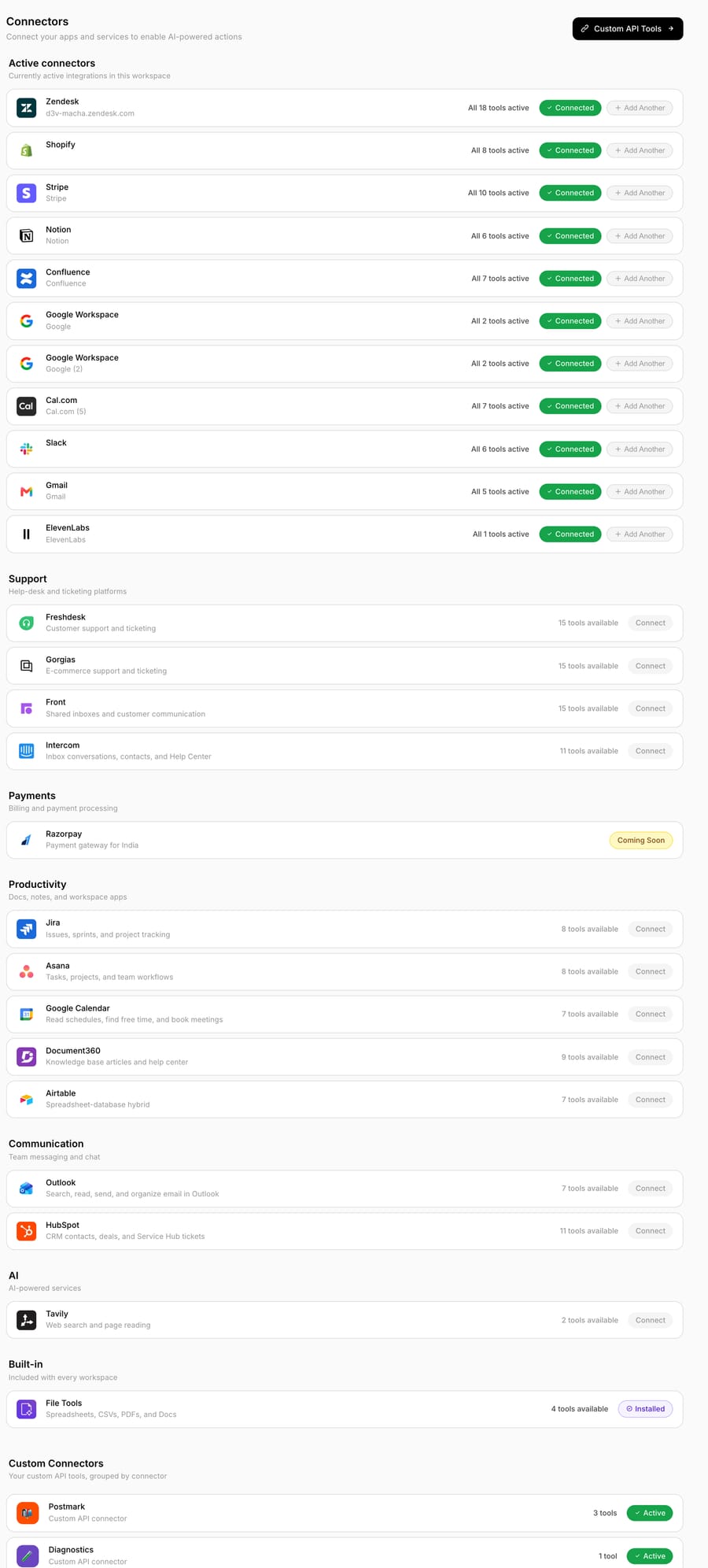
It exposes four generation actions:
| Action | Output | Best for |
|---|---|---|
| Create Spreadsheet | .xlsx (Excel) | Formatted, multi-column/multi-sheet reports |
| Create CSV | .csv | Plain tabular data for import into other tools |
| Create PDF | .pdf | Polished, shareable documents from text + tables |
| Create Document | .docx (Word) | Editable docs with headings, body text, and tables |
Files are generated in memory and returned as a download link, so nothing is stored on your machine until you click. The agent decides which generator to call based on what you ask for: "send me a spreadsheet" gets .xlsx; "draft a PDF summary" gets .pdf.
Why does "built-in, no auth" matter?
Every other connector in Macha is a door to an external system that needs credentials. File Tools is different. It's a capability of the runtime itself, which is why it's available on the trial and the paid plan with nothing to configure. Practically, that means you never have to think about it. You wire up the data sources you care about (Zendesk, Stripe, Notion…), and the moment an agent needs to emit a file, the generators are already there.
How does an agent use File Tools?
A Macha agent is a set of instructions plus a chosen set of tools. To let an agent produce files, you add the File Tools actions in the tool picker the same way you'd add any connector's tools — then tell the agent, in plain language, when to use them.
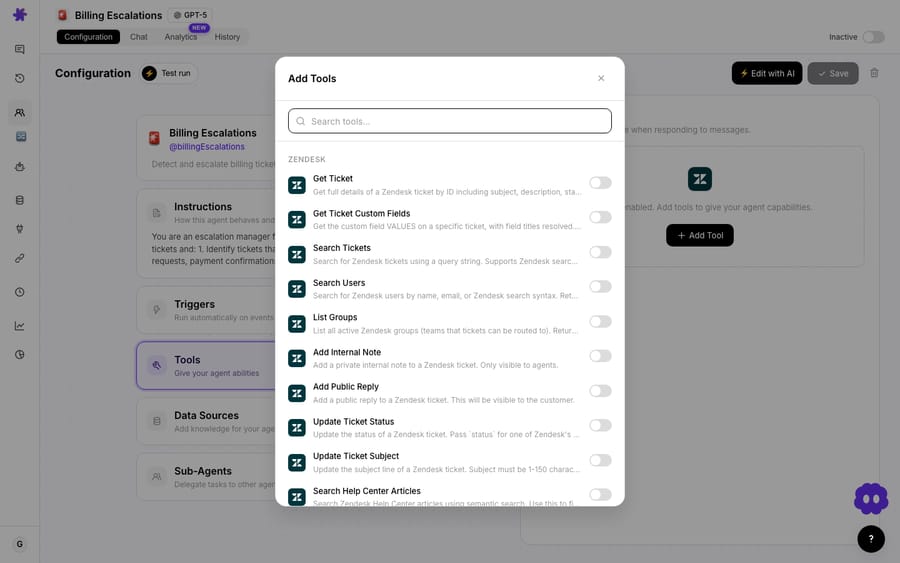
A typical instruction reads like this:
When a teammate asks for a report, pull the relevant tickets from Zendesk, compile the metrics, and generate an Excel spreadsheet. Reply with a one-line summary and the download link.
From there the agent chains tools on its own. The model reads the request, calls the data tools (Search Tickets, Get Ticket), shapes the result into rows, calls Create Spreadsheet, and returns the link. You didn't specify column orders or sheet names in code — you described the outcome, and the agent assembled the file.
Because File Tools is just another tool in the agent's belt, it composes with everything else:
- Live helpdesk data — turn a week of Zendesk or Freshdesk tickets into a metrics workbook.
- Commerce + payments — export Stripe refunds or Shopify orders into a CSV your finance team can reconcile.
- Knowledge — render a Notion or Confluence page into a clean PDF for a customer.
- Autonomous runs — pair it with a scheduled trigger so the file builds itself every Monday morning, no one in the loop.
What does a real File Tools report look like?
Here's the flow that makes File Tools click — it's one of Macha's published use cases, generate weekly support reports as spreadsheets, and it ties together a trigger, a data source, and a generator end to end.
The goal: every Monday at 9:00 AM, produce a shareable Excel report of last week's support performance — no analyst, no manual export.
The agent runs five steps:
- Trigger — a scheduled trigger fires weekly on Monday at 9:00 AM.
- Search tickets — the agent queries all Zendesk tickets from the last 7 days.
- Compile metrics — it calculates volume, resolution time, CSAT, top topics, and agent performance from the returned tickets.
- Create spreadsheet — File Tools generates a multi-sheet
.xlsxwith Summary, Tickets, Agent Performance, and Topics tabs. - Share file — the agent posts the download link and a plain-language recap.
The recap it returns looks like this:
Weekly Support Report — Mar 17 to Mar 23 • Total tickets: 312 • Resolved: 298 (95.5%) • Avg first response: 8 min • Avg resolution time: 1.8 hours • CSAT: 96% • Top topics: Account access (42), Billing (38), Setup help (31) Full report attached as weekly-support-report-mar-24.xlsx with detailed breakdowns by agent, topic, and day.
Notice what didn't happen: nobody opened Zendesk's Explore, exported a CSV, pivoted it in Excel, and pasted highlights into Slack. The agent did the gather-compile-format-share loop itself, and the spreadsheet is a real artifact your team can open and drill into. Swap the schedule for an on-demand chat ("build me this report for last month") and the exact same tools run interactively.
For a Slack-only digest you don't even need a file — see the weekly refund report to Slack pattern. File Tools earns its place precisely when someone needs the attachment: a workbook to filter, a PDF to forward, a CSV to import.
How is File Tools different from text-to-Excel tools?
It helps to be clear about what Macha is. Macha is an AI agent layer that sits on top of the helpdesk you already run (Zendesk, Freshdesk, Gorgias, Front, HubSpot or Intercom), not a replacement for it, and not a spreadsheet app. File Tools is the piece that lets those agents produce documents instead of only reading and replying.
That's the real difference from the standalone "text-to-Excel" tools. Products like Formula Bot, GPTExcel, and Claude's in-chat file creation are excellent at building a file from data you bring them. Macha's agents already have the data — authenticated, live, and current — and can run unattended. You're not exporting from your helpdesk so an AI can read it; the AI is already inside, and File Tools is how it writes back out.
Good fits
- Recurring reports — weekly/monthly support, refund, or order summaries on a schedule.
- Ad-hoc exports — "give me a CSV of every ticket tagged
billingthis month." - Customer-facing documents — a PDF invoice summary or a DOCX onboarding checklist, generated per request.
- Hand-offs — bundle context into a clean file when escalating a ticket to another team.
When should you not use File Tools?
File Tools is genuinely useful, but it isn't a BI suite, and treating it like one will disappoint you. A few honest limits:
- It's generation, not a live dashboard. Each file is a point-in-time snapshot built when the agent runs. If you need an always-current view that updates on its own, a real analytics tool (Zendesk Explore, a warehouse, Looker) is the right home; use File Tools for distributable artifacts, not your source of truth.
- No charts or pivot tables. The generators produce formatted rows, columns, headings, and tables — clean and readable — but not native Excel charts or pivots. If your stakeholders live in pivot tables, generate the data sheet with File Tools and let them pivot, or push the analysis into Macha Studies instead.
- Accuracy depends on the upstream data and the model. The agent compiles metrics from what the data tools return; if your Zendesk tags are messy, the "top topics" column inherits that mess. For high-stakes numbers, scope the query tightly and spot-check the first run.
- Big exports cost tokens and time. Pulling and shaping thousands of records is real work for the model. For very large one-time analyses, a purpose-built analysis run is cheaper and faster than asking a chat agent to assemble a giant workbook.
- Files aren't permanent storage. Generated files are returned as download links, not a document library. If a report needs to live somewhere durable, have the agent also drop it into Google Drive or post it to Slack.
How much does File Tools cost?
File Tools itself is free to add. It's built into Macha's single paid plan and the free trial ($50 of usage, no credit card required). What you pay for is usage, and Macha bills it in one unit: per ticket — one conversation, charged once — not per "file" and not per "report."
A file-generating run takes a handful of tool calls — the data lookups (e.g. Search Tickets, Get Ticket) plus the generation call itself — and none of them are billed separately. A conversation that ends in a DOCX costs the same as one that ends in a sentence: one ticket, about $0.40, on pricing that starts at $299 a month for 750 tickets and scales to $3,999 for 10,000 tickets. The model you run the agent on doesn't change that either. Full plan details live on the pricing page.
Frequently asked questions
Do I need to connect anything to use File Tools? No. File Tools is built into every Macha workspace with no authentication and no setup. You only connect the data sources (like Zendesk or Stripe) you want the files built from.
What file formats can Macha generate? Four: Excel spreadsheets (.xlsx), CSV files (.csv), PDF documents (.pdf), and Word documents (.docx). The agent picks the right generator based on your request.
Where does the file go after it's generated? Files are generated in memory and returned as a download link in the conversation. The agent can also share that link — for example, posting it to a Slack channel as part of an automated report.
Can files be generated automatically on a schedule? Yes. Pair File Tools with a scheduled trigger and an agent will build and share the file on a recurring cadence — the weekly support report above runs every Monday at 9:00 AM with no human involved.
Can it create charts or pivot tables in Excel? Not natively. File Tools produces formatted columns, rows, headings, and tables. For visual analysis, generate the data sheet and pivot/chart it yourself, or use Macha Studies for aggregated reporting.
Which plans include File Tools? Macha sells one plan priced by ticket volume, and File Tools is included in it and in the free trial. You pay only for the tickets the agent handles.
What should you hand to File Tools first?
File Tools is a small connector with an outsized payoff: it turns Macha agents from things that read and reply into things that produce. Because it's always on and wired into the same agent that already has live access to your helpdesk and commerce tools, the gap between "the data exists somewhere" and "here's the finished XLSX/PDF/CSV/DOCX" collapses into a single agent run — interactive or fully automated.
If your team still exports tickets by hand to build a weekly deck, that's the first thing to hand off. Start a free trial and have an agent build the report for you.