Shopify
 Stripe
 Slack
Slack Notion
 Google Workspace
 Confluence

Keeping AI Agents Safe: Confirmations, Read/Write Scopes & Guardrails


The fastest way to lose trust in an AI support agent isn't a wrong answer — it's a wrong action. A hallucinated paragraph gets corrected in the next reply. A refund issued to the wrong customer, a ticket closed that shouldn't have been, an internal note posted as a public reply: those are the mistakes that get an automation project quietly shut off.
So the real question for any team putting agents on top of their helpdesk isn't "can the AI write a good response?" It's "what is this agent allowed to do, who has to say yes before it does the scary stuff, and can we undo it if it's wrong?" That's what guardrails are for. This post is a practical tour of the guardrails that actually matter for support agents — read/write scopes, confirmation gates, the line between answering and acting, and reversibility — using how Macha implements each one as a concrete reference. Macha is the AI agent layer that sits on top of the helpdesk you already run (Zendesk, Freshdesk, Gorgias, Front), so every example here is about governing agents that take real actions in tools you already trust.
The mental model: every tool is either reading or writing
Start with the single distinction that organizes everything else. An agent's capabilities come from tools — discrete functions it can call. And every tool falls into one of two buckets:
- Read tools observe. They fetch a ticket, search the knowledge base, look up an order, list recent comments. The worst case is they surface information the agent didn't need. They don't change anything.
- Write tools act. They post a reply, update a status, change a subject line, issue a refund, create a page. These have side effects in systems your customers and your business depend on.
This isn't a Macha invention — it's the same least-privilege principle every security team applies. OpenAI's own agents guidance puts validation "next to tools that create side effects, not just at agent boundaries," and lets you mark sensitive tools with needsApproval: true. The point is that read and write deserve different defaults, and a safe platform makes that distinction visible rather than burying it.
In Macha, that classification is right there on the connector. Open any connector — here's the Zendesk one with all 17 tools — and each tool is tagged Read or Write with its own toggle. You grant an agent exactly the tools it needs and nothing more.
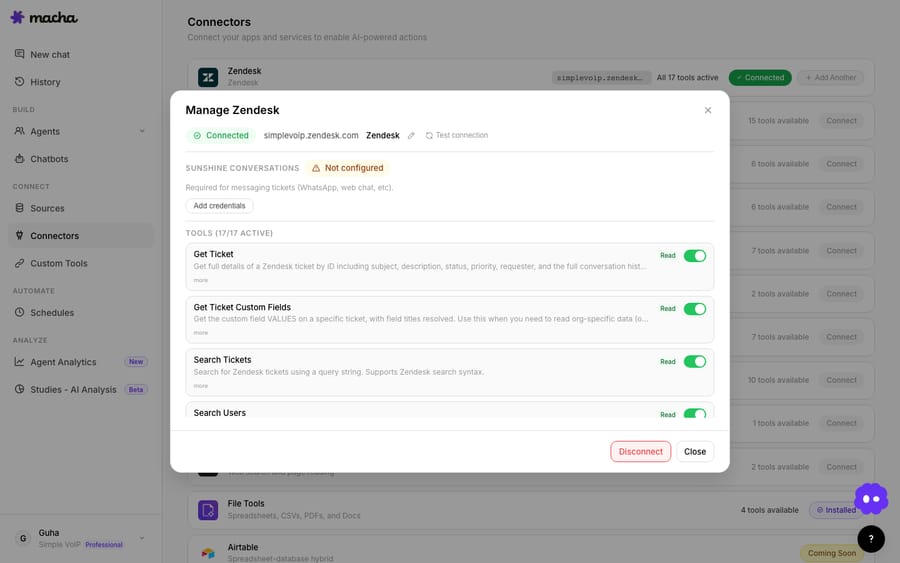
Scroll down the same list and the write tools are tagged differently:
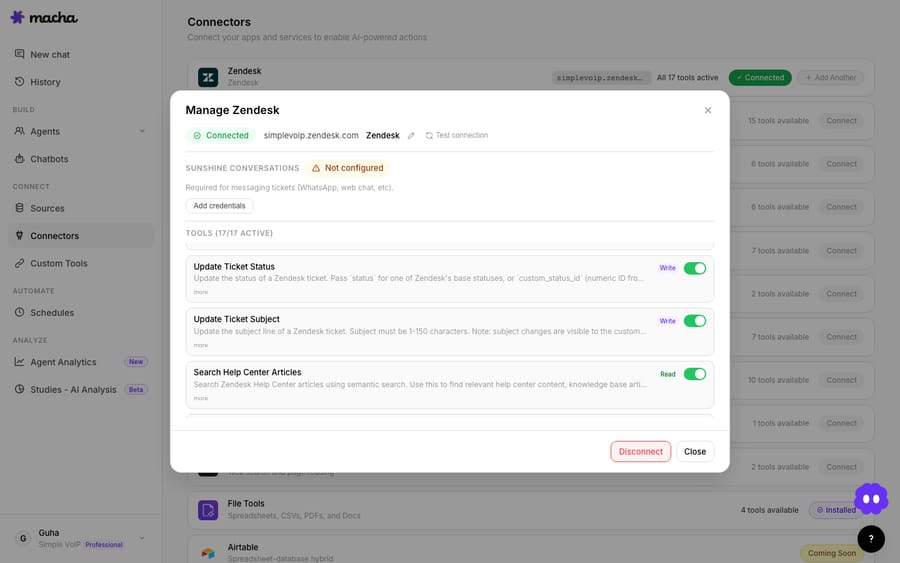
The practical payoff: a triage agent that only categorizes and routes never needs a single write tool. Give it Get Ticket, Search Tickets, and Search Help Center Articles, leave every Write toggle off, and there is no code path by which it can change a customer-facing thing. You've made an entire class of mistake structurally impossible instead of hoping the prompt holds.
Guardrail 1 — Confirmations on write actions
Reading is cheap to get wrong; writing isn't. So the first real gate is a confirmation: before the agent executes a write, a human has to approve the specific action.
In Macha's interactive chat, a write tool doesn't just fire. The agent proposes it, and you get a card showing exactly what's about to happen, with Confirm and Reject:
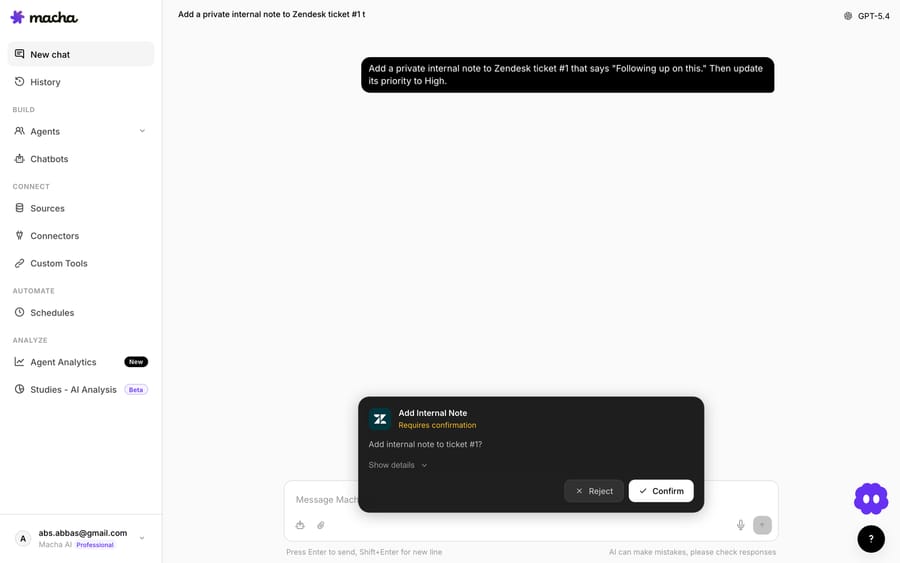
Two details make this trustworthy rather than theatrical. First, the card names the exact operation and target ("Add internal note to ticket #1?"), and a Show details expander reveals the full payload — so you're approving a specific change, not a vague intent. This mirrors the better practice in the field: replace a bare "Approve?" with the actual intent and blast radius so the human is making an informed call. Second, nothing is charged or sent until you click Confirm. Reject and the action evaporates.
This isn't limited to one tool. The pattern is wired into write operations across connectors:
- Zendesk — the subject-update tool "requires confirmation in chat mode" and validates the new subject is 1–150 characters before it'll even offer the action.
- Confluence — all write operations (create page, update page, add comment) require confirmation; the read tools (search, list spaces, get content) don't.
- Shopify —
create_refundships with confirmation baked in, while the order- and customer-lookup tools run freely.
And because Macha lets you connect any REST API as a custom tool, it doesn't make you remember to flag the dangerous ones. When you define an endpoint, Macha auto-detects the tool type from the HTTP method: GET is treated as a read, while POST, PUT, PATCH, and DELETE are automatically marked as write operations that require confirmation. Safe-by-default, even for tools you build yourself.
Guardrail 2 — Interactive vs autonomous: the agent earns write access
Here's the guardrail that most "human-in-the-loop" write-ups miss, and it's arguably the most important one for support.
There are two very different contexts an agent runs in:
- Interactive — a human is in the loop in real time (an agent in chat, a teammate drafting with the agent, you testing a flow).
- Autonomous — the agent runs on its own, fired by a trigger: a new ticket arrives, a customer message lands, a scheduled job kicks off. No human is watching that exact moment.
Macha treats these asymmetrically on purpose. Sub-agents stay read-only during interactive chat — they can look things up and reason, but they cannot execute writes when you're poking at them. They only gain the ability to perform write operations (replies, updates) when running autonomously via a trigger you've deliberately wired up and enabled. Write access is something the agent earns by being promoted into a production trigger, not a default it carries everywhere.
That ordering matches how careful teams actually roll out automation: explore and test with reads, prove the behavior, then turn on autonomous writing for a narrow, well-defined trigger. The EU AI Act's Article 14 codifies the same instinct for high-risk systems — humans must be able to oversee, intervene, and override — and that compliance deadline lands in August 2026, so designing the human-override seam in now is just good timing.
Guardrail 3 — Activation warnings and persistent advisories
Confirmations protect a single action. But some decisions are made once, at configuration time, and then run thousands of times — like enabling "Add Public Reply" on an agent that fires on every customer message. That's a high-blast-radius switch, and it deserves friction.
Macha adds it in two layers. When you toggle on a high-impact tool (Add Public Reply, Update Ticket Status) or a high-volume trigger (Every Customer Message, New Ticket), you get an activation confirmation modal — severity-themed, with a plain-language warning and custom confirm/cancel labels — so nobody flips on autonomous public replies by reflex.
Then, so the warning doesn't vanish the moment you click through, every enabled high-impact tool and trigger leaves a persistent advisory card on the agent's configuration page — a short, always-visible note on how to use it safely. The risk stays legible to the next teammate who opens the agent, not just to whoever set it up.
Guardrail 4 — Make actions reversible
The honest truth about guardrails is that some bad action will eventually slip through — a confirmation clicked too fast, an edge case nobody scoped. A mature system assumes that and asks: can we undo it?
Macha leans on reversibility wherever it can. Deleting an agent doesn't nuke it — it moves to trash with a 30-day restore window, and the confirmation copy says so explicitly:
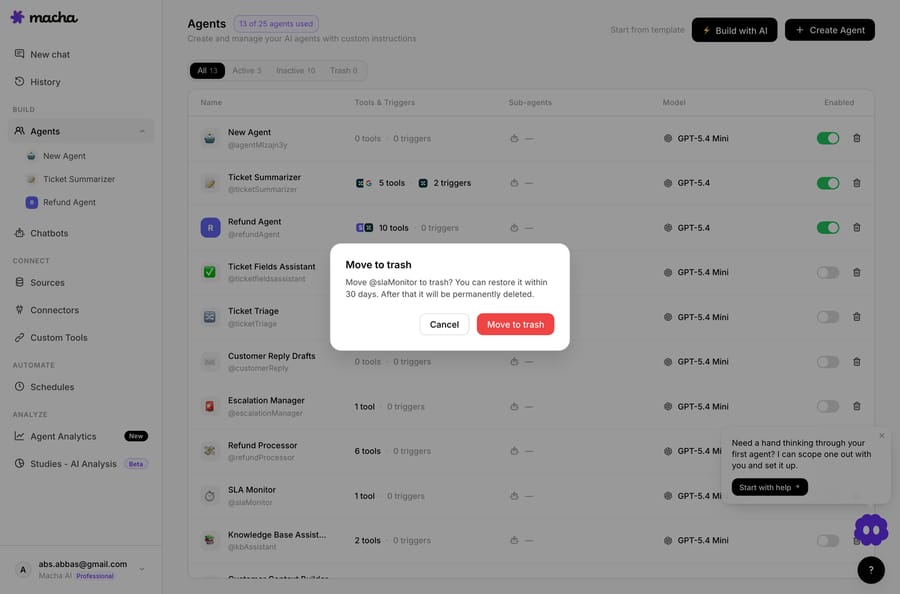
That's a deliberate design note from the changelog: the team rewrote the old "this cannot be undone" warning because, with the 30-day window, it now can be. The same philosophy runs through account and organization deletion (30-day scheduled deletion with cascade cleanup) and through frozen run snapshots in Studies, where editing a definition never rewrites the history of past runs. The pattern: prefer soft-delete and grace periods over irreversible destruction, and tell the user the truth about what's recoverable.
Guardrail 5 — Containment for autonomous runs
Autonomous agents introduce a failure mode interactive ones don't: runaway loops and stampedes. A misbehaving webhook source, a flapping integration, or an over-eager schedule can hammer your agent and your credit balance. Macha boxes those in with hard limits rather than trust:
| Risk | Guardrail |
|---|---|
| A noisy event source firing endlessly | Debounce safeguard — a debounce bucket is force-fired once it hits 25 events, or after 10× the debounce window (capped at 2 minutes), so a malformed stream can't hold an agent open indefinitely. |
| A schedule running too hot | Scheduled-trigger limits — minimum 1-hour interval, a 24-runs/day cap, and a 3-concurrent-runs-per-org ceiling. |
| A trigger silently failing forever | Auto-disable — a trigger switches off after 5 consecutive failures and emails you; stale locks are cleaned up after 30 minutes. |
| A tool disabled at the connector but still wired to agents | Defense in depth — the backend silently skips connector-disabled tools at runtime, and the UI flags them in three places so teams don't waste time toggling tools the platform won't run. |
None of these require you to configure anything. They're the floor the platform enforces so that "the agent went haywire overnight" isn't a sentence you ever have to say.
Guardrail 6 — Data handling and the audit trail
Guardrails aren't only about actions; they're about what the agent can see and what gets kept. A few defaults worth knowing:
- Scoped knowledge. Each data source can be set to "All documents" or hand-picked "Selected" documents per agent, so a given agent only retrieves from the corpus it's meant to. Least privilege for knowledge, not just tools.
- Encryption in logs. API keys and tokens that pass through internal agent logs are encrypted at rest with AES-256-GCM — credentials don't sit in plaintext anywhere.
- An audit trail. The full raw webhook payload is saved on every autonomous conversation for audit and debugging, and tool cards record success/error with the actual result — failed calls even show the "attempted payload (not sent)" so you can see what the agent tried to do.
- Retention with a clock. Conversations auto-delete after 45 days of inactivity; internal agent logs expire after 7 days.
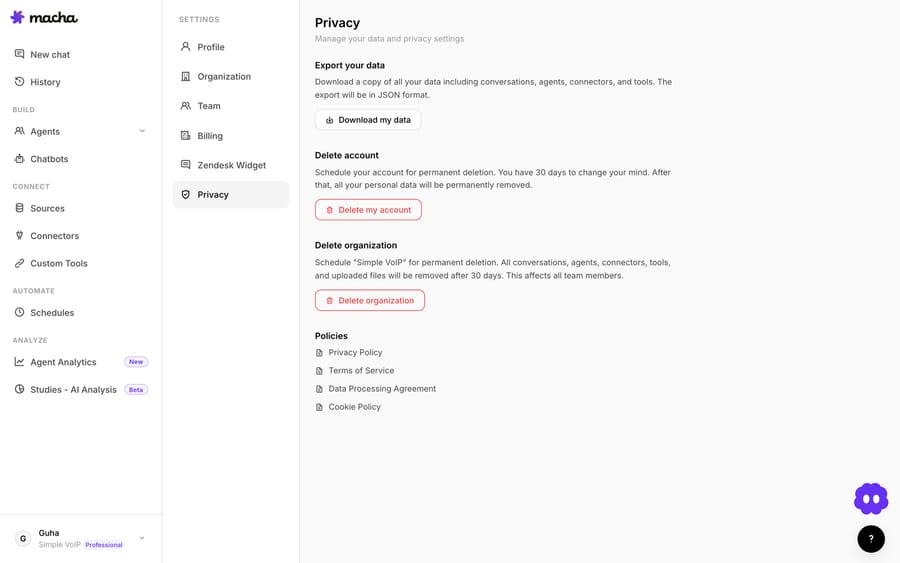
- Your data, exportable and deletable. From Settings → Privacy you can export a complete JSON copy of your data (with credentials and embeddings stripped) or schedule account/org deletion.
Watch-outs: where guardrails can lull you
Guardrails build trust, but they're not a substitute for judgment. A few honest caveats:
- Confirmations only work if a human reads them. In interactive mode that's fine. But the whole point of an autonomous trigger is that no one is clicking Confirm — so the safety there comes entirely from scope (which tools you enabled) and from the activation warnings you acknowledged at setup time. Don't enable autonomous public replies and assume a confirmation will still catch a mistake; it won't, because there's no one there to catch it.
- Read-only isn't risk-free. A read tool can still surface data into a reply that shouldn't be shared. Scope your knowledge sources and instruct the agent on what not to repeat; "it can only read" is not the same as "it can't leak."
- Auto-detected tool types are a default, not a verdict. Macha marks
POST/DELETEcustom tools as writes automatically — but a poorly designedGETthat triggers a side effect on someone's API will be treated as a read. Sanity-check custom tools against what the endpoint actually does. - Reversibility has limits. A 30-day restore window covers a deleted agent. It does not un-send a public reply that already reached a customer's inbox. Treat customer-facing writes as the highest-stakes category and gate them hardest.
The right posture is the one the 2026 production guidance keeps landing on: match the guardrail to the stakes. An internal triage agent can run wide open on reads; an agent that issues refunds or posts public replies should be scoped tight, confirmation-gated, and rolled out behind a deliberate trigger.
A practical rollout checklist
If you're standing up your first agents, this sequence keeps you safe without slowing you to a crawl:
- Start read-only. Build the agent with only read tools and prove its answers in interactive chat and test runs.
- Add writes one at a time, behind confirmation. Turn on a single write tool and exercise it in chat where every action shows a Confirm/Reject card.
- Promote to a narrow trigger. Only after the behavior is solid, wire one specific trigger and acknowledge the activation warning — that's where autonomous write access switches on.
- Keep the blast radius small. One trigger, one tightly-scoped agent, sub-agents for specialist tasks rather than one omnipotent agent.
- Watch the audit trail and credits. Use the saved payloads and tool-result banners to review what ran, and lean on the built-in containment limits.
FAQ
What's the difference between a read tool and a write tool? Read tools only fetch information (get a ticket, search the knowledge base, look up an order) and have no side effects. Write tools change something (post a reply, update a status, issue a refund). In Macha every tool is tagged Read or Write on its connector, so you can grant exactly what an agent needs.
Does the AI need approval before it takes an action? For write actions in interactive chat, yes — Macha shows a confirmation card with the exact operation and a Confirm/Reject choice, and nothing executes until you confirm. Custom API tools using POST/PUT/PATCH/DELETE are auto-flagged to require confirmation too.
Can an agent take actions on its own without a human watching? Only when you deliberately enable it. Sub-agents are read-only in interactive chat and only gain write access when promoted into an autonomous trigger you've wired up — and high-impact tools and triggers throw an activation warning when you switch them on.
If the agent does something wrong, can I undo it? Where possible, actions are reversible: deleting an agent moves it to trash with a 30-day restore window, and account/org deletion is a scheduled 30-day process. Customer-facing writes that already reached someone (like a sent public reply) can't be recalled, which is why those are gated hardest.
How does Macha keep autonomous agents from running away? Built-in limits: debounce safeguards force-fire runaway event streams, scheduled triggers cap at a 1-hour minimum interval / 24 runs a day / 3 concurrent runs per org, and triggers auto-disable after 5 consecutive failures. See the pricing page for plan-level limits on triggers and tools.
Bring your own helpdesk — keep your guardrails
The reassuring part is that none of this asks you to rip out your helpdesk or trust a black box. Macha layers agents on top of the Zendesk, Freshdesk, Gorgias, or Front you already run, with read/write scopes, confirmations, and audit trails as defaults rather than afterthoughts. Start a 7-day free trial, no credit card required, connect read-only first, and promote to writing only when you're ready — or read the docs for the full agent-builder walkthrough.
Written by Abbas (Customer Support & AI, Macha) · Reviewed by Ankeet Guha (Co-founder & CTO) · Published 2026-06-24 · Last updated 2026-06-24.
Resolve tickets automatically with AI agents
Macha's AI agents work on top of the help desk you already use — no code.