Shopify
 Stripe
 Slack
Slack Notion
 Google Workspace
 Confluence

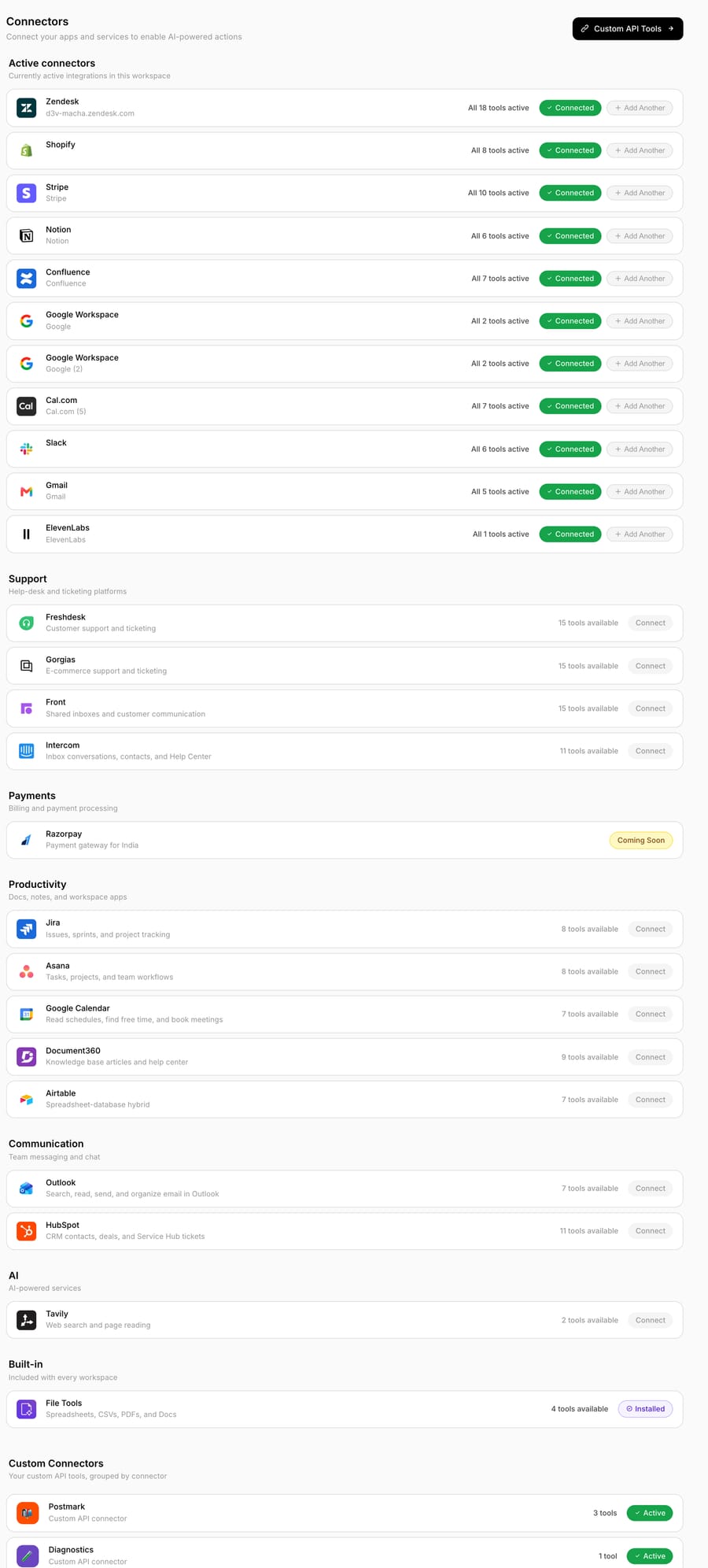
What Can a Confluence AI Agent Do in Your Help Desk? Macha's 7 Confluence Tools


Macha's Confluence connector lets an AI agent search and read your Confluence runbooks, then act on the ticket in your help desk, with every write to Confluence gated behind a confirmation. Here is how the seven tools work, how token access and expiry are handled, and when Atlassian's own Rovo is the better fit.
Key takeaways
- Macha's Confluence connector, shipped on April 9, 2026, gives AI agents seven tools, four reads and three writes, to use Confluence knowledge while working tickets in a separate help desk.
- Macha's three Confluence write tools, Create Page, Update Page and Add Comment, require explicit confirmation before running, while Search Pages, Get Page, List Spaces and Get Page Children run freely.
- Macha emails a reminder 30 days before an Atlassian API token expires and deactivates the Confluence connector on 401 errors, so lookups never fail silently against a dead token.
- Atlassian's pricing page lists Confluence Standard at $5.42 per user a month and Premium at $10.44, with a Free plan for up to 10 users.
- Macha prices the Confluence workflow per ticket, starting at $299 a month for up to 750 tickets, so a ticket costs the same however many Confluence lookups it takes, with setup by the Macha team and a dedicated success manager included.

Macha's Confluence connector gives an AI agent seven tools, four reads and three confirmation-gated writes, so it can search your Confluence runbooks and then act on the ticket in your help desk. The connector shipped on April 9, 2026, authenticates with an Atlassian API token, and works with any help desk Macha connects to: Zendesk, Freshdesk, Gorgias, Front, HubSpot or Intercom. "Confluence AI agent" covers several different products, so here is where each one fits before the Macha-specific tour.
| Option | Where the AI works | Best fit |
|---|---|---|
| Rovo (Atlassian) | Inside Confluence and Jira: Search, Chat, Remix, agents, Studio | Teams whose support runs in Jira Service Management |
| Rovo partner agents | Lovable, Replit and Gamma turn pages into prototypes, apps and decks | Transforming content, not resolving tickets |
| DIY retrieval over the REST API | Your own index plus an LLM | Teams with engineers to maintain it |
| Macha | Reads Confluence, acts in your help desk (7 tools, writes need confirmation) | Knowledge in Confluence, tickets in a non-Atlassian help desk |
Which kind of Confluence AI agent do you need?
There are roughly three families of "Confluence AI agent" on the market in 2026:
- Atlassian's own Rovo. This is AI built inside Confluence and Jira: Rovo Search across your Atlassian estate, Rovo Chat, Remix (turn a page into a chart, doc, or prototype), agents such as Meeting Insights Reporter, and custom agents you build in Studio. Atlassian says Rovo is available on Standard, Premium and Enterprise cloud plans. It's the strongest option if your team lives in the Atlassian suite and you want AI within Confluence. (Rovo in Confluence)
- Third-party Rovo / MCP partner agents. Atlassian announced on April 8, 2026 partner agents from Lovable, Replit and Gamma that consume Confluence content and produce prototypes, starter apps and presentations elsewhere. These are good for transforming content, less so for resolving customer tickets.
- DIY retrieval (RAG) over the Confluence REST API. Roll your own: index pages into a vector store, wire up an LLM, maintain it. Maximum control, maximum engineering cost, and you own every edge case: auth rotation, permissions, stale indexes.
Macha is a fourth shape, and it answers a question the other three mostly don't: what if your knowledge is in Confluence but your support team doesn't work in Atlassian? Macha is an agent layer that reads your Confluence and acts in your helpdesk: Zendesk, Freshdesk, Gorgias, Front, HubSpot or Intercom. The same agent that searches a runbook drafts the reply, adds the internal note, and, if you've connected one, checks the order in Shopify or the charge in Stripe. Confluence is one knowledge source feeding that agent, not the place the work happens.
So Macha doesn't replace Confluence, and it doesn't replace your helpdesk. It connects them and adds the reasoning layer in between. If your support team already lives in Jira Service Management, Atlassian's native tools are the more natural call; if it lives in a non-Atlassian helpdesk, that gap is the one Macha's Confluence connector closes.
What are the 7 Confluence tools, and what does each one do?
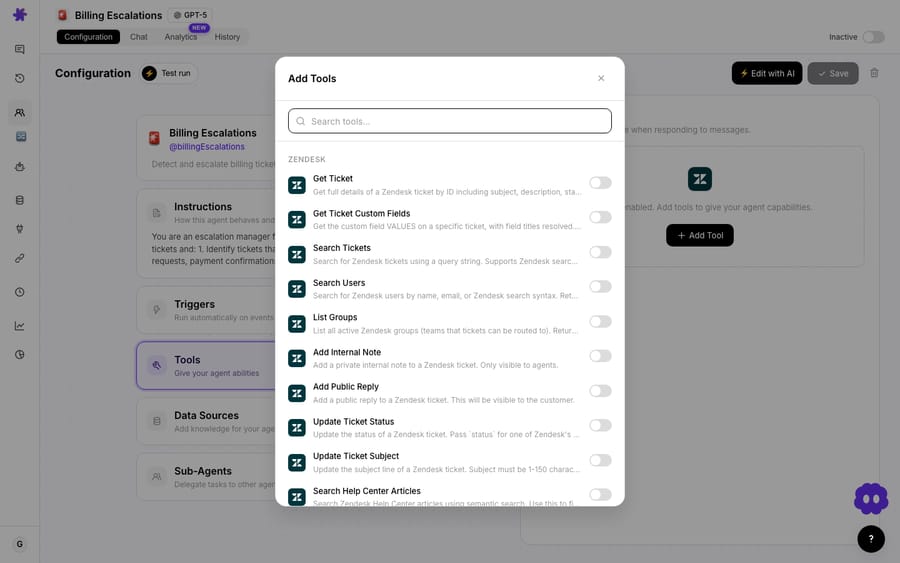
When you connect Confluence, the agent gains seven distinct tools. Four are read/navigate operations and three are writes. Here's the full set:
| Tool | Type | What it does |
|---|---|---|
| Search Pages | Read | Search pages by keyword across all spaces or within a specific space. |
| Get Page | Read | Read the full content of a page by its page ID. |
| List Spaces | Read | List every available space with its key and name. |
| Get Page Children | Read | Fetch the child pages of a page to navigate a hierarchy. |
| Create Page | Write | Create a new page in a space; confirmation required. |
| Update Page | Write | Update an existing page's title and content; confirmation required. |
| Add Comment | Write | Add a comment to a page; confirmation required. |
Authentication is via an Atlassian API token, scoped to whatever the connecting account can see. Once Confluence is connected, those seven tools show up in the agent's tool picker, where you toggle them on per agent and decide whether a given agent is read-only or read-and-write.
The read tools: knowledge in, the agent's way
The four read tools are what make Confluence usable mid-ticket. The pattern an agent follows is the one a good human agent follows: Search Pages to find candidate docs by keyword, Get Page to pull the full content of the right one, and, when the answer lives inside a documentation tree rather than a single page, List Spaces and Get Page Children to walk the hierarchy until it lands on the specific section.
That last pair matters more than it looks. A lot of Confluence knowledge is structured as a parent index page with a dozen children ("Billing → Refunds → EU VAT edge cases"). An agent that can only do flat search will surface the index and stop; one that can list spaces and traverse children can drill to the leaf page where the actual procedure lives.
The write tools: gated by design
An agent that can freely rewrite your wiki is a liability. So Macha gates all three writes: every write operation requires explicit confirmation before it runs. Nothing gets created, edited, or commented on your Confluence without a deliberate go-ahead.
In an autonomous run, that confirmation surfaces as a tool card the operator approves; in an interactive build, you see exactly what the agent intends to write before it commits. You can hand an agent the ability to document without handing it the ability to vandalize: the read tools run freely, the write tools ask first.
How does Macha access your Confluence data?
Every Atlassian admin asks this, and most "Confluence AI agent" pages skip it. Here's the data flow:
- Access is via an Atlassian API token you create and scope. Macha never asks for your Atlassian password. The agent can only see what the connecting account can see; a space or page that account can't read, the agent can't read either. Scope the token to a service account with the minimum spaces it needs.
- Reads are live, not a full-wiki copy. Macha doesn't bulk-export your entire Confluence into its own store. The read tools query Confluence at the moment the agent needs an answer, so what the agent reads reflects the current page, and revoking the token cuts access immediately.
- Writes are token-scoped and gated. Create, update and comment run under the same token's permissions and behind the confirmation gate above, so an agent can't write where its account lacks permission, and can't write at all without approval.
- Tokens are stored as credentials, not left in the open. Macha treats connector credentials as encrypted secrets (the same posture as its Custom API Tools, where credentials are encrypted at rest per the April 9 changelog). Pair that with token-expiry monitoring (below) and the connection has a clean lifecycle: scoped in, monitored, deactivated on failure.
This isn't a substitute for your own security review. Check the docs and Macha's security page before connecting production data. The shape of the data flow is token-scoped, live read, gated write, encrypted credential.
What happens when your Atlassian API token expires?
Two things separate a connector you can demo from a connector you can run in production. Macha's Confluence integration handles both.
It auto-creates a data source. Connecting Confluence automatically creates a Macha data source, the same behavior you get with Google Workspace and Notion. You don't have to separately wire the connector up as searchable knowledge; the moment it's connected, it's available as a source your agents can be pointed at.

It monitors your token expiry so a connection doesn't silently die. Atlassian API tokens expire. When you connect, you enter your token's expiration date, and Macha does two things with it: it emails you a reminder 30 days before expiry, and it automatically deactivates the connector on 401 errors. The second part matters most. Instead of an agent silently failing every Confluence lookup against a dead token (and posting "I couldn't find anything" to customers), the connector deactivates cleanly and you get told. Token rotation is the most common way an integration like this breaks, and the reminder plus the fail-safe turn a week of degraded answers into a one-line outage.
What workflows can you run with the Confluence connector?
Macha ships two configured use cases built on the connector. Both pair Confluence with a helpdesk (Zendesk in these examples; the same shape works on Zendesk, Freshdesk, Gorgias, Front, HubSpot or Intercom).
1. Search internal docs to resolve a ticket
This is the read path end to end. The trigger is a new ticket. The agent runs Get Ticket to read it, Search Pages to find the relevant Confluence doc, Get Page to read it in full, and then adds an internal note on the Zendesk ticket with the troubleshooting steps, so the human agent has the answer staged before they even open it.
A concrete trace from the shipped use case: a customer reports a 503 error on the reporting dashboard. The agent searches Confluence for "503 error reporting dashboard," finds the "Reporting Dashboard: Troubleshooting Guide" in the Engineering space, and drops an internal note listing the fix (check cache service, restart the reporting worker, verify the DB connection pool) plus the historical detail that it was last seen in January and resolved by restarting the worker. No write to Confluence happened, so no confirmation gate was needed.
2. Auto-document resolved issues as runbooks
This is the write path, and it shows why the confirmation gate exists. The trigger is a solved ticket. The agent runs Get Ticket to review the full thread, Search Pages to check whether a runbook already exists, and, if none does, Create Page to write one. In the shipped example, ticket #4821 ("SSO login failing for new users") becomes a new "Runbook: SSO Login Failing for New Users" page in the Support Runbooks space, structured as Problem / Root cause / Solution / Prevention and built from the actual resolution. Over time, every resolved issue becomes searchable documentation, and the next ticket on the same problem gets answered by workflow #1 reading the runbook workflow #2 just wrote.
That loop (resolve, document, then resolve faster next time) is the payoff of having both read and write tools on the same knowledge source.
When is Macha's Confluence connector the wrong fit?
- Confluence search is keyword search. Search Pages queries Confluence's own search. If your spaces are messy, titled inconsistently, or full of stale duplicates, the agent inherits that mess. Macha makes your Confluence usable by an agent; it doesn't clean it up for you. Tidy spaces and clear page titles improve results.
- Write actions need a human in the loop. The confirmation gate means fully unattended page creation isn't the default posture, by design. If you want zero-touch documentation, you're accepting a review step.
- It's scoped to what the token can see. Tools run with the permissions of the connecting Atlassian account. A page that account can't read, the agent can't read either. Scope the token deliberately.
- It's knowledge, not the system of record. For commerce or billing actions, you still want the relevant connector (Shopify, Stripe). Confluence answers "how do we handle this"; it doesn't look up this customer's order. The strength is combining them in one agent.
- You manage token rotation. The 30-day reminder and 401 auto-deactivate are guardrails, but they assume someone acts on the reminder.
For most teams running Atlassian, none of these are dealbreakers. They're the normal contours of connecting a knowledge base to an automation layer.
How does Macha compare to Rovo and Confluence's own plans on cost?
Atlassian's native Rovo works inside Confluence and Jira and is the right call if your support team also lives in Jira Service Management. Atlassian's pricing page (checked 24 September 2026) lists Confluence Free for up to 10 users, Standard at $5.42 per user a month and Premium at $10.44 per user a month, with Enterprise quoted on request. Atlassian prices by seat, so its revenue grows with headcount. What those plans don't do is bring that knowledge into a non-Atlassian helpdesk and act there.
That's Macha's lane: if your agents work in Zendesk, Freshdesk, Gorgias, Front, HubSpot or Intercom and your knowledge lives in Confluence, Macha is the layer that reads the one and acts in the other, with the seven tools above, the confirmation gate on writes, and per-ticket pricing rather than per-seat. Macha is one plan priced by ticket volume, starting at $299 a month for up to 750 tickets (see the pricing page), and setup is done for you on the trial and every plan: the Macha team connects your Confluence spaces, builds the agent on your help desk, tests it on a sample of your past tickets, and runs it in safe mode, with drafts as internal notes, until the answers are right. About $0.40 a ticket also covers a dedicated success manager who handles your changes afterwards, such as new spaces, instruction changes or new tools. One ticket is charged once however many Confluence lookups and replies it takes, and seats are unlimited.
FAQ
What is a Confluence AI agent? It's software that can read (and sometimes write) your Confluence knowledge and act on it. The main flavors in 2026 are Atlassian's own Rovo inside Confluence, third-party partner agents such as Lovable, Replit and Gamma, DIY RAG over the Confluence API, and layers like Macha that read Confluence and act in a separate helpdesk.
What does the Macha Confluence integration do? It gives your AI agents seven tools to work with Confluence (Search Pages, Get Page, List Spaces, Get Page Children, Create Page, Update Page, and Add Comment) so agents can find and read your documentation and, with confirmation, write to it while resolving tickets in your helpdesk.
Does Macha replace Confluence or my helpdesk? No. Macha is an AI agent layer that sits on top of both. Your knowledge stays in Confluence, your tickets stay in your help desk (Zendesk, Freshdesk, Gorgias, Front, HubSpot or Intercom), and Macha's agents read the first to act in the second.
Is my Confluence data safe? What does Macha store? Macha connects with an Atlassian API token you scope, reads pages live rather than bulk-copying your wiki, and stores the token as an encrypted credential. The agent can only see what the token's account can see, and revoking the token cuts access immediately.
Can an agent edit my Confluence pages without me knowing? No. All three write operations (create, update, and comment) require explicit confirmation before they run. Read operations run freely; writes ask first.
How does authentication work, and what happens when my token expires? You connect with an Atlassian API token and enter its expiration date. Macha emails a reminder 30 days before expiry and automatically deactivates the connector on 401 errors, so a dead token can't silently degrade your agents' answers.
Which helpdesks does this work with? Any helpdesk Macha connects to: Zendesk, Freshdesk, Gorgias, Front, HubSpot or Intercom. The two shipped workflows use Zendesk, but the pattern is helpdesk-agnostic.
How much does Confluence cost? Atlassian's pricing page lists a Free plan for up to 10 users, Standard at $5.42 per user a month and Premium at $10.44 per user a month, with Enterprise quoted on request (checked 24 September 2026).
How do you get started?
If your runbooks and SOPs live in Confluence and your tickets live somewhere else, this connector is the bridge. Start a free trial ($50 of usage, no credit card required), connect Confluence and your helpdesk, and point an agent at a space. Read the Confluence integration page for the full tool list, or the docs for the setup walkthrough. If you're on Zendesk specifically, the Macha on Zendesk page shows how the agent layer fits your workspace.
Written by Abbas (Customer Support & AI, Macha) · Reviewed by Ankeet Guha (Co-founder & CTO) · Published 2026-06-24 · Last updated 2026-09-24.