Intercom
 Shopify
 Stripe
 Slack
Slack Notion
 Google Workspace
 Confluence

Zendesk vs. Freshservice (2026): Customer Support vs. IT Service


Before anything else, one clarification that trips up a lot of searchers: Freshservice is not Freshdesk. Both are made by Freshworks, but they do different jobs. Freshdesk is a customer-support help desk (that's the true Zendesk competitor — see our [Zendesk vs. Freshdesk](/blog/zendesk-vs-freshdesk) comparison). Freshservice is an ITSM tool for internal IT and employee service — incidents, changes, assets, and an IT service portal. So Zendesk vs. Freshservice isn't a like-for-like helpdesk fight; it's customer experience (CX) vs. IT service management (ITSM), much like [Zendesk vs. ServiceNow](/blog/zendesk-vs-servicenow) or [Zendesk vs. Jira Service Management](/blog/zendesk-vs-jira-service-management).

Short version: Zendesk for external customer support; Freshservice for internal IT/employee service — and many organizations run both.
The 30-second verdict
| If your job is… | Pick |
|---|---|
| External customer support / CX (email, chat, social, voice) | Zendesk |
| Internal IT service desk (incidents, requests, assets) | Freshservice |
| ITIL processes: incident / problem / change / release | Freshservice |
| CMDB, IT asset & SaaS management | Freshservice |
| High-volume omnichannel customer support | Zendesk |
| Both a customer team and an IT desk | Often both (complementary) |
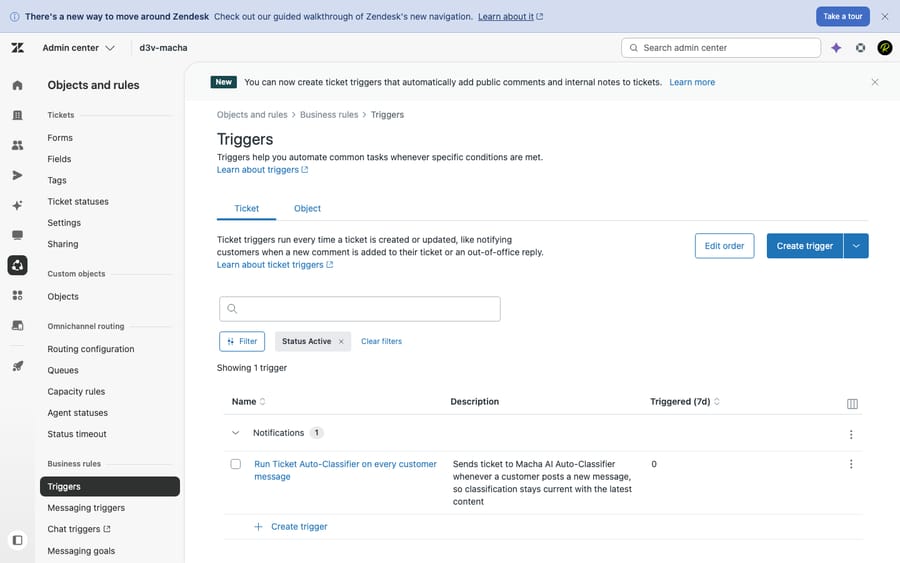
How we compared: Zendesk and Freshservice pricing is verified against each vendor's official page (June 2026); features are checked against the products, and we ran Zendesk hands-on in a live test account (screenshot below). User sentiment comes from real G2, Capterra, and TrustRadius reviews. One caveat worth flagging up front: because these tools serve different jobs, their review bases describe different use cases — most Freshservice reviews come from internal IT/employee-service teams, while Zendesk's come from external customer-support teams, so ratings aren't apples-to-apples. Macha is our own product — we flag that wherever it comes up.
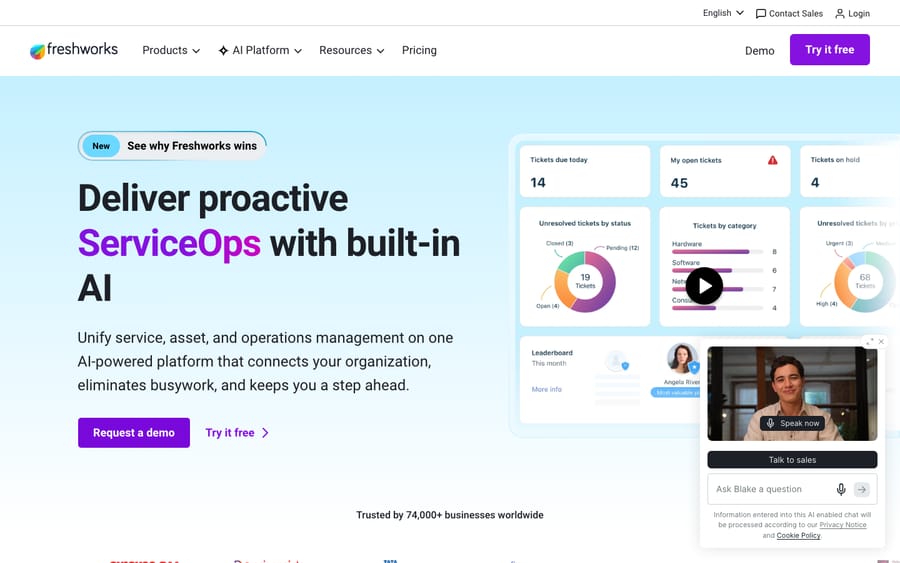
Pricing: close on the sticker, different on the meter
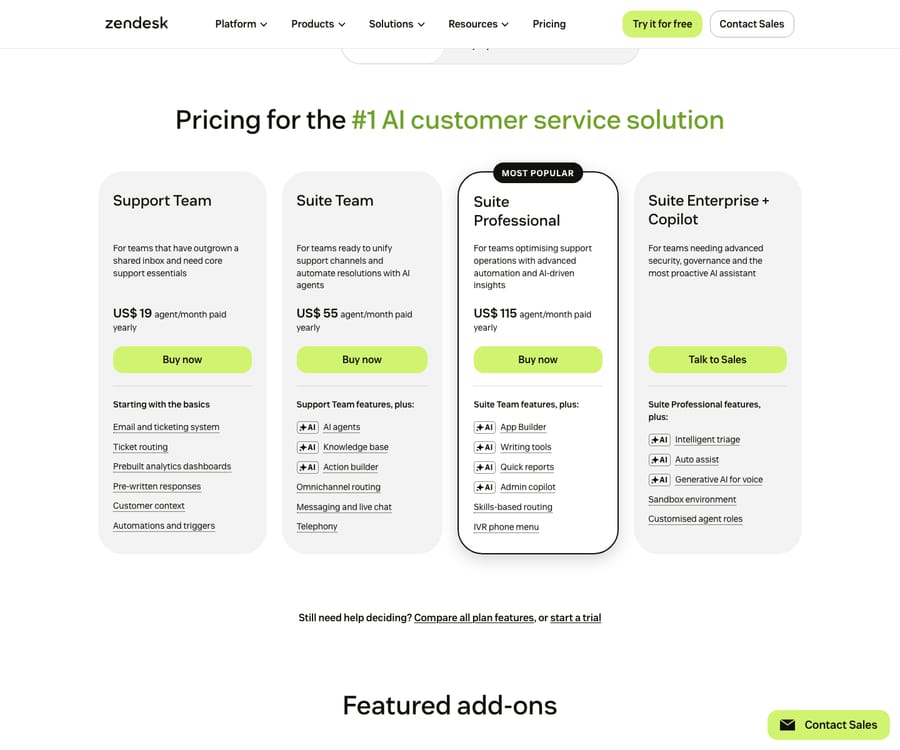
Zendesk Suite (per agent/month, annual): Support Team $19, Suite Team $55, Suite Professional $115, Enterprise contact sales; Copilot $50/agent; AI agents $1.50 per automated resolution on a committed plan, $2.00 pay-as-you-go. Source: Zendesk pricing.
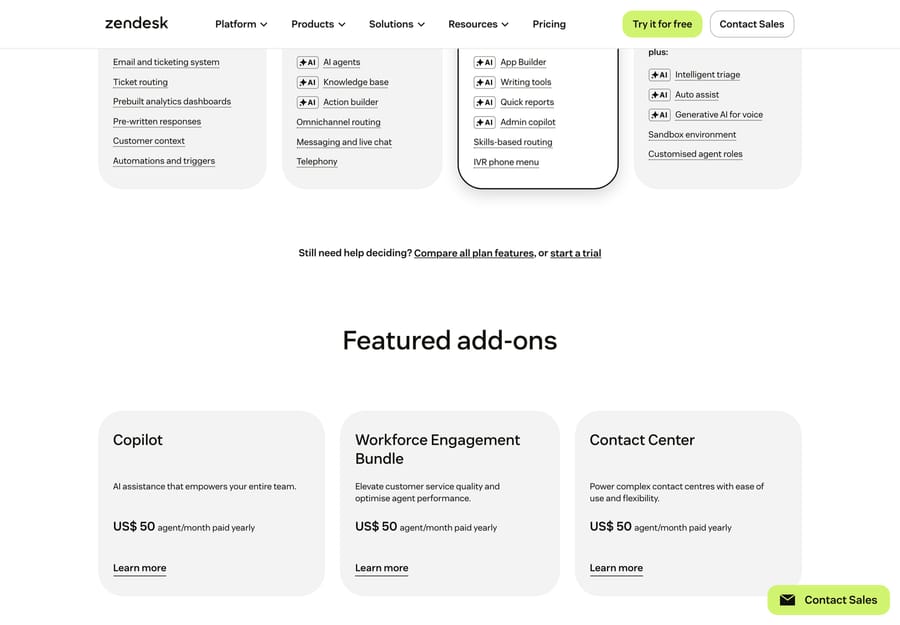
Beyond the per-seat plans, Zendesk’s AI and CX capabilities are sold as separate add-ons — each priced per agent on top of your base plan:
Freshservice (per agent/month, annual): Starter $19, Growth $49, Pro $99, Enterprise custom. Source: Freshservice pricing. AI and IT-specific add-ons: Freddy AI Copilot $29/agent (Pro and Enterprise only); the autonomous Freddy AI Agent is bundled into Enterprise (≈1,200 sessions/year included); occasional-agent day passes from $3; IT asset units sold in packs of 500; orchestration transactions metered.
The sticker tiers look similar ($19 / ~$49–55 / ~$99–115), but the two meter different value. Freshservice charges for assets and orchestration (it's an IT platform); Zendesk charges for AI resolutions and channels/voice (it's a CX platform). Both typically land 30–50% above sticker once add-ons and AI are switched on — so compare based on what you actually need to meter, not the headline.
Feature-by-feature: who wins what
| Capability | Winner | Why |
|---|---|---|
| Customer-support ticketing & agent workspace | Zendesk | Purpose-built CX desk: unified conversations, macros, side conversations, customer context |
| ITSM (incident/problem/change/release) | Freshservice | ITIL-aligned lifecycle out of the box; Zendesk has no native ITIL process model |
| CMDB / IT asset & discovery (ITAM) | Freshservice | Native CMDB, discovery agents, software/SaaS & contract management; Zendesk has none |
| Omnichannel external support (chat/social/WhatsApp/voice) | Zendesk | Deep messaging, social, native voice/contact center; Freshservice is portal/email/Teams/Slack-centric |
| Workflow automation / orchestration | Freshservice | "Orchestration" runs cross-app IT actions (Azure AD, Okta, AWS) — provisioning, on/offboarding |
| Native AI | Split | Zendesk AI is stronger for customer-facing deflection; Freddy AI is tuned for employee/IT intents |
| Knowledge / self-service | Zendesk (customers) / Freshservice (employees) | Guide is a mature public help center; Freshservice's portal suits internal self-service |
| Reporting / analytics | Zendesk | Explore is more mature/customizable, especially at enterprise scale |
| Ease of setup | Freshservice | Consistently praised for fast deployment and intuitive UI |
| Project management / PPM, alerting / on-call | Freshservice | Native IT project management and major-incident/on-call paging; Zendesk has neither |
The pattern: Zendesk is the better customer-support platform; Freshservice is the better internal IT service desk. They're not really substitutes.
Strengths & weaknesses, honestly
Zendesk — strengths: best-in-class external CX ticketing and agent workspace; true omnichannel + native voice; mature KB (Guide) and analytics (Explore); largest CX marketplace; strong customer-facing AI. Zendesk — weaknesses: no native ITSM (no ITIL change/problem/release, no CMDB/ITAM, no on-call, no PPM); cost stacks once Copilot/WFM/Contact Center/AI usage is added; Enterprise is opaque "contact sales."
Freshservice — strengths: purpose-built ITIL ITSM; native CMDB + ITAM + discovery; orchestration for IT automation; project management and on-call; fast to deploy; competitive sticker price. Freshservice — weaknesses: not built for external/customer support (weaker public help center, omnichannel, social, high-volume CX); reporting less deep at enterprise scale; the best autonomous AI is effectively Enterprise-gated; asset/orchestration metering adds variable cost.
What real users say
The headline ratings are high for both — but they describe different jobs, so read them as directional, not head-to-head. (Observed June 2026.)
| G2 | Capterra | TrustRadius | |
|---|---|---|---|
| Zendesk | 4.3 / 5 (~6,700) | 4.5 / 5 (4,038) | 8.7 / 10 |
| Freshservice | 4.6 / 5 (1,312) | 4.5 / 5 (733) | 8.6 / 10 (328) |
Two things to keep in mind. First, the review bases describe different use cases: Freshservice's reviews come overwhelmingly from internal IT and employee-service teams (incidents, assets, change), while Zendesk's come from external customer-support teams — so a higher star average for Freshservice reflects ITSM satisfaction, not a win over Zendesk at customer support. Second, Freshservice's bases are much smaller (1,312 on G2 and 733 on Capterra vs Zendesk's ~6,700 and ~4,000), so its averages are drawn from a narrower, more IT-skewed sample.
- Zendesk — reviewers praise it as a single hub for external conversations and its everyday agent usability: "centralises all customer interactions (email, chat, and tickets) in one place" (Sonu P., Systems Analyst, Capterra, May 2026). The recurring knocks are pricing/add-on creep and changes to reporting: "latest updates with reporting are difficult to navigate and removed helpful features" (Melanie J., HR Manager, Capterra, Dec 2025).
- Freshservice — praised for a clean, fast-to-deploy ITSM experience and time-saving automation: "has a very clean UI that is easy and intuitive to navigate" (Brendan C., Senior Solutions Engineer, Capterra, Jan 2026). The common criticism is complexity at the deeper end — advanced workflows and reporting take time to master: "Some advanced configurations, especially for workflows and reports, can take time to fully understand" (Rakesh M., Senior IT Infra Executive, Capterra, Mar 2026).
The sentiment matches the rest of this guide: Zendesk users talk about cost and reporting on a customer-support platform; Freshservice users talk about setup ease and the learning curve of deeper IT workflows — they're rating two different jobs.
Who each is genuinely for
- Zendesk → organizations whose primary job is external customer support / CX — B2C and B2B support, e-commerce, SaaS support, contact centers. Scales SMB → enterprise CX.
- Freshservice → internal IT and employee service desks needing ITIL processes, CMDB, asset/SaaS management, and IT automation/orchestration. Scales mid-market → enterprise IT.
When to run both (usually the right answer)
Because they serve different jobs, large organizations commonly pair Zendesk for customer-facing support with Freshservice for internal IT/HR/facilities employee service — and integrate them so a customer ticket can spawn an IT change or asset request. Choosing strictly "one or the other" usually means the problem's been mis-scoped: if you have both external customers and internal employees to serve, the answer is often integration, not migration. (Note: Zendesk markets an internal "Employee Experience" angle, but it's an extension, not purpose-built ITSM — don't expect it to replace Freshservice's CMDB/ITIL depth.)
The AI question — siloed by domain
Both vendors have capable AI, but each is siloed to its own domain and data. Zendesk AI (Copilot $50/agent; AI agents $1.50/resolution committed, $2.00 pay-as-you-go) is strong for customer-facing deflection but doesn't reach into IT/asset context. Freddy AI (Copilot $29/agent on Pro+; autonomous agent gated to Enterprise with a capped session allowance) is tuned for employee/IT intents but doesn't handle external CX channels. Neither resolves end-to-end across both customer and IT systems.
That's where an external AI agent layer helps: it sits on top of the help desk(s), reads from your knowledge and connected systems, and adds autonomous resolution — orchestrating across tools rather than re-platforming. A layer like Macha is helpdesk-agnostic and billed per ticket — one conversation, charged once however many messages it takes; it augments whichever desks you run, rather than replacing them. The honest caveat: a layer is another vendor and integration to manage, it only resolves as well as the knowledge you connect, and per-ticket pricing isn't free at high volume — it's additive, not a free win. (More: native AI vs. an AI layer.)
Migration vs. integration
Because the data models differ (Zendesk = customers/orgs/conversations; Freshservice = requesters/assets/CIs/changes), a 1:1 migration between them rarely makes sense — the use cases are different. Migrating to Freshservice only fits if Zendesk was being mis-used as an internal IT desk; migrating to Zendesk only fits if a team adopted Freshservice for customer support (the wrong tool). The far more common pattern is integration — keep both and connect them, so a Zendesk customer ticket can trigger a Freshservice change or asset request.
Frequently asked questions
Is Freshservice the same as Freshdesk? No. Freshdesk is Freshworks' customer-support help desk (the direct Zendesk competitor); Freshservice is Freshworks' ITSM tool for internal IT/employee service. For Zendesk vs. the customer-support product, see Zendesk vs. Freshdesk.
Is Freshservice a Zendesk competitor? Only loosely. They both "do tickets," but Zendesk is for external customer support and Freshservice is for internal ITSM — it's more comparable to ServiceNow or Jira Service Management.
Which is cheaper? Sticker prices are similar ($19 / ~$49–55 / ~$99–115). Real cost depends on what you meter — Freshservice on assets/orchestration, Zendesk on AI resolutions and voice.
Can Zendesk do ITSM? Not natively — no CMDB, ITIL change/problem/release, on-call, or PPM. It offers an internal "employee experience" extension, but it's not purpose-built ITSM.
Should I run both? Often yes — Zendesk for customers, Freshservice for internal IT — integrated rather than consolidated.
The bottom line
This isn't really a head-to-head: Zendesk wins customer support; Freshservice wins internal IT service. If you only have one job, pick the tool built for it. If you have both customers and employees to serve, running both — integrated — is usually smarter than forcing one tool to do everything. And whichever desks you run, an AI layer on top can add autonomous resolution that neither vendor's domain-siloed AI delivers alone.
Run Zendesk (or Zendesk + Freshservice) and want autonomous AI on top? See how Macha layers AI agents over your help desk, billed per ticket. $50 of free usage, no credit card required. Start Trial.
Add AI agents to your Zendesk
Macha reads the ticket, drafts the reply and takes the action, inside the Zendesk you already run.