Intercom
 Shopify
 Stripe
 Slack
Slack Notion
 Google Workspace
 Confluence

Observe.ai: The Complete Guide (2026)


If you run a contact center and you've been evaluating AI for quality assurance, agent coaching, and conversation intelligence, Observe.ai is almost certainly on your shortlist. It's one of the most established voice-AI platforms aimed at large support and sales operations, and it shows up in nearly every "best contact center AI" roundup. This complete 2026 guide covers what Observe.ai actually does, how its AI works, what it really costs, its honest pros and cons, who it fits best, and how it compares to the alternatives — including where a different kind of tool like Macha makes more sense.

We researched pricing, funding, and reviews in July 2026. Observe.ai doesn't publish a public price list, so the numbers below are third-party estimates, clearly flagged as such. Ratings and sentiment are drawn from current G2 reviews, and product claims are cross-checked against Observe.ai's own materials and press coverage.
What Observe.ai is
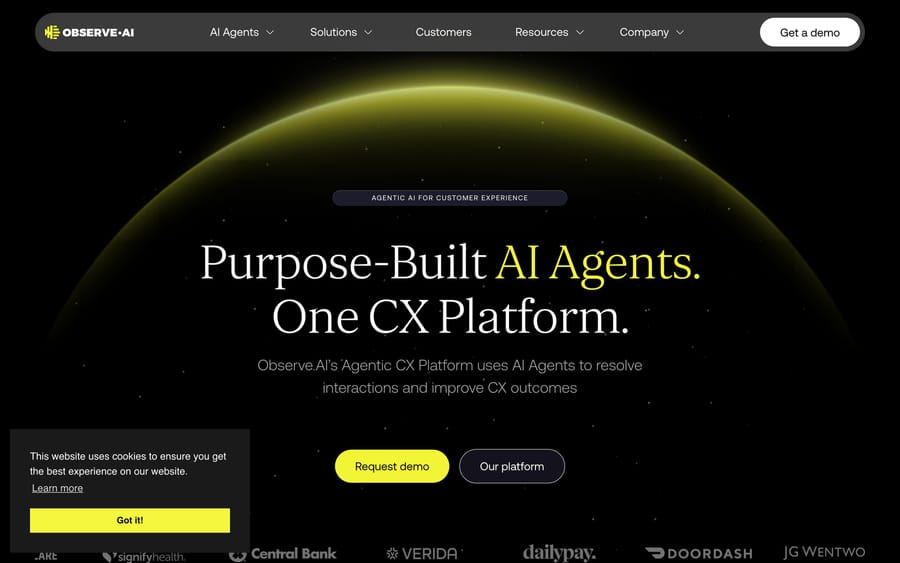
Observe.AI's homepage — a contact-center AI and conversation-intelligence platform.
Observe.ai is a conversation intelligence and automation platform built for contact centers. Its core job is to capture every customer interaction — primarily voice calls — transcribe it, analyze it, and turn that analysis into quality scores, coaching insights, operational reporting, and, increasingly, automated call handling.
The company was founded in 2017 and is headquartered in San Francisco. It has reportedly raised ~$213 million across roughly seven rounds from more than 20 investors, including a $125 million Series C in 2022 led by Softbank Vision Fund 2 (with Zoom Ventures participating) and an earlier $54 million Series B (per Crunchbase, as of 2026). That funding history matters for a buyer: it signals an enterprise-grade vendor with the balance sheet to invest in R&D and support large deployments, and it also explains why the company prices and sells like an enterprise platform rather than a self-serve tool. Observe.ai has reported that its platform is used by more than 350 organizations, concentrated in high-volume voice operations.
In practice, teams use Observe.ai for four connected things:
- Automated quality assurance (Auto QA): scoring 100% of interactions against a scorecard, instead of the 1–2% a human QA team can realistically review by hand.
- Agent coaching and performance: surfacing where individual agents struggle, tracking improvement, and feeding structured coaching workflows.
- Business and CX analytics: mining conversations for trends — churn signals, compliance risks, product complaints, sentiment shifts.
- AI agents that handle calls: its newer VoiceAI agents can autonomously resolve certain call types end to end, moving Observe.ai from a pure analytics tool toward automation.
It's aimed squarely at mid-to-large voice contact centers — think 100+ agents, often in regulated industries like healthcare, financial services, insurance, and collections where compliance scoring and call auditing are non-negotiable.
How Observe.ai's AI works
Observe.ai's pipeline starts with speech-to-text transcription of recorded calls (and text transcripts for chat and messaging channels). Its models are tuned for the messy realities of contact-center audio — regional accents, cross-talk, background noise, and industry-specific jargon like policy numbers, drug names, or billing codes.
The distinctive technical bet underneath the platform is a domain-specific large language model. Rather than relying solely on general-purpose foundation models, Observe.ai has built and markets what it describes as a ~30-billion-parameter LLM trained on hundreds of millions of real contact-center conversations. The argument is that a model steeped in support and sales dialogue understands intent, disposition, and compliance language more reliably than a generic model prompted after the fact — and that it can run with the latency and cost profile a high-volume center needs. In practice the platform blends this proprietary model with other capabilities depending on the workload.
On top of the transcript, the AI layer does the analytical heavy lifting: intent and sentiment detection, automated scorecard evaluation, redaction of sensitive data (PCI/PII), and generative summarization so supervisors don't have to read full transcripts. Observe.ai also markets omnichannel workflow orchestration alongside its analytics core, so dispositions and insights can flow into downstream systems.
The most important architectural fact for buyers: Observe.ai's historical center of gravity is post-call analysis. It is exceptionally strong at evaluating what already happened across your entire call volume. Its real-time and autonomous-agent capabilities are newer and growing (more on that below), but if you're comparing it to a purpose-built live-coaching platform, understand that post-interaction QA and coaching is where the product is deepest and most proven.
Key features
- Auto QA / 100% scorecard coverage — evaluate every interaction against a customizable scorecard, not a 1–2% human sample. Scores are traceable back to the exact moment in the call that triggered them.
- Post-interaction analytics — sentiment, intent, compliance adherence, escalation risk, and CSAT prediction across your full call volume, with dashboards for QA managers and operations leaders.
- Agent coaching workflows — structured, evidence-backed coaching tied to specific moments in specific calls, with tracking so supervisors can see whether coaching actually moves the needle over time.
- VoiceAI agents — autonomous AI agents (launched in early 2025) that handle inbound and outbound calls for defined use cases, from password resets to routine billing questions, escalating to a human when needed.
- Real-time / Agent Assist — in-the-moment knowledge surfacing, prompts, and guidance during live interactions. This is a real and expanding capability, though historically less mature than the post-call core.
- Automated redaction — masking PCI/PII in transcripts and recordings for compliance in regulated industries.
- Generative summaries and after-call work — auto-generated call recaps and dispositions to cut the time agents spend wrapping up.
Integrations and deployment
Observe.ai is designed to sit as an AI layer on top of your existing contact-center stack rather than replace it. It ingests calls and interaction data from major CCaaS platforms — the likes of Genesys, Five9, NICE, Talkdesk, Amazon Connect, and similar telephony and cloud contact-center systems — and pushes analysis, dispositions, and scores back out. It also connects to CRMs and help desks (for example Salesforce and Zendesk) so that call insights land where agents and managers already work.
Deployment is a guided enterprise onboarding, not a plug-and-play sign-up. A typical rollout involves connecting call recording and CCaaS data sources, configuring scorecards to match your existing QA rubric, tuning transcription and redaction for your vertical, and training supervisors on the coaching workflows. Because the value scales with call volume and configuration quality, buyers should budget for implementation time and internal QA-team involvement — this is a platform you configure to your operation, not one you switch on in an afternoon.
Named customers and verticals
Observe.ai's public customer base skews toward high-volume, often regulated voice operations: financial services, insurance, collections, healthcare, retail, and consumer services. These are the environments where the economics work — centers with enough call volume and compliance exposure that automating QA across 100% of interactions replaces a meaningful amount of manual audit labor and reduces regulatory risk. The company points to results framed around QA coverage, coaching-driven performance lift, and reduced after-call work rather than a single headline metric, which is consistent with a platform whose value compounds across a large agent population.
Observe.ai pricing
Observe.ai uses custom, quote-based pricing — there's no public price list, and deals are negotiated per account. This is standard for enterprise contact-center software, but it does mean you can't self-serve your way to a number: you'll go through a sales conversation and, usually, a scoping call before you see a quote.
What actually drives the price. From what buyers report and how the platform is packaged, the main cost drivers are:
- Seats / agents: pricing is commonly structured per agent (or per named user) per month, so headcount is the primary lever.
- Call and interaction volume: because the AI transcribes and analyzes 100% of interactions, total volume — minutes of audio, number of conversations — feeds into the cost.
- Modules turned on: QA/analytics, agent coaching, real-time Agent Assist, and VoiceAI agents can be priced separately. A QA-only deployment costs less than one that adds autonomous voice agents.
- Contract term and commitment: annual commitments and multi-year deals typically unlock better per-seat rates, as does higher volume.
Based on researched third-party estimates (not official figures), the directional picture in 2026 looks roughly like this:
- Entry point: around ~$69 per agent per month for a baseline package, per multiple third-party breakdowns.
- Typical annual deployment: approximately $60,000–$180,000 per year for 100 seats, depending on modules and volume.
Treat these as directional only — they are third-party estimates, not published rates, and your quote could fall outside this range. Because pricing is bundled and negotiated, your actual number depends heavily on which capabilities you turn on and your total interaction volume. The honest takeaway: Observe.ai is priced as an enterprise platform, and it makes the most economic sense at scale (100+ agents) where automating QA replaces a meaningful amount of manual review labor. If you're a small team, the per-seat model and enterprise sales motion are likely to feel heavy relative to the value. Always confirm current numbers directly with Observe.ai.
Pros and cons
No platform is all upside. Here's the balanced view from 2026 reviews.
Pros
- Genuinely strong post-call QA and coaching — widely regarded as one of the best platforms on the market for scoring 100% of interactions and driving structured coaching.
- Ease of use — the most-cited positive on G2; reviewers find the interface intuitive for running detailed conversation analyses.
- Actionable AI insights — turns raw call volume into trends leaders can act on.
- Responsive support — quality of support shows up repeatedly as a strength.
- Solid G2 rating — reportedly around 4.6/5 across ~236 reviews at the time of writing (per G2, as of 2026).
Cons
- Transcription accuracy — the single most common complaint in the review data. Analytics are only as good as the transcript underneath them, and noisy audio, heavy accents, or overlapping speech can degrade results. Because every downstream score depends on the transcript, this is the failure mode to test hardest in a trial with your own calls.
- Real-time assist is newer than the post-call core — Observe.ai does market Agent Assist and live capabilities, but its deepest, most proven strength is post-call QA and coaching. If truly live, in-the-moment mid-call guidance is your single most important requirement, evaluate it head-to-head against a purpose-built real-time coaching tool.
- Setup and learning curve — some features feel complex at first; getting full value takes configuration time, a mapped-out scorecard, and internal QA-team buy-in.
- Enterprise pricing and sales motion — the model favors large centers; smaller teams may find the per-seat cost and quote-based process hard to justify.
- Voice-first focus — it's purpose-built for calls. If most of your support volume is email, chat, and tickets rather than phone, a lot of the platform's strength doesn't apply to you.
Who Observe.ai is best for
Observe.ai is a strong, defensible buy if you are a 100+ seat voice contact center — especially in a regulated industry (healthcare, finance, insurance, collections) where post-call QA, compliance scoring, and call auditing are core requirements. If your primary pain is "we can only review 1% of calls, we need to score all of them, and we need to coach agents from that," Observe.ai is close to a category leader, and its VoiceAI agents give you an on-ramp to automating high-volume, repetitive call types over time.
It's a weaker fit if you need live, real-time agent guidance during calls as your number-one need, if you're a small team that can't amortize enterprise pricing, or if your support volume is mostly text and tickets rather than voice. That last case is worth calling out because it's a genuinely different problem, and it's where a tool like Macha — rather than any voice-QA platform — is the relevant option.
Observe.ai vs. alternatives (including Macha)
Observe.ai competes with other contact-center AI and speech-analytics platforms. A few common comparisons:
| Tool | Core strength | Primary channel | Real-time in-call assist | Pricing model | Best for |
|---|---|---|---|---|---|
| Observe.ai | Post-call QA, coaching, conversation analytics + VoiceAI agents | Voice | Growing (post-call is deepest) | Custom / ~$69+ per agent/mo (est.) | Large voice contact centers, regulated industries |
| Balto | Real-time in-call guidance | Voice | Yes (its whole point) | Custom | Live coaching mid-call |
| Level AI | QA + analytics | Voice + digital | Partial | Custom | QA-focused CX teams |
| CallMiner | Deep speech analytics at scale | Voice | No | Custom (enterprise) | Large-scale interaction analytics |
| Cresta | Real-time assist + generative coaching | Voice + chat | Yes | Custom (enterprise) | Live agent assist at scale |
| Macha | AI agents that resolve email/chat/ticket support inside your help desk | Text / tickets | N/A (not a voice-QA tool) | From $299/mo for 750 tickets (~$0.40/ticket) | Zendesk/Freshdesk teams automating email + chat |
A word on where Macha fits, since it's our product and we want to be straight with you: Macha is not an Observe.ai competitor, and if your job is voice QA and post-call coaching, Observe.ai (or a real-time tool like Balto) is the right category, not us. Macha solves a different problem — it's an AI agent layer that runs on top of your existing help desk (Zendesk or Freshdesk) to actually resolve inbound email and chat tickets in plain English, billed per ticket rather than per agent seat. Some contact centers run both: Observe.ai to analyze and coach their voice channel, and something like Macha to deflect and automate their text channel. They're complementary, not either/or. If your support is primarily written, that's the use case where Macha's AI agents and custom tools are worth a look; you can see how our pricing works on a per-ticket basis.
The two platforms Observe.ai is shortlisted against most often both have guides here: Cresta, which comes at the same real-time coaching problem from the agent-assist side, and Level AI, which is the closer match if auto-QA rather than live coaching is what you are actually buying.
How we researched this: The features, pricing and customer figures above come from Observe.ai's own public pages and the third-party sources linked inline, checked when this guide was researched in August 2026. This pass, on 21 September 2026, re-checked the post's links and added cross-references to our guides on the closest alternatives; it did not re-price the plans against Observe.ai's site, so read the numbers as accurate to August 2026 rather than to today. G2 and Capterra block scripted requests, so the review figures quoted here are the ones recorded at the time of writing and were not re-pulled in this pass.
Frequently asked questions
What does Observe.ai do? Observe.ai is a contact-center conversation intelligence platform. It transcribes and analyzes customer interactions (mainly voice calls) to automate quality assurance, drive agent coaching, and surface CX and compliance insights across 100% of your interactions.
How much does Observe.ai cost? Observe.ai uses custom, quote-based pricing and doesn't publish a list price. Third-party estimates put the entry point around $69 per agent per month, with full 100-seat deployments commonly landing between roughly $60,000 and $180,000 per year depending on modules and volume. Confirm current numbers directly with Observe.ai.
Does Observe.ai offer real-time agent assist? Observe.ai markets real-time and agent-assist capabilities, but its strongest, most mature area is post-call QA and coaching. If live, in-the-moment call guidance is your primary requirement, evaluate dedicated real-time tools alongside it.
Who is Observe.ai best for? Large voice contact centers (roughly 100+ agents), particularly in regulated industries where auditing every interaction for quality and compliance is essential.
What are the best Observe.ai alternatives? Common alternatives include Balto (real-time in-call coaching), Cresta (real-time assist and generative coaching), Level AI (QA plus analytics), and CallMiner (large-scale speech analytics). For teams whose support is primarily text/tickets rather than voice, an AI agent layer like Macha addresses a different need entirely — resolving written tickets rather than analyzing calls.
What is Observe.ai's LLM, and does it use its own model? Observe.ai has built a domain-specific large language model — a 30-billion-parameter model trained on hundreds of millions of contact-center conversations — designed to understand support and sales dialogue, intent, disposition, and compliance language more reliably than a general-purpose model. The platform blends this proprietary model with other capabilities depending on the workload.
Does Observe.ai have AI agents that handle calls on their own? Yes. Observe.ai introduced VoiceAI agents in early 2025 — autonomous AI agents that handle defined inbound and outbound call types end to end (for example password resets and routine billing questions) and escalate to a human when needed. This moves the platform beyond analytics into automation, though QA and coaching remain its most mature strengths.
What integrations does Observe.ai support? Observe.ai sits on top of your existing stack and connects to major CCaaS platforms (such as Genesys, Five9, NICE, Talkdesk, and Amazon Connect) plus CRMs and help desks (such as Salesforce and Zendesk), so call recordings flow in and analysis, scores, and dispositions flow back out to where your team works.
How much funding has Observe.ai raised? Observe.ai has reportedly raised roughly $213 million across about seven rounds, including a $125 million Series C (2022, led by Softbank Vision Fund 2) and an earlier $54 million Series B (per Crunchbase, as of 2026). It has reported more than 350 organizations using its platform.
Can I use Observe.ai for chat and email support instead of calls? Observe.ai can ingest text transcripts and supports omnichannel analytics, but it is purpose-built and strongest for voice. If your support is primarily written — email, live chat, and help-desk tickets — you'll get more value from a tool built for that channel, whether that's a text-native QA product or an AI agent layer like Macha that actually resolves those tickets.
Sources
Resolve tickets automatically with AI agents
Macha's AI agents work on top of the help desk you already use — no code.