Intercom
 Shopify
 Stripe
 Slack
Slack Notion
 Google Workspace
 Confluence

Level AI: The Complete Guide (2026)


If you're researching Level AI, you're probably a customer-service or contact-center leader trying to figure out whether it can help you do quality assurance, coaching, and agent assist without manually listening to calls all day. This guide is a researched (third-party estimates where noted) walk-through of what Level AI is, how its AI actually works, what it costs (honestly — the pricing is opaque), where it shines, where it frustrates buyers, who it's a good fit for, and how it compares to the alternatives, including a fair look at where a tool like Macha fits differently.

Let's set expectations up front: Level AI is a contact-center intelligence platform, not a chatbot you turn on over a weekend. It's aimed at mid-market and enterprise support and sales orgs that run real phone, chat, and email volume and want AI to automate quality monitoring and coaching. If that's you, read on.
What is Level AI?
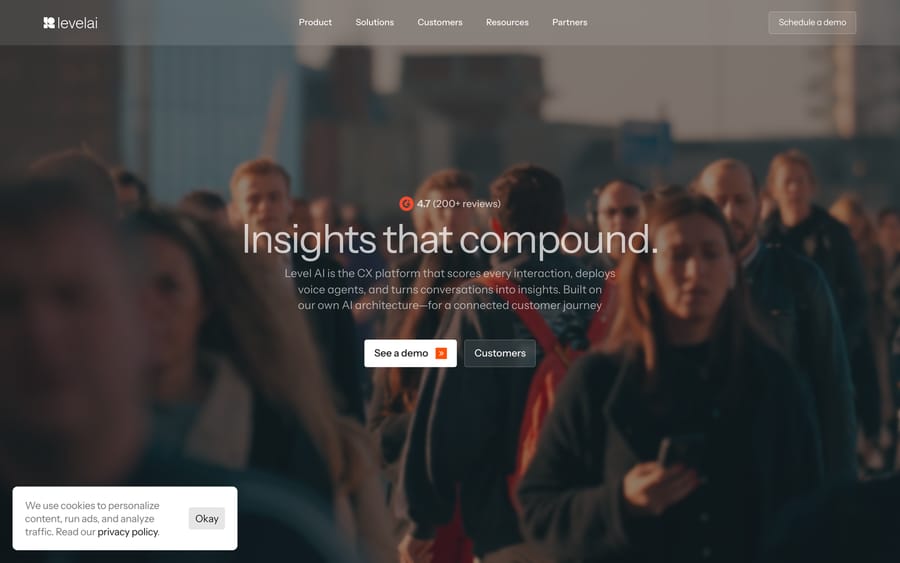
Level AI's homepage, focused on QA and analytics for contact centers.
Level AI is an AI-native customer-experience intelligence platform for contact centers. Its core promise: instead of QA teams manually sampling 1–3% of interactions, Level AI's generative and semantic AI auto-scores close to 100% of calls, chats, and emails, then turns that analysis into coaching, sentiment tracking, and real-time agent guidance.
The company was founded in 2019 by Ashish Nagar, who is still CEO. Before Level, Nagar was a product manager on Amazon Alexa's Conversational AI team and held leadership roles at two other Silicon Valley startups, Kinestral Technologies and Relcy (Pulse 2.0 founder interview). Headquartered in the Bay Area, Level AI has reportedly raised roughly ~$73 million in venture funding to date, including a ~$39 million Series C led by Adams Street Partners with participation from Cross Creek, Brightloop, Battery Ventures, and Eniac Ventures (Level AI Series C announcement) (as of 2026).
The shorthand: Level AI is a quality, coaching, and analytics layer that sits on top of your contact center — it listens to everything, scores it, and tells you and your agents what to do about it. In Level's own framing, the platform spans four connected surfaces: Auto QA (score every interaction), Agent Assist (help reps in the moment), Voice of the Customer / business insights (turn conversations into trends), and, more recently, an AI Virtual Agent for agentic, customer-facing automation. Everything is powered by the same underlying conversation-understanding engine, which is a big part of the pitch — one model of your interactions, many jobs on top of it.
What Level AI does
Level AI lives in the quality management, workforce optimization, and agent-assist category. It's less about deflecting tickets from customers and more about making your human agents (and the QA team behind them) faster and more consistent. The main jobs it does:
- Automated Quality Monitoring (Auto QA) — evaluates 100% of interactions instead of a manual 1–3% sample, auto-filling your scorecards across voice, chat, and email.
- Real-time agent assist — surfaces answers, next-best actions, and guidance to reps mid-conversation, and can prompt supervisors to step in when a live call is going sideways.
- AI coaching — generates coaching plans and flags coaching opportunities from patterns in the data, tying QA scores back to who needs help on what.
- Voice of the Customer & business insights — analyzes, quantifies, and categorizes the priorities and complaints customers express across conversations, so product, CX, and ops teams can see trends (not just individual tickets).
- Sentiment and customer-experience analytics — tracks mood and CSAT-style signals across every interaction.
- AI Virtual Agent — an agentic, customer-facing layer Level has added on top of its analytics core, extending the platform from "measure the humans" toward "automate some of the contact."
Auto QA, in depth
Auto QA is Level AI's flagship. Traditional quality programs sample a tiny slice of interactions — often 1–3% — because human reviewers can only listen to so many calls. That sample is statistically shaky and blind to the long tail. Level AI's core claim is that it can score 100% of calls, chats, and emails automatically, filling in the same scorecard questions a human QA analyst would answer ("Did the agent verify the account?", "Did they follow the refund policy?", "Was the closing compliant?"). Because it evaluates the whole population, the resulting coaching and compliance signal is far less noisy, and outliers surface that random sampling would miss. In practice, teams still calibrate the AI against a set of human-graded interactions and spot-check its judgment — more on that under cons.
Agent Assist and real-time coaching
Alongside offline scoring, Level AI runs in real time during live interactions. Agent Assist surfaces relevant knowledge-base answers and next-best actions to reps mid-conversation, while supervisor-facing monitoring flags calls that are trending negative so a manager can intervene before a customer escalates or churns. The same engine that scores interactions after the fact drives the in-the-moment guidance, which is why Level positions the two as a loop: assist the agent live, score the result, coach the pattern.
Voice of the Customer and business insights
Level AI's VoC Insights layer treats your contact center as a research instrument. Rather than only grading agents, it mines conversations to quantify and categorize what customers are actually asking about, complaining about, and asking for — emerging bugs, confusing policies, gaps in a self-service bot, product friction. For CX and product leaders, this is the "why is contact volume up?" answer, drawn from the raw conversations instead of a survey.
How Level AI's AI works
Level AI leans on generative AI plus a proprietary semantic-intelligence engine. Rather than keyword-spotting (the old way of scoring calls), the platform tries to understand the meaning of a conversation so it can answer scorecard questions the way a human QA reviewer would.
The distinction Level draws is intent-based rather than keyword-based scoring. A keyword system needs the exact trained phrase to fire; if an agent says "let me get that sorted for you" instead of the phrase the rule was written for, a keyword rule misses it. Level's semantic engine is designed to recognize that both express the same intent. In the vendor's telling, that translates into fewer false positives, better QA accuracy, and — importantly for the people who maintain these programs — dramatically less scorecard tuning and rule maintenance over time.
A few mechanics worth understanding:
- 100% auto-QA. Level AI transcribes and analyzes every call, chat, and email, then auto-fills your QA scorecards. Because it evaluates the whole population instead of a tiny sample, the coaching signal is far less noisy.
- Semantic search and generative summarization. Supervisors can ask questions across their interaction data in natural language (Level markets this as generative QA / "AgentGPT"-style querying) and get summaries instead of scrubbing through recordings. Instead of reading 40 transcripts to understand a spike in refund complaints, a supervisor asks a question and gets a synthesized answer with the interactions behind it.
- Real-time monitoring. During live interactions, Level AI can track sentiment and alert supervisors to intervene when a call is going sideways, and prompt agents with the right knowledge in the moment.
- Screen recording and PII redaction. For regulated environments, Level captures interactions (including agent screens) and automatically redacts sensitive information, which is table stakes for QA in financial services, insurance, and healthcare.
The trade-off with any AI-scored QA is calibration: the model's judgment has to be tuned to your scorecard, and reviewers still generally spot-check. We'll come back to that under cons.
Integrations and deployment
Level AI is designed to sit on top of your existing telephony, CCaaS, and help-desk stack rather than replace it. It connects to common contact-center and CRM systems — Zendesk, Salesforce, and other help desks and CCaaS platforms — through pre-built connectors, and can trigger real actions through those connectors or through your own APIs. Notably, Level ships a Level AI QA Assist app on the Salesforce AppExchange, which lets quality analysts evaluate support conversations and run scorecards inside Salesforce, a signal of how tightly it leans into the Salesforce Service Cloud ecosystem.
Because it captures voice, chat, and email in one place, Level positions itself as an omnichannel intelligence layer — the QA and analytics brain over whatever channels and platforms you already run.
On deployment, this is enterprise software, and the timeline reflects that. Level AI has publicly described delivering initial value within roughly 4 weeks and reaching full deployment in around 16 weeks. That's fast for a QA/WFO platform of this scope, but it's a services-led rollout — expect scorecard configuration, integration work, and calibration against your human graders — not a self-serve switch you flip over a weekend.
Customers and verticals
Level AI markets to mid-market and enterprise contact centers, and its published case studies cluster in verticals where quality, compliance, and coaching carry real weight: financial services (BFSI), insurance, healthcare and wellness, retail/e-commerce, and consumer services. The company positions itself as serving global brands and Fortune 500-scale operations that run high interaction volume and need consistent, auditable quality programs. Public case studies describe an online retailer improving CX, a financial-services firm raising service quality, a health-and-wellness brand transforming support, and an insurance provider uncovering customer insights from its contact center — a good proxy for where Level lands best.
Key features
- Automated QA / AutoQA — near-100% coverage of calls, chats, and emails with AI-generated scores.
- Agent Assist — real-time, in-conversation guidance and knowledge surfacing for reps.
- AI coaching & performance management — coaching plans and recommendations derived from interaction analysis.
- Real-time sentiment analysis — live mood tracking with supervisor alerts.
- Generative CX insights / semantic search — ask-anything querying across your interaction data.
- Screen recording and PII redaction — capture and automatic redaction of sensitive information for compliance.
- Omnichannel capture — voice, chat, and email in one place.
Pricing
Here's the honest answer: Level AI does not publish pricing. There's no public pricing page; every path funnels you to "schedule a demo," and quotes are built per account based on seat count and which modules you take (tooldirectory review).
The one third-party figure that circulates is roughly $185 per agent, per month — but treat that as an unofficial, single-source estimate, not a quote. We won't invent a number Level hasn't confirmed.
What actually drives the cost
Even without a public price sheet, it's worth understanding the levers an enterprise QA/WFO quote turns on, because they're where budgets balloon:
- Seats / agents. Level is fundamentally per-agent priced, so headcount is the primary driver. A practical caution: confirm who counts as a seat. Managers and QA analysts who never take a live interaction can quietly inflate a per-agent quote, so clarify whether every platform user is licensed or only active agents.
- Interaction volume. More calls, chats, and emails to transcribe and score means more compute; high-volume centers should expect that to show up.
- Module mix. Auto QA, Agent Assist, VoC/business insights, and the AI Virtual Agent are distinct capabilities. Buying the whole platform costs more than buying Auto QA alone — a pattern across the category, where copilot tools, QA, WFM, and analytics are frequently priced as separate lines.
- Contract length and implementation. This is enterprise, annual-contract software with a services-led rollout. Implementation, integration, and consumption charges — not the headline per-agent rate — are usually where a "competitive" quote turns into a budget overrun.
If transparent, self-serve pricing matters to you, that's a genuine friction point — you can't estimate cost without a sales conversation, and the model is per-seat rather than per-outcome, so you pay for coverage regardless of how much the AI actually does.
What reviewers say: Level AI holds 4.6 out of 5 from 219 reviews on G2, checked 21 September 2026 — a large sample for a QA tool, which is why the recurring complaint below about scorecard accuracy is worth taking seriously rather than dismissing as noise.
Pros and cons
Pros
- 100% QA coverage is a real step-change over manual sampling — the whole point of the product, and it delivers.
- Intent-based, not keyword-based scoring means fewer false positives and less ongoing scorecard maintenance than legacy speech-analytics tools.
- Strong at coaching and consistency — the analysis-to-coaching loop is where customers get the most value.
- VoC / business insights turn conversations into product- and CX-level trends, not just agent grades — value that reaches beyond the QA team.
- Omnichannel (voice, chat, email) in one intelligence layer.
- Real-time assist and sentiment genuinely help supervisors intervene earlier.
- Fits your existing stack — pre-built connectors for Zendesk, Salesforce, and other CCaaS/CRM systems, plus a Salesforce AppExchange app, so it layers on rather than rips-and-replaces.
- Compliance-friendly — screen recording and automatic PII redaction suit regulated verticals.
- Generally positive G2 sentiment on accuracy and efficiency.
Cons
- Opaque pricing — no public numbers, demo-gated, enterprise-oriented, and per-seat rather than per-outcome.
- AI QA scores can need tuning. A recurring G2 complaint is that scores aren't always accurate out of the box and need tailoring to a company's specific scorecards (Level AI on G2). Budget for a calibration period.
- Services-led rollout. Expect roughly 4 weeks to initial value and ~16 weeks to full deployment — meaningful implementation work, not a self-serve turn-on.
- Built for larger centers. Smaller teams may find it heavier — and more expensive per seat — than they need.
- It's QA/WFO, not customer-facing deflection. Level AI makes your agents better and surfaces insight; even with the newer AI Virtual Agent, its center of gravity is measuring and assisting humans, not autonomously resolving the ticket queue on your help desk.
Who Level AI is best for
Level AI is a strong fit if you run a mid-market or enterprise contact center with meaningful voice volume, a QA/quality team that's drowning in manual reviews, and a mandate to improve agent performance and consistency. If your priority is scoring, coaching, and monitoring human agents at scale, it's squarely in its lane.
It's a weaker fit if you're a smaller support team, if you want transparent pricing before talking to sales, or if your actual goal is to automate and deflect support tickets on the help desk you already use — that's a different category, which brings us to alternatives.
Level AI vs. alternatives
Level AI competes most directly with other contact-center intelligence and agent-assist players. It's worth being clear about categories, because tools that get compared to Level AI often do quite different jobs.
| Tool | Primary job | Pricing | Best for |
|---|---|---|---|
| Level AI | Auto-QA, coaching, real-time assist, VoC insights for contact centers | Opaque, demo-gated, per-agent (~$185/agent/mo cited, unofficial) | Enterprise/mid-market centers with heavy voice + QA/compliance needs |
| Cresta | Real-time agent assist + generative AI for contact centers | Opaque, enterprise annual contracts | Large voice-heavy centers wanting live rep guidance |
| Observe.ai | Conversation intelligence + QA for contact centers | Opaque, quote-based | Voice QA and coaching at scale |
| MaestroQA / Klaus | Ticket-level QA scorecards for help-desk teams | Per-seat, quote-based | CX teams wanting structured QA without a full CCaaS suite |
| Macha | AI-agent layer that automates support on your existing help desk | From $299/mo for 750 tickets (~$0.40/ticket) | Teams on Zendesk/Freshdesk/Front/Intercom/Gorgias who want to automate ticket handling |
A note on Macha, since it's a fair alternative for part of what people evaluate Level AI for. The two solve different jobs, and being honest about that is more useful than a feature-count fight. Level AI's job is to measure and improve human agents — score 100% of interactions, coach on the patterns, surface VoC trends. Macha's job is to resolve the tickets themselves. It won't auto-score your calls or build coaching plans, and it isn't trying to.
What Macha does is sit on top of the help desk you already use (Zendesk, Freshdesk, Front, Intercom, Gorgias) as an AI agent for customer service that actually resolves tickets — you build agents in plain English, connect custom tools and data sources, and it works your queue autonomously. Pricing is per ticket (one plan from $299/month for 750 tickets), so you pay for the tickets the AI handles rather than per seat — a different economic shape from Level's per-agent model. If your real goal is automating and deflecting support work rather than scoring and coaching a voice team, Macha is the more direct fit. If you run a large voice-heavy contact center and need deep QA, compliance monitoring, and agent coaching, Level AI is built for exactly that and Macha isn't a substitute. Plenty of teams could reasonably run both: Level AI to raise the quality of the humans, an agent layer to take routine tickets off the queue in the first place. You can see how Macha's usage-based pricing works if that model appeals.
The two platforms Level AI is shortlisted against most often both have guides here: Observe.ai, which comes at the same conversation data from the voice-analytics side, and Cresta, if real-time agent coaching rather than after-the-fact QA is what you are buying.
How we researched this: The features, pricing and customer figures above come from Level AI's own public pages and the third-party sources linked inline, checked when this guide was researched in August 2026. This pass, on 21 September 2026, re-checked the post's links, added the review figures quoted above and cross-referenced our guides to the closest alternatives; it did not re-price the plans against Level AI's site, so read the pricing as accurate to August 2026 rather than to today. The G2 rating and review count above were read in a real browser on 21 September 2026; Capterra lists Level AI but carries no reviews.
FAQ
What is Level AI used for? Level AI is a contact-center intelligence platform used mainly for automated quality assurance (auto-scoring calls, chats, and emails), agent coaching, real-time agent assist, and customer-experience analytics.
How much does Level AI cost? Level AI does not publish pricing; it's quote-based and demo-gated. A commonly cited third-party estimate is around $185 per agent per month, but that's unofficial — actual cost depends on seat count, modules, and contract terms.
Who founded Level AI? Level AI was founded in 2019 by Ashish Nagar, a former product manager on Amazon Alexa's Conversational AI team, who remains CEO.
Is Level AI good for small teams? Not really its sweet spot. Level AI is built for mid-market and enterprise contact centers (often 200+ seats). Smaller teams usually find it heavier than they need.
What are the main alternatives to Level AI? For contact-center QA and agent assist, the closest alternatives are Cresta and Observe.ai; for lighter, ticket-level QA scorecards, MaestroQA/Klaus. If your goal is instead to automate and deflect support tickets on your existing help desk, an AI-agent layer like Macha is a more direct fit.
Does Level AI integrate with Zendesk and Salesforce? Yes. Level AI connects to common help desks and CCaaS/CRM systems including Zendesk and Salesforce via pre-built connectors, and can trigger actions through those connectors or your own APIs. It also offers a Level AI QA Assist app on the Salesforce AppExchange for running scorecards inside Salesforce.
How long does Level AI take to deploy? Level AI has described delivering initial value in roughly 4 weeks and reaching full deployment in around 16 weeks. It's a services-led, enterprise rollout involving integration, scorecard configuration, and calibration — not a self-serve turn-on.
Is Level AI's automated QA accurate? It's strong, but not plug-and-play perfect. Its intent-based engine reduces false positives versus keyword scoring, but a recurring buyer complaint is that scores need tuning to your specific scorecards. Most teams calibrate against human-graded interactions and spot-check before trusting scores at scale.
Does Level AI replace my help desk or contact-center software? No. Level AI is an intelligence layer that sits on top of your existing telephony, CCaaS, and help-desk stack (Zendesk, Salesforce, and others). It analyzes and assists; it doesn't replace your core ticketing or call-routing system.
Want to automate the tickets themselves, not just score them? Macha adds an AI agent to the help desk you already run — Zendesk, Freshdesk, Front, Intercom, or Gorgias — that resolves customer issues autonomously, priced per ticket. Start a free trial and see it work on your own queue.
Resolve tickets automatically with AI agents
Macha's AI agents work on top of the help desk you already use — no code.