Intercom
 Shopify
 Stripe
 Slack
Slack Notion
 Google Workspace
 Confluence

Cresta AI: The Complete Guide (2026)


If you're evaluating Cresta AI, you're likely running a contact center — probably a voice-heavy one — and trying to decide whether real-time AI can make your agents faster and more consistent, or handle some conversations entirely on its own. This guide is an honest, researched walk-through of what Cresta AI is, how its real-time AI actually works, what it costs (spoiler: the pricing is opaque, but there's one real number), where it's strong, where it frustrates buyers, who it's best for, and how it compares to the alternatives — including a fair look at where a tool like Macha fits differently.

Quick framing before we start: Cresta AI is an enterprise real-time contact-center platform. It's built for large support and sales orgs with serious call volume, not a self-serve bot you switch on over a weekend. If that's you, keep reading.
What is Cresta AI?
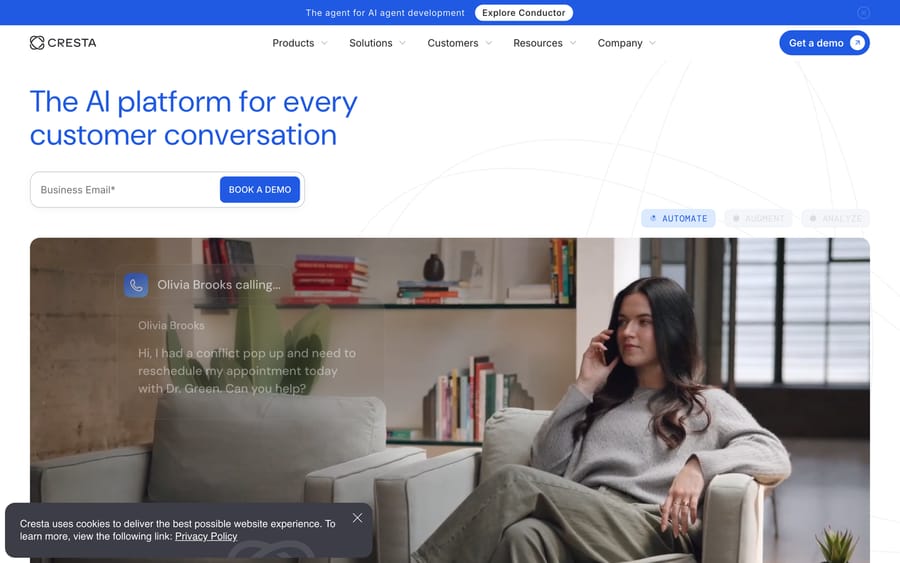
Cresta's homepage, focused on contact-center AI for agents.
Cresta AI is a generative AI platform for contact centers that works in real time — guiding human agents mid-conversation, running fully autonomous AI agents on some interactions, and mining every conversation for analytics, quality, and coaching insights. Cresta describes itself as a Customer Experience AI platform that unifies human and AI agents on a single system of intelligence, and that framing matters: the whole architecture is built so that the same data, models, and analytics flow across everything it does, rather than living in three disconnected tools.
The company has strong pedigree. It was founded in 2017 by Sebastian Thrun (the Stanford professor behind Google's self-driving-car project and co-founder of Udacity) alongside CEO Zayd Enam, Tim Shi, and Andre Esteva (Sacra profile). Headquartered in San Francisco, Cresta has reportedly raised ~$282 million across roughly eight rounds at a reported ~$1.6 billion valuation (per Crunchbase/Tracxn funding trackers, as of 2026). Its most recent raise was reportedly a $125 million Series D in November 2024, co-led by World Innovation Lab (WiL) and the Qatar Investment Authority (QIA), with participation from Accenture, LG Technology Ventures, Qualcomm Ventures, and Workday Ventures, plus returning investors Andreessen Horowitz, Greylock, J.P. Morgan, Sequoia, and Tiger Global (Cresta press release). Its customer base skews Fortune 500 — telecom, financial services, retail, hospitality, and healthcare — with publicly referenced customers including Cox Communications, Hilton, CarMax, Brinks Home, and SCAN Health Plan.
The shorthand: Cresta is an enterprise-grade, real-time AI layer for the contact center, with an emphasis on voice.
What Cresta AI does
Cresta packages its capabilities into a few connected products, which it frames as three pillars — autonomous agents, real-time assist for humans, and conversation intelligence — all sharing one underlying system:
- Cresta Agent (AI Agent) — an autonomous virtual agent that handles voice, chat, and SMS conversations end-to-end, escalating to a human when the interaction calls for it.
- Agent Assist — real-time, outcome-driven behavioral guidance delivered to human reps mid-conversation.
- Conversation Intelligence — analytics, quality management, and coaching built on 100% of interactions, delivered through two components:
- Cresta Director — the coaching and performance layer, where managers build, track, and review coaching plans for each agent, blending automated QA scoring with live coaching moments.
- Cresta Insights — the analytics layer, which correlates specific agent behaviors with business outcomes (sales, resolution, handle time) and can answer natural-language questions about what's actually happening across your conversations.
- Knowledge Agent — a real-time knowledge co-pilot (launched March 2026) that surfaces the exact answers agents need from a unified knowledge base (CMSWire).
The through-line is real time: Cresta's differentiator is doing this fast enough to matter during a live call, not after it. And because Insights, Director, and Agent Assist run on shared models, the pattern that Insights spots across thousands of past calls can feed straight into what a rep sees on the next live one — a feedback loop Cresta markets heavily as its advantage over stitching together separate point tools.
How Cresta AI's AI works
Cresta's core bet is latency. Cresta says its agent-assist guidance is delivered in under 200 milliseconds — fast enough that reps get direction mid-sentence rather than after the interaction is over. That speed is the technical moat the company markets most heavily, and it's genuinely hard to do on live voice, where the AI has to transcribe, interpret, and respond faster than a human can notice a pause.
The other technical claim is that Cresta trains its own models on contact-center conversations rather than relying purely on general-purpose LLMs. The idea is that a model tuned on your actual transcripts learns the intents, objections, and winning "behaviors" specific to your business — so guidance is grounded in what your best agents already do, not generic best practice. Under the hood, Cresta combines that with generative AI to:
- Detect intent and context in real time and match it to outcome-driven "behaviors" the top-performing agents use — then nudge every rep toward those behaviors live.
- Proactively deliver knowledge — the Knowledge Agent unifies your knowledge base so the AI hands agents the right answer without them searching a wiki mid-call.
- Run autonomous AI agents on a subset of interactions, handing off to humans when the conversation gets complex.
- Score and analyze 100% of conversations for QA, coaching, and analytics — replacing the old model where a QA team manually reviewed a 2–3% sample of calls.
The result is a platform that tries to do three things at once: assist humans, automate some conversations, and turn everything into coaching insight — all off a single model of your conversations.
Key features
- Cresta Agent — autonomous voice/chat/SMS handling with human handoff.
- Agent Assist — sub-200ms real-time behavioral guidance for reps on live interactions.
- Knowledge Agent — real-time knowledge co-pilot (2026 launch) that surfaces answers proactively.
- Cresta Director — coaching plans, performance management, and AI-driven QA at scale.
- Cresta Insights — outcome-correlated analytics with natural-language querying of conversation data.
- Conversation Intelligence — analytics, QA, and coaching across 100% of interactions.
- CCaaS integrations — runs on top of the major contact-center platforms rather than replacing them.
- Enterprise deployment — direct enterprise sales plus availability on AWS, Google Cloud Marketplace, and through CCaaS partners.
How Cresta AI integrates and deploys
This is where Cresta's positioning becomes clearest: it is designed to sit on top of the contact center you already run, not replace it. Cresta integrates with the major CCaaS (Contact Center as a Service) platforms — Genesys (listed on the AppFoundry marketplace), Amazon Connect, Five9 (an accredited VoiceStream integration), NICE CXone, Avaya, Twilio, 8x8, and LivePerson (Cresta LLM info). In practice, Cresta layers its AI over — or replaces the native AI modules of — those suites, adding enterprise-grade depth where the CCaaS platform's built-in AI is thin.
On deployment, Cresta is sold direct to enterprise and is also available through the AWS Marketplace, Google Cloud Marketplace, and via partners including Five9, Genesys, NICE, AWS, and Twilio. One point Cresta makes about migrations: because it runs as a software layer above the telephony platform, it can operate across an old and a new CCaaS system simultaneously, which de-risks a platform switch and lets a large center move on its own timeline. The flip side of all this flexibility is scope — connecting Cresta to a live voice stack, training models on your transcripts, and rolling it out to a floor of agents is an enterprise implementation, not a self-serve toggle.
Pricing
Here's the honest picture: Cresta does not publish pricing. The cresta.com/pricing URL returns a 404, and every product path requires a demo before you see numbers (eesel's Cresta pricing breakdown). Pricing is built per account, based on agent seats and feature tiers, and customers typically sign annual contracts.
There is, however, one researched public data point (a third-party-visible listing rather than an official price list) — the AWS Marketplace listing. On AWS, Cresta has listed 12-month contracts at:
- Agent Assist for Chat — up to 125,000 chats: $150,000
- Agent Assist for Voice — up to 100,000 calls: $150,000
Those figures tell you two things: Cresta is priced at six figures a year for real volume, and it's firmly an enterprise purchase. If you're a smaller team hoping for transparent, self-serve pricing, that's a genuine mismatch.
What actually drives the cost
Even though the number is quoted, the shape of Cresta's pricing is predictable, and it's worth understanding before you sit through a demo. The main cost drivers are:
- Agent seats. The core license is seat-based — you pay per human agent (or per named user) who gets Agent Assist, Director, and the rest. A 500-seat center costs far more than a 50-seat one, and headcount is usually the dominant line item.
- Interaction volume. Autonomous AI Agent handling and analytics scale with the number of calls, chats, and messages processed. The AWS listing's "up to 125,000 chats" and "up to 100,000 calls" tiers make this explicit — you're buying volume bands, and higher bands cost more.
- Voice minutes. For voice, real-time transcription and analysis are compute-heavy, so minutes (not just call count) can factor in.
- Products enabled. Turning on the full stack — autonomous agents plus assist plus Director plus Insights plus Knowledge Agent — costs more than a single module.
- Contract term. Deals are annual, and multi-year commitments typically move the effective price.
A deliberately honest note: we're not going to invent a per-seat figure because Cresta doesn't publish one, and the number varies enormously by center size, volume, and which products you light up. Treat the $150K AWS listing as an order-of-magnitude signal — "this is a six-figure platform" — not as a quote you can hold Cresta to.
Pros and cons
Pros
- Best-in-class real-time latency — sub-200ms guidance is a real technical strength for live voice calls, which is genuinely hard.
- One unified platform — autonomous agents, agent assist, knowledge, coaching (Director), and analytics (Insights) share a single system of intelligence, so insights feed live guidance instead of sitting in a separate BI tool.
- Purpose-built models — training on your own contact-center transcripts produces guidance grounded in what your best agents actually do, not generic scripts.
- Strong for voice, where many AI tools are weak and most help-desk-native tools don't play at all.
- Broad CCaaS integration — layers onto Genesys, Amazon Connect, Five9, NICE, Twilio, 8x8, and more without ripping out your platform.
- Deep, credible pedigree and funding — founded by Sebastian Thrun, a reported ~$1.6B valuation and ~$282M raised (as of 2026), and Fortune 500 customers like Cox, Hilton, and CarMax.
- New Knowledge Agent (2026) keeps the platform current and closes the "agent can't find the answer" gap.
Cons
- Opaque pricing — no public page, demo-gated; the only visible number is a $150K/year AWS listing.
- Enterprise-only economics — seat-based, six-figure annual contracts put it out of reach for most SMB and mid-market teams.
- Heavy to implement — connecting a live voice stack, training models on your transcripts, and rolling out to a floor of agents is a real deployment, not a weekend setup.
- Voice/contact-center centric. If you run support primarily on a modern help desk (email, chat, tickets) rather than a big phone center, much of Cresta's value — real-time voice assist, QA at call scale — is aimed elsewhere.
- Change-management load. Real-time guidance and 100%-of-calls QA change how agents work and how managers coach; adoption isn't automatic and needs buy-in.
Who Cresta AI is best for
Cresta is a strong fit for large, voice-heavy contact centers — telecom, financial services, insurance, healthcare — that want real-time agent assist, some autonomous automation, and deep conversation analytics, and that have the budget (six figures a year) and the team to implement an enterprise platform. If real-time coaching on live calls is the problem you're solving, Cresta is one of the best in the category.
It's a weaker fit if you're a small or mid-market team, if you want transparent pricing without a sales cycle, or if your support runs primarily through a help desk and you mostly want to automate and resolve tickets — a different category, which leads us to alternatives.
Cresta AI vs. alternatives
Cresta competes most directly with other real-time contact-center AI and agent-assist platforms — chiefly Observe.AI and ASAPP, both of which we cover in full. As with any of these tools, the category matters — comparisons often lump together products that do different jobs.
| Tool | Primary job | Channel focus | Pricing | Best for |
|---|---|---|---|---|
| Cresta | Real-time agent assist + autonomous AI + conversation intelligence | Voice-first (also chat/SMS) | Opaque; seat + volume based; ~$150K/yr AWS listing | Large voice-heavy enterprise contact centers |
| Level AI | Auto-QA, coaching, real-time assist | Voice + digital | Opaque, demo-gated | Enterprise/mid-market centers with heavy QA needs |
| Observe.ai | Conversation intelligence + QA + agent assist | Voice-first | Opaque, quote-based | Voice QA and coaching at scale |
| Gong / others | Conversation intelligence (sales-leaning) | Voice + meetings | Opaque, seat-based | Revenue teams analyzing calls |
| Macha | AI-agent layer that automates and resolves support on your existing help desk | Help desk (email, chat, tickets) | From $299/mo for 750 tickets (~$0.40/ticket) | Teams on Zendesk/Freshdesk/Front/Intercom/Gorgias automating tickets |
A fair word on Macha, since it's an honest alternative for part of what buyers evaluate Cresta for. Macha isn't a real-time voice agent-assist suite — it won't whisper guidance to a rep mid-call or run a large call center's QA. What it does is sit on top of the help desk you already use (Zendesk, Freshdesk, Front, Intercom, Gorgias) as an AI agent for customer service that resolves tickets autonomously. You build agents in plain English, wire up custom tools and data sources, and it works your queue — and because pricing is per ticket, you pay for the tickets the AI actually handles instead of six-figure seat-based contracts. If your real goal is automating support on a help desk rather than guiding live agents in a voice center, Macha is the more direct and far more accessible fit; if you need real-time assist for a large call center, Cresta is purpose-built for that and Macha isn't trying to be. You can see how Macha's usage-based pricing compares.
How we researched this
The product, deployment and customer detail in this guide comes from Cresta’s own site and documentation and from its published case studies; Cresta does not publish a price, so the figures in the pricing section are third-party estimates and reported contract values, labelled as such. On September 21, 2026 we re-checked the internal links in this post and added the comparisons above, and we did not obtain a quote on that pass. Cresta is sold through an enterprise cycle with no self-serve trial, so nothing here comes from hands-on use, and G2 turned away every request we made that day.
FAQ
What is Cresta AI used for? Cresta AI is a real-time contact-center platform used for autonomous AI agents (voice/chat/SMS), real-time agent assist for human reps, knowledge delivery, and conversation intelligence (analytics, QA, and coaching).
How much does Cresta AI cost? Cresta doesn't publish pricing and its pricing page 404s; quotes are demo-gated and seat/tier based on annual contracts. The one public data point is Cresta's AWS Marketplace listing at roughly $150,000/year for Agent Assist (up to 125,000 chats or 100,000 calls).
Who founded Cresta AI? Cresta was founded in 2017 by Sebastian Thrun (Google X, Udacity) with CEO Zayd Enam, Tim Shi, and Andre Esteva.
Is Cresta AI good for small teams? No. Cresta is an enterprise platform with six-figure annual pricing, built for large voice-heavy contact centers. Small and mid-market teams are outside its target market.
What are the main alternatives to Cresta AI? For real-time contact-center AI and QA, the closest alternatives are Level AI and Observe.ai (and, on the sales-conversation side, tools like Gong). If your goal is instead to automate and resolve support tickets on your existing help desk, an AI-agent layer like Macha is a more direct and more accessible fit.
What CCaaS platforms does Cresta integrate with? Cresta layers on top of the major contact-center platforms rather than replacing them, including Genesys, Amazon Connect, Five9, NICE CXone, Avaya, Twilio, 8x8, and LivePerson. It's available direct and through the AWS and Google Cloud marketplaces, plus CCaaS partners.
Is Cresta AI just for voice? Voice is Cresta's strongest and most differentiated channel — its sub-200ms real-time assist is built for live calls — but it also handles chat and SMS, both through autonomous AI agents and through agent assist for human reps.
What are Cresta Director and Cresta Insights? They're the two halves of Cresta's Conversation Intelligence. Director is the coaching and performance layer, where managers build and track coaching plans and run AI-driven QA across every interaction. Insights is the analytics layer, which correlates agent behaviors with outcomes like resolution and handle time and lets you ask natural-language questions about your conversation data.
Does Cresta train its own AI models? Yes — a key part of Cresta's pitch is that it trains models on your contact center's own conversations, so guidance reflects the intents, objections, and winning behaviors specific to your business rather than generic best practice.
How is Cresta different from Macha? They solve different problems. Cresta is a real-time, voice-first platform for large contact centers — assisting live agents, running autonomous voice agents, and coaching at call-center scale. Macha is an AI-agent layer that sits on your existing help desk (Zendesk, Freshdesk, Front, Intercom, Gorgias) and autonomously resolves support tickets, priced per ticket. If you run a voice center and want live agent assist, Cresta fits; if you run support on a help desk and want to automate tickets, Macha fits.
Want to automate the tickets themselves, without a six-figure contract? Macha adds an AI agent to the help desk you already run — Zendesk, Freshdesk, Front, Intercom, or Gorgias — that resolves customer issues autonomously, priced per ticket. Start a free trial and see it work on your own queue.
Resolve tickets automatically with AI agents
Macha's AI agents work on top of the help desk you already use — no code.