Intercom
 Shopify
 Stripe
 Slack
Slack Notion
 Google Workspace
 Confluence

Uniphore: The Complete Guide (2026)


Uniphore calls itself "The Business AI Company," selling an enterprise AI platform built out of eight acquisitions and at least $860 million in disclosed venture funding since 2008 (Series A and B amounts were never disclosed, so the real total is higher). This guide covers what that platform actually does today, how Uniphore assembled it, what a deal costs, what G2 reviewers actually say, and how it compares to Cresta, the closer of its contact-center AI rivals.

We build AI agents for customer service ourselves, at a much smaller scale than Uniphore's enterprise contracts, so treat this as a working comparison from the outside. Vendor-reported figures are labeled as such throughout.
What is Uniphore?
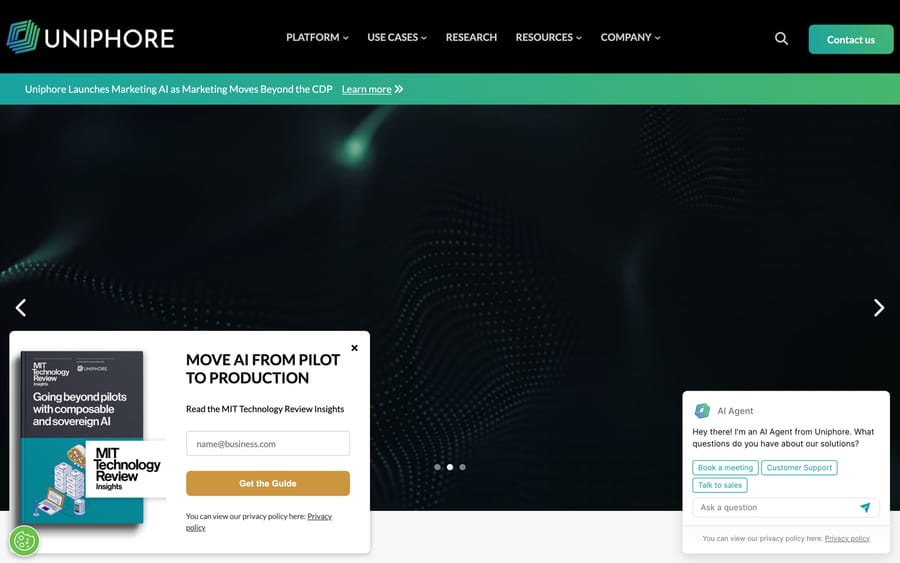
Uniphore was founded in 2008 by Umesh Sachdev and Ravi Saraogi, incubated at IIT Madras, and is now headquartered in Palo Alto. It started as a voice-analytics company (its early products, auMina, Akeira, and amVoice, shipped in 2014) and has spent the last five years turning itself into a general enterprise AI platform through acquisition: Emotion Research Lab (2021) for video emotion detection, Jacada (2021) for low-code automation, Red Box (2023) for call recording, Hexagone (2023) for behavioral analytics, ActionIQ (December 2024) for customer data, Infoworks (December 2024) for data engineering, and Orby AI plus Autonom8 (both August 2025) for multi-agent workflow automation. That's eight acquisitions in under five years, which is the actual mechanism behind "Business AI Cloud": Uniphore bought most of the pieces, then sells the combined result as one platform.
The company says it serves 2,000+ businesses across 20+ countries, with 60+ Fortune 500 logos on its site including KPMG, Cognizant, Farmers Insurance, AT&T, Sony, Allstate, and DocuSign. Older public case studies also name the US Coast Guard, the Singapore Police Force, JPMorgan Chase, DirecTV, Vodafone, and Verizon as customers. These are large, complex organizations, which tracks with Uniphore's own positioning: it doesn't sell to a 20-person support team.
How Uniphore's platform works
Uniphore's current pitch is the Business AI Cloud, launched in June 2025, built from four layers stacked on top of each other.
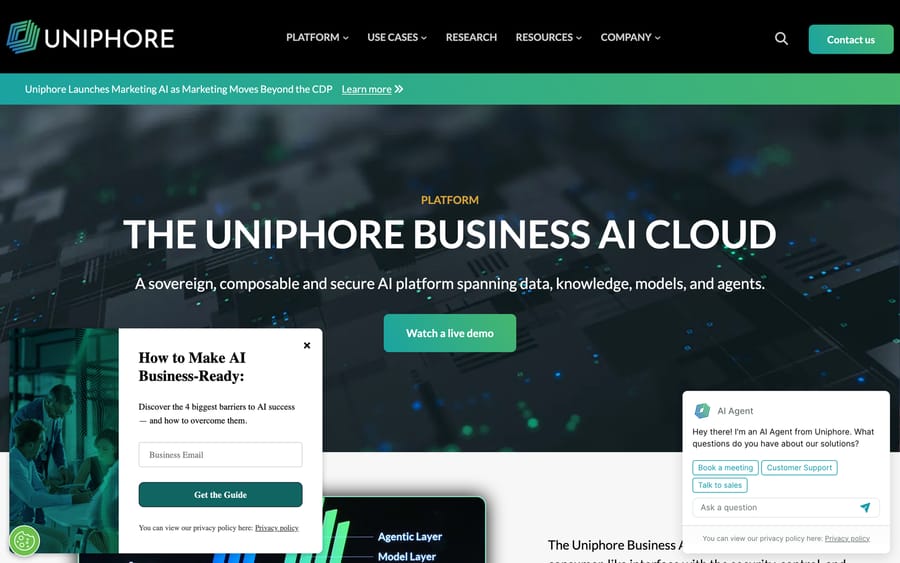
- Data Layer connects to a company's existing systems (multiple clouds, structured and unstructured data) without requiring a migration, and uses "data agents" to automate the cleanup work that normally precedes any AI project.
- Knowledge Layer turns that data into something a model can use: retrieval-augmented generation, knowledge graphs, and an "SLM Factory" for fine-tuning small language models on a company's own domain, rather than relying only on a general-purpose model.
- Model Layer handles governance across whichever models a company runs, whether Uniphore's own, open-source, or a customer's fine-tuned model, with guardrails and policy controls sitting in front of all of them.
- Agentic Layer is where the actual agents live: multi-agent orchestration, Model Context Protocol connections to third-party tools, and a visual, BPMN-based builder for designing how agents hand work to each other.
The pitch to a buyer is that most enterprise AI projects fail at the data and governance layers, not the model layer, so Uniphore sells the whole stack instead of leaving a customer to stitch data pipelines and guardrails together themselves. Whether that's a genuine advantage over assembling best-of-breed tools depends on how much you trust one vendor to own that much of your infrastructure, and how much lock-in you're willing to accept in exchange for the integration.
Key features
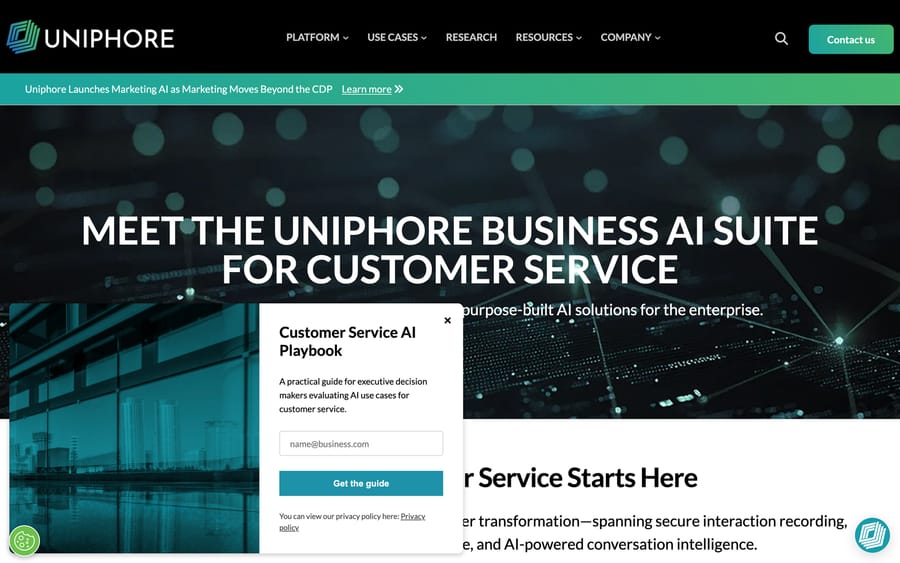
- Customer service AI suite: interaction recording, real-time agent assist, and conversation intelligence built on the acquired Red Box and Jacada technology.
- Agentic Layer: multi-agent orchestration with MCP-based tool connections and a visual workflow builder, aimed at back-office use cases (finance, procurement, employee service) as much as customer-facing ones.
- SLM Factory: fine-tunes small language models on a company's own data, positioned as more cost-efficient and controllable than routing everything through a frontier model.
- ActionIQ (customer data platform): acquired in December 2024, it unifies customer data across systems so an agent has a full profile to work from before a call starts.
- Marketing AI, launched in 2026, extends the same architecture into campaign and activation workflows, which is Uniphore's most direct signal that "Business AI" now means considerably more than contact-center AI.
Uniphore pricing
Uniphore does not publish pricing anywhere on its site. There's no calculator, no per-seat number, and no self-serve signup; every call to action leads to a demo request or "Contact us."
We checked before writing "not published." No AWS, Azure, or Google Cloud Marketplace listing exists for Uniphore as of this writing, and Vendr has no public entry either. What we can say is structural: Uniphore sells the Business AI Cloud as one platform with modular layers, and enterprise AI contracts in this category typically scale with usage volume (calls, interactions, or agent actions processed) plus the number of layers and use cases a customer activates. Expect a sales-led evaluation, a proof-of-concept phase, and a multi-month procurement cycle rather than a published price list, which matches how Cresta and most of Uniphore's direct competitors price as well.
The incentive behind the roll-up
Buying eight companies and selling them as one platform is a specific strategy with a specific incentive: cross-sell. A customer who signed with Uniphore for voice analytics in 2020 is now a warm lead for ActionIQ's customer data platform and the new Marketing AI product, without a second sales cycle from scratch. That's good for Uniphore's growth: its homepage claims 87% of customers expand to multiple use cases within six months, which is a vendor-reported number and also the clearest statement of the strategy you'll find anywhere on the site. It can also be good for a buyer who wants one procurement relationship instead of five. The risk sits on the other side: acquired products vary in how deeply they're actually integrated versus rebranded, and a platform assembled this fast can carry more seams than a company built around one architecture from day one. Ask, specifically, which layer a feature you care about shipped in natively versus arrived through an acquisition, and how long ago that acquisition closed.
Uniphore's Series F, closed in October 2025, is a useful data point here. It raised $260 million from NVIDIA, AMD, Snowflake, and Databricks alongside existing investors, at a $2.5 billion valuation, the same valuation the company held after its $400 million Series E in February 2022.
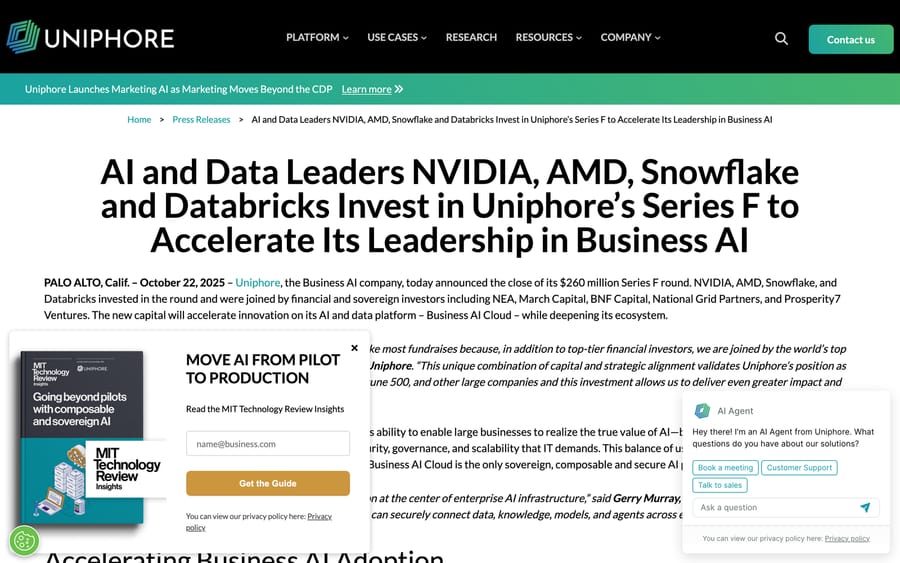
A flat valuation on a much larger round, three and a half years later, isn't a red flag by itself. Strategic investors like NVIDIA and Snowflake often price a round on partnership value as much as growth multiples. But it's worth knowing before a sales conversation: Uniphore raised more capital without a markup, in a period when several AI-native competitors have raised at rapidly rising valuations.
Reviews: what we could and couldn't verify
Here is the honest state of independent evidence on Uniphore, because it is thinner than the logo wall suggests and we would rather say so than dress it up.
G2: the seller listing for Uniphore carries 71 reviews across its products as of 2026-09-17. That count is the one number we can show our work for: g2.com returns a 403 to every automated request we made, including through a headless browser, so we read it off the title of G2's own seller page as Google currently indexes it. We could not open a single review, which means we cannot give you a verified star average, a reviewer's role or company size, or one verbatim quote. An earlier version of this guide carried two short quotes sourced from a search-result cache; we removed them, because a quote we cannot re-open on a live page is not evidence.
Capterra: zero reviews, confirmed by fetching the listing directly. Gartner Peer Insights has a Uniphore Business AI Cloud listing, which also blocks automated access.
That pattern is itself the finding. For a company with 60+ Fortune 500 customers, near-total absence from the self-serve review sites is normal rather than suspicious: enterprise procurement teams evaluating a six-figure platform don't leave Capterra reviews, they take reference calls. The practical consequence for you is that the reference call is where your diligence has to happen, because there is no public review base to sanity-check the sales deck against. Ask for three customers on the specific layer you're buying, and at least one who bought before the acquisition that produced it.
Pros and cons
Pros
- A genuinely broad platform: data, knowledge, model governance, and agents in one architecture, useful if you want one vendor relationship instead of assembling five tools.
- Real enterprise credibility: 60+ Fortune 500 logos, 71 G2 reviews across its products, and government customers like the US Coast Guard.
- Backed by serious, strategically relevant capital: NVIDIA, AMD, Snowflake, and Databricks all invested in the same round.
- Fast expansion into adjacent use cases (back-office, marketing) if a customer wants to consolidate more of its AI spend with one vendor.
Cons
- No published pricing, no marketplace listing, and no Vendr estimate, so every deal starts from zero information.
- A platform stitched together from eight acquisitions in under five years, which raises real integration questions a buyer should ask about directly rather than assume away.
- Independent evidence is thin and hard to reach: zero Capterra reviews, and a G2 and Gartner presence that blocks public access, so there's no review base to check the sales deck against before a reference call.
- A flat valuation between a $400M round in 2022 and a $260M round in 2025 is a data point worth understanding before you're the one signing a multi-year contract with them.
Who Uniphore is best for
Uniphore fits large enterprises that want to consolidate contact-center AI, customer data, and back-office automation under one vendor, and that have the procurement bandwidth to run a proper evaluation across a wide, acquisition-assembled platform. If you're already running Red Box for call recording or ActionIQ for customer data on their own, or if a marketing team and a support team both want to buy from the same AI stack, Uniphore's breadth is the actual selling point.
It's the wrong fit if you only need one narrow piece, like agent assist on live calls, since you'd be paying into a platform built for much more than that. It's also the wrong tool if your real problem is a support team's email and chat backlog rather than voice interactions. That's a help-desk automation problem, priced and built on a different model entirely.
Uniphore vs alternatives
| Uniphore | Cresta | Macha | |
|---|---|---|---|
| Model | Four-layer enterprise AI platform (data, knowledge, model, agentic) | AI Agent, Agent Assist, and Conversation Intelligence for contact centers | AI agent layer on your existing help desk |
| Built via | Organic core plus 8 acquisitions since 2021 | Built in-house | Built in-house |
| Best for | Large enterprises consolidating multiple AI use cases under one vendor | Enterprises automating voice and digital contact-center conversations | Support teams on Zendesk, Freshdesk, Front, or Gorgias |
| Pricing | Not published; no marketplace or Vendr listing found | Not published; demo-gated | From $299/mo for 750 tickets (~$0.40/ticket), published |
| Self-serve trial | No | No | $50 of free usage, no credit card |
| Reviews | G2: 71 reviews listed, ratings not publicly readable; Capterra: 0 reviews | Limited public review data | N/A (new category on G2) |
| Setup | Multi-month enterprise deployment, proof-of-concept phase | Enterprise deployment with Cresta's team | Built, tested and monitored by the Macha team |
| Replaces your help desk? | Not applicable; not a help desk product | Not applicable; not a help desk product | No, it deliberately augments it |
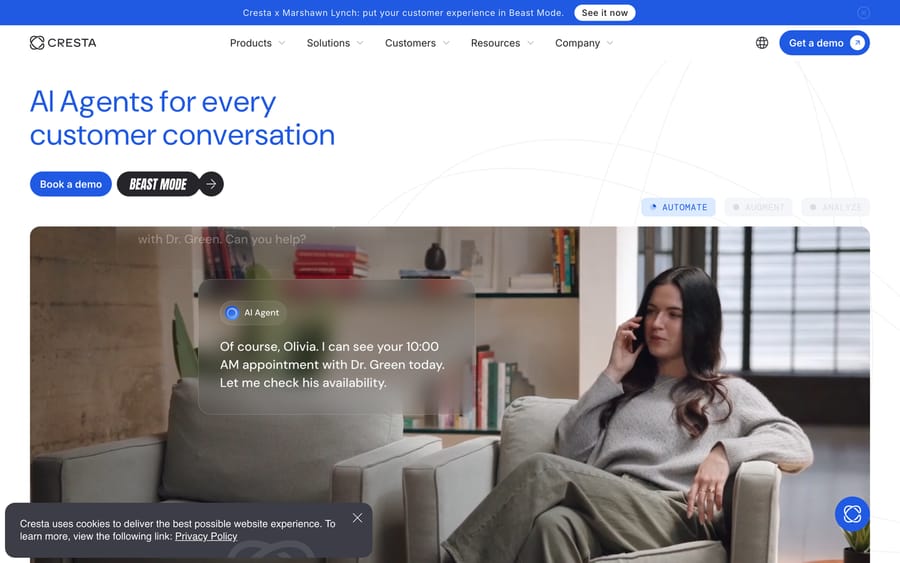
Cresta is the closer comparison of the two. Both companies sell AI for live contact-center conversations to large enterprises (Cresta names United Airlines, Alaska Airlines, Marriott, and Hilton), and both keep pricing off their public sites. The real difference is scope: Cresta stays focused on the conversation layer (AI Agent, Agent Assist, Conversation Intelligence), while Uniphore has expanded outward into data platforms, governance, and now marketing. If you want a specialist in the call itself, Cresta's narrower focus is easier to evaluate. If you want one platform spanning data, knowledge, and multiple departments, Uniphore's breadth is the point.
Two other vendors belong on the same shortlist if breadth is what you're buying. Kore.ai sells a comparably wide enterprise agent platform built organically rather than by acquisition, which makes it the clean test of whether the roll-up seams matter to you. Observe.AI sits at the narrow end of the same market, doing conversation intelligence and agent coaching only, and is worth pricing as a control: it tells you what the one layer you actually need costs on its own.
Neither company touches a support team's ticket queue, which is where Macha fits instead. If the actual bottleneck is email and chat tickets stacking up in Zendesk, Freshdesk, Front, or Gorgias, that's a smaller, cheaper, and much faster-to-deploy problem than either Uniphore's or Cresta's enterprise voice platforms solve, and it's priced per ticket instead of per enterprise contract.
How we researched this
We pulled architecture and product claims directly from uniphore.com (home, /platform/, and the customer service use-case page, fetched 2026-09-17), and the 87% expansion figure and Fortune 500 count from the homepage itself. Funding rounds and the acquisition timeline are cross-checked against Wikipedia's Uniphore entry and Uniphore's own live Series F press release, which confirms the $260M raise, the $2.5B valuation and every named investor. G2, Gartner Peer Insights and TrustRadius all returned a Cloudflare 403 on every attempt, including through a headless browser, so the only review figure we can evidence is the 71-review count in G2's own indexed seller-page title; Capterra's zero-review listing we fetched directly. We removed two review quotes an earlier draft carried from a search cache, because we could not re-open them on a live page.
FAQ
What is Uniphore? An enterprise AI company, founded in 2008, that sells "Business AI Cloud," a four-layer platform (data, knowledge, model, and agentic) assembled through eight acquisitions since 2021 alongside organic development.
How much does Uniphore cost? Pricing isn't published, and there's no marketplace listing or Vendr estimate available either. Expect a sales-led, per-deal negotiation typically tied to usage volume and how many of the platform's layers and use cases you activate.
Is Uniphore good, based on reviews? There's very little public review evidence either way. G2's seller page lists 71 reviews across Uniphore's products as of 2026-09-17, but G2, Gartner Peer Insights and TrustRadius all block automated access, so we could not read a single review or verify a star average. Capterra shows zero reviews, which we confirmed directly. Diligence here has to run through reference calls, not review sites.
Does Uniphore offer a free trial? No. Every path on the site leads to a demo request or a sales conversation.
What companies has Uniphore acquired? Emotion Research Lab (2021), Jacada (2021), Red Box (2023), Hexagone (2023), ActionIQ (2024), Infoworks (2024), Orby AI (2025), and Autonom8 (2025), each folded into a different layer of the Business AI Cloud.
Who are Uniphore's investors? Its October 2025 Series F included NVIDIA, AMD, Snowflake, and Databricks alongside NEA, March Capital, BNF Capital, National Grid Partners, and Prosperity7 Ventures, at a $2.5 billion valuation.
What are good alternatives to Uniphore? Cresta is the closer comparison for contact-center AI specifically, with a narrower focus on live conversations rather than a full data-and-governance platform. Neither is a fit for a support team's email and chat queue, which is a help-desk automation problem instead.
Who are Uniphore's named customers? KPMG, Cognizant, Farmers Insurance, AT&T, Sony, Allstate, and DocuSign appear on its current site; older public case studies also name the US Coast Guard, the Singapore Police Force, JPMorgan Chase, DirecTV, Vodafone, and Verizon.
If your actual bottleneck is a support team's ticket queue rather than a full enterprise AI platform, see how Macha's pricing works or start a trial.
Sources: Uniphore, Uniphore - Business AI Cloud platform, Uniphore - Business AI Suite for Customer Service, Uniphore Series F press release, Wikipedia - Uniphore, Cresta. G2's Uniphore seller page, Gartner Peer Insights and TrustRadius all block automated fetches; only the 71-review count from G2's indexed page title is cited here. Capterra's Uniphore listing was fetched directly and shows 0 reviews.
Resolve tickets automatically with AI agents
Macha's AI agents work on top of the help desk you already use — no code.