Intercom
 Shopify
 Stripe
 Slack
Slack Notion
 Google Workspace
 Confluence

ASAPP: The Complete Guide (2026)


ASAPP is an enterprise contact-center AI platform built for companies running large, complex support operations, its named customers include American Airlines, JetBlue, Dish, and Astound Broadband, and it doesn't publish a price anywhere. This guide covers what ASAPP's GenerativeAgent actually does, which of its published results are attributed to a real customer versus a composite estimate, and how it compares to Cresta and Macha for teams evaluating enterprise contact-center AI against a lighter, help-desk-native option.

ASAPP sells to "the world's largest and most complex contact centers," in its own words, and everything about how it's sold, no self-serve signup, no public price, six- and seven-figure named case studies, reflects that positioning.
What is ASAPP?
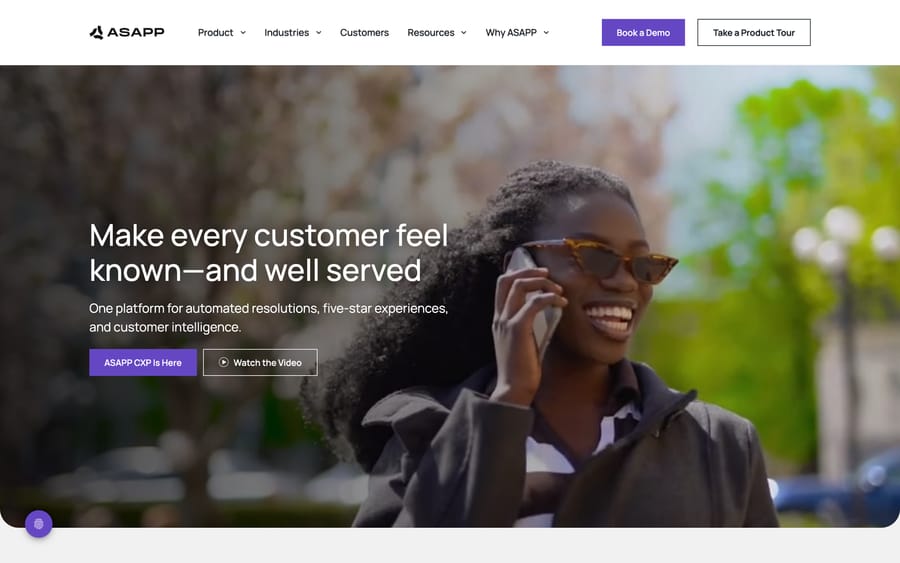
ASAPP describes itself as "the leading agentic customer experience platform for enterprises at scale," built around GenerativeAgent®, an AI system the company says "understands, reasons, and acts with precision, turning every interaction into a resolved outcome." Founded in 2014 by Gustavo Sapoznik and now led by CEO Priya Vijayarajendran, ASAPP has spent over a decade selling specifically to enterprise contact centers, skipping the SMB and mid-market self-serve tools most newer AI vendors chase.
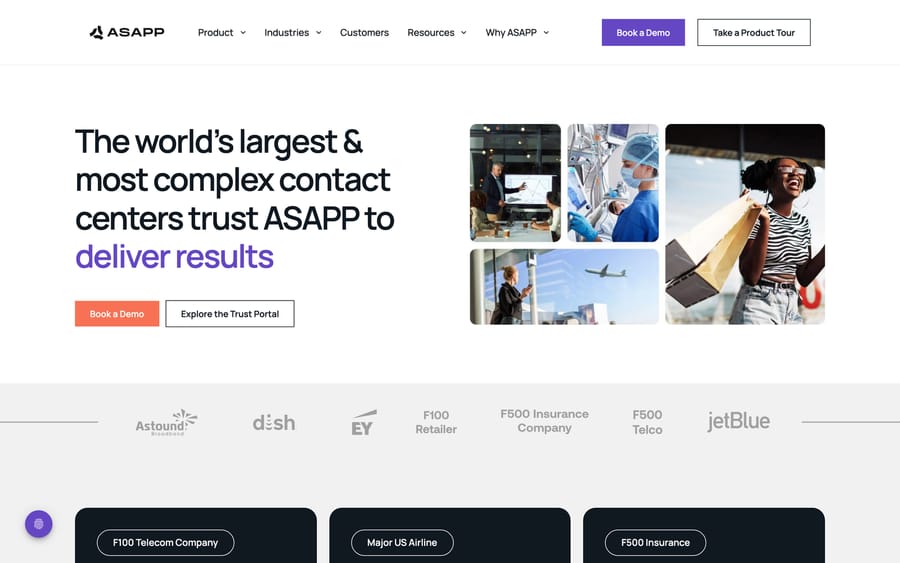
Named customers on ASAPP's results page include American Airlines, JetBlue, Dish, Astound Broadband, and EY (Ernst & Young), alongside anonymized but specific logos like an "F100 Retailer," "F500 Insurance Company," and "F500 Telco." That mix, real airlines and telecoms next to unnamed Fortune 500 accounts, is typical of enterprise vendors whose biggest contracts carry non-disclosure terms.
How ASAPP's AI works
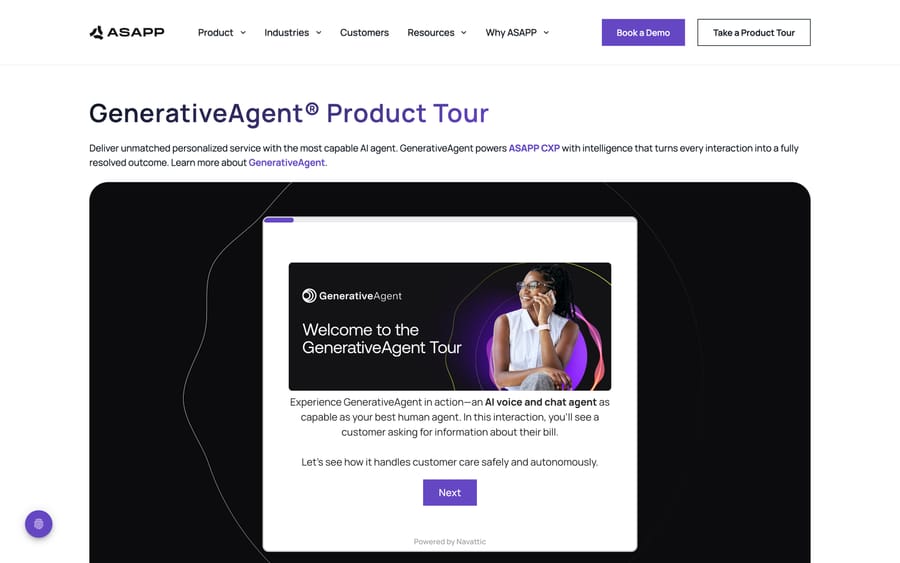
GenerativeAgent is built to act autonomously on customer interactions while staying inside guardrails an enterprise can audit. The platform is organized into distinct product surfaces instead of one monolithic AI: Human-in-the-Loop (routing to a person when the AI shouldn't decide alone), Agent Observability and Control (visibility into what the AI did and why), Interaction Intelligence (analysis across calls and chats), Multiple AI Agents (specialized agents split by intent), Safety and Security, Testing and Simulation, and dedicated Voice handling.
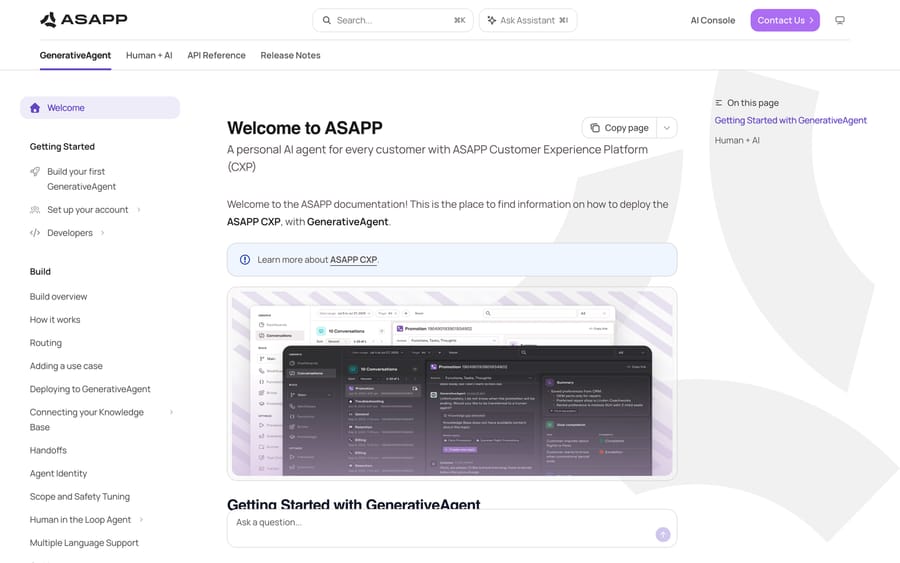
The observability product is a deliberate sales pitch aimed at a specific enterprise fear: "No black box, just a transparent, accountable, continuously improving AI platform." For a bank or airline that has to explain an automated decision to a regulator, that framing matters more than raw model capability. ASAPP backs it with SOC 2, HIPAA, GDPR, CCPA, PCI DSS, and HITRUST certifications, and pre-built integrations with Salesforce, Microsoft, Google Cloud, AWS, Snowflake, Genesys, and Zendesk, so it plugs into a contact-center stack an enterprise already runs instead of replacing it outright.
Which results are attributed, and which aren't
This is worth a dedicated section because it's the single most useful thing a buyer can check before a sales call, and ASAPP's own pages don't make it obvious.
Real, customer-attributed results appear on ASAPP's results page: JetBlue reports 92% CSAT and a 25-point jump in first-call resolution; American Airlines reports an 11-point CSAT increase and 50% containment within six months; an F500 Insurance account reports $4.1 million in average annual savings, 57% average containment, and a 13.2x return on investment; an F100 telecom account reports $10.3 million in annual savings and a 25% lift in containment. These are specific numbers tied to a specific (if sometimes anonymized) account.
The homepage's headline claim, 330% ROI and $9.8 million in annual savings, has no customer name attached anywhere we could find on ASAPP's site. ASAPP's own ROI calculator is explicit about why: it states its outputs "use assumed model parameters and should be treated as directional," refined only "after a pilot." That's a composite, illustrative figure, not a result any named company achieved, and a buyer should ask directly which number applies to their situation before repeating it internally.
The GenerativeAgent product page's own stat block, 34% fewer agents needed, 91% first-call resolution, 77% lower cost per chat, 49% more self-service, has the same shape: strong numbers, no visible customer attribution on that page. Treat product-page statistics and results-page case studies as two different tiers of evidence.
Key features
- GenerativeAgent: the core autonomous resolution engine for voice and chat.
- Agent observability and control: an explicit answer to the "black box" objection enterprises raise about generative AI in regulated industries.
- Multiple AI agents: specialized agents split by intent, instead of one general-purpose model handling everything.
- Testing and simulation sandbox: built to "test how the agent handles real scenarios before it ever talks to a customer," reducing the risk of a bad answer reaching a real caller.
- Deep enterprise integrations: Salesforce, Microsoft, Google Cloud, AWS, Snowflake, Genesys, and Zendesk, plus compliance certifications spanning SOC 2, HIPAA, GDPR, CCPA, PCI DSS, and HITRUST.
ASAPP pricing
ASAPP does not publish pricing anywhere on its site, and we found no AWS, Azure, or Google Cloud Marketplace listing to check either, which is common for a vendor whose contracts are individually negotiated with Fortune 500 accounts instead of sold self-serve. Every path on the site leads to "Book a Demo."
Given the scale of the named case studies, $4.1 million and $10.3 million in reported annual savings for two of its enterprise accounts, it's reasonable to assume ASAPP's contracts run into six or seven figures annually for a large deployment, but we have no published number or reliable third-party estimate to cite. If you're evaluating ASAPP, budget for a multi-month sales and pilot cycle instead of a self-serve trial.
The incentive worth naming: a negotiated, sales-led price lets ASAPP charge each enterprise account closer to what that specific deployment is worth to them, rather than leaving money on the table with one public rate card. That's standard enterprise software practice, not a red flag on its own, but it does mean your own contract's economics depend heavily on how hard you negotiate and whether you run a competitive process against Cresta or another rival before signing.
What actual users say
We checked directly and couldn't produce a confident real-user rating for ASAPP. G2's reviews page returned a 403 to a direct fetch; a search-engine summary reported a 4.3/5 rating from 3 reviews with a 33%/66% four-star/five-star split, but that split works out to a 4.67 average, not 4.3, so the numbers don't reconcile and we're not citing it as fact. Gartner Peer Insights and TrustRadius, both platforms enterprise contact-center software typically appears on, also returned 403 when we tried them directly.
That scarcity is itself informative: ASAPP sells through a small number of large, sales-led enterprise contracts instead of a self-serve base that generates organic reviews at volume, so an independent, well-populated review picture may simply not exist yet for this product.
Pros and cons
Pros
- Real, customer-attributed results at meaningful scale (JetBlue, American Airlines, and named F500 accounts), beyond generic testimonials.
- A dedicated observability and control product aimed directly at the "black box" objection regulated enterprises raise about generative AI.
- Deep integrations with the CRM, cloud, and CCaaS platforms a large contact center already runs.
- Over a decade of enterprise contact-center focus predates the recent wave of pivots into the category.
Cons
- Zero published pricing, and no marketplace listing to estimate from either; every evaluation starts with a sales call.
- The homepage's headline ROI figures aren't attributed to a specific customer, unlike the case-study numbers one click away.
- No independently verifiable review base we could access, so a prospective buyer is largely working from ASAPP's own published numbers.
- Built for large, complex contact centers. A 20-person support team gains nothing from the scale this platform is priced and built for.
Who ASAPP is best for
ASAPP fits teams at a large enterprise contact center, telecom, airline, insurer, bank, or major retailer, running high call and chat volume across a CRM and CCaaS stack that already includes Salesforce, Genesys, or similar systems, and that needs to prove to a compliance or risk function exactly what an AI agent did and why. The observability product and the compliance certification list are built specifically for that buyer.
It's the wrong choice if you want to see a price before a sales conversation, or if your support volume runs through a single help desk rather than an enterprise contact-center stack. A 15-person e-commerce brand on Zendesk has no path to ASAPP's pricing tier or its integration depth; a national telecom's contact center is exactly the account ASAPP is built to win.
ASAPP vs alternatives
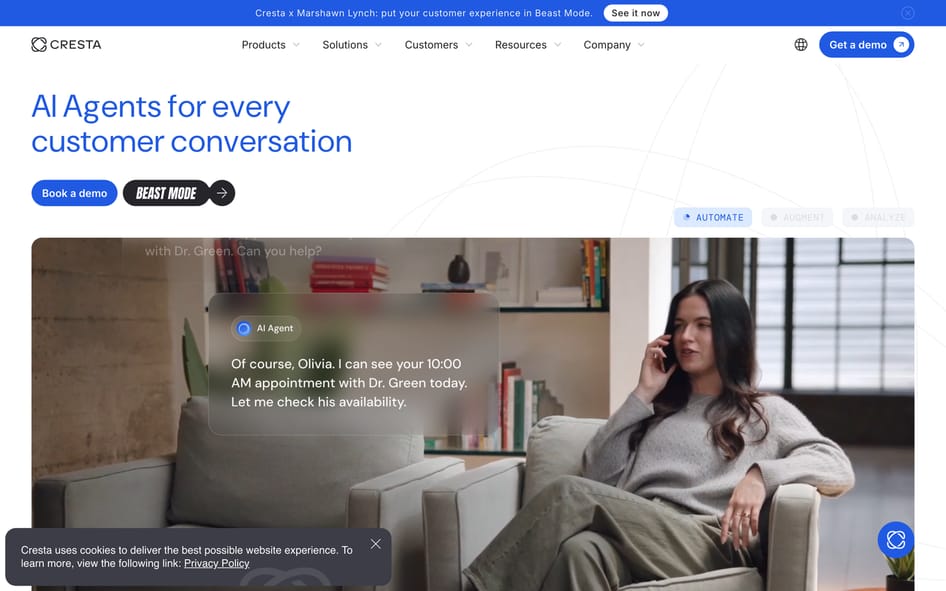
The closest comparison is Cresta, another enterprise contact-center AI platform organized around real-time agent assistance and automation. Like ASAPP, Cresta doesn't publish pricing; both vendors sell through enterprise sales cycles instead of self-serve signup, which makes them structurally similar to compare even before features enter the picture.
| ASAPP | Cresta | Macha | |
|---|---|---|---|
| Model | Enterprise contact-center AI (GenerativeAgent) | Enterprise contact-center AI (real-time agent assist + automation) | AI agent layer on your existing help desk |
| Best for | Large telecoms, airlines, insurers, banks | Enterprise contact centers, sales and support | Teams on Zendesk, Freshdesk, Gorgias, or Front |
| Pricing | Unpublished, sales-led | Unpublished, sales-led | From $299/mo for 750 tickets (~$0.40/ticket), published |
| Self-serve trial | No | No | $50 free usage |
| Observability/control | Dedicated product, explicit "no black box" positioning | Built into the platform | Standard controls; scoped per agent |
| Replaces your help desk? | No, layers onto an existing CCaaS/CRM stack | No, layers onto an existing CCaaS/CRM stack | No, sits on top of Zendesk, Freshdesk, Gorgias, or Front |
Both ASAPP and Cresta compete for the same enterprise buyer, one already running a large contact-center operation who needs an AI layer with enterprise-grade observability and integration depth. Neither is reachable, or sensible, for a team whose support runs through a single help desk rather than a full CCaaS stack. That's the gap Macha fills: published, per-ticket pricing and a self-serve trial, built as an AI agent layer inside Zendesk, Freshdesk, Gorgias, or Front instead of a sales-led enterprise contact-center platform. For more on how enterprise contact-center AI compares to help-desk-native agents, see our guide to AI agents for customer service.
How we researched this
We fetched ASAPP's homepage, customers/results page, GenerativeAgent product page, and observability page directly on 2026-09-17. No pricing page exists (it 404s), and a search for an AWS or Azure Marketplace listing found none. G2, Gartner Peer Insights, and TrustRadius all returned 403 to direct access; a search-engine summary of G2's rating didn't arithmetically reconcile, so we're not citing a specific score. We could not verify ASAPP's actual contract pricing at any scale, or find a well-populated, independently checkable review base.
FAQ
What is ASAPP? ASAPP is an enterprise contact-center AI platform built around GenerativeAgent, an autonomous AI system for voice and chat resolution, sold to large telecoms, airlines, insurers, and retailers since the company's 2014 founding.
How much does ASAPP cost? ASAPP doesn't publish pricing, and no marketplace listing exists to estimate from. Named case studies report annual savings in the millions of dollars for enterprise accounts, which suggests a correspondingly large contract size, but there's no reliable published number to cite.
Is ASAPP's "330% ROI" figure real? It appears on ASAPP's homepage but isn't attributed to a specific customer anywhere we could find. ASAPP's own ROI calculator describes its outputs as directional estimates based on assumed parameters, refined only after a pilot, which makes it a composite illustration rather than a measured result.
What companies use ASAPP? Named, attributed customers include American Airlines, JetBlue, Dish, Astound Broadband, and EY, alongside anonymized Fortune 100 and Fortune 500 accounts in retail, insurance, and telecom.
Does ASAPP have good reviews? We couldn't confirm. G2, Gartner Peer Insights, and TrustRadius all blocked automated access, and a search-engine summary of G2's rating contained numbers that didn't reconcile, so we're not citing a specific score here.
What's the difference between ASAPP and Cresta? Both are enterprise contact-center AI platforms sold through sales-led cycles with no published pricing. ASAPP leads with observability and "no black box" positioning; Cresta leads with real-time agent assistance alongside automation. Compare both directly for your specific use case.
Does ASAPP replace a help desk? No. ASAPP layers onto an enterprise's existing CCaaS and CRM stack (Salesforce, Genesys, Zendesk, and similar systems). A team running support through a single help desk rather than a full contact-center stack needs a different, lighter tool.
Is ASAPP a good fit for a small support team? No. ASAPP is built and priced for large, complex contact centers. A team under a few hundred agents is unlikely to be the account ASAPP's sales process, or its integration depth, is built for.
Ready to automate the ticket queue with published, per-ticket pricing instead of a sales-led enterprise contract? See how Macha's pricing works or start a trial on top of the help desk you already run.
Sources: ASAPP, ASAPP customer results, ASAPP GenerativeAgent, ASAPP agent observability and control, ASAPP ROI calculator, Cresta.
Resolve tickets automatically with AI agents
Macha's AI agents work on top of the help desk you already use — no code.