



 Intercom
 Shopify
 Stripe
 Slack
Slack Notion
 Google Workspace
 Confluence

Zendesk vs. HappyFox (2026): Predictable Pricing vs. Depth


Zendesk and HappyFox both do solid ticketing — the difference is philosophy. HappyFox is the predictable, no-frills choice: clean ticketing, categories, SLAs, no-code Smart Rules, and pricing built to stay flat as you grow. Zendesk is the deep, scalable, modern-AI platform for teams that need omnichannel breadth, deep automation, and a huge ecosystem. This guide uses verified June-2026 pricing (HappyFox's is now mostly behind a form, so we reconstruct it carefully) and stays neutral.

Short version: HappyFox if you want predictable cost and solid ticketing without complexity; Zendesk if you need depth, omnichannel, modern AI, and scale.
The 30-second verdict
| If you are… | Pick |
|---|---|
| An SMB/mid-market team wanting predictable, flat pricing | HappyFox |
| Running a large team where per-seat cost balloons | HappyFox (unlimited-agent plans) |
| Wanting solid ticketing + Smart Rules without complexity | HappyFox |
| Needing deep omnichannel incl. native voice | Zendesk |
| Wanting the most advanced native AI + biggest ecosystem | Zendesk |
| Scaling to enterprise with deep analytics | Zendesk |
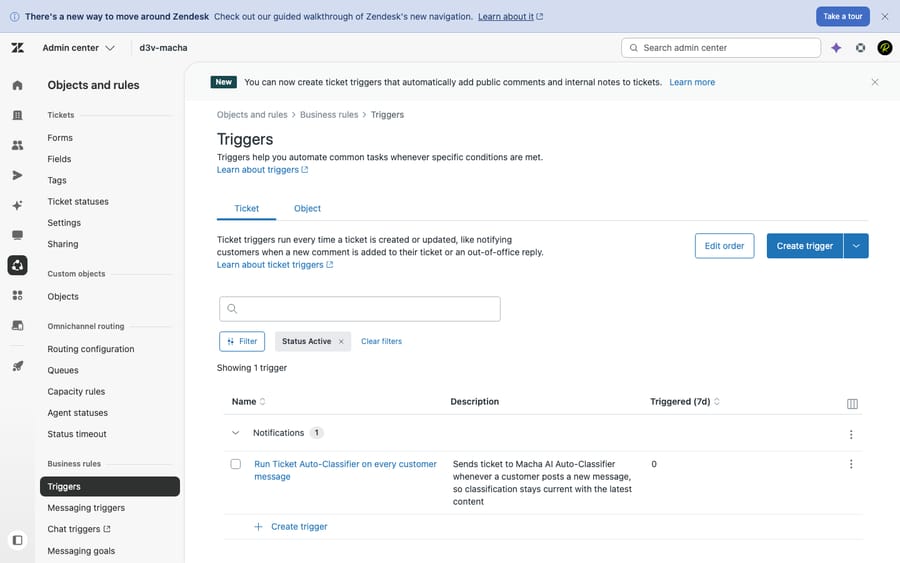
How we compared: Zendesk's pricing is verified against its official page (June 2026); HappyFox's is now form-gated, so we reconstruct it from HappyFox's own pricing posts and third-party teardowns and flag it as approximate. Features are checked against the products — and we ran Zendesk hands-on in a live test account (screenshot below). User sentiment comes from real G2, Capterra, and TrustRadius reviews. Macha is our own product — we flag that wherever it comes up.
Pricing: flat-and-predictable vs. seat-plus-usage
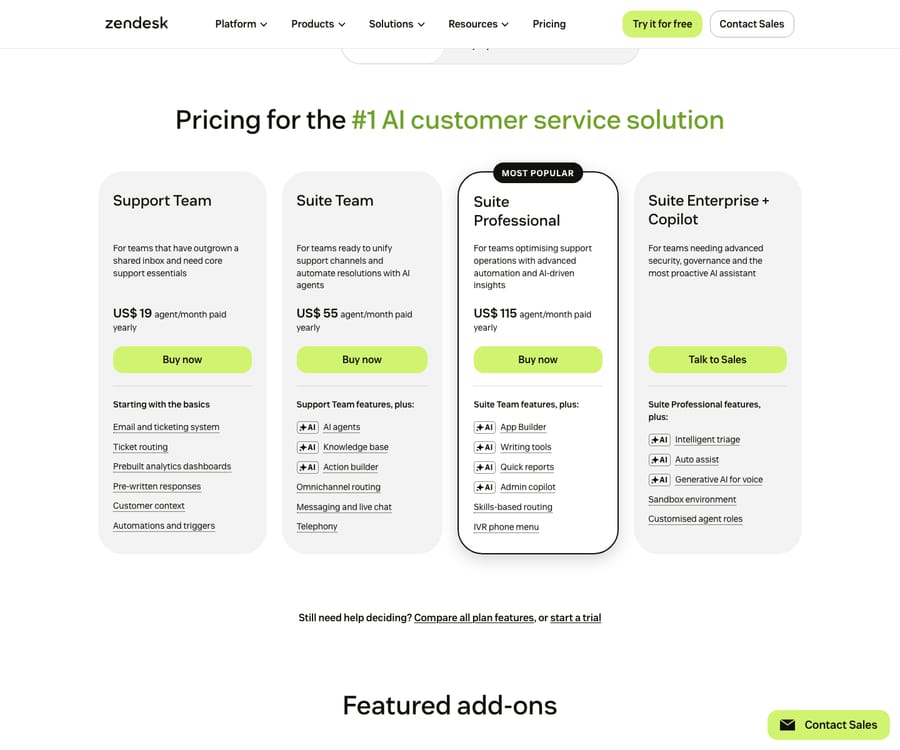
Zendesk Suite (per agent/month, annual): Support Team $19, Suite Team $55, Suite Professional $115, Enterprise contact sales; Copilot $50/agent; AI agents ~$1.50–$2.00 per automated resolution. Source: Zendesk pricing.
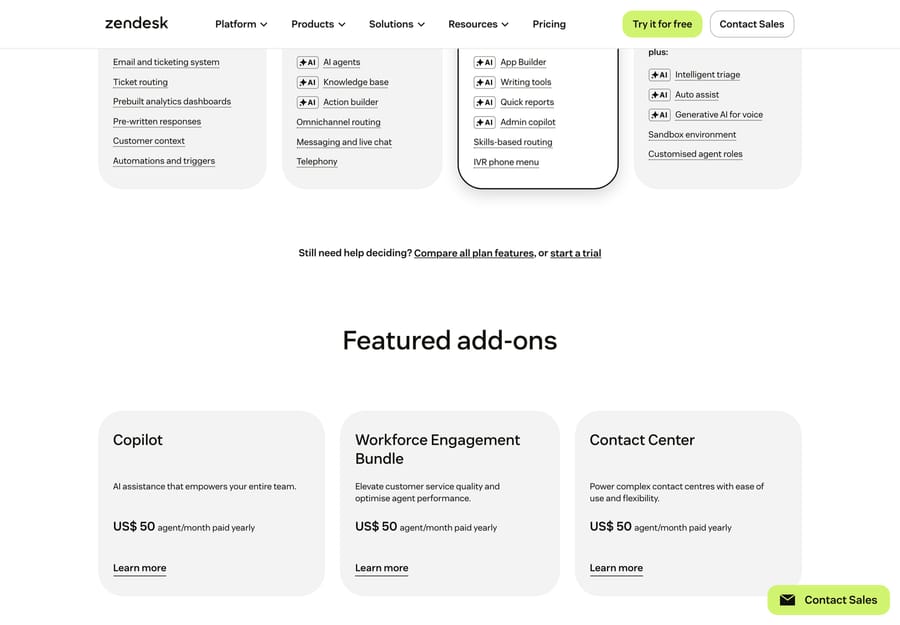
Beyond the per-seat plans, Zendesk’s AI and CX capabilities are sold as separate add-ons — each priced per agent on top of your base plan:
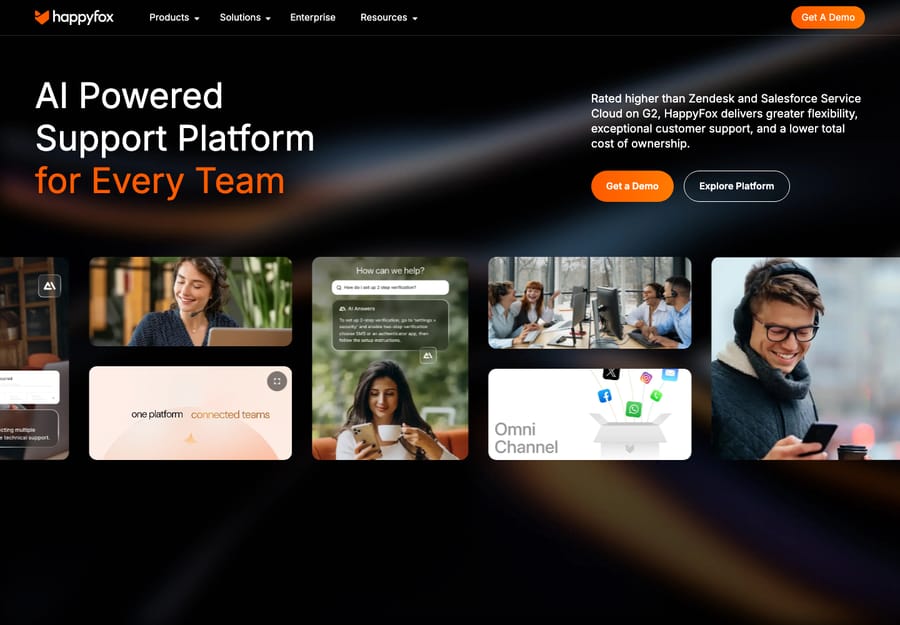
HappyFox — note that HappyFox now hides its prices behind a "request pricing" form, so the figures below are reconstructed from HappyFox's own pricing-update posts and third-party teardowns (treat as approximate, and verify in a quote):
- Per-agent plans: Basic ~$24–$29 (capped at 5 agents), Team ~$49–$69 (sources disagree — likely a recent increase), Pro ~$99, Enterprise Pro contact sales. No free tier; historically a 5-agent minimum.
- Unlimited-agent flat plans (volume-tiered by tickets/year): Growth ~$1,999/mo (150k tickets), Scale ~$3,999/mo (200k), Scale Plus ~$5,999/mo (250k), Ultimate custom.
HappyFox's structural pitch: the unlimited-agent plans become cheaper than per-seat at roughly 20–25+ agents — that's the "predictable cost as you grow" story. Zendesk has no flat unlimited-agent equivalent; its cost scales with seats plus AI usage.
The AI pricing nuance most comparisons get wrong
HappyFox and Zendesk price AI on different units, and it matters:
- HappyFox Autopilot (autonomous) bills ~$0.02 per successful action. A single resolution can take several actions, so per-action pricing isn't directly comparable to a per-resolution number. Its Assist AI (agent-assist) is sold as an add-on (~$14/agent per some sources, bundled into higher tiers per others — verify).
- Zendesk bills autonomous AI per resolution (~$1.50–$2.00) on top of the $50/agent Copilot add-on.
So "HappyFox AI is cheaper" is only sometimes true — model it on your real actions-per-resolution, not the sticker.
Feature-by-feature: who wins what
| Capability | Winner | Why |
|---|---|---|
| Ticketing & agent workspace | Tie (HappyFox for simplicity) | HappyFox is clean and fast to learn; Zendesk is deeper but heavier |
| Categories / Smart Rules / SLAs | HappyFox | No-code, card-based Smart Rules and category routing are native from base plans — a genuine strength |
| Omnichannel (email/chat/social/voice) | Zendesk | Broader, more mature messaging, social, and native telephony |
| Automation / workflows | Zendesk (depth) / HappyFox (ease) | Zendesk's triggers go deeper; HappyFox's are simpler and included earlier |
| Native AI | Zendesk | More advanced/autonomous; HappyFox AI is lighter and newer |
| Knowledge base & self-service | Zendesk (slight) | Both solid; Zendesk's Guide is more mature and AI-integrated |
| Reporting / analytics | Zendesk | Explore is far deeper; HappyFox native reporting is adequate-for-SMB |
| Integrations | Zendesk (decisive) | 1,500+ marketplace apps vs HappyFox's ~100–150 |
| Ease of use & setup | HappyFox | Live in hours to a week vs Zendesk's multi-week setup |
| Scalability | Zendesk | Built for enterprise volume, governance, and compliance breadth |
Strengths & weaknesses, honestly
HappyFox — strengths: predictable/flat pricing (incl. an unlimited-agent option); fast setup; intuitive UI; strong native ticketing/categories/Smart Rules from base plans; cheap modular AI ($0.02/action); a separate ITSM/asset product if you need it. HappyFox — weaknesses: smaller integration ecosystem; lighter/less mature AI and analytics; reported SLA quirks and occasional slow loads; no free tier and pricing now hidden behind a form; a 5-agent Basic cap; AI sold as separate products adds line-item complexity despite the "simple" image.
Zendesk — strengths: depth and scale; huge app marketplace; mature omnichannel + native voice; best-in-class reporting; the most advanced native AI; strong compliance/security. Zendesk — weaknesses: expensive, and cost compounds (seat + Copilot + per-resolution + WFM/QA); steep learning curve; long setup; support access criticized.
What real users say
The headline ratings actually favor HappyFox — but the base tells the real story. (Observed June 2026.)
| G2 | Capterra | Other | |
|---|---|---|---|
| Zendesk | 4.3 / 5 (~6,000+) | 4.4 / 5 (~4,000+) | TrustRadius 8.7/10 |
| HappyFox (Help Desk) | 4.5 / 5 (137) | 4.6 / 5 (92) | TrustRadius (~14 — tiny base) |
HappyFox scores higher on average, but on a fraction of the reviews — roughly 100–140 per platform versus Zendesk's thousands, and only ~14 on TrustRadius. Small bases skew positive and shift fast, so treat the gap as "both are well-liked," not "HappyFox is decisively better."
- HappyFox — the recurring praise is simplicity, value, and responsive support: "I loved the quick and effective assistance that I received when I was having issues" (Allison L., Health Insurance CSR, Capterra, Jan 2026). The recurring knocks are a dated/dense UI, lighter reporting, and a thinner integration list — and the knowledge base in particular draws fire: "The Knowledge Base editor is horrible compared to Zendesk" (Branko B., Training & Documentation Specialist, Capterra, Sep 2024). Reviewers also mention occasional sluggish load times.
- Zendesk — praised for breadth and everyday omnichannel usability: "a very good tool to provide customer support in an omnichannel way, it's easy to use" (Pablo T., CX Consultant, Capterra, Dec 2025). The two recurring complaints are add-on/pricing creep and reporting changes that removed familiar features: "latest updates with reporting are difficult to navigate and removed helpful features" (Melanie J., HR Manager, Capterra, Dec 2025).
The pattern fits the rest of this comparison: HappyFox users like the ease and price and wish it were deeper; Zendesk users like the depth and wish it were simpler and cheaper.
Who each is genuinely for
- HappyFox → SMB and mid-market teams (roughly 5–50 agents, or high-volume teams wanting a flat ceiling) that want solid ticketing, categories, SLAs, and no-code Smart Rules without enterprise complexity or per-seat budget creep — especially teams that value predictable cost and a sub-week rollout over a giant app ecosystem.
- Zendesk → teams that need scale, channel breadth, deep analytics, a massive integration ecosystem, and the most advanced native AI — and that have the budget and resources to absorb add-ons and a multi-week setup. Best for enterprise, high-growth, and compliance-heavy orgs.
The AI question — different units, same ceiling
Zendesk's AI is the more advanced native stack (Copilot + autonomous agents billed per resolution); HappyFox's is lighter and à-la-carte (Assist AI + Autopilot at $0.02/action). But both share the same real-world limit: autonomous-resolution quality depends heavily on KB grounding and configuration, and both are tied to (and priced by) the help-desk vendor.
That's the case for an independent AI agent layer. A layer like Macha sits on top of either Zendesk or HappyFox, delivers autonomous end-to-end resolution grounded in your existing KB and connected systems, and prices per ticket — one conversation, charged once however many messages it takes — so you keep your ticketing and add resolution on top, without paying Zendesk's per-resolution premium or re-architecting HappyFox's stack. It's helpdesk-agnostic, not a replacement. The honest caveat: a layer is another vendor and integration to manage, it only resolves as well as the knowledge you connect, and per-ticket pricing isn't free at high volume — it's additive, not a free win. (More: native AI vs. an AI layer.)
Before you switch: migration realities
Tickets, contacts, KB articles, tags, custom fields, and SLA policies migrate with standard tools (both have importers; third-party movers are common). What doesn't port cleanly:
- Automation logic — HappyFox Smart Rules and Zendesk triggers/automations use different models, so you rebuild, not migrate them.
- Macros, SLA definitions, and dashboards — plan rebuild time.
- The cost model flips — to Zendesk means re-modeling to seat + per-resolution; to HappyFox means re-modeling to flat/unlimited + per-action AI. Re-model before committing.
Frequently asked questions
Is HappyFox cheaper than Zendesk? Often, especially at scale — its unlimited-agent flat plans beat per-seat pricing at roughly 20–25+ agents, and its per-action AI can be cheaper. But HappyFox now hides prices behind a form and has no free tier, so get a quote and model AI on your real usage.
Why can't I see HappyFox's prices? HappyFox moved its pricing behind a "request pricing" form in 2026. Published figures (including ours) are reconstructed from its blog and third parties — verify in a quote.
Is Zendesk's AI better than HappyFox's? Zendesk's is more advanced and autonomous; HappyFox's is lighter and priced per action ($0.02). They're not directly comparable on price — model actions-per-resolution.
Which is easier to set up? HappyFox — most teams are live in hours to a week, versus a multi-week Zendesk configuration.
Can I add autonomous AI to either? Yes — an AI agent layer like Macha adds end-to-end autonomous resolution on top of HappyFox or Zendesk, priced per ticket — one conversation, charged once, never per resolution.
The bottom line
Choose HappyFox if you want predictable, flat pricing and solid ticketing without complexity — its unlimited-agent plans are genuinely attractive for larger teams. Choose Zendesk if you need depth, omnichannel including voice, the most advanced native AI, and a huge ecosystem, and can absorb the cost and setup. And keep the AI decision separate: both native bots are KB-bound, so an AI layer on top is how you get dependable autonomous resolution on either.
Keep your ticketing, add autonomous AI on top? See how Macha layers AI agents over HappyFox or Zendesk, priced per ticket. $50 of free usage, no credit card required. Start Trial.
Add AI agents to your Zendesk
Macha reads the ticket, drafts the reply and takes the action, inside the Zendesk you already run.