Intercom
 Shopify
 Stripe
 Slack
Slack Notion
 Google Workspace
 Confluence

Zendesk vs. Helpshift (2026): General-Purpose CX vs. In-Game Support


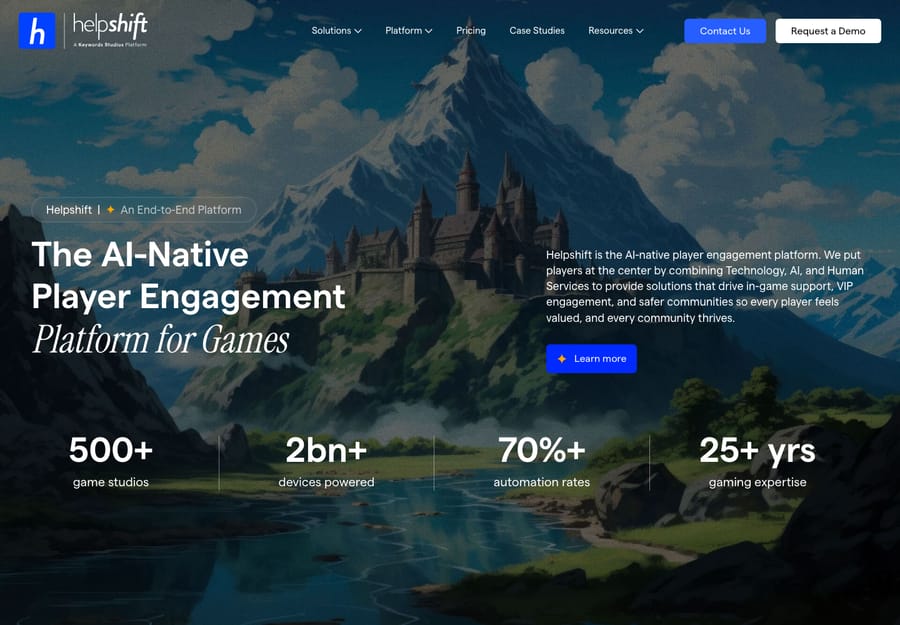
The most useful thing to know about Zendesk vs. Helpshift in 2026 is that they barely compete anymore. Zendesk is the general-purpose, omnichannel ticketing platform for any industry. Helpshift has become, in practice, a gaming player-support platform — owned by Keywords Studios, with a native in-app/in-game SDK and quote-only pricing built for game studios. So the real question usually isn't "which is better" — it's "are you a game studio (Helpshift) or any other kind of business (Zendesk)?" This guide makes that distinction the spine, with verified June-2026 details.

Short version: Zendesk for any non-gaming business and true omnichannel; Helpshift for mobile/console game studios that need in-game player support.
The 30-second verdict
| If you are… | Pick |
|---|---|
| A mobile/console game studio needing in-game support | Helpshift |
| High-volume, seasonal player support (launches, live events) | Helpshift |
| Any non-gaming business (SaaS, e-commerce, fintech, etc.) | Zendesk |
| Needing true omnichannel incl. native voice/phone | Zendesk |
| Wanting transparent, self-serviceable pricing | Zendesk |
| An enterprise needing broad integrations + governance | Zendesk |
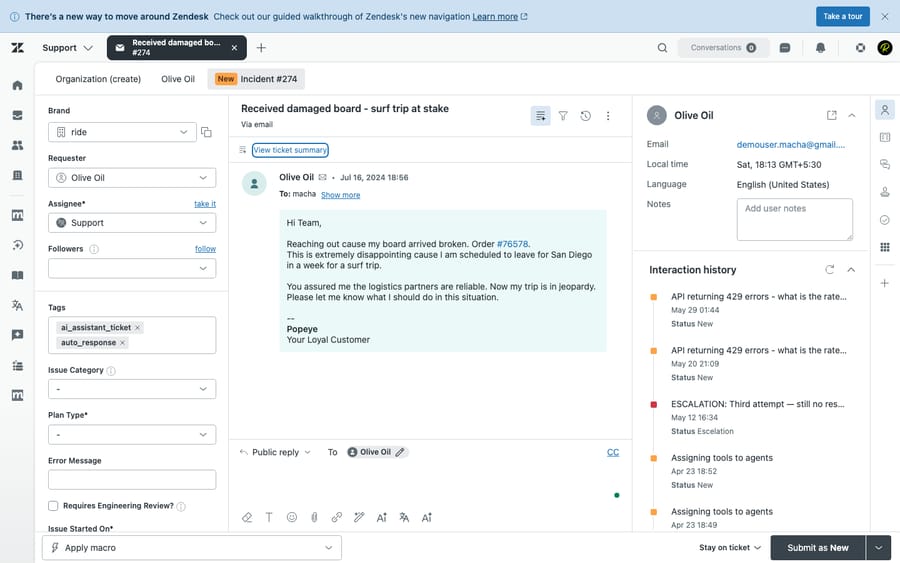
How we compared: Zendesk pricing is verified against its official page (June 2026); Helpshift no longer publishes plans, so its model is described from its current site plus reviewer accounts and flagged as quote-only throughout. Features are checked against both products — and we ran Zendesk hands-on in a live test account (screenshot below). User sentiment comes from real G2, Capterra, and TrustRadius reviews. Macha is our own product — we flag that wherever it comes up.
Pricing: transparent tiers vs. quote-only-for-gaming
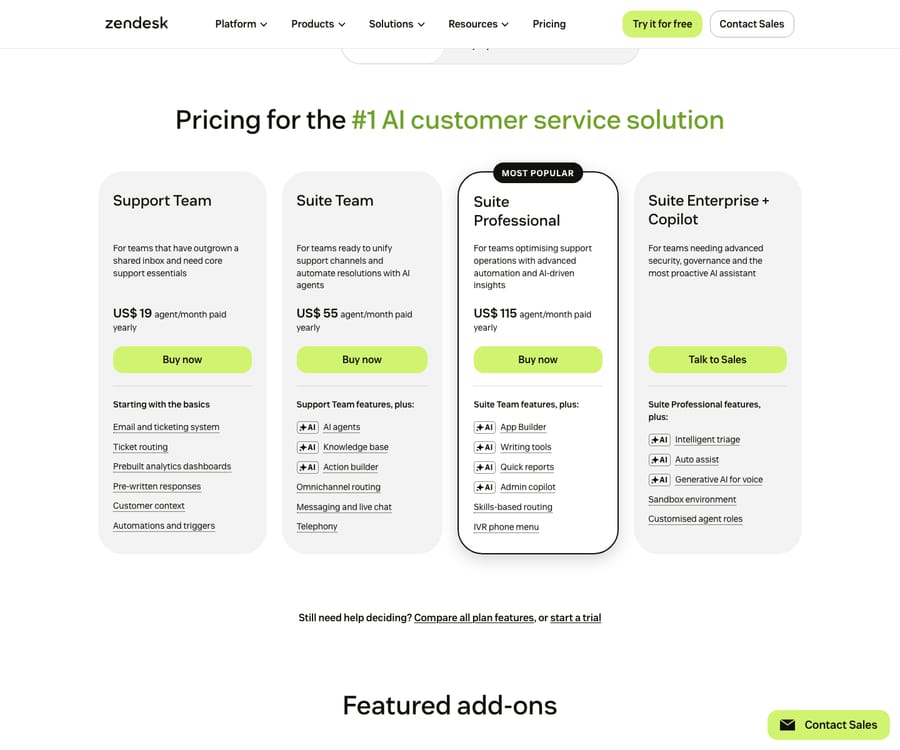
Zendesk Suite (per agent/month, annual): Support Team $19, Suite Team $55, Suite Professional $115, Enterprise contact sales; Copilot $50/agent; AI agents ~$1.50–$2.00 per automated resolution. Fully published and self-calculable. Source: Zendesk pricing.
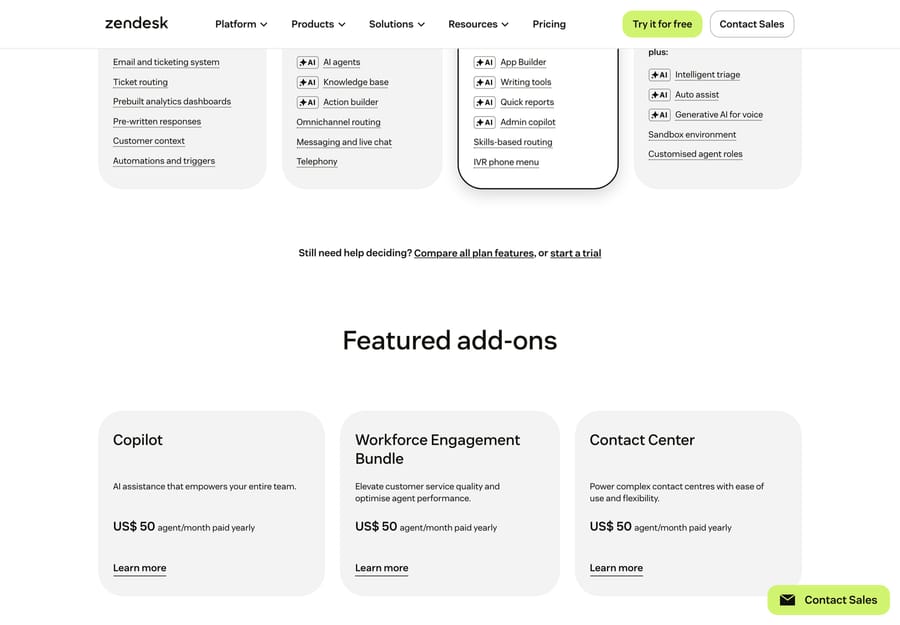
Beyond the per-seat plans, Zendesk’s AI and CX capabilities are sold as separate add-ons — each priced per agent on top of your base plan:
Helpshift: its pricing page no longer lists plans or numbers. Pricing is now quote-only and modular, built for gaming economics — priced per issue, with unlimited seats and no per-channel fees, scaled by interaction volume, the solutions you activate (Support, Engagement, Trust & Safety, Community), the capabilities you use (including Keywords Studios' human agents), and your geography/language coverage. (If you see a "$150 Starter / 250 issues" tier in older articles, it's stale — the live model is quote-only. Reviewers also describe renewal negotiations as tense.)
The trade-off: Zendesk is predictable and self-serviceable; Helpshift is opaque and sales-gated, but its per-issue + unlimited-seats model can be cheaper at gaming volumes (huge, spiky support around launches and live-service events).
Feature-by-feature: who wins what
| Capability | Winner | Why |
|---|---|---|
| In-app / mobile SDK | Helpshift (decisive) | Native in-game messaging, in-app FAQ, push, rich metadata — built for gaming volumes; Zendesk's mobile SDK is comparatively thin |
| Ticketing & agent workspace | Zendesk | Mature unified workspace, macros, triggers, SLAs, custom objects — the general-purpose gold standard |
| Omnichannel breadth | Zendesk | Email, web, chat, social, voice/IVR + full contact center; Helpshift has no native voice and a narrower set |
| Native AI & bots | Split | Helpshift's gaming-trained agents (Care/Engage/Guard/Community) win for gaming intent; Zendesk's AI is broader and general-purpose |
| Knowledge base & self-service | Tie (context-dependent) | Zendesk: robust multi-brand help center; Helpshift: in-game embedded FAQ that never pulls the player out |
| Reporting / analytics | Zendesk | Explore = deep custom dashboards; Helpshift focuses on CSAT, FAQ effectiveness, player sentiment |
| Gaming-specific features | Helpshift (decisive) | Unity/Unreal/console SDKs, QR console→mobile handoff, unified player identity, Keywords Studios gaming agents |
| Integrations | Zendesk | 1,000+ marketplace apps + deep CRM/commerce; Helpshift's catalog is far smaller (game engines + Discord) |
| Voice | Zendesk | Native voice + IVR + generative voice AI; Helpshift has no real voice story |
Strengths & weaknesses, honestly
Zendesk — strengths: transparent pricing; the broadest omnichannel incl. voice; massive integration marketplace; mature ticketing/workspace; deep reporting; industry-agnostic; enterprise depth; a large talent pool. Zendesk — weaknesses: cost stacks fast (Copilot $50 + WFM $50 + Contact Center $50 + per-resolution AI); an à-la-carte/modular feel; a thin native in-app/in-game experience; no gaming specialization.
Helpshift — strengths: best-in-class in-app/in-game SDK; deep gaming specialization (engines, console QR handoff, player identity); unlimited seats + per-issue economics suited to volume spikes; gaming-trained AI; an optional Keywords Studios human-agent layer; preserves player immersion. Helpshift — weaknesses: opaque, quote-only pricing and tense renewals; effectively gaming-only — a poor fit for non-gaming businesses; no native voice/phone; a narrower channel + integration set; smaller analytics footprint; tiny market presence; some reliability gripes in third-party reviews.
(One honesty note: Helpshift markets eye-catching stats — "~95% intent accuracy vs ~60%," "70%+ autonomous resolution," "90% web-form churn." These are vendor-stated and not independently verified; treat them as claims.)
What real users say
The headline stars look similar, but the base tells the real story — Zendesk is reviewed by the thousands across industries, while Helpshift's public review base is small and skews older and gaming-heavy. (Observed June 2026.)
| G2 | Capterra | TrustRadius | |
|---|---|---|---|
| Zendesk | 4.3 / 5 (~6,000+) | 4.4 / 5 (~4,080) | 8.7 / 10 |
| Helpshift | 4.3 / 5 (381) | 3.9 / 5 (29)* | 8.0 / 10 |
\*Small base, read with caution: Helpshift's Capterra listing has just 29 reviews (vs Zendesk's ~4,080), and many of its public reviews date back several years — a few data points, not a trend.
- Zendesk — praised for consolidating channels and everyday usability: "centralises all customer interactions (email, chat, and tickets) in one place" (Sonu P., Systems Analyst, Capterra, May 2026). The recurring knock is price vs. value at the lower end: "packed full of features… [but] for organizations with a tighter budget, it might be hard to justify the price" (Alexandra V., People Business Partner, Capterra, Mar 2026) — echoing the broader complaint about add-on/pricing creep.
- Helpshift — the praise centers on its signature in-app experience: "Their In App messaging is a life saver and extremely polished" (Fabiana H., Learning and Development Associate, Capterra, Feb 2020). The sharpest criticism is cost and renewal pressure: "On renewal they wanted to up our pricing by 500%" (Keith N., CEO, Capterra, Nov 2017) — consistent with the quote-only, sales-gated model and the tense-renewal pattern noted above. (Reviewers also flag thin/awkward analytics and a learning curve.)
The pattern fits the pricing story: Zendesk users debate what they pay for the breadth; Helpshift users — when they review at all — praise the in-app UX and worry about opaque, escalating costs.
Who each is genuinely for
- Helpshift → mobile game studios and live-service games that need in-game support across iOS/Android/console/PC without pulling players out of the experience; high-volume, seasonal/spiky support where per-issue + unlimited seats beats per-seat; studios wanting gaming-trained AI plus optional managed human agents.
- Zendesk → essentially any non-gaming business — SaaS, e-commerce, healthcare, fintech, retail, B2B services — that needs true omnichannel (incl. voice), transparent pricing, a huge integration ecosystem, and enterprise depth.
The AI question — vertical-locked vs. broad, and a neutral layer
Helpshift's AI is genuinely strong within gaming (gaming-trained NLU, in-game bots) but vertical-locked — outside gaming it has no relevant training. Zendesk's AI is broad and now outcome-priced (~$1.50–$2.00/resolution) with independent verification of resolutions, but it's general-purpose and not domain-tuned. Both tie their best autonomy to their own pricing meters and platforms.
An independent AI agent layer sidesteps that: a layer like Macha sits on top of either help desk, resolves against your existing KB and tickets, and decouples resolution quality from any single vendor's per-resolution/per-issue meter — useful if you run a mixed estate (gaming + non-gaming, or multiple help desks). It's helpdesk-agnostic and billed per ticket — one conversation, charged once however many messages it takes — a layer on top, not a replacement. The honest caveat: a layer is another vendor and integration to manage, it only resolves as well as the knowledge you connect, and per-ticket pricing isn't free at high volume — it's additive, not a free win. (More: native AI vs. an AI layer.)
Before you switch: migration realities
- Helpshift → Zendesk (outgrew gaming-only constraints, or need voice/broader channels): migrate issues, KB articles, macros, and user data; rebuild the in-app SDK as Zendesk's mobile SDK (expect feature loss on in-game UX); mind metadata mapping.
- Zendesk → Helpshift (going gaming-native): re-architect around the in-game SDK and per-issue model, lose the voice channel, and plan a sales-led implementation; re-map intents to Helpshift's gaming-trained models.
- Either direction: historical conversation data, KB structure, SLA/automation logic, and agent retraining are the heavy lifts — and Helpshift's quote-only model makes TCO hard to estimate before a quote.
Frequently asked questions
Is Helpshift only for gaming now? In practice, largely yes. Helpshift is owned by Keywords Studios and its product, case studies, and site are now gaming-oriented (in-app/in-game player support). For non-gaming support, Zendesk is the general-purpose fit.
How much does Helpshift cost? It's quote-only and modular — priced per issue with unlimited seats, scaled by volume, solutions, capabilities, and geography. Older "$150 Starter" figures are stale; get a quote.
Which has better in-app support? Helpshift, clearly — its native in-app/in-game SDK is its signature strength. Zendesk's mobile SDK is thinner.
Does Helpshift have phone/voice support? No native voice — it's built around in-app, web, email, and Discord. Zendesk has full native voice/IVR.
Can I add autonomous AI to either? Yes — an AI agent layer like Macha adds autonomous resolution on top of Zendesk or Helpshift, billed per ticket rather than per resolution, decoupled from each vendor's AI meter.
The bottom line
This one is unusually clear: if you're a game studio that needs in-game player support, Helpshift is purpose-built for you; for essentially any other business, Zendesk is the general-purpose, omnichannel choice with transparent pricing and a huge ecosystem. And whichever you run, an AI layer on top can add vendor-neutral autonomous resolution — especially handy if your estate spans gaming and non-gaming.
Want vendor-neutral autonomous AI on top of your help desk? See how Macha layers AI agents over Zendesk or Helpshift, billed per ticket. $50 of free usage, no credit card required. Start Trial.
Add AI agents to your Zendesk
Macha reads the ticket, drafts the reply and takes the action, inside the Zendesk you already run.