Intercom
 Shopify
 Stripe
 Slack
Slack Notion
 Google Workspace
 Confluence

Zendesk vs. Kayako (2026): Depth & AI vs. a Simpler (Pivoting) Desk


Kayako used to be an easy recommendation: a simple, affordable help desk with a nice unified customer view for small teams. In 2026, the picture is different — Kayako has pivoted to a flat-fee-plus-per-resolution model (a platform fee around $79/month plus ~$1 per AI-resolved ticket), and most comparisons you'll find still quote its retired per-agent tiers. Zendesk, meanwhile, is the deep, modern, scale-to-enterprise platform with a mature AI stack. This guide uses verified June-2026 information and is honest about what's changed (and what's unproven).

Short version: Zendesk for depth, modern AI, integrations, and scale; Kayako for a simple unified customer view at low volume — but go in clear-eyed about its pricing opacity and new, unproven AI.
The 30-second verdict
| If you are… | Pick |
|---|---|
| A small team that wants a simple unified customer view, low volume | Kayako |
| Comfortable with flat-fee + per-resolution pricing | Kayako |
| Needing native voice, deep automation, big integrations | Zendesk |
| Wanting mature, proven native AI | Zendesk |
| Scaling to enterprise with compliance and analytics | Zendesk |
| Mainly after autonomous AI resolution | Add an AI layer on either (below) |
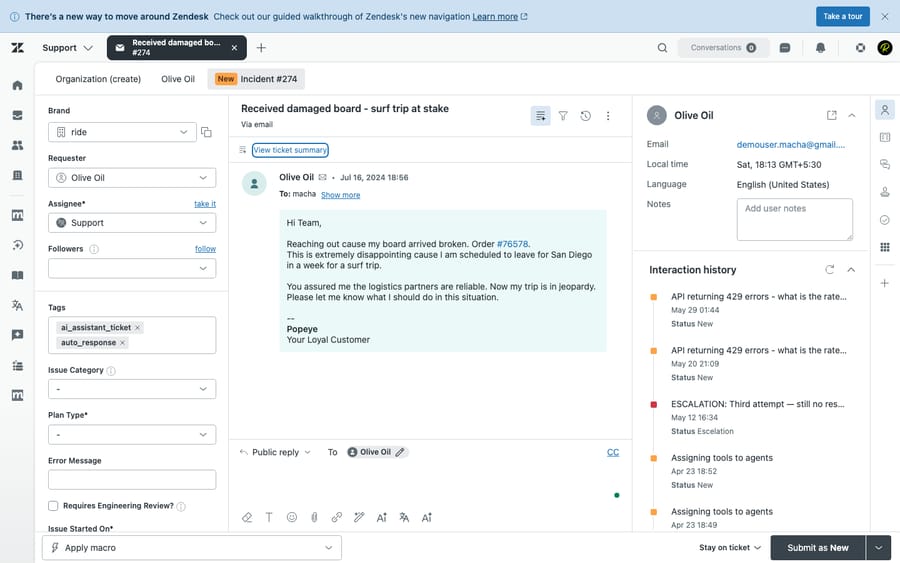
How we compared: Zendesk's pricing is verified against its official page (June 2026); Kayako's is now a flat platform fee (~$79/mo) plus ~$1 per AI resolution after its pivot, with larger deployments quoted — published figures conflict, so we flag them and cite the most current sources. Features are checked against the products — and we ran Zendesk hands-on in a live test account (screenshot below). User sentiment comes from real G2 and Capterra reviews (observed June 2026). Macha is our own product — we flag that wherever it comes up.
Pricing: Kayako changed its model — read this first
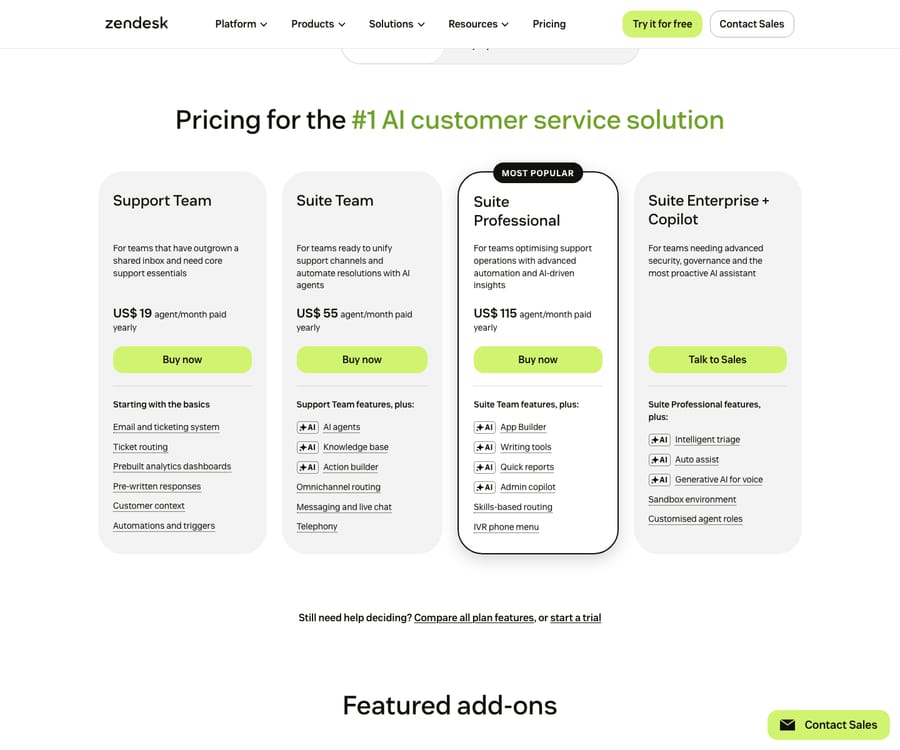
Zendesk Suite (per agent/month, annual): Support Team $19, Suite Team $55, Suite Professional $115, Enterprise contact sales; Copilot $50/agent; AI agents ~$1.50–$2.00 per automated resolution. Transparent and published. Source: Zendesk pricing.
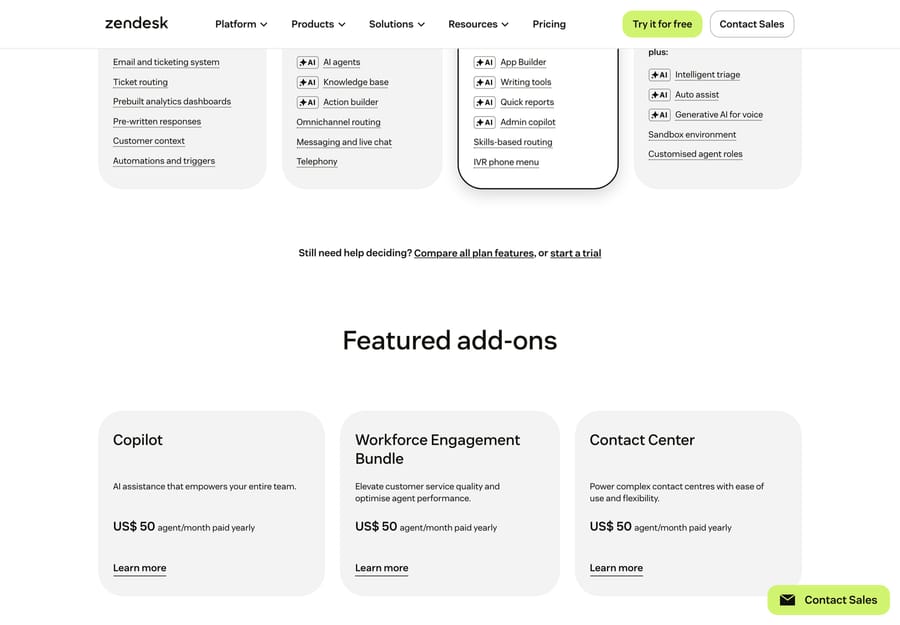
Beyond the per-seat plans, Zendesk’s AI and CX capabilities are sold as separate add-ons — each priced per agent on top of your base plan:
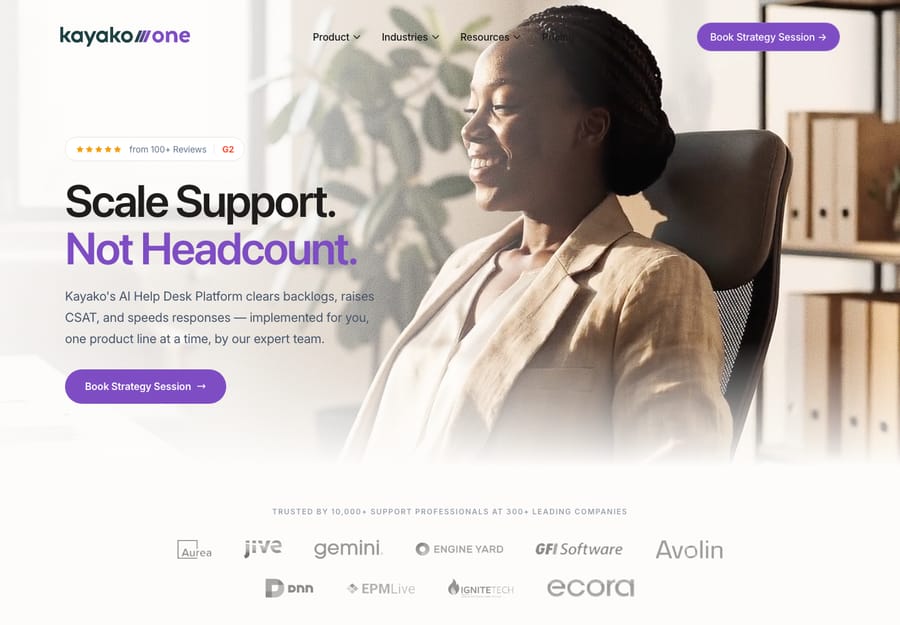
Kayako (pivoted to a flat-fee-plus-usage model): Kayako has retired its old per-agent tiers (Inbox/Growth/Scale) and moved to an AI-resolution model. The current picture, pieced together from Kayako's site and recent (late-2025/2026) third-party trackers:
- "Kay" AI agent: ~$1 per resolved ticket — usage-based, you pay when the AI resolves an issue.
- "Kayako One" (full platform): unified inbox, ticketing, KB, live chat, automation, reporting — pitched as "no seat fees, no setup fees." Several 2026 sources (e.g. Featurebase) report a published flat platform fee around $79/month layered on top of the $1-per-resolution usage; at least one (eesel) reports a pure $1-per-resolution model with no base fee; and Kayako's own site routes larger deployments to a quote ("talk to an expert").
So the honest read is a flat ~$79/month platform fee + ~$1 per AI resolution for most teams, with the exact base and any volume terms worth confirming in writing — the published figures conflict, and Kayako no longer lists a clean public price grid. The old "$79/agent" and "$15/mo" numbers you'll see in stale articles refer to the retired per-agent tiers, not this model — don't budget from them.
What this means at volume. Because the model is flat-fee-plus-usage rather than per-agent, the cost driver is resolution volume, not headcount. A rough model: at 1,000 AI resolutions/month you're near ~$79 + ~$1,000 = ~$1,079/month; at 10,000 resolutions, ~$10,079/month. Compare that to Zendesk, where cost scales with agents (e.g., 20 Suite Professional agents ≈ $2,300/month before AI) plus its own per-resolution AI on top. The crossover is real: Kayako's model is cheap for a small team with modest AI volume and gets expensive fast as resolutions climb — model your actual monthly resolution count before committing.
Feature-by-feature: who wins what
| Capability | Winner | Why |
|---|---|---|
| Unified customer view (SingleView) | Kayako | Its signature: a customer's full cross-channel history on one screen with little config |
| Ticketing & agent workspace | Zendesk | Deeper workspace, macros, triggers, multi-brand, granular fields, SLA enforcement |
| Omnichannel (email/chat/social/voice) | Zendesk | True omnichannel incl. native voice/IVR; Kayako has no native voice |
| Live chat | Tie | Live chat is Kayako's historical core and still solid; Zendesk matches it among many channels |
| Automation / workflows | Zendesk | Richer conditional logic, skills-based routing; Kayako's automation is comparatively shallow |
| Native AI | Zendesk | Mature stack (AI agents, Copilot, triage); Kayako's "Kay" is new and unproven (see below) |
| Knowledge base & self-service | Zendesk | Robust help center + AI self-service; Kayako's KB is basic |
| Reporting / analytics | Zendesk | Custom dashboards (Explore); Kayako reporting is limited |
| Integrations | Zendesk (decisive) | 1,500+ marketplace apps; Kayako has no real marketplace (leans on Zapier) |
| Modernity / active development | Zendesk | Continuous shipping; Kayako languished for years and is mid-relaunch |
A note on Kayako's AI ("Kay") — verify before you believe
Here's something most comparisons won't tell you: sources disagree on whether Kayako even has meaningful AI in 2026. Kayako's own site describes "Kay" as an autonomous agent (it claims a 68% resolution rate); other 2026 write-ups say Kayako has no native LLM-based resolution at all. The honest read is that Kay is a recent bolt-on relaunch with unproven, vendor-claimed performance. Treat its numbers as marketing until independently validated. Zendesk's AI, by contrast, is mature and battle-tested — but it's premium-gated ($50/agent Copilot + per-resolution fees).
Strengths & weaknesses, honestly
Zendesk — strengths: transparent, published per-seat pricing; deepest feature set; mature, proven native AI; 1,500+ integrations; enterprise compliance and scale. Zendesk — weaknesses: expensive once add-ons stack (Copilot, voice, WFM); complexity and admin overhead; per-resolution AI adds usage cost; overkill for tiny teams.
Kayako — strengths: genuinely good unified "SingleView" timeline; simple, low-config agent experience; a "no seat fee" $1/resolution model that's appealing at low volume; a contemporary chat-style UI. Kayako — weaknesses: pricing is no longer a clean public grid (published figures conflict; larger deployments are quote-based); years of minimal development; no native voice, no app marketplace, shallow automation and reporting; "Kay" AI is new and contested.
What real users say
The headline ratings look close, but the review bases are very different — and Kayako's tell a story about momentum. (Observed June 2026.)
| G2 | Capterra | Note | |
|---|---|---|---|
| Zendesk | 4.3 / 5 (~6,000+) | 4.4 / 5 (4,081) | TrustRadius 8.7/10; very large, current base |
| Kayako | 4.0 / 5 (222) | 4.0 / 5 (176) | Much smaller base; many reviews are years old |
A recency flag worth stating up front: Kayako's review base is a fraction of Zendesk's, and a lot of it is stale — Capterra reviews span back to 2017–2018, so weight the recent ones. Some G2 trackers also note Kayako's satisfaction score has drifted down over the past few years (reviewers repeatedly cite a dated feel, slower development, and a thin integration ecosystem), with the most upbeat recent reviews clustered around the new "Kay" AI agent — itself unproven (see above).
- Zendesk — praised for centralising every channel in one workspace and for sheer feature breadth: "centralises all customer interactions (email, chat, and tickets) in one place" (Sonu P., Systems Analyst, Capterra, May 2026). The recurring knock is cost/value at smaller budgets: "packed full of features… [but] for organizations with a tighter budget, it might be hard to justify the price" (Alexandra V., People Business Partner, Capterra, Mar 2026).
- Kayako — recent praise centres on the new AI agent and the simple, low-touch experience: "Kay handles the top of the funnel so cleanly that my team barely touches password resets" (David M., Admin, Telecommunications, Capterra, Apr 2026). The enduring criticism is shallow reporting and analytics: "The complexities of building usable reports made the reporting part unusable" (Barbara B., Senior Project Manager, Higher Education, Capterra) — note this one is older (Jun 2022), and reporting depth is a complaint that still recurs.
The pattern matches the rest of the comparison: Zendesk users debate what they pay for a deep, current platform; Kayako users like the simplicity but flag a smaller, older, thinner product still proving its relaunch.
Who each is genuinely for
- Kayako → small teams that prize a simple, unified single-customer view across email/chat/social, run low-to-moderate ticket volume (where $1/resolution stays cheap), and don't need native voice, a big integration ecosystem, or deep reporting — and who are comfortable with a flat-fee-plus-per-resolution model (and getting a written quote for larger deployments).
- Zendesk → growing-to-enterprise teams needing scale, omnichannel including voice, deep automation, mature native AI, 1,500+ integrations, and compliance — and who can budget for per-seat + add-on costs and absorb setup complexity.
The AI question — and a layer that sidesteps the bet
On either platform, there's a clear case for an independent AI agent layer: it lets a Kayako shop add real, mature autonomous resolution without betting on the unproven "Kay," and it lets a Zendesk shop add resolution capacity without jumping to Enterprise tiers or stacking $50 Copilot fees. A layer like Macha sits on top of your help desk, reads your knowledge and connected systems, resolves end-to-end, and prices per ticket — one conversation, charged once however many messages it takes, never per resolution — helpdesk-agnostic, not a replacement. The honest caveat: a layer is another vendor and integration to manage, it only resolves as well as the knowledge you connect, and per-ticket pricing isn't free at high volume — it's additive, not a free win. (More: native AI vs. an AI layer.)
Before you switch: migration realities
- Kayako → Zendesk (scaling up): map SingleView conversations to Zendesk tickets/threads; migrate contacts, tickets, KB, and canned responses (→ macros). Kayako's lighter automation won't map 1:1 — expect to rebuild and expand workflows.
- Zendesk → Kayako (simplifying): re-create triggers, SLAs, custom fields, and reports; Kayako's automation/reporting is shallower, so plan for feature loss.
- Either direction: the biggest change is the cost model — moving to Kayako's per-resolution pricing changes forecasting entirely, so model it against real monthly resolution volume before committing.
Frequently asked questions
How much does Kayako cost in 2026? Kayako now markets a "Kay" AI agent at ~$1 per resolved ticket plus a "Kayako One" platform ("no seat fees"). Recent sources report a flat platform fee around $79/month on top of the per-resolution usage (one source reports no base fee at all), with larger deployments routed to a quote. Its old per-agent tiers are retired, so ignore the "$79/agent" and "$15/mo" figures in stale articles — confirm current terms in writing.
Does Kayako have AI? It markets a new "Kay" AI agent (claiming a 68% resolution rate), but its maturity is unproven and some 2026 sources question whether it has meaningful native AI at all. Treat the claims cautiously.
Is Zendesk better than Kayako? For depth, modern proven AI, integrations, native voice, and scale — clearly yes. Kayako's edge is a simple unified customer view for small, low-volume teams.
Is Kayako still actively developed? It stagnated for years under previous ownership and is now mid-relaunch around AI. Evaluate how current the product feels before committing.
Can I add proven autonomous AI to either? Yes — an AI agent layer like Macha adds mature autonomous resolution on top of Zendesk or Kayako, billed per ticket — one conversation, charged once, never per resolution — without betting on a new native bot.
The bottom line
Choose Zendesk if you want depth, modern and proven AI, a huge integration ecosystem, native voice, and room to scale. Consider Kayako only if a simple unified customer view at low volume is the priority — and go in clear-eyed about its flat-fee-plus-per-resolution pricing and unproven new AI. Either way, if autonomous resolution is the real goal, an AI layer on top is the more dependable path than betting on either native bot.
Want mature autonomous AI on top of your help desk? See how Macha layers AI agents over Zendesk or Kayako, priced per ticket. $50 of free usage, no credit card required. Start Trial.
Add AI agents to your Zendesk
Macha reads the ticket, drafts the reply and takes the action, inside the Zendesk you already run.