Shopify
 Stripe
 Slack
Slack Notion
 Google Workspace
 Confluence

What to Automate First: A Maturity Model for AI Support


The hardest question in support automation isn't can the AI do it — modern models can draft, classify, look up an order, and issue a refund. The hard question is which of those to turn on first, and in what order, without blowing up trust the week you go live. Most teams get this wrong in one of two directions: they either flip on full auto-resolution on day one and spend a month firefighting bad replies, or they get so cautious that the AI never does anything more useful than suggest a help-center link.

This post lays out a maturity model for AI support — six levels, ordered by how much autonomy you hand over and how reversible the action is. It's not a vendor pitch for "AI everywhere." It's a sequencing guide: start where the blast radius is smallest, prove the model on your real tickets, and only climb a rung once the rung below it is boringly reliable.
The frame matters because automation risk is not evenly distributed. Suggesting an article to an agent is a near-zero-risk action. Auto-issuing a $400 refund is not. A good roadmap treats those as different problems and earns its way up.
The principle: order by reversibility, not by difficulty
Every public maturity model agrees on the shape if not the labels. Kustomer's CX AI maturity model moves from foundational RAG retrieval, to personalized agentic workflows, to autonomous multi-agent resolution, to an AI-run enterprise. Salesforce, Gartner, and a dozen 2026 how-to guides describe the same arc in different words. The recurring advice across all of them is blunt: don't automate everything first — classify and route first, and start with high-volume, low-risk, pattern-based tasks while keeping a human in the loop.
We'd push that one step sharper. The right ordering variable isn't volume and it isn't technical difficulty — it's reversibility. Rank every candidate task by "if the AI gets this wrong, how bad is it and how fast can we undo it?" Drafting a reply a human approves is fully reversible. Posting a public reply is mostly reversible. Refunding money or changing an account is not. Automate in that order and your worst-case failure on each new rung is always something you can take back.
That gives us six levels.
| Level | Name | What the AI does | Autonomy | Reversibility |
|---|---|---|---|---|
| 0 | Measure | Reads your history, quantifies the queue | None (analysis only) | n/a |
| 1 | Deflect | Auto-answers repetitive, known questions | Customer-facing, read-only knowledge | High |
| 2 | Assist | Drafts, summarizes, suggests — human sends | Agent-facing only | Total (human gate) |
| 3 | Retrieve | Pulls live order/payment/account context | Read-only tool calls | High |
| 4 | Triage | Classifies, prioritizes, routes, alerts | Internal actions | High |
| 5 | Act | Refunds, cancellations, account changes | Write actions on systems of record | Low — needs guardrails |
Most teams should expect to live happily at Levels 1–4 for a long time, dipping into Level 5 only for narrow, well-bounded actions. Climbing isn't the goal; matching the rung to the risk is.
Level 0 — Measure before you automate anything
Before you automate a single ticket, you need a real answer to "what is actually in our queue?" Almost every team operates on a gut guess — "most of our tickets are about shipping" — that turns out to be half wrong once you count. The standard heuristic from the 2026 automation guides is that five categories account for 60–80% of volume; the entire point of Level 0 is to find your five, not the generic ones.
This is what Macha's Studies feature exists for: point an AI model at thousands of historical tickets, define the columns you want (category, billing-related yes/no, refund-requested yes/no, urgency 1–5), and get a structured report back. In a real run over 57 tickets, it surfaced that 40% touched billing and not a single ticket was an outright refund request — which immediately tells you a billing-context agent would earn its keep and a refund-automation flow would sit idle.
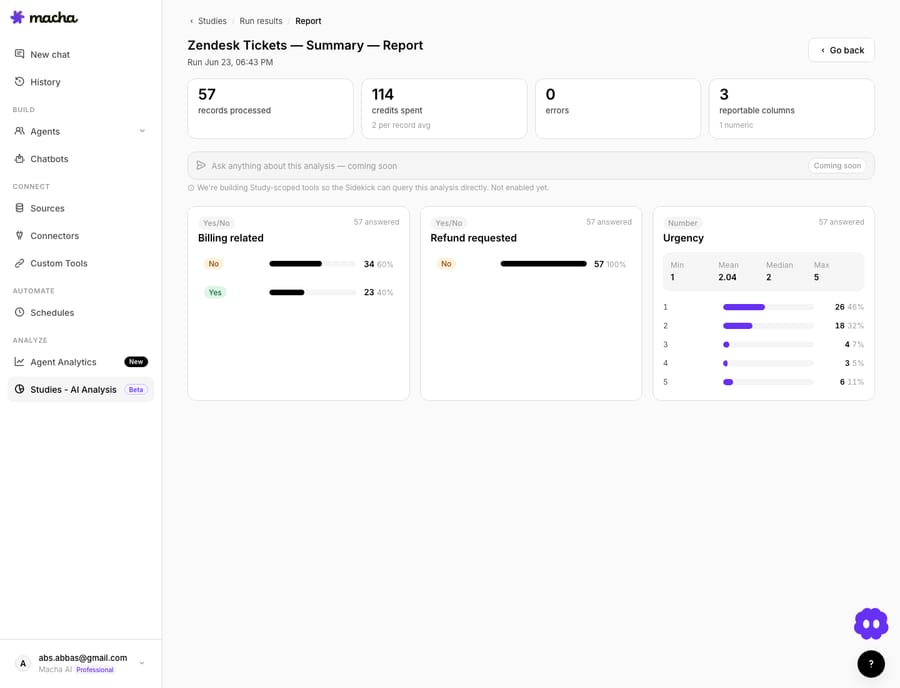
The output of Level 0 is a ranked list: for each category, its share of volume, its average handle time, and its risk (does resolving it require a write action or a refund?). High-volume, low-risk, high-AHT categories are your Level 1 candidates. Spend an afternoon here and the rest of the roadmap writes itself.
Level 1 — Deflect: auto-answer the questions you already answer
The first thing to automate is the cluster of questions whose answers are already written down and never change: return policy, business hours, "how do I reset my password," "where's my tracking link." These are repetitive, low-stakes, and fully covered by your knowledge base — the textbook starting point.
In Macha terms this is an auto-reply agent grounded in a knowledge source (your help center, a Notion or Confluence wiki, uploaded docs). It only answers when it has a confident, sourced match; everything else falls through to a human. Macha ships agent templates so you don't start from a blank canvas — pick the auto-reply pattern, connect the knowledge source, and constrain it.
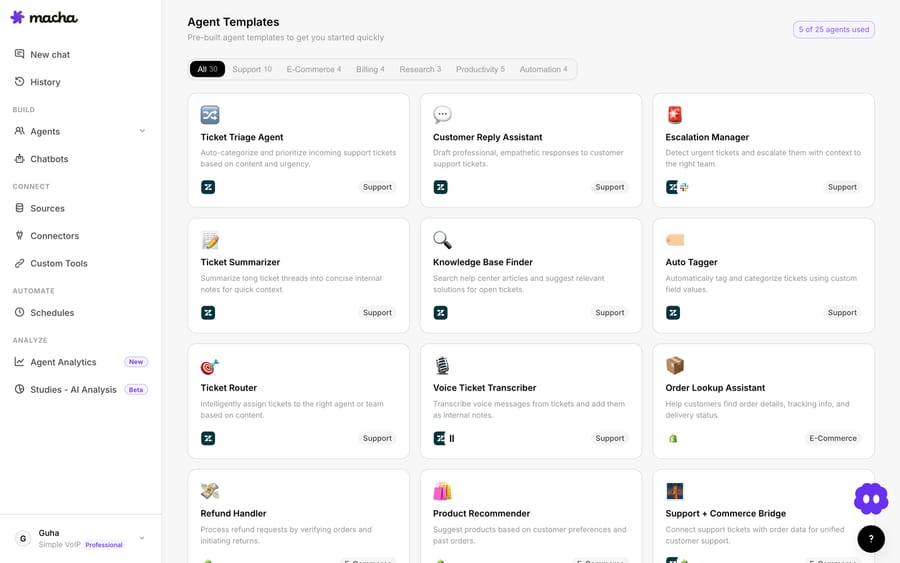
The guardrail that makes Level 1 safe: confidence-gated answering. The agent must be allowed to say "I'm not sure, routing you to a person" rather than confabulate. A deflection agent that answers 30% of tickets correctly and hands off the rest cleanly is worth far more than one that answers 90% with a 10% confident-but-wrong rate.
- Automate here: policy questions, FAQ, order-status lookups against a knowledge base, "how do I" articles.
- Don't yet: anything needing live customer data (that's Level 3) or any judgment call.
- Metric: deflection rate and the hand-off accuracy — track both, never just the first.
Level 2 — Assist: draft and summarize, human sends
Running in parallel with deflection — and arguably even safer — is agent assist: the AI drafts a reply, summarizes a long thread, or surfaces the relevant article, but a human reviews and sends. Because there's a human gate on every output, this level is fully reversible by construction. Nothing reaches the customer the team didn't approve.
This is where nervous teams should start if customer-facing automation feels like too big a first step. Macha's library has the patterns ready: draft ticket responses for agent review, summarize long ticket threads, and surface relevant help-center articles while an agent is typing. Adoption is voluntary and the downside is essentially zero — worst case, an agent ignores a bad draft.
The reason assist matters in the roadmap and not just as a feature: every accepted or edited draft is a labelled training signal. You're watching the model's judgment on your real tickets with a human backstop, which is exactly the evidence you need before you let it answer anyone directly. Level 2 is how you de-risk Levels 1, 3, and beyond.
- Automate here: reply drafting, thread summarization, internal knowledge lookup for agents.
- Metric: draft acceptance rate (how often agents send with minimal edits) — your single best leading indicator for higher autonomy.
Level 3 — Retrieve: give the AI eyes on live data
Levels 1 and 2 work off static knowledge. Level 3 connects the AI to systems of record, read-only: look up an order in Shopify, pull a customer's payment history from Stripe, check a subscription status. Now "where's my order?" gets a real answer with the real tracking number, not a link to a tracking page.
This is a genuine step up in usefulness and still a low-risk one, because reading is reversible — the worst case is the AI surfaces the wrong record, which a human catches. The action it takes is "fetch and show," never "change."
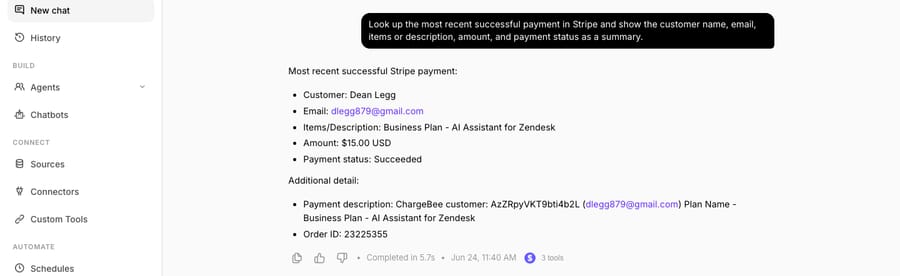
The architectural point: at Level 3 you stop thinking of the AI as a chatbot and start thinking of it as an agent with tools. Macha connects Shopify, Stripe, Notion, Confluence, Google Workspace, Airtable and more, and the agent decides which tool to call based on the ticket. Crucially, you scope tools by permission — a retrieval agent gets read scopes only. That permission boundary is the safety rail between Level 3 and Level 5.
- Automate here: order/shipment lookups, payment history, subscription status, account details — anything read-only.
- Don't yet: any tool call that writes (refunds, cancellations, address changes).
- Metric: retrieval accuracy (right record, right field) and the share of tickets where context was found automatically.
Level 4 — Triage: classify, prioritize, route, alert
With measurement, deflection, assist, and retrieval working, the next high-leverage move is triage — and notably, this is the one most maturity frameworks tell you to do first. We put it at Level 4 deliberately: triage is low-risk, but it's far more valuable once the AI can already read context (Level 3), because routing decisions improve dramatically when the model can see the order, the tier, and the sentiment, not just the subject line.
Triage covers classifying every incoming ticket by topic, setting priority, routing to the right queue or team, and firing alerts: relay urgent tickets to Slack, alert the team when a VIP customer submits, escalate with a full context bundle. These are internal actions — a mis-route is annoying but instantly correctable, so reversibility stays high.
Triage is where AI quietly pays for itself even if you never automate a single customer-facing resolution. Faster, more accurate routing compresses first-response time across the whole queue, and good prioritization means your urgent 11% (there's always an urgent tail) gets seen first.
- Automate here: topic classification, priority scoring, queue routing, VIP/urgent alerting, escalation bundles.
- Metric: routing accuracy and first-response-time reduction.
Level 5 — Act: write actions, behind a guardrail
This is the rung everyone wants to skip to and the one that earns the most caution. Level 5 is write actions on systems of record: issue the refund in Stripe, cancel the order in Shopify, update the account, change the subscription. These are the use cases that genuinely close tickets without a human — process refund requests automatically, handle cancellations, handle account update requests.
They're also the only ones that are hard to reverse. A wrongly issued refund is real money out. A wrong account change is a security and trust event. So Level 5 is not "let the AI do whatever" — it's "let the AI propose and execute a bounded action behind explicit guardrails."
The guardrails Macha gives you for this rung:
- Confirmation cards / human approval gates — the agent prepares the action and asks for a one-click confirm before it executes, so a person stays on the hook for the irreversible step.
- Bounded limits — only auto-refund under $X, only cancel orders not yet shipped, only for accounts in good standing. Outside the bounds, it escalates.
- Per-action credits and a full audit trail — every action the agent takes is logged, so you can see exactly what ran and why.
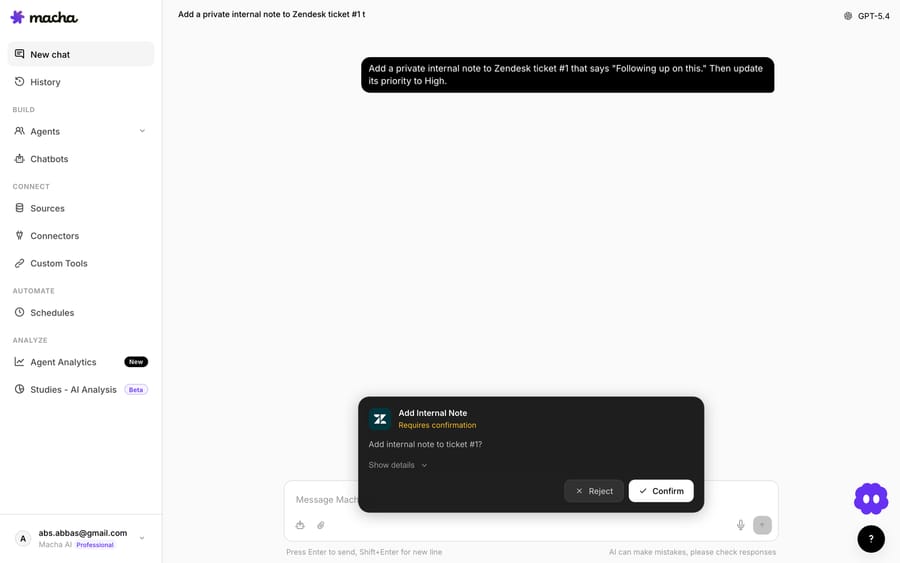
The discipline here is to automate one narrow, well-defined action at a time. "Refund duplicate charges under $50 with a matching Stripe record" is a great Level 5 starter. "Handle all billing disputes" is not. Earn each action; don't grant a category.
- Automate here, carefully: bounded refunds, pre-fulfillment cancellations, low-risk account updates — each with a limit and (initially) a confirm gate.
- Metric: action accuracy, escalation rate, and reversal rate (how often a human had to undo what the AI did).
Beyond the ladder — proactive and orchestration
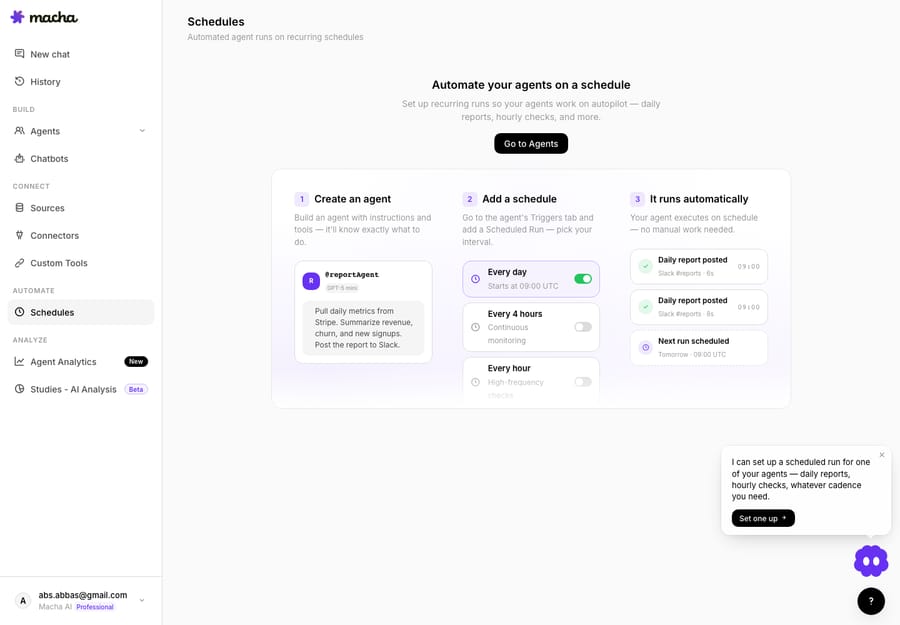
There's a layer that sits across all six levels rather than above them: making the AI proactive instead of purely reactive, and orchestrating multiple agents. Once the reactive rungs are solid, scheduled and event-driven automations are the multiplier: notify customers about shipping delays the moment fulfillment slips, post a daily support-metrics summary to Slack, send a weekly refund report. Macha's scheduled triggers run these on a clock or on an event, no ticket required.
Orchestration is the other dimension: a lead agent that routes to specialized sub-agents (a billing agent, a shipping agent, a policy agent), each with its own tools and guardrails. That's how you scale without building one monolithic prompt that's impossible to reason about. But — and this is the whole thesis — orchestration is something you grow into after the individual rungs are reliable, not the place you start.
How to actually run the climb
A workable cadence, drawn from how this tends to go in practice:
- Week 1 — Measure (Level 0). Run a Study over your last few thousand tickets. Get your real top-five categories and their risk profile.
- Weeks 2–3 — Deflect + Assist (Levels 1–2) together. Auto-reply the safest FAQ cluster; turn on drafting/summarization for everything else. Watch deflection accuracy and draft acceptance.
- Weeks 4–5 — Retrieve (Level 3). Connect read-only tools so agents (AI and human) stop tab-hopping for order and billing context.
- Week 6 — Triage (Level 4). Layer classification and routing on top of the now-context-aware agents.
- Later, selectively — Act (Level 5). Pick one bounded write action, ship it behind a confirm gate, watch the reversal rate, then loosen the gate only when it's boring.
Track progress with real numbers at each stage rather than vibes. Macha's agent analytics show resolution, deflection, and volume per agent so you can see whether a rung is actually reliable before you climb the next one.
Watch-outs: where this goes wrong
- Skipping Level 0. Automating the wrong category is the most common failure. If you don't measure, you'll build a beautiful refund agent for a queue that has almost no refunds. Measure first, every time.
- Confusing deflection rate with resolution. A 70% deflection rate that includes confidently-wrong answers is worse than a 40% rate with clean hand-offs. Always pair an automation metric with an accuracy/escalation metric.
- Jumping to Level 5 for prestige. "We let AI issue refunds" sounds impressive in a board deck and is the fastest way to a trust incident. The irreversible rung should be the last one you touch and the narrowest in scope.
- Treating credits as free. Every AI action consumes credits (in Macha, 0.5–9 by model, with the default GPT-5.4 Mini at 1). More autonomy means more actions per ticket. Map cost to value as you climb — automation that costs more credits than the human time it saves is a step backward.
- When NOT to automate at all: genuinely novel, emotionally charged, legal, or high-value-account situations. These should route to a human fast (Level 4) and stop there. A mature program is as good at recognizing what to escalate as it is at resolving the rest.
FAQ
What should I automate first in customer support? Measure your queue, then automate the highest-volume, lowest-risk category — usually FAQ and policy questions your knowledge base already answers (Level 1 deflection), alongside agent-assist drafting (Level 2). Avoid starting with refunds or account changes.
Is triage really lower priority than deflection? They're close, and many frameworks put triage first. We rank triage at Level 4 because routing decisions get dramatically better once the AI can read live context (Level 3) — but it's low-risk, so if your biggest pain is mis-routing, do it early. The ordering is a default, not a law.
How do I know when to move up a level? When the rung below is boringly reliable — its automation metric is stable and its accuracy/escalation metric is within tolerance — for a few weeks. Use agent analytics, not gut feel.
Does this require replacing my helpdesk? No. Macha is an AI agent layer on top of the helpdesk you already use (Zendesk, Freshdesk, Gorgias, Front) — see Macha on Zendesk. The maturity model applies to the agents you build on top, not to swapping out your system of record.
How much does it cost to climb? Macha is credit-based — credits are spent per AI action (0.5–9 depending on the model). Start a 7-day free trial, no credit card required and see the pricing page for plans. Higher levels take more actions per ticket, so weigh credit cost against the human time saved at each rung.
Start at Level 0
If you take one thing from this: don't ask "what's the most impressive thing AI can do for support?" Ask "what's the highest-volume, most-reversible thing it can do today?" — and start there. Measure your queue, automate the safe and repetitive, keep humans on the irreversible, and climb only when the rung below is boring.
Start a 7-day free trial, no credit card required, connect your helpdesk, and run a Study to find your real first move — or browse the use-case library to see what each rung looks like in practice.
Written by Abbas (Customer Support & AI, Macha) · Reviewed by Ankeet Guha (Co-founder & CTO) · Published 2026-06-24 · Last updated 2026-06-24.
Automate your support workflows
Macha's agents run multi-step workflows across the tools you already connect.