




 Shopify
 Stripe
 Slack
 Notion
 Google Workspace
 Confluence


What Is the Best Customer Support Automation Software in 2026? 15 Tools With Real Prices


The best customer support automation software depends on where your tickets live: your help desk's own AI, an AI agent added to that help desk, or a chat-first bot for a small site. We compared 15 tools, including our own, on published price, billing unit, ratings and setup effort, with prices read on September 18 and re-checked on September 24, 2026.
Key takeaways
- The best customer support automation software depends on where tickets live: help desk AI such as Zendesk from $55 an agent, an agent like Fin, or a chat-first bot.
- Fin charges $0.99 per outcome, including a Procedure handoff a human finishes, and its 50-outcome monthly minimum applies only when Fin runs on a help desk other than Intercom.
- Macha ranks first of the six AI agents scored here, on 16 out of 20, because the Macha team builds the agent and a dedicated success manager handles changes after go-live, from $299 a month for 750 tickets, about $0.40 a ticket; Fin is second on 15.
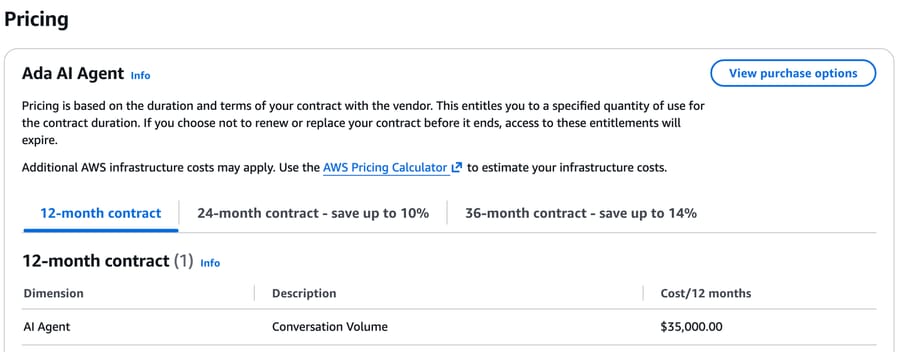
- Ada's Salesforce AgentExchange listing starts at $30,000 a year, while Vendr's buyer data puts the median contract at $72,000 a year.
- HubSpot's Customer Agent uses 50 credits, a $0.50 list price, per resolved conversation, and Service Hub Professional includes 3,000 credits a month, enough for 60 resolutions.

The best customer support automation software in 2026 depends on where your tickets already live: the AI your help desk sells (Zendesk Suite from $55 an agent a month, Freshdesk from $19), an AI agent added to that help desk (Fin at $0.99 per outcome, Fini at $0.89 per resolved ticket, Macha from $299 a month for 750 tickets), or a chat-first bot for a small site (Tidio, or Chatbase from $40 a month). Below, 15 tools are compared on what each charges for, the published price, the G2 and Gartner ratings, and how much setup each needs. Macha publishes this blog and is one of the 15, scored on the same criteria as the rest, and it ranks first of the six AI agents we score, on 16 out of 20, because its team builds the agent and runs it with you after launch; the research note at the end says where every price and rating came from. If you're still working out what to automate, and in what order, start with our guide to customer service automation, which has a rollout plan and a one-month cost model.
Which type of tool should you start with?
| Your situation | Type to look at | Start with |
|---|---|---|
| You already run Zendesk, Freshdesk, HubSpot or Gorgias and want the least new software | Help desk with built-in AI | The AI your help desk sells, priced below |
| Staying on Zendesk, Freshdesk, Gorgias, Front, HubSpot or Intercom, and you want agents resolving tickets inside that workflow at a monthly price you can forecast | AI agent on your existing help desk | Macha; Fin or Fini if you run another help desk |
| Human handoff matters most | A tool that works inside the help desk your team already uses | Your help desk's own AI, Fin on the help desks it supports, or Macha |
| You want a predictable bill as volume grows | Per-ticket or bundled pricing | Macha, Chatbase, Gorgias plans with included interactions |
| A small team with lots of repeat questions and no developer | Chat-first bot | Tidio (Lyro) or Chatbase |
| Enterprise volume, many channels, an RFP | Enterprise agent platform | Agentforce (on Salesforce), Ada, Decagon, Yellow.ai |
How do the 15 tools compare on price and ratings?
Prices are the lowest published entry point or the unit that drives the AI bill. Prices and ratings (stars and review count) were read on September 18, 2026, and the prices that moved were re-checked on September 24. Gartner figures are from the market where each product has the most reviews; "Not listed" means we didn't find the product in a relevant Gartner market.
| Tool | Type | What its AI automates | Price we found | AI billing unit | G2 | Gartner Peer Insights | Best for |
|---|---|---|---|---|---|---|---|
| Zendesk | Help desk with AI | Triggers, routing, AI agents, Copilot | Suite from $55/agent/mo (annual) | Automated resolution: $1.50 committed, $2.00 pay-as-you-go (Zendesk pricing page), minus a $2 to $10 monthly allowance per seat | 4.3 (7,075) | 4.4 (1,049) | Mid-size and large teams on Zendesk |
| Freshdesk | Help desk with AI | Automations, Freddy AI Agent, Copilot | From $19/agent/mo (annual), no free plan; Freddy: 500 free sessions once per account, then $49 per 100 | Session | 4.4 (3,771) | 4.4 (671) | Cost-conscious teams wanting one vendor |
| HubSpot Service Hub | Help desk with AI, CRM-native | Customer Agent, workflows | Starter $7/seat/mo; Professional $90/seat/mo plus $1,500 onboarding | 50 credits ($0.50 list) per resolved conversation | 4.4 (3,014) | 4.3 (22) | Teams whose customer data already lives in HubSpot |
| Zoho Desk | Help desk with AI | Workflows, Blueprint, Zia agents | From $7/agent/mo (G2's pricing tab) | Included on Professional and up | 4.4 (7,942) | Not listed | Budget teams, Zoho users |
| Gorgias | Help desk with AI, ecommerce | Rules, macros, AI Agent | Basic $77/mo annual incl. 300 tickets and 30 AI interactions | Automated interaction ($1.50 past the plan) | 4.6 (582) | Not listed | Shopify stores |
| Fin | AI agent on any help desk | Answers, procedures, handoffs | $0.99 per outcome; 50-outcome monthly minimum off Intercom | Outcome | 4.5 (3,912) | 4.6 (18) | Teams wanting a proven agent on their current help desk |
| Fini | AI agent on any help desk | Answers, actions | $0.89 per resolved ticket (Growth) | Resolved ticket | 4.9 (14) | Not listed | Teams that want per-resolution pricing below Fin's |
| Macha | AI agent on your existing help desk | Triage, replies, actions inside the ticket | From $299/mo for 750 tickets (~$0.40/ticket), published | Ticket | No profile | Not listed | Teams on Zendesk, Freshdesk, Gorgias, Front, HubSpot or Intercom who want it built and monitored for them |
| Ada | Enterprise AI agent | Omnichannel agent incl. voice | Salesforce AgentExchange: from $30,000 a year; Vendr median $72,000 | Contract, conversation volume | 4.6 (173) | Not listed | Large consumer brands |
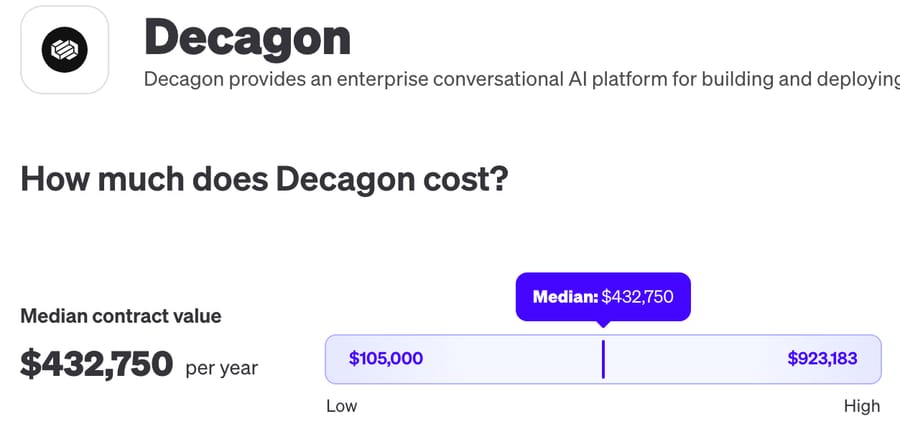
| Decagon | Enterprise AI agent | Chat, email, voice | AWS private offer; Vendr median $432,750 a year | Contract | 4.8 (30) | Not listed | Enterprises buying a vendor-built agent |
| Forethought (Zendesk) | AI agent | Triage, answers, agent assist | Not published; no marketplace price | Contract | 4.3 (166); newer AI Agents listing 3.3 (13) | Not listed | Enterprise teams already talking to Zendesk |
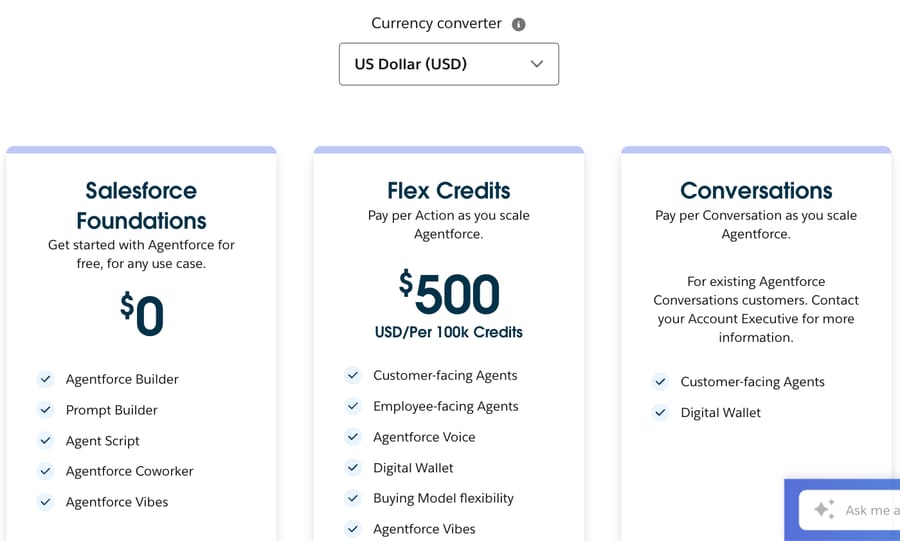
| Salesforce Agentforce | Enterprise agent platform | Agents across Service Cloud | $500 per 100,000 Flex Credits (20 per action) | Action | 4.3 (1,694) | 4.3 (72) | Salesforce Service Cloud customers |
| Yellow.ai | Enterprise agent platform | Chat and voice in many languages | Free: 500 sessions/mo, then $0.99 per resolution | Resolution, or contract | 4.4 (107) | 4.5 (2) | Multilingual, multichannel service |
| Tidio (Lyro) | Chat-first bot | Website chat answers | Starter $24.17/mo; Lyro from $32.50/mo for 50 conversations | AI conversation tier | 4.6 (1,962) | Not listed | Small ecommerce and service sites |
| Chatbase | Chat-first agent builder | Answers from your content, actions | Hobby $40/mo for 700 message credits | Message credit | 4.8 (45) | Not listed | Small teams building their own chat agent |
What are the three kinds of customer support automation software?
Most tools on this page fit one of three types, and the type decides who does the work and what you pay for.
| Type | Examples | Who sets it up | Main channel | How AI is billed |
|---|---|---|---|---|
| Help desk with built-in automation | Zendesk, Freshdesk, HubSpot, Zoho Desk, Gorgias | Your help desk admin | Email, chat, messaging | Per seat for copilots; per resolution, session or credit for agents |
| AI agent that works on your existing help desk | Macha, Fin, Fini, Ada, Forethought, Decagon | The vendor's team with yours, or mostly configured | Tickets, chat, email | Per outcome, resolution, ticket, or annual contract |
| Chat-first bot or builder | Tidio, Chatbase | One person, in a visual builder | Website chat, messaging | Conversation tiers or message credits |
Two other buyers land on this search and need a different shortlist. Contact centers automating phone calls should look at contact-center suites (NiCE CXone, Talkdesk, Five9) and voice-agent platforms; a separate comparison of conversational AI platforms, which we're publishing next, will cover them. Internal IT teams automating employee requests want a service desk (Freshservice, Jira Service Management, ServiceNow) rather than a customer help desk; our guide to AI help desk software has a section for that buyer.
How does each tool charge, and whose incentive does the unit serve?
The billing unit decides what you pay for when the AI gets it wrong. A per-resolution vendor earns more when it counts more conversations as resolved, so read its definition. Fin, for example, bills $0.99 for a resolution and also for a "Procedure handoff", where Fin completes a handoff you configured (Fin pricing FAQ). A handoff you designed is a billable outcome.
| Unit | Tools | You pay for | The vendor earns more when |
|---|---|---|---|
| Per seat | Zendesk Copilot, Freddy Copilot | Every human agent | You add people |
| Per resolution or outcome | Fin, Fini, Zendesk AI agents, HubSpot Customer Agent, Gorgias, Yellow.ai | Conversations the vendor counts as resolved | More conversations meet its definition of resolved |
| Per session | Freshdesk Freddy AI Agent | Every conversation the AI engages | The AI engages more, resolved or not |
| Per action | Agentforce | Each step the agent takes | Agents take more steps |
| Credits or tiers | Chatbase, Tidio | Messages or AI conversations in a bundle | You move up a bundle |
| Per ticket | Macha | Each ticket handed to an agent, once, however many replies | You hand it more ticket categories |
| Annual contract | Ada, Decagon, Forethought | A committed fee | You renew bigger |
For what those units add up to in a real month (1,200 AI conversations, 900 resolved), the cost model in our automation guide prices six of these products and Macha side by side. Our explainer on AI agent pricing models covers each unit's trade-offs.
How should you evaluate customer support automation software?
These are the criteria that separate the tools in practice, including the ones readers search for most: handoff, predictable pricing and setup without developers.
- Human handoff. When the AI stops, does the human get the conversation, a summary and what the AI already tried, in the help desk they work in? Ask to see a handoff, not a slide. Our guide to AI chatbot to human handoff lists what a good one carries.
- Predictable pricing as volume grows. Per-resolution bills rise with success and fall with failure; bundles and per-ticket plans rise in steps. Model your next 12 months, not this one.
- Setup without a developer. Chat-first bots and help desk AI are configured in a UI. Agents that take actions need connected systems; check whether the vendor or your team does that work.
- Actions, not only answers. Can it look up an order, update a field, issue a refund with approval? Most of the time saved comes from actions.
- Testing before launch. Look for a way to run the agent on past tickets or in draft mode before customers see it.
- Compliance and data. SOC 2 and GDPR are standard asks; HIPAA, PCI and data residency narrow the list fast at the enterprise end.
- Languages and channels. Enterprise platforms lead on languages and voice; chat-first bots are usually web chat first.
Which help desks have built-in automation?
Zendesk
Zendesk is the most-reviewed help desk here, and its automation stack has three layers: triggers, automations and macros for rules; AI agents, now included on every Suite and Support plan; and Copilot, a $50-per-agent-a-month add-on for triage and reply help. Suite Team is $55 and Suite Professional $115 per agent a month on annual billing. AI agents are billed in automated resolutions. Since May 18, 2026, each plan includes a monthly dollar allowance per agent seat: $5 on Suite Growth and Professional, $2 on Team, $10 on Enterprise, capped at $5,000 a year (Zendesk help, edited September 8, 2026). Beyond that, Zendesk's blog says it "charges $1.50 per automated resolution" (Zendesk), while its chatbots buyer's guide says "as low as $1.00 per automated resolution" (Zendesk). The pricing page's plan comparison table lists $1.50 per committed automated resolution and $2.00 pay-as-you-go, and counts the included allowance as 5 automated resolutions per agent a month on Support Team and Suite Team and 10 on Suite Professional (up to 10,000 a year). Zendesk also completed its acquisition of Forethought on March 26, 2026.
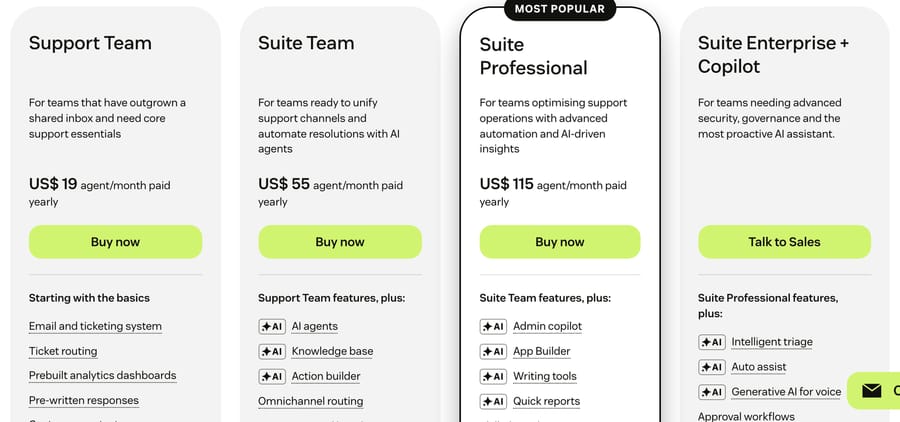
G2 shows 4.3 from 7,075 reviews, and Gartner Peer Insights 4.4 from 1,049 in its customer engagement center market. "Missing Features" (216) and "Learning Curve" (179) lead the complaint tags. A support coordinator at a mid-market company wrote that "implementing both the customer-facing AI agents and the agent-assist capabilities requires time and effort" (G2, May 2023).
Zendesk fits a team that's already on it and wants rules and AI from one vendor. Skip it if you need a predictable AI bill: every resolution past the allowance costs $1.50 on a committed plan or $2.00 pay-as-you-go, so the bill rises with success. At 900 resolutions a month on 8 Suite Professional seats, that's 900 × $1.50 = $1,350 minus the $40 allowance, or $1,310 committed; pay-as-you-go it is 900 × $2.00 = $1,800 minus $40, or $1,760. Our Zendesk AI explainer covers the add-ons.
Freshdesk
Freshdesk sells the same three layers for less. Growth is $19, Pro $55 and Enterprise $89 per agent a month on annual billing, all with automations. There is no free plan on the pricing page; a separate Free program covers up to 2 agents for 6 months. Freddy AI Agent comes with 500 free sessions, which Freshworks' pricing FAQ says are "limited to once per account", then $49 per 100, and an email session covers 72 hours of replies. Freddy AI Copilot is $29 per agent a month on Pro and Enterprise. Freshworks says its agents can "resolve up to 80% of queries", which is a vendor claim, not a measured rate.
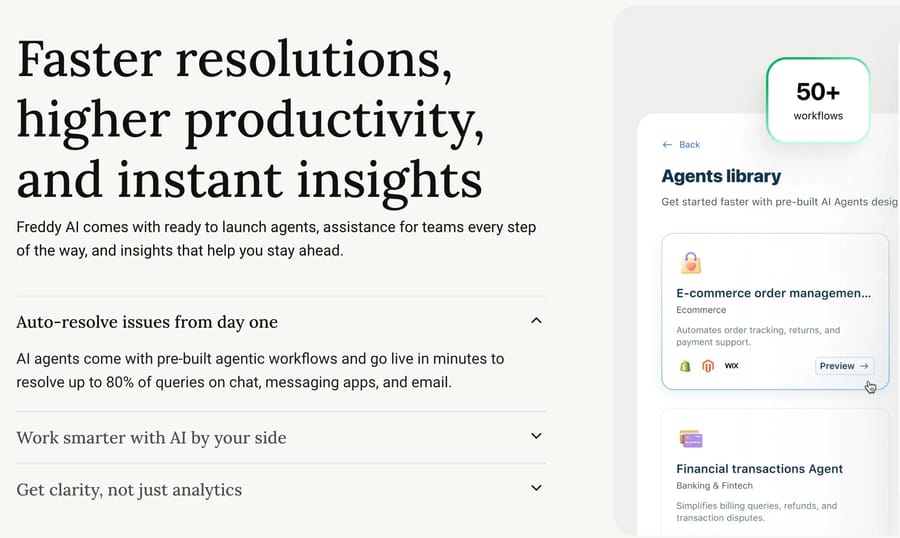
G2 shows 4.4 from 3,771 reviews; Gartner lists Freshdesk Omni at 4.4 from 671. The recurring complaint is feature gating. A QA engineer at a mid-market healthcare company wrote that advanced automation and analytics are "limited to higher-tier plans, which can drive up costs for growing teams" (G2, July 2026).
It fits a price-sensitive team that wants one vendor and mostly email and chat. Skip it if your AI will engage many conversations it can't finish: sessions bill whether or not the AI resolves. More in our Freddy AI explainer.
HubSpot Service Hub
HubSpot's pitch is that the help desk and the CRM are the same database, so its Customer Agent can read the contact, deal and ticket without an integration. Service Hub Starter is $7 a seat a month on annual billing ($20 monthly), and Professional is $90 a seat a month with a $1,500 onboarding fee. The Customer Agent uses 50 HubSpot credits, a $0.50 list price, per resolved conversation, and comes with a 14-day free trial; Professional includes 3,000 credits a month, and more cost $9 per 1,000 on annual billing. Those 3,000 credits cover 60 resolutions, and they're shared with HubSpot's other AI features.
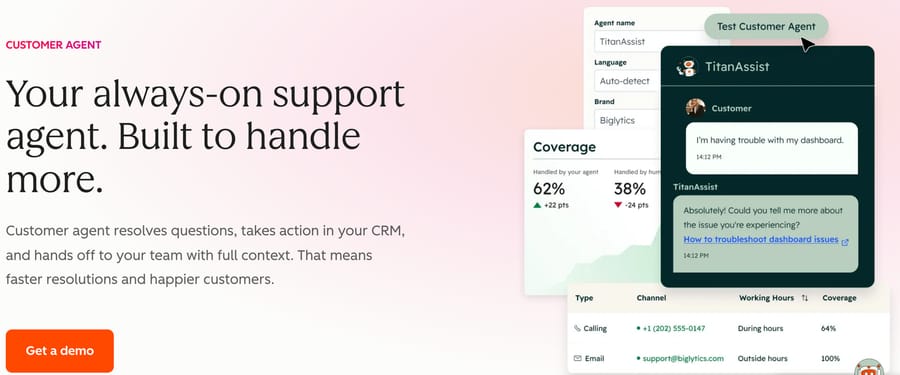
G2 shows 4.4 from 3,014 reviews; Gartner 4.3 from 22. A business development analyst at a mid-market company wrote that "advanced automation" features "are locked behind higher-tier plans" (G2, August 2025), echoing the Freshdesk complaint.
It fits a team whose customer records already live in HubSpot. Skip it if your support team is on another help desk: moving the help desk to get the agent is a bigger project than adding one. See our HubSpot Breeze agent guide.
Zoho Desk
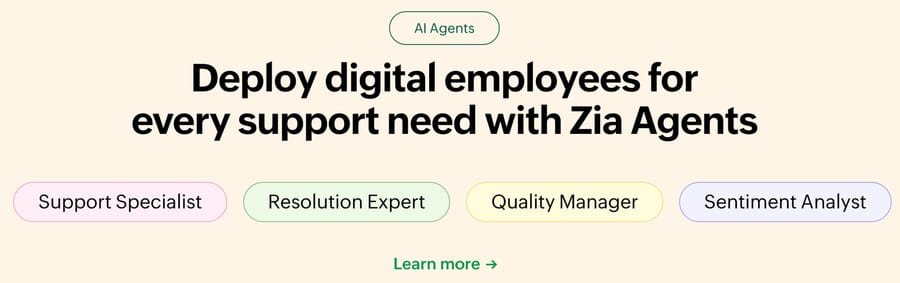
Zoho Desk is the lowest-priced full help desk here: G2's pricing tab lists Express at $7, Standard $14, Professional $23 and Enterprise $40 per agent a month (Zoho's own page showed us rupees from our location). Zia, its AI, is included from Professional, and Zoho now ships "Zia Agents" in four roles. G2 shows 4.4 from 7,942 reviews. The watch-out is depth: Blueprint and Zia need Professional or above, so the $7 plan is rules only. More in what is Zoho Desk.
Gorgias
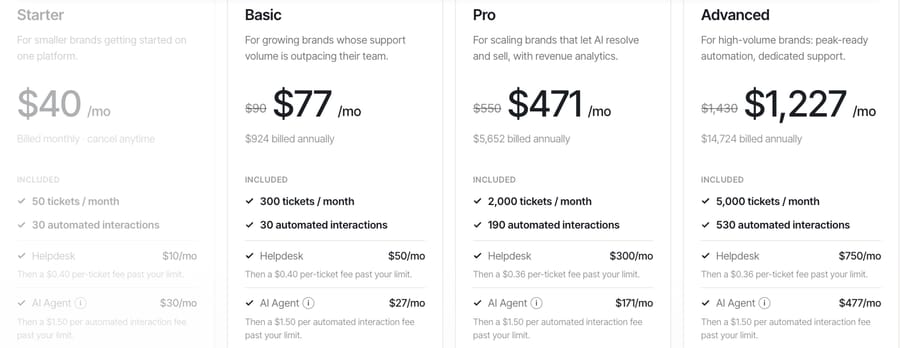
Gorgias prices by ticket volume rather than seats, and bundles AI interactions into each plan. On annual billing, Basic is $77 a month (300 tickets, 30 AI interactions), Pro $471 (2,000 and 190) and Advanced $1,227 (5,000 and 530), with each extra automated interaction at $1.50. That's $0.90 each inside the plan and $1.50 outside it, so pick the plan by AI volume as well as tickets. G2 shows 4.6 from 582 reviews. It suits Shopify stores; it's the wrong fit outside ecommerce. See our Gorgias AI Agent explainer.
Which AI agents work on your existing help desk?
These six are scored from 1 to 5 on four things, and the total out of 20 sets the order, with ties going to the vendor with more published reviews. Published price: 5 for a rate on the vendor's own site, 3 for a marketplace listing only, 2 for a placeholder or buyer data only, 1 for nothing. Deployment evidence: G2 review volume: 5 for thousands, 4 for over 100, 3 for 25 to 100, 2 for under 25, 1 for no profile. Implementation, who builds it: 5 when the vendor builds, tests and launches the agent on your help desk on every plan including the trial, 4 when implementation is included on every plan, 3 when hands-on setup comes through a contract or a higher tier, 2 for self-serve. Ongoing management after go-live: 5 when a dedicated person handles your changes (new categories, instructions, tools) on every plan, 3 when a dedicated success manager or team comes with an enterprise contract, a paid support add-on or a higher tier, 2 when you maintain the agent yourself with standard support. On 7 October 2026 we split what used to be one setup-and-support score into these last two, because getting an agent live and running it after launch are two different costs.
| Agent | Published price | Deployment evidence | Implementation: who builds it | Ongoing management after go-live | Total (out of 20) |
|---|---|---|---|---|---|
| Macha | 5 | 1 | 5 | 5 | 16 |
| Fin | 5 | 5 | 2 | 3 | 15 |
| Fini | 5 | 2 | 4 | 3 | 14 |
| Ada | 3 | 4 | 3 | 3 | 13 |
| Forethought | 1 | 4 | 3 | 3 | 11 |
| Decagon | 2 | 3 | 3 | 3 | 11 |
Macha comes first on 16 out of 20. The Macha team builds the agent on your help desk, and a dedicated success manager handles your changes after go-live, on the trial and every plan. It also scores lowest on deployment evidence, because it has no public review profile, and that is a real gap when you're checking a vendor you have never used. Fin is second on 15, carried by its review volume: you set it up yourself, and a dedicated support team comes with Intercom's paid Premier Support, which needs a contract. Fini includes implementation on every plan and adds a dedicated AI engineer from its Scale plan up. Forethought and Decagon tie on 11, and Forethought goes ahead on review count.
Macha
Macha is our product, and it gets the same treatment as everything else on this page. It's an AI agent layer that works inside the help desk you already use: Zendesk, Freshdesk, Gorgias, Front, HubSpot or Intercom today, with the current list on our integrations page. It doesn't replace the help desk, and it doesn't run phone lines. You describe each agent's job, give it knowledge and tools, and connect it to help desk events; agents can triage, draft into internal notes, reply on their own, and act in connected tools such as Shopify, Stripe and Slack. Templates cover the common jobs.
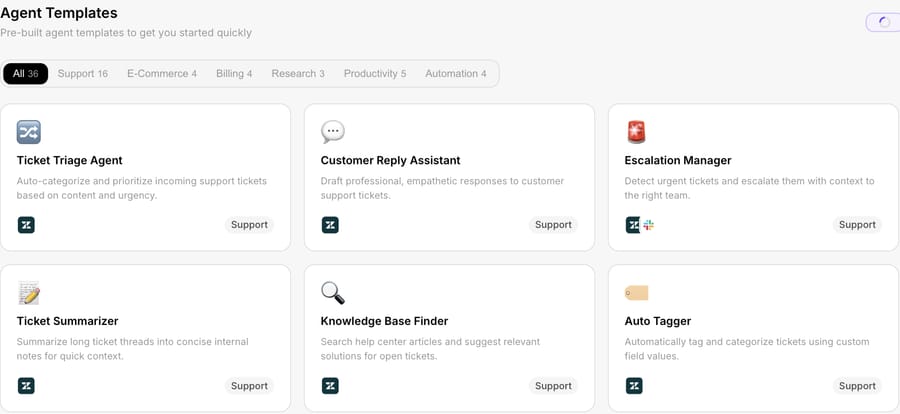
Pricing is one plan priced on monthly ticket volume, from $299 for 750 tickets up to $3,999 for 10,000, about $0.40 a ticket at every tier, charged once per ticket however many replies it takes. Macha is the done-for-you option among these six. You connect your help desk and the tools your answers come from, about 15 minutes; the Macha team analyzes your past tickets, builds the knowledge base and the agent, tests it on a sample of those tickets, and runs it in safe mode, with drafts as internal notes, until the drafts are right. That's included on the trial and every plan, and the $0.40 a ticket also covers a dedicated success manager who handles your changes after go-live: new categories, instruction changes, new tools. The trial is $50 of free usage with no card. It fits teams already on one of those help desks who want agents doing work inside the ticket. Skip it if you're on Salesforce, Zoho Desk or Help Scout, where the native agents above are the simpler route, or if the volume you want automated is phone calls, since there's no voice channel. We're also a much smaller company than Ada or Decagon and have no G2 or Capterra profile, so a shortlist scored on third-party review volume will drop us. And an agent does only what its written instructions say, so a vague instruction produces a vague agent, which is why the Macha team writes and tunes them with you rather than handing over an empty console. Details on the agent-on-your-help-desk page and the pricing page; our overview of AI agents for customer service explains the category.
Fin
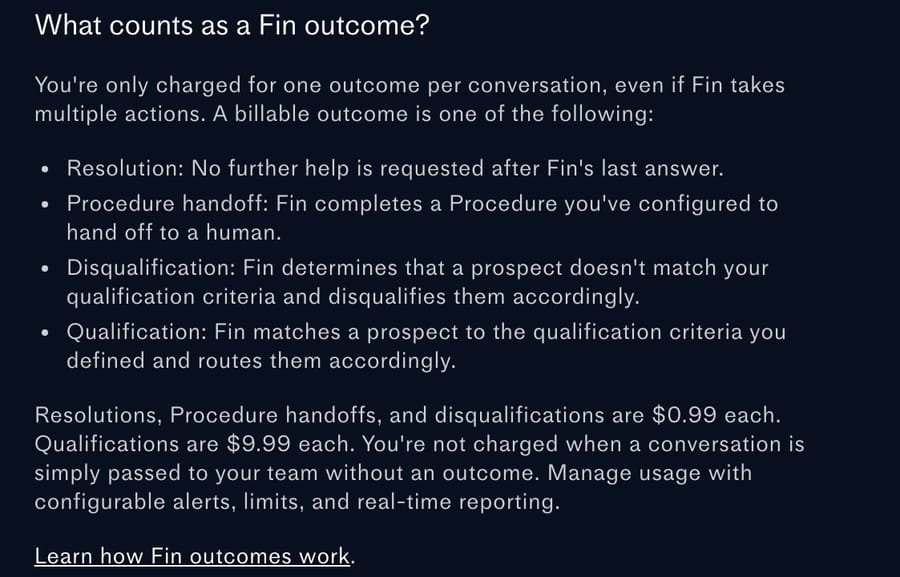
Fin is the most-reviewed AI agent that runs on other companies' help desks as well as its own. It costs $0.99 per outcome, charged once per conversation, with a 50-outcome monthly minimum that applies only when Fin runs on a help desk other than Intercom. An outcome is a resolution ("No further help is requested after Fin's last answer."), a completed handoff procedure, or a sales disqualification at $0.99, or a qualification at $9.99. Fin was Intercom until its rename, and Salesforce completed its acquisition of Fin on September 10, 2026; Salesforce cites a 76% average resolution rate for it, a vendor figure rather than a measured one.
G2 shows 4.5 from 3,912 reviews, and Gartner 4.6 from 18. A customer support manager at a mid-market software company wrote that Fin's "workflow builder feels very stiff", listing no webhook triggers and one trigger per workflow (G2, August 2026).
It fits teams that want a mature agent without changing help desk, and whose resolution rate is high enough that paying per outcome beats a flat fee. Skip it if you're about to standardize on a non-Salesforce stack and the acquisition worries you, or if many of your conversations end in configured handoffs, since those bill too. Our Fin guide goes deeper.
Fini
Fini sells an AI agent that plugs into your help desk at $0.89 per resolved ticket on Growth (up to 3,000 tickets a month), $0.69 on Scale and $0.49 on Enterprise, with no seat fees. Its pricing page says implementation is included on every plan, with a dedicated AI engineer from Scale up, and the Enterprise plan includes a 90-day free pilot. G2 shows 4.9, but from only 14 reviews. The watch-out is sample size: 14 reviews is thin evidence for a vendor you'd put in front of customers, so ask for references. On Growth, customer success is shared, and Fini quotes about 14 days to go live (pricing page and homepage, checked 8 October 2026). Macha is done for you on the trial and every plan, with a dedicated success manager, and goes live in under a week, at about $0.40 a ticket against Fini Growth's $0.89 per resolved ticket. Our Fini guide has the detail.

Ada
Ada is an enterprise AI agent across chat, email, messaging and voice. Its site has no prices, but its Salesforce AgentExchange listing starts at $30,000 a year (checked 25 September 2026), and Vendr's buyer data puts the median contract at $72,000 a year from 119 purchases by 35 buyers (middle 80% $36,211 to $286,200, read October 13, 2026). G2 shows 4.6 from 173 reviews. It's built for high-volume consumer brands; a team under a few thousand conversations a month will pay for capacity it doesn't use. See our Ada guide.
Forethought
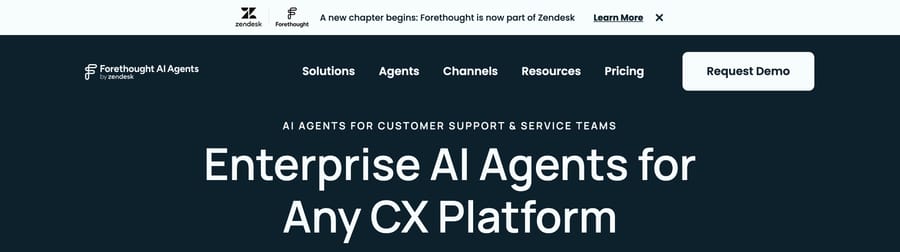
Forethought now belongs to Zendesk and sells as "Forethought AI Agents by Zendesk", for Zendesk and other platforms. It publishes no price, and we found no listing on AWS, Azure or Google Cloud Marketplace and no buyer data on Vendr. G2 carries two listings: the older Forethought page shows 4.3 from 166 reviews, while the newer Forethought AI Agents listing shows 3.3 from 13, the lowest score on this page. Expect its roadmap to follow Zendesk's. Skip it if you need a price before a sales call, since every quote now goes through Zendesk sales and no marketplace or buyer-data figure exists, or if putting a Zendesk-owned vendor on a rival help desk's tickets is a question your security review will ask. More in our Forethought guide.
Decagon
Decagon sells vendor-built agents to large companies. Its AWS listing is a $1,000,000 private-offer placeholder, and Vendr's median buyer pays $432,750 a year (range $105,000 to $923,183). G2 shows 4.8 from 30 reviews. It's the most expensive option on this page by a wide margin and makes sense only at enterprise volume. More in our Decagon guide.
Which enterprise agent platforms are worth a look?
Salesforce Agentforce
Agentforce is Salesforce's agent platform, and for support it runs on Service Cloud data. New buyers pay with Flex Credits, listed at $500 per 100,000, and a standard action costs 20 credits, so $0.10 an action. Salesforce sells them prepaid in packs or on pay-as-you-go ("no upfront commitment", billed monthly in arrears), and its own examples price per credit. A support agent that looks up an order, checks a policy and replies uses three actions, about $0.30 a conversation, or $360 to $500 a month for 1,200 conversations depending on whether you pay as you go or prepay a 100,000-credit pack. Salesforce's older $2-per-conversation option is still in its page data, but the pricing card now reads "For existing Agentforce Conversations customers".
G2 shows 4.3 from 1,694 reviews; Gartner 4.3 from 72, the most-rated product in its AI agents for customer service market. An operations associate at a small business wrote that "building effective agents can take some customization and a solid understanding of the workflow" (G2, August 2026).
It fits companies whose service already runs on Salesforce, with admins who can build flows. Skip it if you're not on Service Cloud: the platform, licenses and implementation cost more than the agent. Our Agentforce guide covers licensing.
Yellow.ai
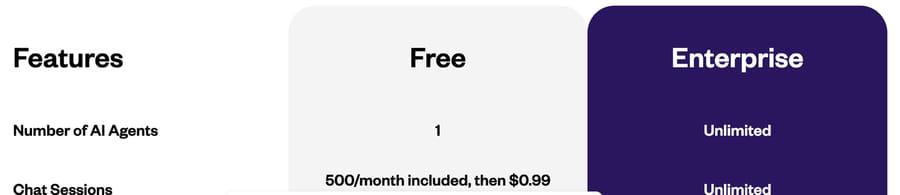
Yellow.ai is an enterprise platform for chat and voice agents in many languages. Its free plan includes one AI agent and 500 chat sessions a month, then $0.99 per resolution; enterprise is by quote, and its AWS listing sells a Basic plan at $10,000 a year. G2 shows 4.4 from 107 reviews. It announced a merger with Bluerock Acquisition Corp. on August 3, 2026, a planned listing that hasn't completed. The watch-out is vendor support: a small-business owner on G2 wrote that "it's extremely difficult to contact them" (July 2026), so test responsiveness during the trial. More in our Yellow.ai guide.
Which chat-first bots suit small teams?
Tidio (Lyro)
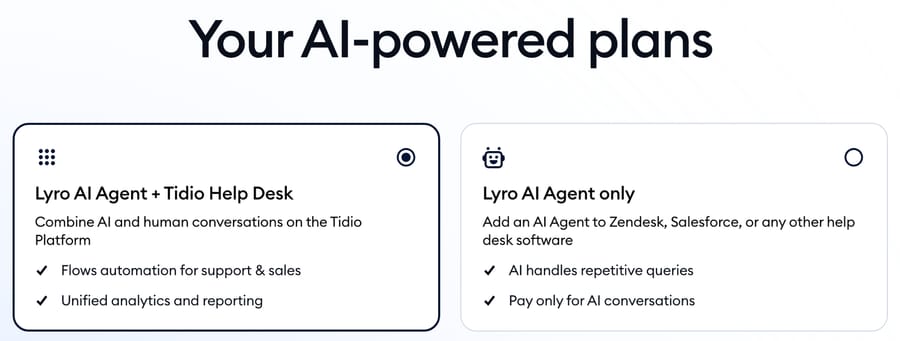
Tidio is a website chat tool with an AI agent, Lyro. Plans run from free (50 conversations) to Starter at $24.17 and Growth at $49.17 a month, and Lyro starts at $32.50 a month for 50 AI conversations. Tidio now also sells Lyro on its own, for Zendesk, Salesforce or another help desk. G2 shows 4.6 from 1,962 reviews. It's the easiest setup on this page for a small team with repeat questions; the watch-out is that Lyro's price rises in conversation tiers, so check the tier your volume needs. See our Lyro explainer.
Chatbase
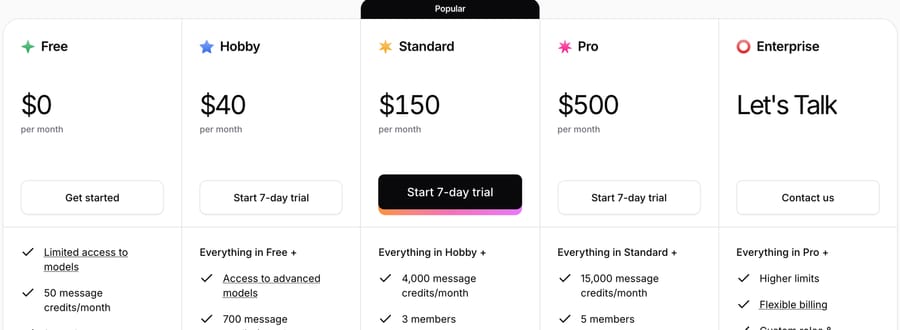
Chatbase lets one person build a chat agent trained on their docs and connect actions. Hobby is $40 a month for 700 message credits, Standard $150 for 4,000 and Pro $500 for 15,000, with 20% off yearly. G2 shows 4.8 from 45 reviews. It suits a small team that wants control over its own agent; the watch-out is that credits count messages, not conversations, so a long conversation uses several. More in our Chatbase guide.
Which tools did we leave out?
Named in one of the ranking lists but not covered here: Help Scout, Hiver, Re:amaze, HelpCrunch and Kustomer (help desks, see our help desk comparison); Talkdesk, NiCE CXone and Five9 (contact-center suites for phone-heavy teams); Crescendo and DevRev's Computer (single-list entries; DevRev wrote one of the ranking lists and puts itself first); Respond.io and Gladly (messaging-first and people-centric help desks).
Who should not buy each type
- Help desk AI is the wrong buy if you're about to switch help desks, since the AI doesn't come with you.
- AI agents on your help desk are the wrong buy if your ticket volume is under a few hundred a month; rules and macros will cover it.
- Enterprise platforms are the wrong buy without a platform team or an implementation budget.
- Chat-first bots are the wrong buy if most of your support arrives by email.
How did we research this?
Disclosure: Macha publishes this blog. Macha is one of the 15 tools compared here, scored on the same criteria as everything else on this page, placed where those criteria put it, and carrying the same where-it-falls-short line as every other entry. It has no G2 or Gartner profile, so those two columns stay blank for it rather than being filled with our own numbers.
We pulled the live Google results for "customer support automation software" and "customer service automation tools" on September 18, 2026, and read the ranking lists from Zapier, DevRev and Chargeflow and Gartner's AI agents market page. We built the shortlist from the tools named in at least two of those sources, plus the tools the previous version of this page covered. The same day we read every price on the vendor's own page, and for vendors without a published price we searched AWS Marketplace, Azure Marketplace, Google Cloud Marketplace and Vendr. We read G2 and Gartner Peer Insights in a browser for ratings and quotes. We did not build an agent on any of the 15 tools; the only first-hand screenshot is Macha's own, and our hands-on agent test is in the automation guide.
Frequently asked questions
What is customer support automation software? Software that takes repetitive support work off your team: routing and tagging, answering common questions, looking up orders, drafting replies and following up. It comes in three forms: help desks with built-in rules and AI, AI agents that work inside your existing help desk, and chat-first bots.
Where can I find tools to automate customer support tasks? Start with the help desk you already use, because its rules and AI need no integration. Then compare an AI agent that works on your help desk (Macha, Fin, Fini) and, for small websites, a chat-first bot (Tidio, Chatbase). The comparison table above lists 15 with prices.
Which customer service automation tools have the best human handoff? The ones that hand the human the whole conversation, a summary and what the AI tried, inside the help desk the human already works in. Tools that live inside the help desk (Zendesk's AI, Fin on its supported help desks, Macha) keep the handoff in the same ticket. Ask each vendor to demo a handoff on a real ticket.
Which tools have predictable pricing as volume grows? Plans that bundle a fixed amount (Macha's ticket tiers, Chatbase's credits, Gorgias's included interactions) rise in steps you can see coming. Per-resolution pricing (Fin, Zendesk, Fini) rises with every extra resolution, which is fair but harder to budget.
What are the easiest tools to set up without a developer? Tidio's Lyro and Chatbase for website chat, and your help desk's built-in AI. Agents that take actions in other systems need those systems connected. With Macha that's the one part you do (about 15 minutes); the Macha team analyzes your past tickets, builds the knowledge base and the agent, and runs it in safe mode until the drafts are right, included on the trial and every plan at about $0.40 a ticket. With enterprise platforms it's usually a project.
What are the top 10 help desk software options? By review volume on G2, the help desks on this page rank Zoho Desk (7,942), Zendesk (7,075), Freshdesk (3,771), HubSpot Service Hub (3,014) and Gorgias (582). Our help desk comparison covers more, including Help Scout and Intercom's help desk.
Will AI replace CRM or help desk software? Not so far. AI agents need somewhere to read customer records and write outcomes, and that's still the CRM and the help desk. The change is that more of the work inside them is done by agents.
What's the cheapest customer support automation tool? For a very small team, Tidio's free plan or Zoho Desk at $7 an agent. For AI answers at volume, compare the billing unit rather than the sticker: Agentforce's Flex Credits on pay-as-you-go ($360) and HubSpot's Customer Agent ($378) were the cheapest per month in our cost model, but only if you're on their platforms.
If your tickets are in Zendesk, Freshdesk, Gorgias, Front, HubSpot or Intercom, you can start a Macha trial with $50 of free usage. You connect your tools, and the Macha team builds the first agent for your most repetitive ticket category and runs it in safe mode until you're happy with the drafts.
Sources: Zendesk pricing · Zendesk: managing resolution allowances · Zendesk: outcome-based pricing · Zendesk: chatbots buyer's guide · Freshdesk pricing · Freshworks Freddy AI · HubSpot Service Hub pricing · HubSpot Customer Agent · Zoho Desk Zia · Gorgias pricing · Fin pricing · Salesforce completes acquisition of Fin · Fini pricing · Forethought · Zendesk completes acquisition of Forethought · Ada on AWS Marketplace · Ada on Salesforce AgentExchange · Vendr: Ada · Decagon on AWS Marketplace · Vendr: Decagon · Agentforce pricing · Yellow.ai pricing · Tidio pricing · Chatbase pricing · G2: Zendesk · G2: Freshdesk · G2: HubSpot Service Hub · G2: Fin · G2: Agentforce · Gartner: AI agents for customer service · other G2 and Gartner pages read September 18, 2026