 Shopify
 Stripe
 Slack
Slack Notion
 Google Workspace
 Confluence

What Is the Best Enterprise Help Desk Software in 2026? 8 Platforms Compared


Zendesk suits most large support teams, Salesforce Service Cloud suits companies already on Salesforce CRM, and ServiceNow CSM suits teams that need support tied to ITSM. We compare eight enterprise help desks on security, admin controls, scale, omnichannel, SLAs and AI cost, with prices re-checked in September 2026.
Key takeaways
- Zendesk is the default enterprise help desk for most large teams, with Suite Team at $55 and Suite Professional at $115 per agent a month, and Suite Enterprise + Copilot sold only through sales.
- Salesforce Service Cloud now sells Core at $195, Advanced at $395 and Max at $550 per user a month, replacing the old Enterprise and Unlimited edition names.
- Freshdesk's Enterprise plan costs $89 per agent a month and Omni Enterprise costs $119, with the first 500 Freddy AI Agent sessions included and $49 per 100 after that.
- Intercom's Expert plan costs $132 per seat a month billed annually, with Fin charged from $0.99 per outcome, and Salesforce closed its acquisition of Fin on September 10, 2026.
- Kustomer, ServiceNow CSM, Sprinklr and Gladly publish no price lists, so enterprise buyers on those platforms need a sales quote before modeling total cost.

The best enterprise help desk software in 2026 is Zendesk for most large teams, Salesforce Service Cloud for companies already on Salesforce CRM, and ServiceNow CSM when support has to share a workflow engine with ITSM. Freshdesk, Intercom (Fin), Sprinklr, Gladly and Kustomer fill specific niches. Published prices now run from $89 per agent a month (Freshdesk Enterprise) to $550 per user (Salesforce Service Cloud Max), and Zendesk's top tier, Suite Enterprise + Copilot, has moved behind a sales call. We compare all eight on security and compliance, identity and admin controls, scale, omnichannel, SLAs and AI cost, with prices re-checked on each vendor's pricing page on September 24, 2026. For the all-segments view, see our best help desk software roundup.
How do the top enterprise help desks compare at a glance?
| Tool | Rating (approx.) | Pricing model | Best for | Watch-out |
|---|---|---|---|---|
| Zendesk | G2 4.3/5 (~7,100) | $55–$115/agent/mo; Enterprise + Copilot quote-only; AI resolutions extra | Enterprises wanting depth, ecosystem, fast deploy | Costs climb; AI billed on top |
| Salesforce Service Cloud | G2 ~4.4/5 (~7,300) | $195–$550/user/mo (Core to Max) | Enterprises standardized on Salesforce CRM | Complex, admin-heavy, expensive |
| Freshdesk (Freshworks) | G2 4.4/5 (~3,700) | $89/agent/mo (Enterprise); $119 (Omni Enterprise) | Mid-large teams wanting enterprise features for less | Deepest features/AI gated to top tiers |
| Intercom (Fin) | G2 4.5/5 (~2,900) | $132/seat/mo (Expert, annual) + from $0.99/Fin outcome | Digital-first enterprises, chat-led, AI resolution | Per-resolution AI hard to forecast |
| ServiceNow CSM | G2 ~4.4/5 | Quote-only (~$40k/yr+) | Large enterprises unifying CSM with ITSM | Cost + implementation are major projects |
| Sprinklr Service | G2 ~4.3/5 | Quote-only (~$50k–130k+/yr) | Enterprises with heavy social + omnichannel | Premium price; complex to operate |
| Gladly | Capterra ~4.8/5 | Quote-only (~$180–210/agent/mo) | Consumer/retail brands wanting people-first CX | Voice/SMS billed separately; niche fit |
| Kustomer | G2 4.5/5 (~512) | Quote-only (no public price list) | Mid-large B2C wanting a unified customer timeline | Steep setup; AI add-ons stack up |
Update (September 2026): Salesforce completed its acquisition of Fin — the company that had already renamed itself from Intercom on May 12, 2026, before any deal was signed — on September 10, 2026, in a deal worth ~$3.6 billion, and plans to fold it into Salesforce's Agentforce. Worth weighing in any long-term Intercom/Fin decision.
Published prices checked on vendor pricing pages on September 24, 2026; ratings are approximate. Verify in procurement before buying.
How did we evaluate these platforms?
We focused on platforms that are deployed at enterprise scale today — by large support orgs running high ticket volume across multiple regions, brands, and channels. For each we pulled pricing from the vendor's pages (or cited third-party trackers where pricing is quote-only, as it is for most enterprise tiers), the current G2 or Capterra star rating and approximate review count as a real-user signal, and we read review sentiment for the recurring praise and complaints that ratings alone hide. We then graded each on six enterprise priorities:
- Security & compliance — SOC 2, ISO 27001, HIPAA/BAA availability, FedRAMP where relevant, data residency.
- Identity & admin — SSO (SAML/OIDC), SCIM provisioning, granular RBAC, audit logs, sandboxes.
- Scale — performance at high volume, multi-brand/multi-region, API throughput.
- Omnichannel — email, chat, voice, social, messaging in one workspace.
- SLAs & routing — contractual SLA management, skills-based and omnichannel routing.
- AI at scale — automation and resolution that holds up across volume, with predictable cost.
G2's review pages are bot- and login-walled (they return a 403 to automated access), so the sentiment below is synthesised from current G2 and Capterra review pages and framed as recurring themes paraphrased in aggregate, not verbatim quotes from named individuals. Prices were re-checked on September 24, 2026; ratings are approximate — confirm in your own procurement process, because enterprise and AI pricing in this category moves fast.
What makes help desk software enterprise-grade?
It's worth naming the dividing line, because plenty of mid-market tools market themselves as "enterprise." A genuinely enterprise help desk clears five bars:
- It survives a security review. SOC 2 Type II and ISO 27001 are table stakes; HIPAA via a signed BAA, FedRAMP, and data residency options separate the real contenders. If your InfoSec team can't get a clean answer, the rest is moot.
- It fits your identity stack. SSO (SAML/OIDC), SCIM auto-provisioning, IP allowlisting, and granular role-based access are non-negotiable when you have hundreds or thousands of agents and strict access governance.
- It scales without degrading. Multi-brand, multi-region, high concurrent volume, and API headroom for the integrations every enterprise inevitably builds.
- It enforces SLAs and routes intelligently. Contractual SLA tracking, skills- and priority-based routing across every channel, and escalation paths that hold up under audit.
- It governs AI. AI is now the differentiator — but enterprises need it auditable, controllable, and priced predictably, not a black box that bills per resolution with no ceiling.
Keep those five in mind as you read; they're what the comparison turns on.
Which are the 8 best enterprise help desk platforms?
1. Zendesk — the enterprise standard
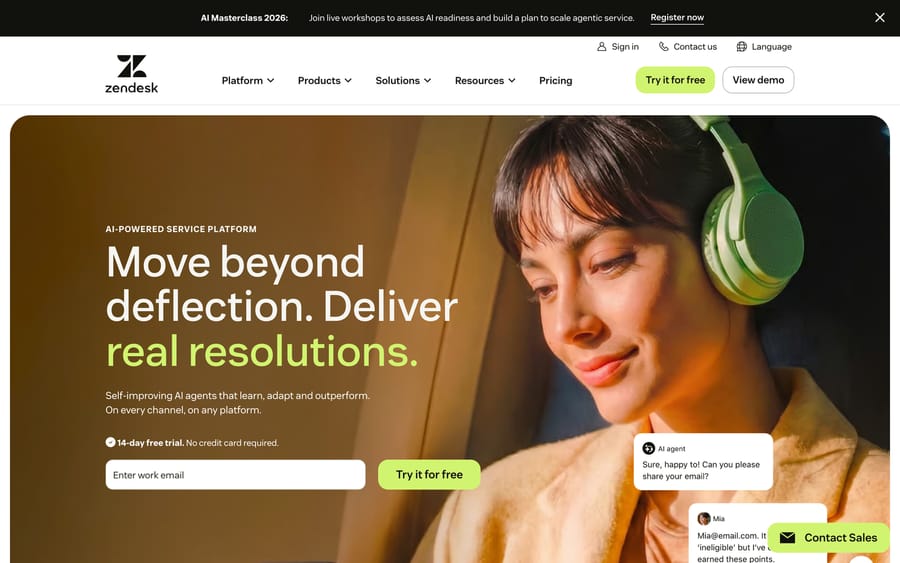
Enterprise fit: The category heavyweight and the safest default for most enterprises. Deep omnichannel ticketing, a mature 1,000+ app marketplace, robust analytics, and native AI agents (built partly on the acquired Ultimate and Forethought technology). On the compliance front it holds SOC 2 Type II and ISO 27001/27018/27701, with HIPAA available via the Advanced Compliance add-on, plus SAML/OIDC SSO, audit logs, custom agent roles, sandboxes, and up to 300 help centers at the Enterprise tier — enough to clear most security reviews. Pricing model: Per agent, annual. Zendesk's public pricing page now shows only Suite Team $55 and Suite Professional $115 per agent/month; Suite Growth ($89) has dropped off the page, and the top tier is sold as Suite Enterprise + Copilot through sales, where it used to list at $169. Copilot runs $50/agent/month, and automated AI resolutions are billed on top, at $2.00 each on pay-as-you-go (Zendesk pricing). Who it's for: Enterprises that want maximum configurability, a vast ecosystem, and a fast, well-trodden deployment path. Rating: G2 4.3/5 across ~7,100 reviews (also 4.5/5 on Capterra). Standout strength: Depth and extensibility — almost anything you need exists natively or in the marketplace, and the talent pool who knows Zendesk is huge. Watch-out: The most consistent review theme is cost — reviewers say the price is justified once you lean on the automation and reporting, but it climbs fast at scale and the AI agent adds its own per-resolution bill. Setup complexity and learning curve are the other recurring cons.
2. Salesforce Service Cloud — for the Salesforce enterprise
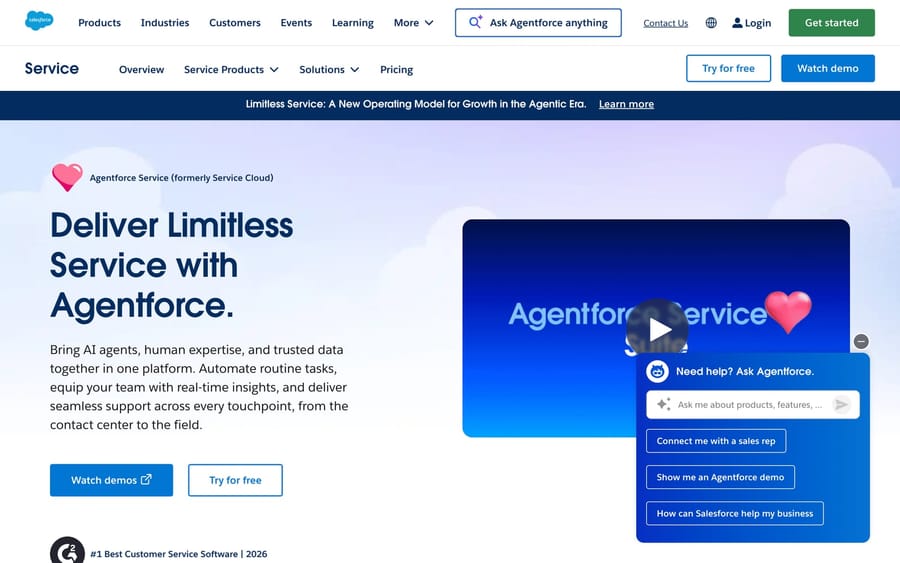
Enterprise fit: If your enterprise already runs Salesforce CRM, Service Cloud (now sold alongside the Agentforce AI suite) is the gravitational default — support cases sit on the same record as every sales and marketing touch, with omni-channel routing, deep customization, and enterprise-grade compliance (SOC 2, ISO, HIPAA, FedRAMP options) inherited from the platform. Its Agentforce AI agents are a major 2026 push. Pricing model: Per user, annual. Salesforce has renamed its service editions: Core $195, Advanced $395 and Max $550 per user/month, with Starter ($25) and Pro Suite ($100) below them for small teams (Salesforce pricing). The old Enterprise, Unlimited and Einstein 1 Service names no longer appear on the page. Max includes unmetered access to AI agents; below it, Agentforce usage adds more. Who it's for: Large enterprises standardized on Salesforce that want one customer record across the whole funnel and have admin resources to run it. Rating: G2 ~4.4/5 across ~7,300 reviews. Standout strength: Unmatched CRM unification and customization ceiling — if it can be modeled, Salesforce can model it. Watch-out: Reviewers consistently flag complexity, admin overhead, and cost. It typically needs dedicated admins or a consulting partner, and the per-user prices above are before the add-ons most enterprises end up buying.
3. Freshdesk (Freshworks) — enterprise capability, lower entry
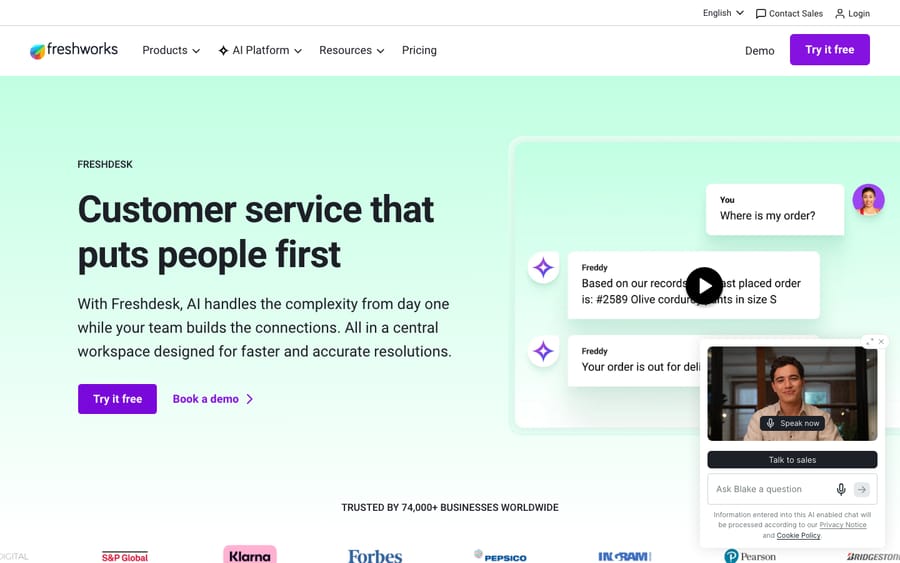
Enterprise fit: Freshworks' help desk delivers a genuine enterprise feature set — SSO, role-based access, IP allowlisting, omnichannel via Freshdesk Omni, and the Freddy AI layer — at a noticeably lower price point than Zendesk or Salesforce. It's the value pick for large teams that want enterprise controls without enterprise sticker shock. Pricing model: Per agent, annual. Email & Ticketing Enterprise $89; the omnichannel Omni Enterprise $119. Freddy AI Agent includes the first 500 sessions on every plan, then $49 per 100 sessions; Freddy AI Copilot is $29/agent/month (Freshdesk pricing). Who it's for: Mid-large and enterprise teams that want strong omnichannel ticketing and admin controls at a more forgiving total cost. Rating: G2 4.4/5 across ~3,700 reviews (Capterra 4.5/5). Standout strength: Strong value and a famously gentle setup relative to the heavyweights — faster time-to-live. Watch-out: The consistent theme is that the deepest reporting, customization, and AI all live in the top tiers and session packs, so the real bill climbs with scale. We break the numbers down in our help desk software roundup.
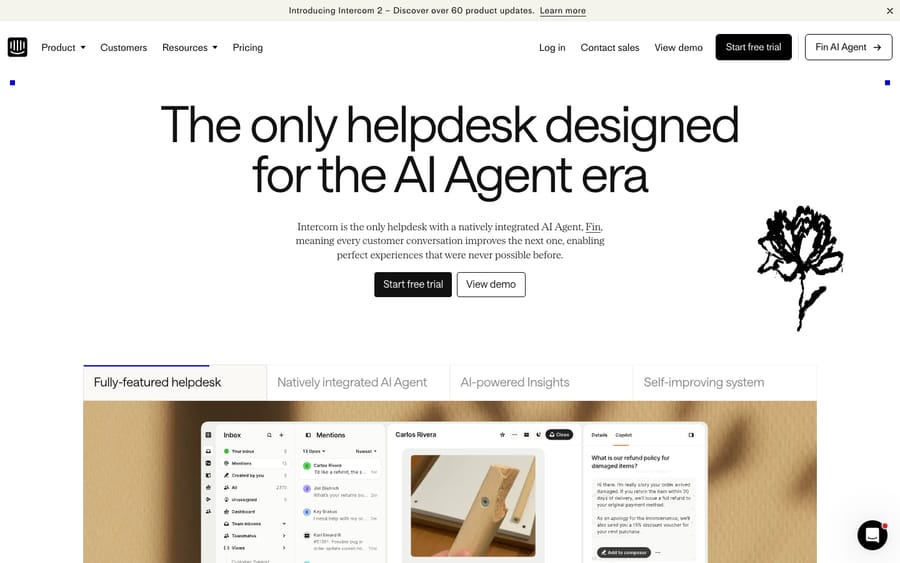
4. Intercom (with Fin AI) — the AI-first, chat-led enterprise
Enterprise fit: A messenger-first support platform whose Fin AI agent is among the most-cited per-resolution products on the market. At the Expert tier it adds the enterprise pieces — SSO, HIPAA via BAA, SLAs, custom roles, and multibrand Messenger and Help Center — and Intercom holds SOC 2 Type II and ISO 27001. The trade is that it's strongest for digital-first, chat-led support rather than heavy case management. Pricing model: Per seat, billed annually: Essential $29, Advanced $85 and Expert $132 per seat/month. Fin is charged from $0.99 per outcome on top, so the real bill scales with deflection volume (Intercom pricing). Ownership changed too: Salesforce closed its acquisition of Fin on September 10, 2026. Who it's for: SaaS and digital-first enterprises whose support skews to in-app chat and email and who want best-in-class AI resolution. Rating: G2 4.5/5 across ~2,900 reviews (Fin). Standout strength: The strongest combination of a polished messenger and a genuinely effective AI agent — Fin is consistently rated a top AI agent on G2. Watch-out: Reviewers love the deflection but consistently flag that the per-resolution pricing adds up fast and is hard to forecast at enterprise volume — you never quite know next quarter's AI bill. For an AI-focused shortlist, see the best AI customer service software.
5. ServiceNow CSM — for the workflow-driven enterprise
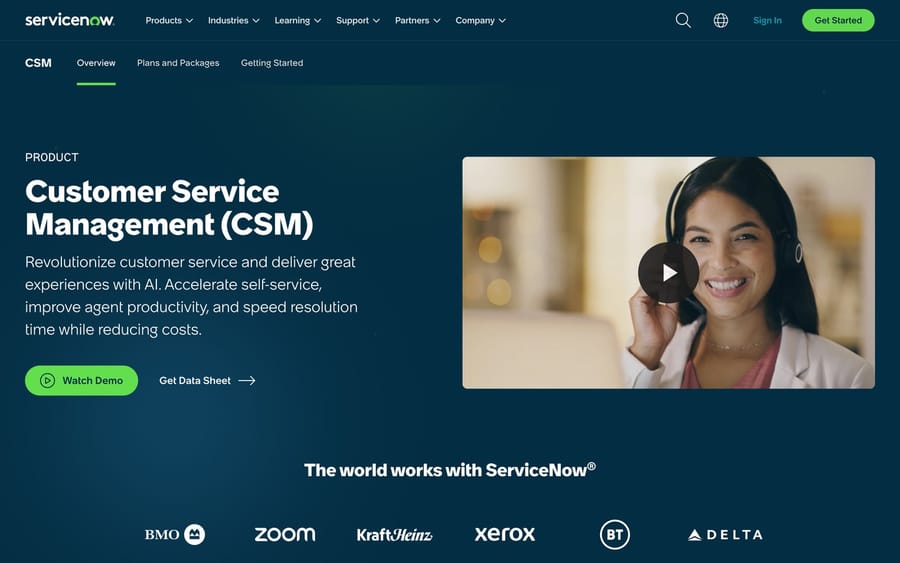
Enterprise fit: ServiceNow's Customer Service Management is the choice when support is part of a larger enterprise workflow problem. Built on the Now Platform, CSM connects customer cases to back-office processes, field service, and especially ITSM — so an outage, an order issue, and the engineering ticket behind it live in one workflow engine. Compliance is enterprise-serious (SOC 2, ISO, FedRAMP, HIPAA available), and the automation/orchestration depth is unmatched for complex operations. Pricing model: Quote-only. Third-party estimates put starting spend around $40k/year, fulfiller seats in the ~$70–200/user/month range, with implementation and professional services often ~75% of first-year cost. Who it's for: Large, process-heavy enterprises that want to unify customer service with ITSM and back-office workflows on one platform. Rating: G2 ~4.4/5 (rating approximate — flagged). Standout strength: Best-in-class workflow automation and orchestration; for organizations with the scale to absorb implementation, Forrester TEI studies have documented strong ROI on the Now Platform. Watch-out: Cost and implementation are real projects, not purchases. Reviewers note it's expensive and complex, and overkill for organizations under ~1,000 employees or those that only need front-line ticketing.
6. Sprinklr Service — for omnichannel and social at scale
Enterprise fit: Sprinklr Service is built for enterprises whose customer conversations sprawl across 30+ digital and social channels — it unifies social, messaging, voice, email, and chat in one AI-powered platform with deep listening and analytics. It's a fit for global consumer brands, telecom, and financial services managing very high volumes where social and digital care are first-class, not afterthoughts. Pricing model: Quote-based. Listed packages run roughly $3,600 / $4,200 / $5,100 per user/year, but procurement data shows median enterprise contracts around $129k/year, with minimums commonly $50k–$100k. Who it's for: Large enterprises with heavy social and omnichannel care needs and the budget to match. Rating: G2 ~4.3/5 (varies 4.0–4.5 across listings — flagged). Standout strength: Unrivaled breadth of channels and unified omnichannel analytics; reviewers from enterprise telecom, banking, and consumer services praise the scalability. Watch-out: It's a premium, complex platform — reviewers consistently caution that pricing is steep and the platform is heavy to operate, making it poorly suited to smaller teams or simpler workflows.
7. Gladly — the people-not-tickets enterprise CX platform
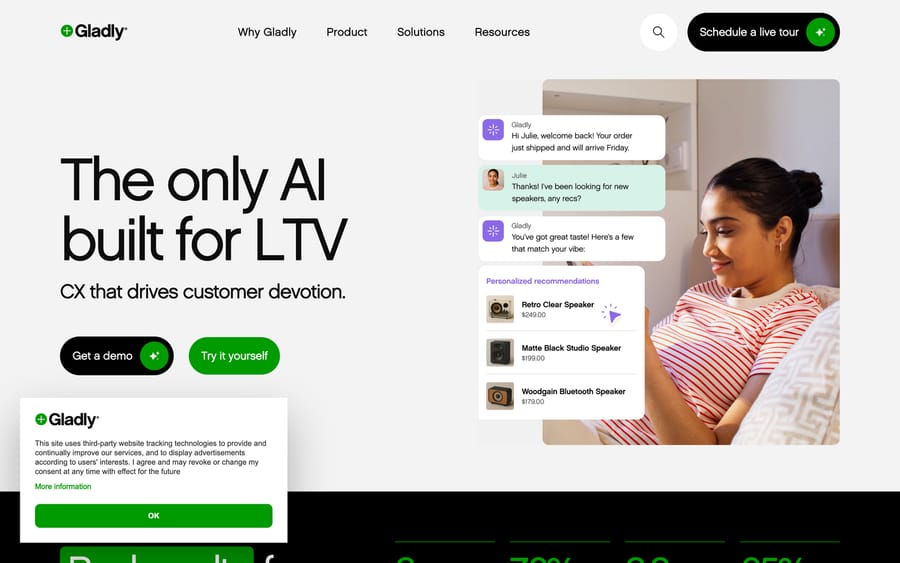
Enterprise fit: Gladly takes a deliberately different stance: it organizes support around the customer, not the ticket — a single lifelong conversation thread per person across voice, chat, email, and messaging, with its own Customer AI on top. It's built for consumer and retail brands (Crate & Barrel, Ulta Beauty, Breeze Airways are cited customers) where relationship continuity and a premium experience matter more than rigid case mechanics. Pricing model: Quote-based, typically ~$180–210/agent/month (Hero/Superhero packages); voice and SMS usage are billed separately on top. Who it's for: Consumer, retail, and high-touch B2C enterprises that want a warm, customer-centric model rather than a ticket queue. Rating: Capterra ~4.8/5; strong on G2 (exact star/count approximate — flagged). Standout strength: The unified, person-centric thread genuinely reduces context-switching and makes high-touch service feel personal at scale — reviewers consistently praise the experience. Watch-out: The people-first model is a poorer fit for process-heavy B2B or IT-style ticketing, and the separate voice/SMS billing means the true cost climbs for text- and call-heavy teams.
8. Kustomer — the unified-timeline B2C platform
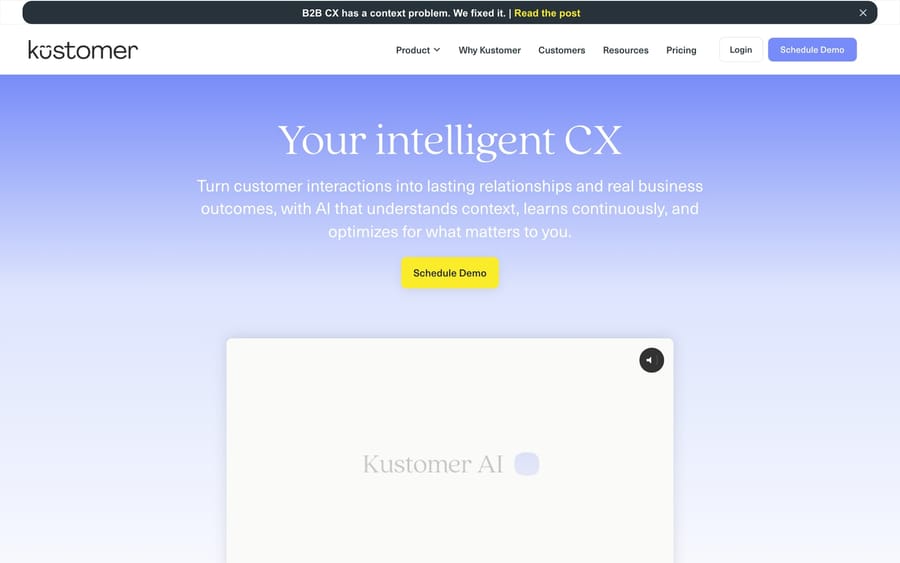
Enterprise fit: Kustomer (now part of Meta's broader ecosystem history, since spun back out) centers on a unified customer timeline that pulls every order, conversation, and data point into one view, with strong automation and AI agents. It's aimed at mid-large B2C and high-volume consumer support, with omnichannel including native messaging. Pricing model: Quote-only. Kustomer used to list Enterprise and Ultimate seats with an 8-seat minimum; its pricing page now says "we don't post one-size-fits-all pricing" and sends buyers to a sales quote, with voice, SMS and WhatsApp billed pay-as-you-go. Who it's for: Mid-large B2C and high-volume consumer brands that want a single customer timeline and data-rich automation. Rating: G2 4.5/5 across ~512 reviews (72% five-star). Standout strength: The unified timeline and automation are genuinely strong; reviewers praise the single-view experience and workflow automation. Watch-out: The most frequent complaints are a steep learning curve and complex backend configuration, with pricing becoming a growing concern as teams stack AI agents and channel add-ons on the base seat.
The other option: an AI layer on top of your help desk
Here's the honest part, and a disclosure: we make this one, and it is not a help desk — so it isn't a ninth item on the list.
If you read the watch-outs above, the pattern at enterprise scale is clear: the platform decisions are largely settled (most large orgs are already on Zendesk, Salesforce, or Freshdesk), and the real frustration is usually AI — per-outcome Fin bills, Freddy session packs, Agentforce usage, black-box automation that's hard to govern. Ripping out a help desk that already passed security review to chase better AI is an enormous, multi-quarter project to solve the wrong problem.
Macha is an AI agent layer that runs on top of your existing help desk: Zendesk, Freshdesk, Gorgias, Front, HubSpot or Intercom. It isn't a help desk and doesn't replace one. It reads the customer's actual question, pulls from your connected order/CRM data and help center, and resolves routine tickets inside your existing help-desk workflow — drafting the reply, tagging, routing — then hands off to a human with full context when its agents aren't confident. Your security review, SSO, SLAs, and admin controls stay exactly where they are; you just make the platform resolve more on its own.
Pricing model: per ticket — one conversation, charged once, however many steps the agent takes in it (drafting a reply, looking up an order, tagging, routing) and whichever model it runs on. Pricing starts at $299 a month for 750 tickets, about $0.40 each. We bill per ticket rather than per "resolution" so the bill never hangs on an outcome definition you don't control.
The honest watch-out: because Macha rides on your help desk, it's only as good as the integrations and knowledge you connect, it works with Zendesk, Freshdesk, Gorgias, Front, HubSpot or Intercom, not with every platform above, and it's one more thing to configure and govern. If your real problem is the help desk platform itself — compliance, scale, omnichannel — one of the eight above is the right move, not a layer. See how the AI layer works on your help desk, or start a free trial ($50 of usage, no credit card required).
How should an enterprise buy help desk software?
At this tier, the decision is won or lost in procurement, not the demo. Work it in this order:
- Clear security and compliance first. Map your hard requirements — SOC 2 Type II, ISO 27001, HIPAA/BAA, FedRAMP, data residency — and disqualify anything that can't produce evidence. There's no point evaluating features on a tool your InfoSec team will veto.
- Confirm the identity and admin fit. SSO (SAML/OIDC), SCIM provisioning, granular RBAC, audit logs, and sandboxes. At hundreds-to-thousands of agents, access governance and change management are as important as the agent UI.
- Model total cost of ownership, not list price. Add implementation and professional services (which can dwarf licensing — ~75% of year-1 for ServiceNow), AI usage (per-resolution or session packs), channel/voice fees, and admin headcount. Then compute TCO at your real volume over three years.
- Pressure-test scale and SLAs. Multi-brand, multi-region, peak concurrent volume, API throughput, and contractual SLA enforcement. Ask for references at your scale, not the vendor's flagship logo.
- Govern the AI. Decide whether you need AI deflection, full resolution, or step-level automation — and how you'll audit and cap it. If your platform is fine and only the AI is the gap, an AI layer on top can close it without a migration.
- Run a real pilot. Whatever you shortlist, pilot on a live slice of your queue and measure resolution rate, CSAT, SLA attainment, and cost-per-contact before you sign a multi-year contract.
What do enterprise users say about each platform?
Ratings give you the average; reviews give you the why. The recurring themes across G2 and Capterra in 2026 are consistent:
- Zendesk (G2 4.3/5): powerful, complete, huge ecosystem; the dominant gripe is cost at scale and a non-trivial learning curve, with AI billed on top.
- Salesforce Service Cloud (G2 ~4.4/5): unbeatable CRM unification and customization; reviewers consistently flag complexity, admin overhead, and high total cost.
- Freshdesk (G2 4.4/5, Capterra 4.5/5): praised for intuitive setup and value; the common complaint is that advanced reporting, customization, and Freddy AI are gated to higher tiers.
- Intercom / Fin (G2 4.5/5): loved for AI deflection and a polished messenger; the recurring concern is unpredictable per-outcome AI cost at volume.
- ServiceNow CSM (G2 ~4.4/5): praised for workflow depth and ITSM unification; the consistent caution is cost and implementation complexity.
- Sprinklr Service (G2 ~4.3/5): enterprise reviewers praise omnichannel and social breadth and scalability; smaller teams find it expensive and heavy to operate.
- Gladly (Capterra ~4.8/5): reviewers love the customer-centric single thread and premium experience; it's a weaker fit for process-heavy or B2B ticketing.
- Kustomer (G2 4.5/5): praised for the unified timeline and automation; the frequent cons are a steep learning curve and AI/channel add-ons stacking up.
These are aggregate sentiment themes drawn from current G2 and Capterra review pages (login-walled to automated access), not single attributed individuals — but the patterns repeat across hundreds of reviews per tool.
Frequently asked questions
What is the best enterprise help desk software in 2026? There's no single winner — it depends on your stack and priorities. Zendesk is the safest, most extensible default; Salesforce Service Cloud wins if you're standardized on Salesforce CRM; Freshdesk delivers enterprise controls at a lower cost; Intercom leads on chat and AI resolution; ServiceNow CSM is best when support must unify with ITSM and back-office workflows; Sprinklr owns social-heavy omnichannel; Gladly is the people-first choice for consumer brands; and Kustomer suits high-volume B2C wanting a unified timeline.
What security and compliance should enterprise help desk software have? At minimum SOC 2 Type II and ISO 27001, plus HIPAA via a signed BAA for healthcare, FedRAMP for public sector, and data residency options for global teams — alongside SSO (SAML/OIDC), SCIM provisioning, granular RBAC, and audit logs. Zendesk, Salesforce, Intercom (Expert), Freshdesk (Enterprise), and ServiceNow all support the core set; verify the specifics in your own security review.
How much does enterprise help desk software cost? Most enterprise tiers are quote-based. Published per-seat tiers range from $89/agent/month (Freshdesk Enterprise) and $132 (Intercom Expert) up to $195–$550 (Salesforce Service Cloud Core to Max). Zendesk's top tier, Suite Enterprise + Copilot, and Kustomer are now quote-only. Quote-only platforms like ServiceNow and Sprinklr commonly start in the $40k–$130k+/year range. Remember to add implementation, AI usage, and channel fees — at this tier, services and AI often cost more than licenses.
Do I have to replace my enterprise help desk to get better AI? No. If your platform clears security and scales fine and your only gap is AI cost or capability, you can add an AI agent layer on top instead of running a multi-quarter migration. Macha does exactly that for Zendesk, Freshdesk, Gorgias, Front, HubSpot or Intercom: it resolves routine tickets inside your existing workflow and escalates to a human with context, while your compliance and admin setup stay put. If your problem is the platform itself, one of the tools above is the better move.
Which enterprise help desk is best for omnichannel? Sprinklr Service is the broadest for social and digital channels at scale; Zendesk and Salesforce Service Cloud offer strong general omnichannel with mature routing; Gladly and Kustomer unify channels around a single customer view for consumer brands.
Which enterprise help desk should you choose?
The best enterprise help desk software is the one that clears your security review, fits your identity and admin stack, scales to your volume, and prices its AI in a way you can forecast. Zendesk is the extensible default; Salesforce Service Cloud the choice for Salesforce shops; Freshdesk the value play; Intercom the AI- and chat-led option; ServiceNow CSM the workflow-and-ITSM unifier; Sprinklr the omnichannel/social powerhouse; Gladly the people-first consumer platform; and Kustomer the unified-timeline B2C pick. Clear compliance first, model true TCO including services and AI, pressure-test scale and SLAs, and pilot on real tickets before you sign. And if your real frustration is AI rather than the platform, remember you don't have to migrate at all — an AI layer on top of Zendesk or Freshdesk can close that gap while you keep the tool your enterprise already trusts.
Vendors and compliance details researched in June 2026; published prices re-checked on each vendor's pricing page on September 24, 2026. Enterprise and AI pricing in this category changes fast — confirm current terms in your own procurement process before buying.