Intercom
 Shopify
 Stripe
 Slack
Slack Notion
 Google Workspace
 Confluence

Gladly AI Explained: What It Automates and Where It Stops (2026)


Gladly built its name as a customer service platform for premium retail brands, and its AI has grown from a support feature into the centerpiece of the product: the company now calls itself an "agentic commerce platform" instead of a helpdesk. This guide covers what Gladly's AI actually does inside the platform, how it's set up, how it's priced, where it stops without a human, and where a separate AI agent layer fits if you're not moving your support stack onto Gladly. We checked Gladly's current site, its own AI pricing post, and Vendr's contract data directly for this guide.
What Gladly's AI does inside the platform
Gladly's AI operates as one conversational agent across the entire customer relationship instead of separate bots for sales and support. It handles product discovery ("something warm for a winter trip, under $200"), recommends items based on a shopper's history and past purchases, completes checkout inside the same thread, and then handles the exchange, delivery question, or return that comes up afterward, without switching tools or losing context. Gladly's own framing is direct about this: "the same AI that just sold the jacket handles the exchange."
The AI is trained on 450 million retail conversations, according to Gladly, which the company says informs product recommendations, sizing guidance, and which items in a catalog tend to get returned versus kept. It also acts proactively: when a shopper stalls mid-browse or shows signs of abandoning a cart, the AI can step in with help before the visit ends. Gladly reports 41% of carts saved this way, alongside a 19% lift in conversion rate and a $34 increase in average order value across its customer base, plus a reported 4.8-star customer satisfaction score. These are the company's own reported figures; we found no independent audit of them.
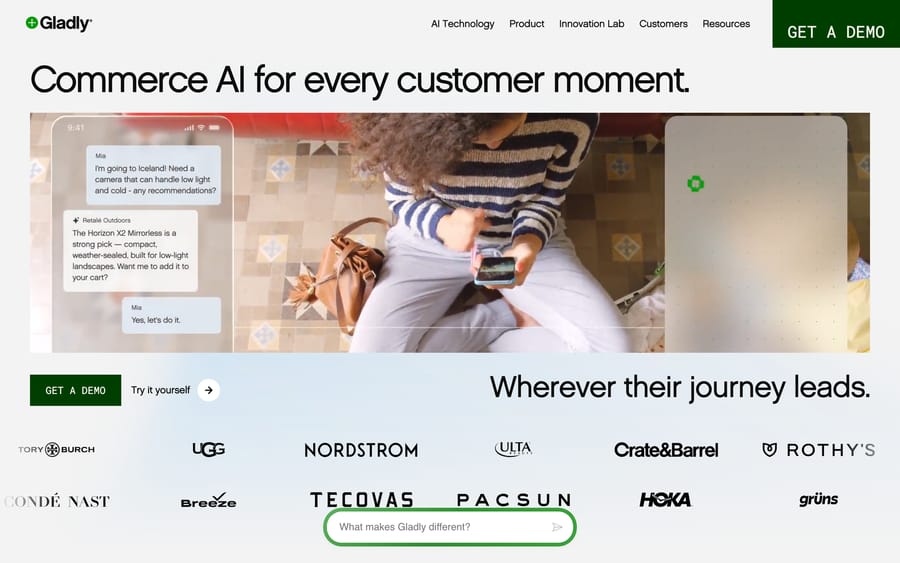
Gladly names Tory Burch, UGG, Nordstrom, Ulta Beauty, Crate & Barrel, Rothy's, TUMI, and Condé Nast among its customers, which signals the tier of retailer the product is built around: brand-conscious, catalog-heavy, and willing to let AI touch both revenue and support in the same conversation.
How to set it up
Gladly positions setup as configuration work a support or commerce team can do directly through its "Controls" capability, instead of filing a ticket with an engineering team. In practice that means connecting your product catalog and order data, defining what the AI can do unsupervised (recommend, checkout, process a standard return) versus what it should hand to a person, and letting the 450-million-conversation training generalize to your specific catalog and policies.
Human agents stay "one tap away for the high-stakes buy," in Gladly's phrasing, but the company doesn't publish exact rules for when a conversation escalates versus stays with the AI. That threshold is something you configure and tune against your own risk tolerance; it isn't a fixed setting Gladly ships out of the box.
What it costs
Gladly does not publish pricing. There's no price list, no calculator, and every quote goes through a "Get a demo" flow.
What Gladly does publish is its pricing philosophy, and it's worth reading directly because it's a genuine point of difference. In a company blog post, Gladly explicitly criticizes vendors that charge only for AI resolutions, arguing that model creates an incentive to deflect a customer regardless of whether the outcome was actually good. Gladly's own model instead charges for two outcomes: a fully automated resolution, and an "assist," meaning an AI-enhanced conversation a human agent still closes. The company's stated logic: "Gladly succeeds when your AI continuously improves," not just when it deflects volume.
That's a real difference in what the vendor is optimizing for. Resolution-only pricing pays a vendor more the more it can get away with sending a customer off without a human, whatever the customer thought of the answer. Paying for assists too gives Gladly's AI a reason to make a human agent faster and better, beyond simply making the ticket disappear.
On actual numbers, since none are published: Vendr reports a median annual contract around $24,150, with a range of roughly $14,323 to $78,521, and cites a community-reported per-user rate for "Hero AI Support" around $155 to $180 per user per month. Treat these as third-party estimates rather than confirmed list prices.
Where it stops
Gladly's AI is built for retail: a catalog, a return policy, an order history. Outside that shape, its 450-million-conversation training doesn't transfer, and a business without a product catalog at the center of its support (B2B software, financial services, healthcare) gets little from what makes this AI specifically good.
The bigger limit is that Gladly doesn't publish hard rules for escalation, which cuts two ways. Teams get real flexibility to tune the AI's autonomy to their own risk appetite, but that also means the "where it stops" line is something you have to build and monitor yourself; Gladly doesn't guarantee it out of the box. And because the AI is the platform, not an add-on you can trial separately, adopting it means adopting Gladly's helpdesk and commerce layer wholesale, a bigger commitment than testing an AI feature inside a tool you already run.
Who it suits
Gladly fits teams that want one AI handling both the sales conversation and the support conversation that follows it, and that are comfortable configuring AI autonomy themselves instead of working from a fixed rulebook. It's a strong pick for premium and mid-to-large retail brands specifically. The customer list, Tory Burch, UGG, Nordstrom, points at brands with real catalogs, real return complexity, and a customer experience bar high enough to justify AI trained specifically on retail conversation patterns.
It's a weaker fit for a business without a product catalog driving its support volume, a team that wants an AI feature to try inside its current helpdesk before committing to a platform switch, or a company that wants a published, checkable price before a sales call. If your support already runs comfortably in Zendesk, Freshdesk, Gorgias, or Front, or in a smaller-business tool like Help Scout, moving that whole operation onto Gladly to get its AI is a much bigger step than adding automation to what you have.
Where an AI agent layer fits on top
Gladly's AI is inseparable from the Gladly platform by design, so there's no version of "add Gladly's AI to my existing help desk." If your team is on Zendesk, Freshdesk, Gorgias, or Front and wants agents acting inside tickets you already have, that's a different problem, and it's the one Macha is built to solve. Macha runs as an AI agent layer on top of the help desk you already use: you configure agents in plain English, they act inside real tickets with confirmation gates on customer-facing steps, and pricing is one plan by monthly ticket volume, from $299/month for 750 tickets, about $0.40 a ticket at every tier. Setup and monitoring by the Macha team is included, and the trial is $50 of free usage with no credit card. See Macha pricing for the full table, or Macha on your existing help desk.
To be clear about the comparison: Macha isn't a Gladly alternative. Gladly is a full commerce-and-support platform with retail-specific AI baked in; Macha doesn't compete at that layer at all. If you like what Gladly's AI does for a retail catalog and you're ready to run your support on Gladly, that's a Gladly decision. If you want AI automation without replacing the help desk you already have, that's the gap Macha fills.
FAQ
What is Gladly's AI called? Gladly doesn't market a single named AI product the way some vendors do; its AI is described through capabilities like Conversational Commerce, Lifelong Customer Memory, and AI Observability, all part of the core platform instead of a separate add-on.
Is Gladly's AI included in the base price, or an add-on? Gladly doesn't publish pricing, so this isn't stated publicly. Third-party sources (Vendr) report per-user rates for a product called "Hero AI Support" around $155-180/user/month, alongside median contract values around $24,150/year, but these aren't confirmed list prices.
How does Gladly price its AI? By its own account, Gladly charges for both fully automated resolutions and AI-assisted conversations a human still closes, specifically to avoid the incentive it says resolution-only pricing creates: rewarding deflection over a good outcome.
Do I have to switch my whole helpdesk to use Gladly's AI? Yes. Gladly's AI is built into the platform itself; it isn't sold as a standalone feature you can add to another help desk.
What kind of businesses use Gladly? Premium and mid-to-large retail brands: Gladly names Tory Burch, UGG, Nordstrom, Ulta Beauty, Crate & Barrel, Rothy's, TUMI, and Condé Nast as customers.
What happens when Gladly's AI can't handle a request? Gladly says human agents stay "one tap away" for high-stakes purchases, but it doesn't publish fixed escalation rules; teams configure and tune that threshold themselves.
Is Gladly still a customer service platform, or something else now? Its own site now describes it as an "agentic commerce platform" instead of a customer service platform, reflecting a shift toward AI-driven sales alongside support. gladly.com now redirects to gladly.ai.
What's a good alternative if I don't want to switch off my current help desk? An AI agent layer that runs on top of your existing help desk, like Macha on Zendesk, Freshdesk, Gorgias, or Front, adds automation without a platform migration.
Sources: Gladly AI platform, Gladly Conversational Commerce, Gladly's AI pricing philosophy, Vendr — Gladly pricing.
Automate your support workflows
Macha's agents run multi-step workflows across the tools you already connect.