Intercom
 Shopify
 Stripe
 Slack
Slack Notion
 Google Workspace
 Confluence

What Are the Best Zoho Desk Alternatives in 2026? 10 Options Compared


Macha is the top pick if you want the AI agent on your new help desk set up and run for you. Freshdesk is the closest like-for-like Zoho Desk alternative, while Zendesk, Help Scout, Front, Gorgias, Intercom, HubSpot Service Hub, Hiver and Tidio each win a specific segment. Zoho Desk starts at $14 per agent a month, so the right switch depends on why you're leaving, not on price alone.
Key takeaways
- Freshdesk is the closest like-for-like Zoho Desk alternative, with Growth at $19, Pro at $55 and Enterprise at $89 per agent a month billed annually.
- Zoho Desk Standard costs $14 per agent a month billed annually, and Zoho lists its Zia AI on Professional and above only, so few teams switch to save money.
- Front charges $25, $65 and $105 per seat a month billed annually, and its Autopilot AI agent starts at $0.05 per conversation.
- Gorgias bills by ticket volume, from $10 a month for 50 tickets to $900 for 5,000, while HubSpot Service Hub Professional at $90 a seat carries a one-time $1,500 onboarding fee.
- Macha ranks first for teams that want the AI agent set up and run for them: it doesn't run on Zoho Desk, but on the help desk you move to the Macha team builds and runs it for about $0.40 a ticket, setup and a dedicated success manager included.

The best Zoho Desk alternatives in 2026 are Macha (the AI agent set up and run for you on the help desk you move to, about $0.40 a ticket), Freshdesk (the closest like-for-like swap, from $19 per agent a month billed annually), Zendesk (the heavyweight upgrade, $55 to $115 on Suite plans), Help Scout, Front, Gorgias, Intercom, HubSpot Service Hub, Hiver and Tidio. Each wins a specific segment, and the right one depends on why you're leaving: Zoho Desk itself starts at $14 per agent a month on Standard (billed annually), so few teams switch to save money. We rechecked every vendor's own pricing page on 24 September 2026; ratings are approximate G2 figures from our June 2026 research. (New to the product itself? Start with what is Zoho Desk and our Zoho Desk pricing explained breakdown.)
How do the best Zoho Desk alternatives compare at a glance?
| Tool | Rating (approx.) | Starting price | Best for | vs Zoho Desk |
|---|---|---|---|---|
| Macha | Our product (not rated here) | $299/mo for 750 tickets (~$0.40/ticket), setup included | Teams that want the AI agent set up and run for them | AI agent on the desk you move to; doesn't run on Zoho Desk |
| Freshdesk | G2 4.4 (~3,700) | $19–$89/agent/mo | Teams wanting Zoho-like value, simpler UI | Cleaner to start; Copilot is a paid add-on |
| Zendesk | G2 4.3 (~6,000+) | $55–$115/agent/mo | Scaling teams wanting depth + ecosystem | More powerful and pricier; AI costs extra |
| Help Scout | G2 4.4 (~435) | $25/user/mo | Small/mid teams wanting simplicity | Far simpler; less configurable |
| Front | G2 4.5 (~2,400) | $25–$105/seat/mo | Collaborative, email-heavy ops | Shared-inbox feel; less classic ticketing |
| Gorgias | G2 4.6 (~560) | from $10/mo (ticket-based) | Shopify / DTC ecommerce | Ecommerce-native; not for non-retail |
| Intercom (Fin) | G2 4.5 (~3,200) | $29 to $132/seat + Fin usage | SaaS / digital-first, chat-led | Stronger AI + messenger; complex pricing |
| HubSpot Service Hub | G2 ~4.4 | $7–$150/seat/mo | Teams on HubSpot CRM | CRM-unified; pricey at the top |
| Hiver | G2 4.6 (~1,283) | from $25/user/mo | Gmail-native small teams | Lives inside Gmail; lighter than Zoho |
| Tidio | G2 4.6–4.7 (~1,880) | $24.17–$300+/mo + Lyro AI | SMB live chat + AI deflection | Chat-first; not a full ticketing suite |
Update (September 2026): Salesforce completed its acquisition of Fin, the company formerly called Intercom, on 10 September 2026 in a deal worth about $3.6 billion. Fin is still sold at $0.99 per outcome, and Salesforce cites a 76% average resolution rate. Worth weighing in any long-term Intercom/Fin decision.
Seat prices are billed annually unless noted and were checked on vendor pricing pages on 24 September 2026. Ratings are approximate, from June 2026.
Why do teams look for a Zoho Desk alternative?
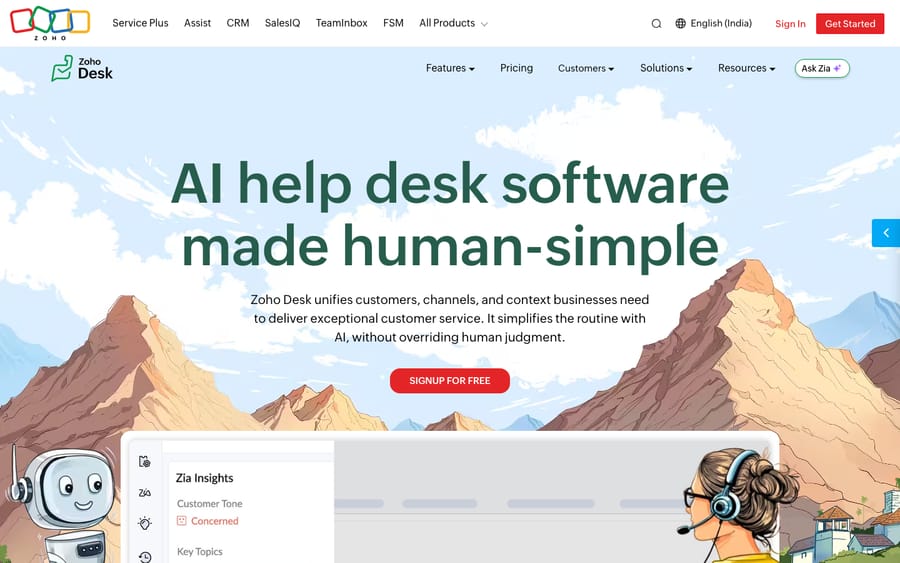
Zoho Desk isn't broken; it's genuinely capable and genuinely cheap. But a few recurring, fair complaints push teams to look elsewhere, and it's worth naming them precisely before you switch, because some are solvable without leaving.
- The learning curve is real. The single most consistent theme across G2 and Capterra reviews is that Zoho Desk is so configurable it becomes overwhelming. Setting up Blueprints (its workflow automation), custom modules, and granular routing tends to take real trial and error. Small teams that want to be live by Friday often feel the friction.
- The UI feels busy. Reviewers repeatedly describe the interface as "cluttered" or "text-heavy" compared with more minimalist tools. Power users love the density; newcomers and smaller teams sometimes find it hard to scan.
- The good stuff lives in higher tiers. Zoho lists Zia, its built-in AI, on Professional and above only, and native phone/call-center, skill-based routing and the deepest analytics also sit on Professional and especially Enterprise. Teams that start on Standard often upgrade for features rather than seats.
- The ecosystem pull cuts both ways. Zoho Desk is at its best when you're running Zoho CRM or Zoho One: the integrations are seamless and the value is unbeatable. Standalone, outside that ecosystem, some of that magic fades and a few third-party integrations feel less polished.
None of this makes Zoho Desk a bad choice. It makes it a specific one, outstanding for budget-conscious, configuration-loving teams (especially inside Zoho), weaker if your bottleneck is simplicity, a particular channel mix, or AI that works out of the box. Keep your real reason in mind as you read; it determines which alternative below actually fixes your problem.
How did we compare them?
We focused on established, currently-selling helpdesks that a Zoho Desk team could realistically migrate to, plus the ecommerce- and shared-inbox-specific tools that win for particular segments. For each we pulled live pricing from the vendor's own pages (or cited third-party trackers where pricing is quote-only), the current G2 or Capterra star rating and approximate review count as a real-user signal, and we read through G2, Capterra, and TrustRadius sentiment for recurring praise and complaints. We rechecked every price against the vendor's own pricing page on 24 September 2026; ratings date from our June 2026 research. Confirm on each vendor's page before you sign, because help desk and AI pricing in this category changes fast. We make Macha and rank it first for teams that want the AI agent on their new help desk set up and run for them; it has no third-party rating or review quote below.
What are the 10 best Zoho Desk alternatives?
1. Macha: the done-for-you AI agent for the help desk you move to
What it is: An AI agent layer that sits on top of a help desk and resolves routine tickets inside it, rather than replacing the platform. It runs on Zendesk, Freshdesk, Gorgias, Front, HubSpot or Intercom; it does not integrate with Zoho Desk, and it isn't a help desk itself. Its agents read the customer's actual question, pull from your connected data and help center, and resolve or escalate with full context. Who it's for: If the reason you're leaving Zoho Desk is AI that works out of the box, and your shortlist already leans toward one of those desks (several of the strongest options below), Macha is the AI on whichever one you pick, set up and run for you. Pricing: About $0.40 a ticket, from $299 a month for 750 tickets, billed per ticket rather than per seat. There's no free plan; the trial is $50 of free usage (about 125 tickets), no credit card. Rating: We make it, so we don't rate it here.
Done for you: You connect your new help desk and the tools your answers come from, which takes about 15 minutes. The Macha team then analyzes about a month of your past tickets, builds the knowledge base and the agent, tests it on a sample of those tickets, and runs it in safe mode, with drafts as internal notes, until the drafts are right. It goes live in under a week, on the trial and every plan. The $0.40 a ticket includes that setup and a dedicated success manager who handles your changes after go-live: new categories, instruction changes, new tools. For a team leaving Zoho Desk over its learning curve, that means nobody has to learn an AI builder as well as a new help desk.
Pros: nobody on your team builds or tunes the agent; it acts inside the help desk you choose rather than adding another tool; per-ticket billing doesn't grow with seats. Watch-outs: no free plan (the trial is $50 of usage); it works on top of a help desk, so you still need one of the desks it runs on, and it doesn't help if you stay on Zoho Desk (lean on Zia there); and it's only as good as the data and knowledge behind it. vs Zoho Desk: Zoho lists Zia on Professional and above and leaves the configuration to you; Macha's agent is built and run for you on the desk you move to. See how the layer works on Zendesk.
2. Freshdesk: the closest like-for-like value swap
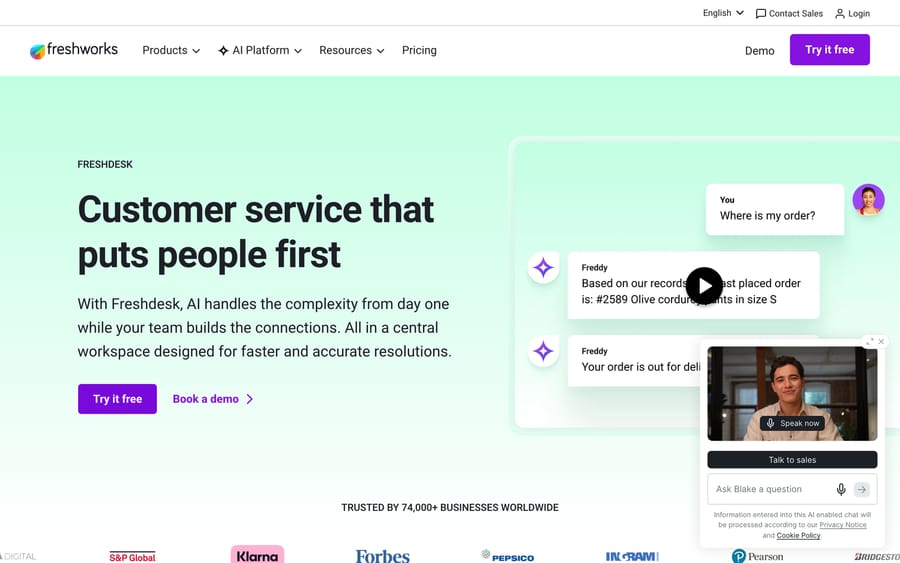
What it is: Freshworks' helpdesk, and Zoho Desk's most direct rival: affordable, quick to set up, with omnichannel ticketing, automation, and the Freddy AI suite layered on top. Who it's for: Teams that like Zoho Desk's value math but want a cleaner, friendlier interface and a gentler onboarding curve. Pricing: Growth $19, Pro $55, Enterprise $89/agent/month (annual); Freddy AI Copilot is a separate add-on at $29/agent/month (annual), and the Freddy AI Agent comes with 500 sessions as a one-time allowance per account, then $49 per 100 sessions. Freshdesk shows no free plan on its pricing page; a Free program covers up to 2 agents for 6 months. Rating: G2 4.4/5 (~3,700 reviews), Capterra 4.5/5, neck-and-neck with Zoho Desk. What users say: Praised for ease of use and a tidy interface; the common gripe is that AI economics and advanced reporting climb as you scale. vs Zoho Desk: A genuine head-to-head. Freshdesk usually feels simpler out of the box and less "text-heavy," while Zoho Desk is deeper and cheaper at the top end, and pulls ahead if you're already in the Zoho ecosystem. The differentiator is UI polish vs. raw configurability.
3. Zendesk: the enterprise-grade upgrade
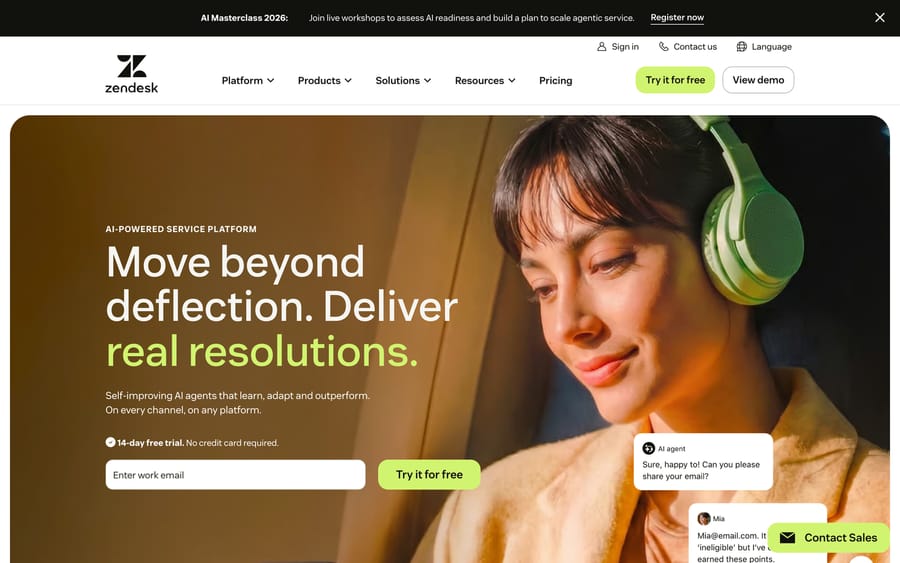
What it is: The category heavyweight: a deep, extensible support platform with omnichannel ticketing, a mature marketplace, robust reporting, and native AI agents (built partly on the acquired Ultimate and Forethought technology). Who it's for: Teams outgrowing Zoho Desk that want more configurability, reporting horsepower, and a vast app ecosystem, and have the budget for it. Pricing: Suite plans run roughly $55 (Suite Team) to $115/agent/month (Suite Professional), billed annually; the Copilot add-on is $50/agent/month on top. Zendesk's pricing page says AI agents are billed per automated resolution and lists the rate: $1.50 committed or $2.00 pay-as-you-go. Rating: G2 4.3/5 (~6,000+ reviews), Capterra 4.5/5. What users say: Reviewers call the ticketing organized, intuitive, and reliable, and value the depth at scale, but flag that key capabilities and storage sit behind higher tiers and add-ons, so the real bill climbs. vs Zoho Desk: More powerful, more extensible, stronger analytics, but materially pricier, and its AI carries its own cost. Where Zoho Desk wins on value, Zendesk wins on ceiling and ecosystem.
4. Help Scout: the simpler, human-first inbox
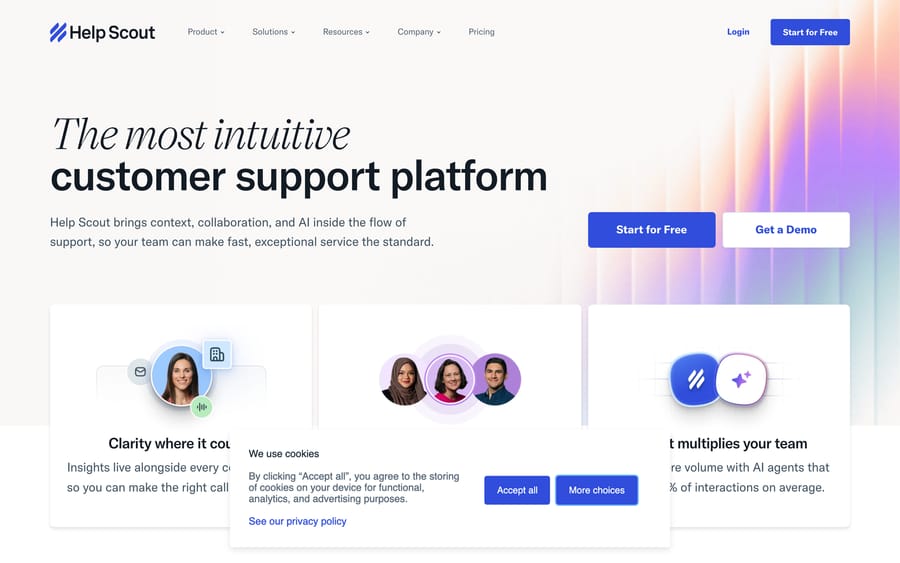
What it is: A clean, conversation-style helpdesk built around a shared inbox, knowledge base (Docs), and live chat (Beacon), with AI layered in. It deliberately hides the "ticket" machinery to feel more like email. Who it's for: Small to mid-sized teams, especially SaaS and services, that find Zoho Desk's interface heavy and want fast onboarding with a warm customer experience. Pricing: Standard $25/user/month, Plus $45, Pro $75 (Pro requires a 10-user minimum), with a free plan for up to 5 users; AI Answers is billed separately at $0.75 per resolution. Rating: G2 4.4/5 (~435 reviews), consistently praised for ease of use. What users say: One G2 reviewer summed up the appeal: "The best feature of Help Scout is how easy the setup is. It literally takes five minutes to convert all your email requests." The trade-off reviewers note is depth. vs Zoho Desk: The opposite philosophy: Help Scout strips configuration to the essentials, so it's faster to adopt but caps out earlier on complex routing, SLAs, and heavy automation, which is Zoho Desk's home turf.
5. Front: the collaborative shared inbox
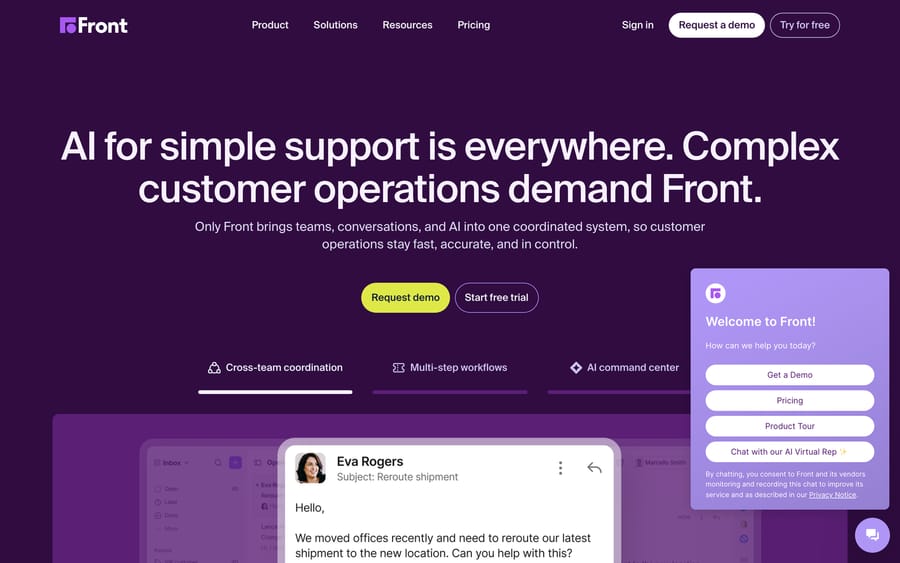
What it is: A shared-inbox platform that blends email, chat, SMS, and social into one collaborative workspace with internal comments, assignments, and shared drafts, plus AI features (Copilot, Autopilot) on top. Who it's for: Operations-heavy, high-touch teams (logistics, finance, B2B services) where support is a team sport and conversations need real collaboration, not just tickets. Pricing: Starter $25, Professional $65, Enterprise $105 per seat/month (annual); Copilot and Smart QA are $20/seat each (both included on Enterprise), and the Autopilot AI agent starts at $0.05 per conversation. Rating: G2 4.5/5 (~2,400 reviews), among the higher-rated tools here. What users say: Reviewers love managing multi-channel conversations without losing context; the most common complaint is that pricing is expensive and escalates quickly. vs Zoho Desk: Feels like a souped-up shared inbox rather than a traditional helpdesk, which collaborative teams love and process-heavy ticketing shops may miss. Stronger on collaboration, lighter on classic ticket structure.
6. Gorgias: the ecommerce specialist
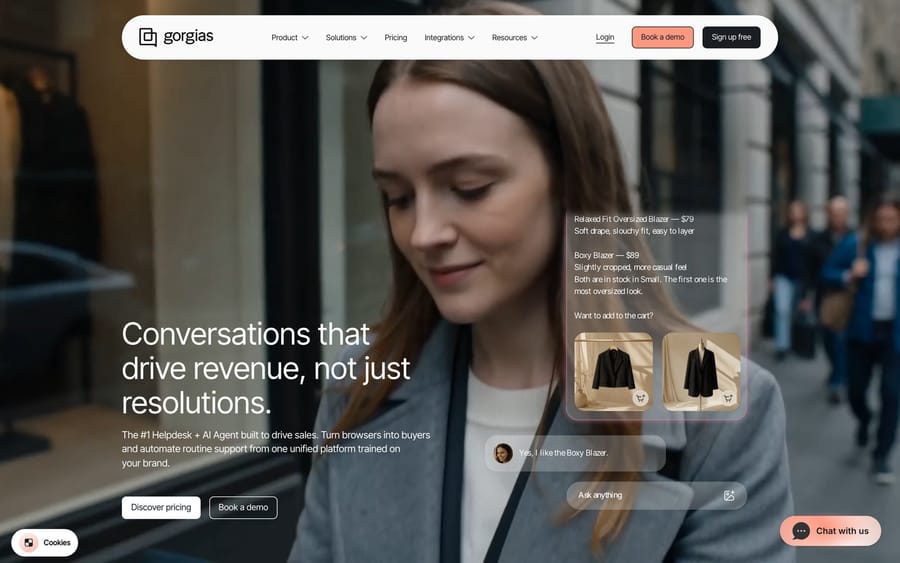
What it is: The dominant Shopify-era helpdesk, purpose-built for ecommerce. It pulls order, refund, and subscription data into the ticket, and its AI Agent resolves WISMO, returns, and product questions natively. Who it's for: Shopify, BigCommerce, and DTC brands whose support is mostly order-related. Pricing: Billed on monthly ticket volume, not seats: Starter $10 (50 tickets), Basic $60 (300), Pro $360 (2,000), Advanced $900 (5,000), with overage from $0.40 a ticket on the smaller plans. Gorgias says the AI Agent is included on every plan and charged only when it resolves a conversation; third-party breakdowns put that at $1 per resolution ($0.90 on annual billing). Rating: G2 4.6/5 (~560 reviews). What users say: Reviewers consistently praise the Shopify integration and ease of use; on cost, one G2 reviewer wrote: "It's a bit too expensive. I would like it to be more affordable or offer AI services at an integrated cost." vs Zoho Desk: Far better for retail conversations out of the box, with ticket-based pricing that rewards lean, high-volume teams. It's a poor fit if you're not in ecommerce: it's a specialist, not a general-purpose Zoho Desk replacement.
7. Intercom (with Fin AI): the AI-first, chat-led platform
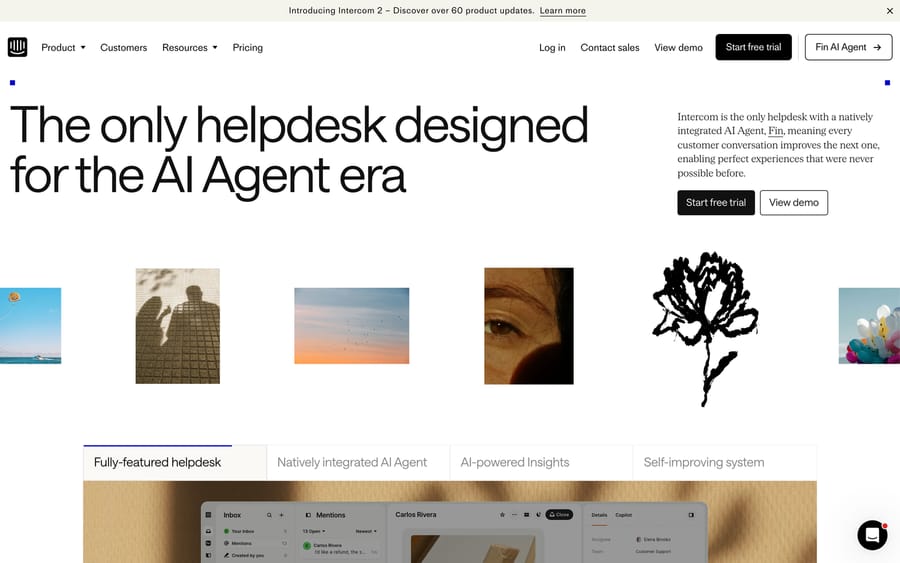
What it is: A messenger-first support and engagement platform whose Fin AI agent is one of the most-cited per-resolution products on the market. Strong at proactive in-app messaging, chat, and product-led support. Who it's for: SaaS and digital-first companies whose support skews to in-app chat and email rather than phone, and who want best-in-class AI resolution. Pricing: Seats run $85 (Advanced), $132 (Expert) per seat/month annually, with the entry Essential plan at $29 a seat billed annually (Intercom has also shown $19 in a pricing test), and Fin charged per outcome on top at $0.99, so your real bill depends heavily on volume. Rating: G2 4.5/5 (~3,200 reviews), with 91% of users saying it meets their requirements. What users say: Strong satisfaction in software and SaaS, often citing 50–80% deflection, but reviewers warn the per-resolution model becomes unpredictable and "can add up rapidly" at scale. vs Zoho Desk: A stronger messenger and a far more capable AI agent, but the modular pricing is the opposite of Zoho Desk's predictable per-seat model. Best when chat and AI deflection are your priority, not budget certainty.
8. HubSpot Service Hub: the CRM-unified choice
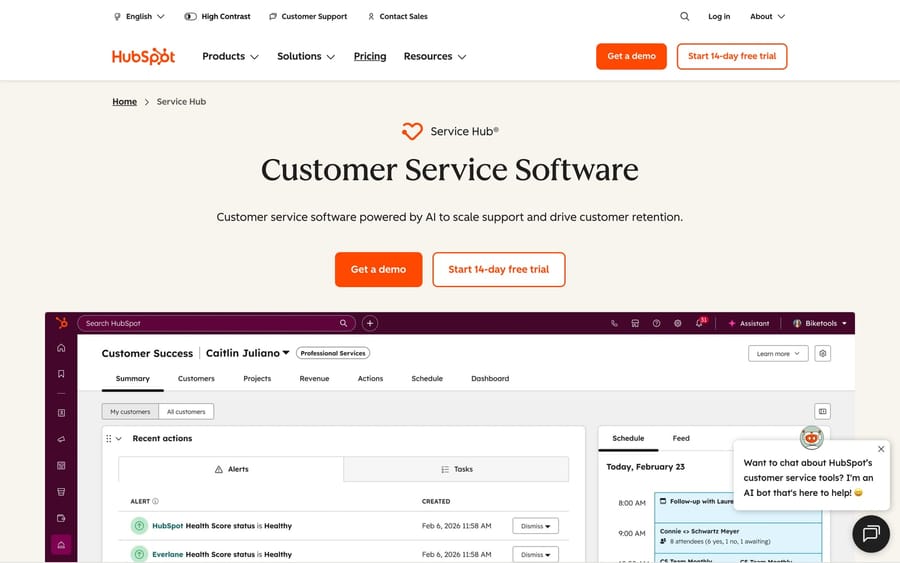
What it is: HubSpot's support product, tightly fused with its CRM, marketing, and sales tools, plus the Breeze AI agent for resolution. Support tickets sit on the same customer record as every sales and marketing touch. Who it's for: Teams already on (or moving to) HubSpot that want support, sales, and marketing on one platform. Pricing: From a free tier (up to 2 users) and Starter at $7/seat/month on an annual commitment ($20 billed monthly), up to Professional $90/seat (with a one-time $1,500 onboarding fee) and Enterprise $150/seat (with a $3,500 onboarding fee). The Breeze Customer Agent uses 50 HubSpot credits per resolved conversation. Rating: HubSpot overall sits at ~4.4/5 on G2 across tens of thousands of reviews; Service Hub draws consistent praise for CRM integration and ticketing. What users say: Reviewers love the unified customer record and automation as genuine time-savers; the watch-out is that costs (and the onboarding fee) climb fast as you move up tiers. vs Zoho Desk: Unbeatable if you value one customer record across the funnel, but weaker as a pure ticketing tool and pricier at the top. Zoho Desk gives more support depth per dollar; HubSpot gives unification.
9. Hiver: the Gmail-native option
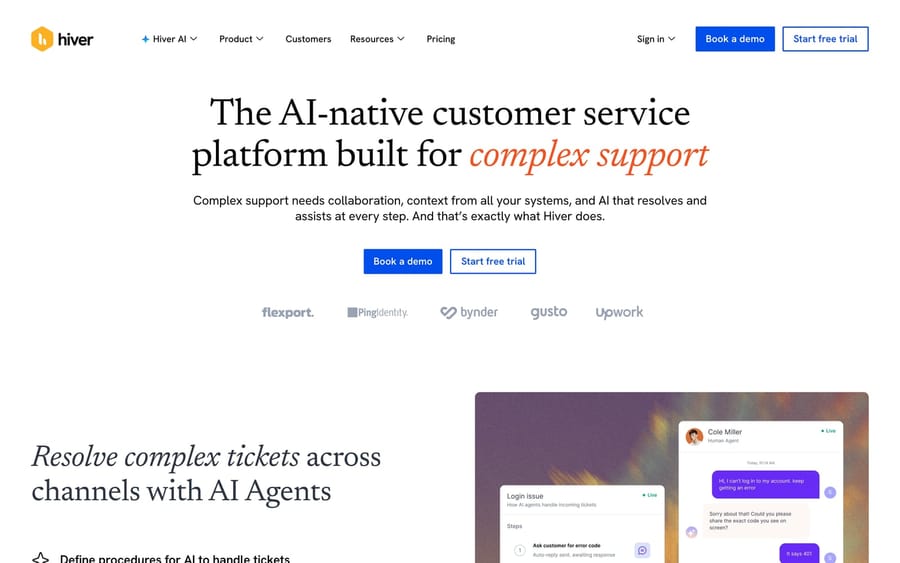
What it is: A helpdesk that lives entirely inside Gmail, turning Google Workspace into a shared support inbox with assignments, SLAs, analytics, and AI assistance, no separate app to learn. Who it's for: Small and mid-sized teams already on Google Workspace that want helpdesk structure without leaving the inbox they already use. Pricing: Growth $25, Pro $55, Elite $85 per user/month (annual; $35, $65 and $95 billed monthly). Plans require a 2-seat minimum and scale in blocks of 5 above 5 users, and Hiver offers a 7-day trial of Elite rather than a free plan. Rating: G2 4.6/5 (~1,283 reviews), strongly praised for ease of use. What users say: Reviewers love the near-zero learning curve and the way it "skips the yet-another-tool problem"; the flip side is a lower ceiling for complex, multichannel operations. vs Zoho Desk: The polar opposite of Zoho Desk's density: lighter and far quicker to adopt for Gmail shops, but with less room to grow into heavy automation and omnichannel.
10. Tidio: the SMB live chat + AI deflection pick
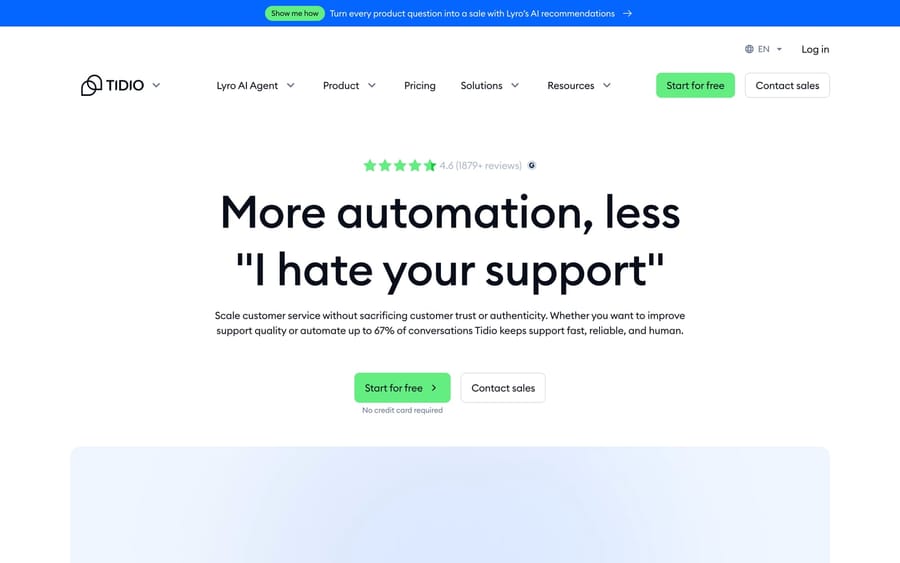
What it is: A live chat and chatbot platform whose Lyro AI agent automates a large share of routine conversations, aimed squarely at small businesses and ecommerce. Who it's for: SMBs and online stores that want strong website live chat plus AI deflection, more than a heavyweight ticketing back end. Pricing: Free, Starter $24.17/month, Growth from $49.17/month (the rates tidio.com/pricing shows; yearly billing gets 2 months free), then Plus from $300/month plus usage; Lyro AI is metered separately from $32.50/month for 50 AI conversations, and every account gets 50 Lyro conversations as a one-off. Rating: G2 4.6–4.7/5 (~1,880 reviews), with live chat scoring ~93% satisfaction. What users say: Reviewers like how easily it switches between bot automation and human takeover and how quickly Lyro cuts repetitive work; the structural watch-out is that pricing is metered by billable conversations, so a busy month raises the bill. vs Zoho Desk: Chat- and AI-first rather than a full omnichannel ticketing suite. Tidio wins for website conversion and SMB deflection; Zoho Desk wins for structured, multichannel case management.
What do real users say about Zoho Desk?
Ratings tell you the average; the reviews tell you the why. Zoho Desk holds a G2 rating of 4.4/5 (~6,500 reviews) and a Capterra rating of 4.5/5 (~2,200 reviews), strong numbers that reflect genuine value. The recurring critiques, verbatim from Capterra, cluster around the same two themes that drive teams to shop around:
"What I like least about Zoho Desk is its steep learning curve, especially when configuring advanced workflows or custom modules." Verified Reviewer, Capterra, 2026
"The interface is packed with features, which can feel cluttered or 'text-heavy' compared to more minimalist competitors like Intercom." Verified Reviewer, Capterra, 2026
"In larger projects with many ongoing requests, the interface could also feel slightly crowded.", Verified Reviewer (Architecture & Planning), Capterra, 2026
Read together, the message is consistent: Zoho Desk's depth is its best feature and its biggest tax. Reviewers who invest in the setup get an enormous amount of capability for the money; reviewers who want to be productive on day one sometimes find the density and configuration overhead frustrating. Which camp you're in should guide your shortlist.
How do you choose the right Zoho Desk alternative?
- Name your real reason for leaving. If it's AI that works without you building it, Macha on the help desk you move to. If it's the learning curve or busy UI, look at Help Scout, Hiver, or Freshdesk. If it's reporting depth or scale, Zendesk. If it's ecommerce, Gorgias. If it's AI out of the box, Intercom or Tidio. Don't migrate to fix a problem a setting could solve.
- Match the tool to your channel mix. Chat- and product-led? Intercom or Tidio. Email-heavy and collaborative? Front or Hiver. Order-driven retail? Gorgias. Omnichannel with a CRM tie-in? HubSpot Service Hub.
- Model the total cost, including AI. Zoho Desk's sticker price is low, but many alternatives bill AI separately (per resolution or per seat). Add the AI line item at your real volume before comparing like-for-like: a $0.99-per-resolution agent can dwarf the base plan.
- Weigh migration cost honestly. Moving helpdesks means data migration, retraining, and rebuilt workflows. That effort is worth it for a structural problem and overkill for a single feature gap or a setting you haven't found yet.
- Pilot on a real slice of your queue. Whatever you shortlist, run it on live tickets and measure resolution rate, CSAT, and time-to-first-response against your Zoho Desk baseline before you commit.
Frequently asked questions
What is the best Zoho Desk alternative in 2026? If AI is the reason, Macha, which we make and rank first: the Macha team sets up and runs the AI agent on the help desk you move to, at about $0.40 a ticket, which includes setup and a dedicated success manager who handles your changes. For the help desk itself it depends on why you're leaving. Freshdesk is the closest like-for-like value swap with a cleaner UI; Zendesk is the strongest upgrade for depth and ecosystem; Help Scout and Hiver win on simplicity; Front is best for collaborative, email-heavy teams; Gorgias owns ecommerce; Intercom leads on chat and AI; HubSpot Service Hub is best if you're on HubSpot CRM; and Tidio is a strong SMB live-chat-plus-AI pick.
What's the cheapest Zoho Desk alternative? Zoho Desk is already one of the cheapest full helpdesks (Standard at $14/agent/month billed annually, plus a free plan for 3 agents). Among alternatives, Freshdesk (from $19) and HubSpot Service Hub (free tier for 2 users, Starter $7/seat annually) are the most budget-friendly full helpdesks, while Hiver (from $25/user) is cost-effective for Gmail teams and Tidio has a usable free plan. Always add AI costs when comparing; the base price is rarely the final number.
Is Freshdesk better than Zoho Desk? They're remarkably close: both score ~4.4–4.5 across G2 and Capterra and target similar buyers. Freshdesk usually feels simpler and cleaner out of the box; Zoho Desk is deeper, often cheaper at the top end, and far stronger if you're already in the Zoho ecosystem. The decision usually comes down to UI preference and which suite you already use.
Why do people leave Zoho Desk? The most common reasons in reviews are the steep learning curve, a UI that feels cluttered or "text-heavy," advanced automation and phone support being gated to higher tiers, and the fact that Zoho Desk delivers its best value mainly when you're running the wider Zoho suite. For a deeper look at the plans, see our Zoho Desk pricing explained guide.
Can I add an AI agent to Zoho Desk instead of switching? Zoho Desk has its own native AI (Zia) you can lean on. The standalone AI layer we build, Macha, does not integrate with Zoho Desk; it works on Zendesk, Freshdesk, Gorgias, Front, HubSpot or Intercom. So if you stay on Zoho Desk, Zia is your route; if you migrate to one of those, an AI layer like Macha can ride on top of it, with the Macha team setting up and running the agent for you on the trial and every plan.
Which Zoho Desk alternative should you pick?
The best Zoho Desk alternative is the one that fixes your specific reason for looking. Macha is the top pick if you want the AI agent on your new help desk set up and run for you; Freshdesk is the closest like-for-like swap; Zendesk the heavyweight upgrade; Help Scout and Hiver the simplicity picks; Front the collaborative inbox; Gorgias the ecommerce specialist; Intercom the AI- and chat-led platform; HubSpot Service Hub the CRM-unified option; and Tidio the SMB live-chat pick. Pin down your channel mix, model the total cost including AI, and pilot on real tickets before you migrate. Zoho Desk is hard to beat on value, so make sure you're switching for a structural reason, not a setting you haven't found yet.
Prices rechecked on each vendor's pricing page on 24 September 2026; ratings from June 2026 research. Help desk and AI pricing in this category changes fast, so confirm current terms before buying.
Resolve tickets automatically with AI agents
Macha's AI agents work on top of the help desk you already use — no code.