






 Shopify
 Stripe
 Slack
 Notion
 Google Workspace
 Confluence


Crisp Hugo or a Dedicated AI Agent Layer on Crisp: Which Should You Use in 2026?


Use Crisp's own Hugo if you're happy to train and tune it yourself, including its 1-Click Shopify and Stripe lookups: it's included in paid plans and costs about $0.05 to $0.10 a conversation in credits. Add a dedicated AI agent layer when you want AI replies drafted as internal notes for review first, when one run should combine an order or billing lookup with Crisp notes, segments and routing, or when you'd rather someone else built and ran the agent. The billing meters differ most: Hugo spends token-metered plan credits (Crisp estimates $0.05 to $0.10 a conversation), Macha charges per ticket with setup included, and SiteGPT counts messages.
Key takeaways
- Crisp's Hugo is included in paid Crisp plans through $5, $25 or $75 of monthly credit, and a full Hugo conversation averages about $0.05 to $0.10.
- Hugo stops answering when its monthly Crisp credits run out unless pay-as-you-go is enabled, while a layer billed on a chosen monthly volume runs to that volume.
- Macha's Crisp connector has 13 tools, including Add Internal Note, so a Macha agent can draft replies for an operator to approve before customers see them.
- SiteGPT connects through a Crisp Marketplace plugin on its Growth plan or higher, answers in the Crisp chatbox, and goes silent once an operator replies.
- At 1,500 AI conversations a month, Hugo's credit cost is about $50 to $125 on top of Essentials, against $599 for Macha with setup and a success manager included.
| Crisp Hugo (native) | Macha (layer) | SiteGPT (chatbot plugin) | |
|---|---|---|---|
| What it is | Crisp's built-in AI agent and copilot | AI agents running inside your Crisp workspace through Crisp's API | A website chatbot answering in the Crisp chatbox |
| Billing meter | Plan credits metered by tokens (Crisp estimates $0.05–$0.10 a conversation) | Per ticket, monthly volume | Per message (question plus reply) |
| Indicative price | $5 / $25 / $75 credit on Mini / Essentials / Plus; about $0.05 to $0.10 a conversation | about $0.40 per ticket, from $299/month for 750 tickets | Growth $129 a month for 10,000 GPT-4.1-mini messages |
| Who builds it | You (self-serve setup and Playground) | The Macha team, with a dedicated success manager | You |
| Review before sending | Automated inbox to watch Hugo; replies go straight to customers | Drafts as internal notes in safe mode, then public replies when approved | Replies go straight to visitors |
| Actions | 1-Click integrations (Shopify, PrestaShop, WooCommerce, Stripe) and custom MCP tools; unlimited task automations on Plus | Crisp writes (reply, note, state, segments, routing) plus Shopify, Stripe and custom API tools | Answers and escalation |
| Starts on | Customer messages on channels Hugo is live on | New conversation, new customer message, or a custom webhook | Visitor messages in the chatbox |
| When budget runs out | Stops and escalates unless pay-as-you-go is on | Pauses at your chosen volume; move up a tier or top up | Extra message packs |
Prices and behaviors are from each vendor's public page, read November 21, 2026. Disclosure: Macha is one of the layers compared, so we say plainly where Hugo is the better buy.
How did we compare them?
We read Crisp's pricing page, AI page and the help-center guides on Hugo billing, setup and models; SiteGPT's Crisp integration doc and pricing page; and Macha's own Crisp connector and pricing. We didn't run Hugo or SiteGPT on a paid Crisp workspace, so their behavior here is as documented, not measured. Macha's capabilities come from its Crisp connector screens and integration listing.
We left Voiceflow out because its integrations page doesn't list Crisp, and we left out general agent frameworks with Crisp connectors because they're developer toolkits rather than products a support team buys. Crisp also publishes an MCP server for teams that want to wire their own agent, which we mention below.
What is the difference between Hugo and an AI agent layer?
Hugo is Crisp's AI agent, built into the inbox and included from the Mini plan up (our Crisp AI explainer covers its features in full). Crisp's Hugo billing guide says it's paid from a monthly credit allowance of token-based credits; a conversation "is not billed per message," and Crisp estimates a full one at $0.05 to $0.10. You train it on snippets, a website crawl, files and your Crisp knowledge base, write its instructions, test it in the Playground and switch it on per channel. There's nothing to integrate.
An AI agent layer is a separate product that connects to Crisp through its API and works inside the same workspace. It reads conversations and customer profiles, then replies, writes notes, tags and routes, and like Hugo it can reach systems outside Crisp. It isn't a help desk and doesn't replace Crisp. A chatbot plugin like SiteGPT sits in between: it answers in the chatbox but hands off to the Crisp inbox for anything else.
For the same comparison on other help desks, see Freddy AI vs an AI agent layer and Intercom Fin vs an AI agent layer.
Where do Hugo and a dedicated layer actually differ?
Who builds and runs it
Hugo is self-serve. Crisp's getting-started guide (updated October 26, 2026) has five steps: configure the agent, import training resources, write guidance and routing actions, test in the Playground, then deploy per channel. A support lead can get through that in an afternoon. Tuning it until the answers are right, and keeping it right as your product changes, is ongoing work that stays with your team.
Macha is done for you. The Macha team analyzes your past Crisp conversations, builds the knowledge base and the agent, and runs it in safe mode until the drafts are right, and a dedicated success manager handles changes after go-live. That's included on the trial and every plan.
Billing model
Hugo's meter is credits. The billing guide puts an average conversation at $0.05 to $0.10, and the plan estimates in the AI Core Update post (90, 450, 1,350 conversations on $5, $25, $75) all assume about $0.056. Credits reset on the 4th of the month, and Crisp's troubleshooting article says "Unused monthly Hugo credits do not roll over to the next month at the moment." When they run out with pay-as-you-go off, "Hugo stops answering automatically and incoming conversations are escalated to human operators." Our guide to Hugo credits shows how fast each plan's allowance runs out at real volumes.
Macha's meter is the ticket: one charge per conversation with one person, whatever the model, tool calls or length, on a monthly volume you choose ($299 a month for 750 tickets, $599 for 1,500, $1,199 for 3,000, $1,999 for 5,000, $2,999 for 7,500 and $3,999 for 10,000, with custom pricing above that). Agents pause when the month's tickets are used, and nothing is charged without you choosing it.
SiteGPT's meter is the message. Its pricing page says each message "counts both the user's question and the AI's reply," with 10,000 GPT-4.1-mini messages on the $129 Growth plan and 5,000-message packs at $59.
Each meter tells you what the vendor wants. Crisp's credit pool is tied to plan tiers, so heavier AI use pulls teams toward Plus. A per-message meter earns more the longer conversations run. Macha's per-ticket price includes the setup and management work, so Macha earns more by getting your team to add more categories, not by making conversations longer.
Actions and tools
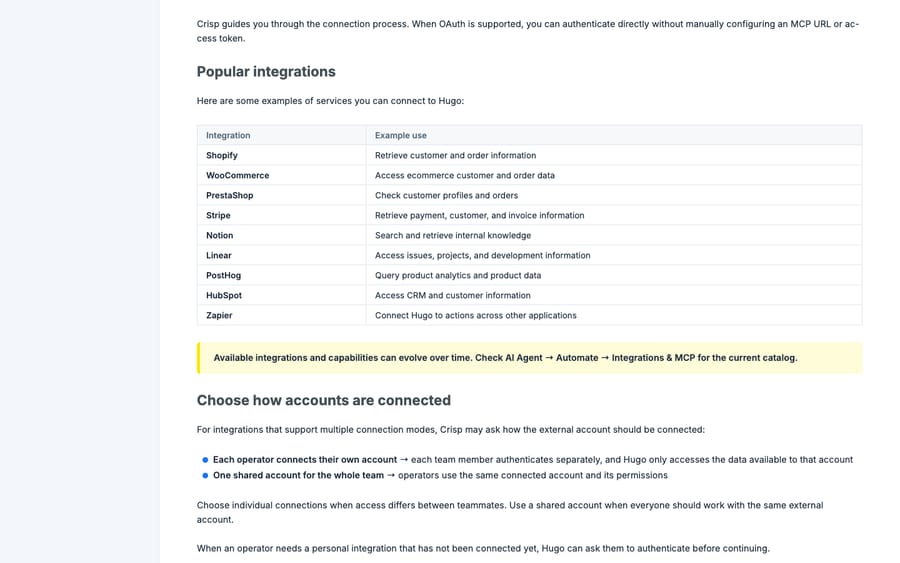
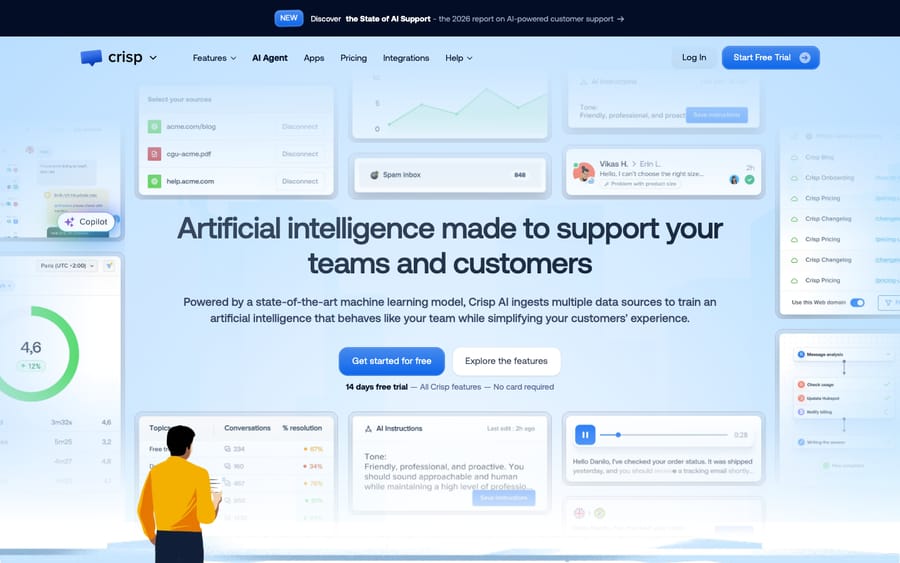
Hugo can act, too, without code. Crisp's MCP guide (updated October 26, 2026) says Crisp "natively ships" 1-Click integrations for Shopify, PrestaShop, WooCommerce and Stripe, which let Hugo check orders, tracking and subscriptions and "perform a refund", with an optional email or SMS one-time code to verify the customer first. Crisp's integrations guide puts the catalog at "26,000+ MCP servers" under AI Agent, then Automate, then Integrations & MCP, and lets you switch each tool on or off. Neither guide states a plan requirement for these integrations, though the pricing page lists "unlimited task automations" on Plus. The developer path is separate: Crisp documents an MCP server and an example integration for teams that want to wire their own systems.
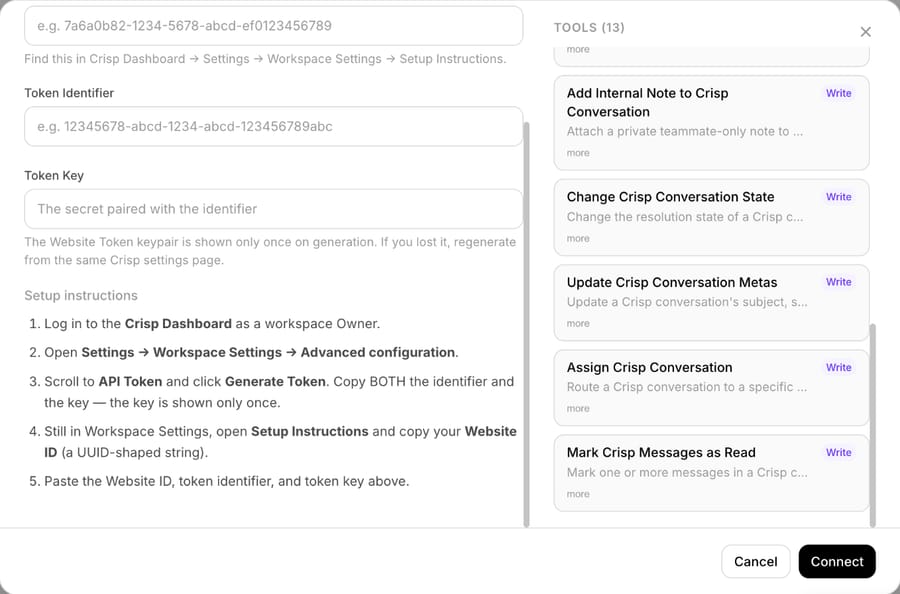
Macha's agent acts on Crisp and beyond. Its Crisp connector has 13 tools: reads for conversations, messages, people profiles, operators and teams, and writes to send a message, add an internal note, change state, update the subject, segments and custom data, assign to an operator or team, and mark messages read. The same agent can look up a Shopify order, check a Stripe subscription or call a custom API tool the Macha team builds. Our walkthrough of automating order status in Crisp compares the ways to answer "where is my order?" chats.
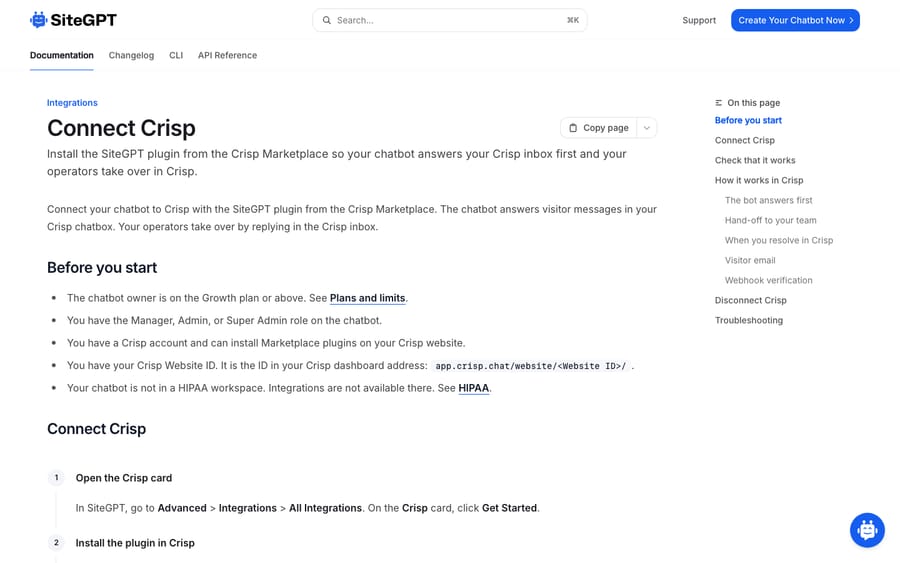
SiteGPT answers and escalates. Its Crisp integration doc says the bot stops responding once an operator replies, that resolving the conversation hands it back to the bot, and that replies sent from the SiteGPT dashboard don't reach Crisp.
Review before a customer sees it
Crisp does have a human-in-the-loop tool: its AI copilot suggests replies to operators inside a conversation, and the operator decides what to send. But Hugo, the autonomous agent, replies to customers directly on the channels it's live on. Crisp gives you an Automated inbox to watch what Hugo does, and the Playground to test before launch, but there's no documented mode where Hugo drafts and an operator approves each reply.
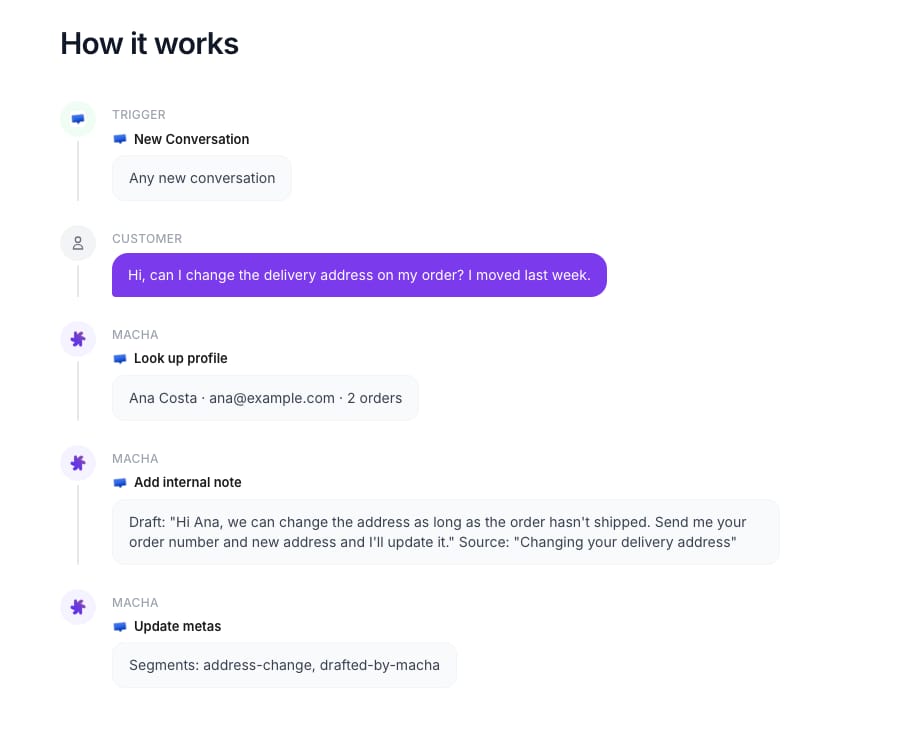
Macha's safe mode is exactly that: the agent writes its reply as a Crisp internal note, an operator reads it and sends or edits it, and only when a category's drafts are consistently right does it switch to public replies. That's the internal-note drafting workflow, and it's how the Macha team rolls out every new category.
On Crisp the draft goes in through the connector's Add Internal Note tool, shown below.
Routing and triage
Hugo has prompt-based routing actions, and Crisp's own workflows route by rules without spending credits. A Macha agent can read the conversation, tag it with segments, set its state and route it to the right operator or team as part of the same run. If your routing is rule-based (language, segment, keyword), use Crisp workflows; they're free. If it depends on reading the message and checking an account, a layer does it in one step.
Cost at three volumes
Every option needs a Crisp plan. This table compares the AI cost only, for a team on Essentials ($95, which includes $25 of Hugo credit):
| AI-handled conversations a month | Hugo credits past the $25 included | Macha | SiteGPT (assuming 4 messages a conversation) |
|---|---|---|---|
| 450 | $22.50–$45 − $25 = $0–$20 | $299 (750-ticket tier) | $129 Growth (1,800 messages) |
| 1,500 | $75–$150 − $25 = $50–$125 | $599 (1,500-ticket tier) | $129 Growth (6,000 messages) |
| 3,000 | $150–$300 − $25 = $125–$275 | $1,199 (3,000-ticket tier) | $129 + $59 pack = $188 (12,000 messages) |
Hugo's column prices every conversation at Crisp's own $0.05 to $0.10 average and subtracts the $25 included credit, because Hugo's pay-as-you-go rate isn't published. Hugo is far cheaper than Macha at every volume, and at 3,000 conversations its range ($125 to $275) straddles SiteGPT's $188. The Macha column includes setup, safe-mode rollout and a dedicated success manager; the Hugo and SiteGPT columns include none of that, so the honest comparison is Hugo's credit cost plus the hours your team spends building and maintaining it.
What do users say about Hugo?
AI-specific comments on Crisp are mixed. On Trustpilot, which showed 1.9 out of 5 from 56 reviews on November 21, 2026, a February 2026 reviewer said the new Hugo agent switched on and deactivated their existing AI workflows without notice, with a handoff message they couldn't customize. Crisp replied that deactivating workflows without clear notice "was disruptive, and we own that," and that customizing escalation messages "is actively on our roadmap." An April 2026 reviewer described customers stuck in loops and capped after one message, which Crisp attributed to a mistake the reviewer made while migrating, adding that its previous AI system remains supported and customers aren't required to migrate.
Trustpilot's sample is small and skews toward complaints, and none of it is a test of answer quality. Treat it as a list of things to check in a trial: the escalation message your customers will see, and what happens on the day the credit runs out.
Which option fits which team?
| Your situation | Best fit | Why |
|---|---|---|
| Under about 450 AI conversations a month, questions answered from docs | Hugo | Mostly covered by Essentials credit; nothing else to buy |
| A website-only chatbot that a marketer manages, no inbox actions | SiteGPT or Hugo | Both answer in the chatbox; SiteGPT if you already use it elsewhere |
| Order or billing questions you want answered without building the integration yourself | Macha, or Hugo with 1-Click integrations | Hugo's 1-Click tools cover Shopify, WooCommerce and Stripe if you set them up; Macha's team builds and tests the lookups for you |
| You want every AI reply reviewed before it goes out | Macha | Safe mode drafts internal notes in Crisp |
| No one on the team has time to build and tune an agent | Macha | The Macha team builds, tests and manages it |
| A developer team that wants to wire its own tools | Hugo plus Crisp's MCP server | Crisp documents the MCP path |
When is Hugo enough, and when does a layer win?
Hugo is enough when three things are true: most chats are answered by reading your help content, a wrong answer reaching a customer is a low-cost mistake, and someone on your team owns the training and the credit budget. For a SaaS team answering onboarding and how-to questions in live chat, that's often the case, and at $0.05 to $0.10 a conversation there's no cheaper way to automate them.
A layer wins when you'd rather not configure, test and maintain the tool connections yourself, when a wrong reply is expensive (a refund, a cancellation, a billing promise), or when nobody has the hours to build and maintain the agent. Macha fits teams on Crisp in that position: it runs inside the Crisp workspace you already have, starts on a new conversation or customer message, and comes set up and managed for about $0.40 per ticket. See Macha on Crisp, the Crisp connector's full tool list, the done-for-you setup and pricing, or start with $50 of free usage (about 125 tickets), no credit card, no time limit.
If you're unhappy with Crisp itself rather than its AI, our Crisp alternatives roundup covers the help desks, and if you want to compare more AI tools than these two, our roundup of the best AI agents for Crisp does that. The two AI options can also run side by side. A team can leave Hugo on simple FAQ chats and have a Macha agent handle order and billing conversations, routed by a Crisp workflow on segment or keyword.
Common questions
Is Hugo free on Crisp?
Hugo is included from the Mini plan up, paid from monthly credit: $5 on Mini, $25 on Essentials and $75 on Plus. The Free plan includes no AI credit. Before February 2026, Crisp's AI replies were free.
What is an AI agent layer for Crisp?
A separate product that connects to Crisp's API and works inside your existing Crisp workspace: it reads conversations and profiles, replies or drafts notes, tags, routes and calls other systems. It doesn't replace Crisp.
Can I use Hugo and another AI agent at the same time?
Yes. Crisp workflows can route conversations by segment, keyword or language, so Hugo can take some chats while a layer like Macha handles others. Agree the split in routing rules so two agents don't reply to the same conversation.
Is Hugo cheaper than Macha?
Per conversation, yes: about $0.05 to $0.10 in Crisp credits against about $0.40 per ticket for Macha. Macha's price includes setup by the Macha team, safe-mode rollout and a dedicated success manager, which Hugo leaves to your team.
Can Hugo draft replies for an operator to approve?
Crisp's copilot suggests replies to operators who are already handling a conversation. Hugo, the autonomous agent, replies directly, with an Automated inbox for monitoring and the Playground for testing, and we found no documented mode where Hugo drafts and an operator approves. Macha's safe mode drafts every reply as a Crisp internal note until you switch a category to public replies.
Which AI agent layers work with Crisp?
Of the products we checked on November 21, 2026, Macha connects through Crisp's API with 13 tools and three triggers, and SiteGPT connects through a Crisp Marketplace plugin on its Growth plan or higher. Developer frameworks can also use Crisp's MCP server.
What happens to Hugo when credits run out?
With pay-as-you-go off, Hugo stops answering and new conversations go to human operators until credits reset on the 4th of the month.
How we researched this
We read and captured Crisp's pricing page and AI page, and read the Hugo billing guide (updated November 1, 2026), getting-started guide and model guide (both updated October 26, 2026), the Hugo troubleshooting article, MCP integrations guide and integrations guide (both updated October 26, 2026), the February 2026 AI Core Update and Crisp's MCP server guide. SiteGPT's facts come from its Crisp integration doc and pricing page. User sentiment comes from Crisp's Trustpilot page. Everything was read on November 21, 2026.
The cost table is our arithmetic. Hugo's overage uses Crisp's published $0.05 to $0.10 average because no pay-as-you-go rate is published, and SiteGPT's column assumes four messages per conversation. Macha's tiers come from our pricing page. We didn't run Hugo or SiteGPT on a paid Crisp workspace; Macha's Crisp capabilities come from Macha's own connector, shown above; the safe-mode draft screenshot is from our Zendesk test desk.